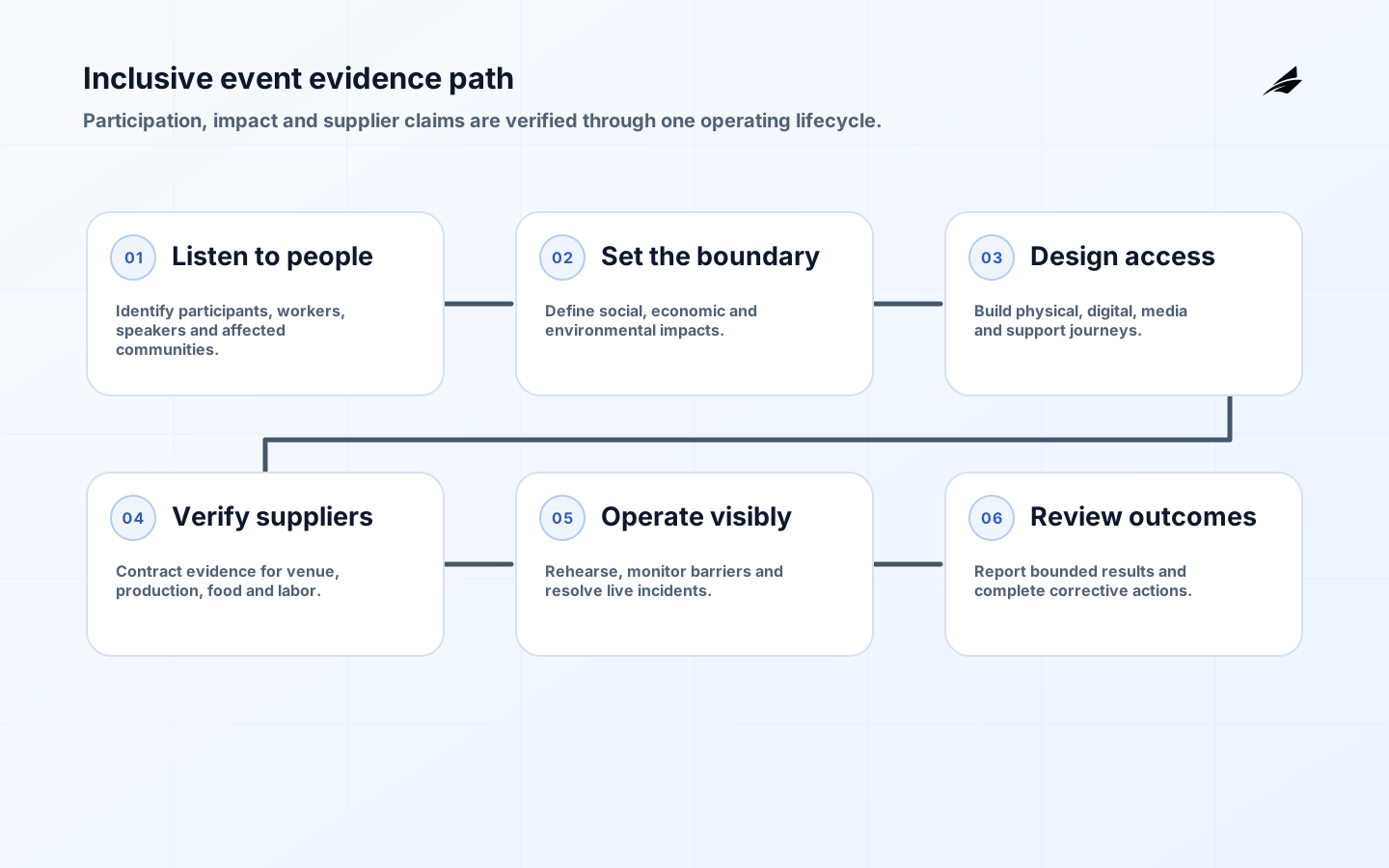
Sustainability events inclusion means designing an event so that environmental responsibility, economic value and equitable participation reinforce one another. It is broader than recycling and broader than disability compliance. A credible plan considers who can attend, speak, work and benefit; what resources and emissions the event creates; how suppliers behave; and whether claims are supported by evidence. This sustainability events inclusion FAQ answers the operational questions teams face when planning in-person, virtual and hybrid events.
For a step-by-step companion, use the sustainable and inclusive events implementation checklist. The practical inclusion guide develops the business case, while the corporate event measurement guide covers portfolio-level decisions.
What makes an event both sustainable and inclusive?
ISO 20121:2024 treats event sustainability as management of social, economic and environmental impacts and gives stronger attention to inclusivity and legacy than the previous edition. In practice, the organizer sets a bounded policy, identifies affected groups, ranks material issues, assigns controls and reviews results. Inclusion is therefore part of the management system, not a separate courtesy list added after venue and platform contracts are signed.
Start with participant journeys. Registration, travel, arrival, security, navigation, sessions, networking, food, prayer or quiet space, emergency response and post-event media can each create barriers. Ask participants about access and dietary requirements through a private, usable channel, but do not make people disclose a diagnosis to receive an accommodation. Design common needs into the baseline and reserve a named contact and budget for individual adjustments.
| Decision area | Good baseline | Evidence to retain |
|---|---|---|
| Participation | Accessible venue, platform, registration and support route | Access review, user test and resolved issue log |
| Content | Captions, readable materials, described visuals and accessible recordings | Sample files, caption quality check and speaker brief |
| Environment | Travel, energy, food, materials and waste boundary | Activity data, supplier records and calculation method |
| Economic and social value | Fair work, local participation and responsible purchasing | Contract clauses, supplier declarations and payment records |
| Legacy | Useful outcomes after the event rather than one-day claims | Follow-up actions, owners and completion evidence |
Which accessibility measures belong in the standard plan?
W3C guidance recommends accessible venues and remote platforms, advance accessible materials, microphones, descriptions of important visuals and captions or transcripts for media. Event websites and applications should be evaluated against WCAG 2.2, commonly at Level AA where policy or law requires it. Automated scans can find some defects, but keyboard use, focus order, labels, zoom, reflow, contrast and assistive-technology journeys need human testing.
Physical access includes step-free routes, usable toilets, seating choices, hearing support, lighting, signage, service-animal arrangements and evacuation assistance that preserves dignity. Publish factual access information before registration closes. For hybrid events, avoid creating a remote audience that can watch but cannot ask questions, join workshops or network. Give online participants equivalent moderation, response times and routes for technical help.
How should the team define and measure impact?
Write the measurement boundary before collecting numbers. State which dates, venues, participant travel, freight, accommodation, streaming, energy, food, materials and waste are included. Record estimation methods and exclusions. The result is useful when it supports decisions and comparisons under a stable method; an impressive total without a boundary is not. Do not imply that a single offset purchase makes the event impact-free.
Select a small balanced scorecard. Environmental measures may include energy, travel mode, food choices, material purchases and waste destination. Inclusion measures may include successful accommodation delivery, caption availability, access-related incidents, speaker diversity using voluntary and appropriate data, and participation by format. Economic measures can include local or diverse supplier spend and on-time payment. Protect privacy by reporting groups only when counts are sufficient and the purpose was explained.
| Metric | Interpret with | Common mistake |
|---|---|---|
| Travel emissions estimate | Response rate, distance method and transport assumptions | Presenting estimates as exact measurements |
| Waste diversion | Total waste, contamination and destination evidence | Counting bins rather than verified treatment |
| Accommodation completion | Requests, response time and participant confirmation | Reporting zero requests as proof of accessibility |
| Caption coverage | Live hours, recordings and quality review | Equating auto-caption availability with usable captions |
| Supplier inclusion | Eligible spend and procurement boundary | Publishing percentages without defining the denominator |
What should contracts require from venues and suppliers?
Translate the policy into measurable duties. Venue contracts can specify accessible routes, room layouts, energy and waste records, water provision, emergency support and permission to inspect. Production suppliers can be required to provide caption feeds, accessible stage content, reusable inventory and power data. Caterers can report quantities, dietary controls and waste. Staffing suppliers should address fair work, working hours, safeguarding and grievance routes.
Ask for evidence during selection and again before final payment. A supplier questionnaire alone does not establish performance. Review samples, certificates where relevant, subcontractors, data definitions and incident history. Assign each obligation to a person on the organizer side because clauses without acceptance checks tend to disappear during a compressed build. Where a requirement cannot be met, record the risk, alternative and approval rather than silently lowering the baseline.
How do we operate inclusion during the live event?
Run a rehearsal that follows real journeys with disabled participants or trained reviewers. Test registration edits, badge collection, lifts, hearing systems, captions, interpretation, presentation contrast, remote questions, quiet-space access and emergency communications. Check that staff know the escalation route without asking a participant to repeat private information at multiple desks. A single inclusion lead cannot personally solve every issue, so venue, production, digital and program owners need clear authority.
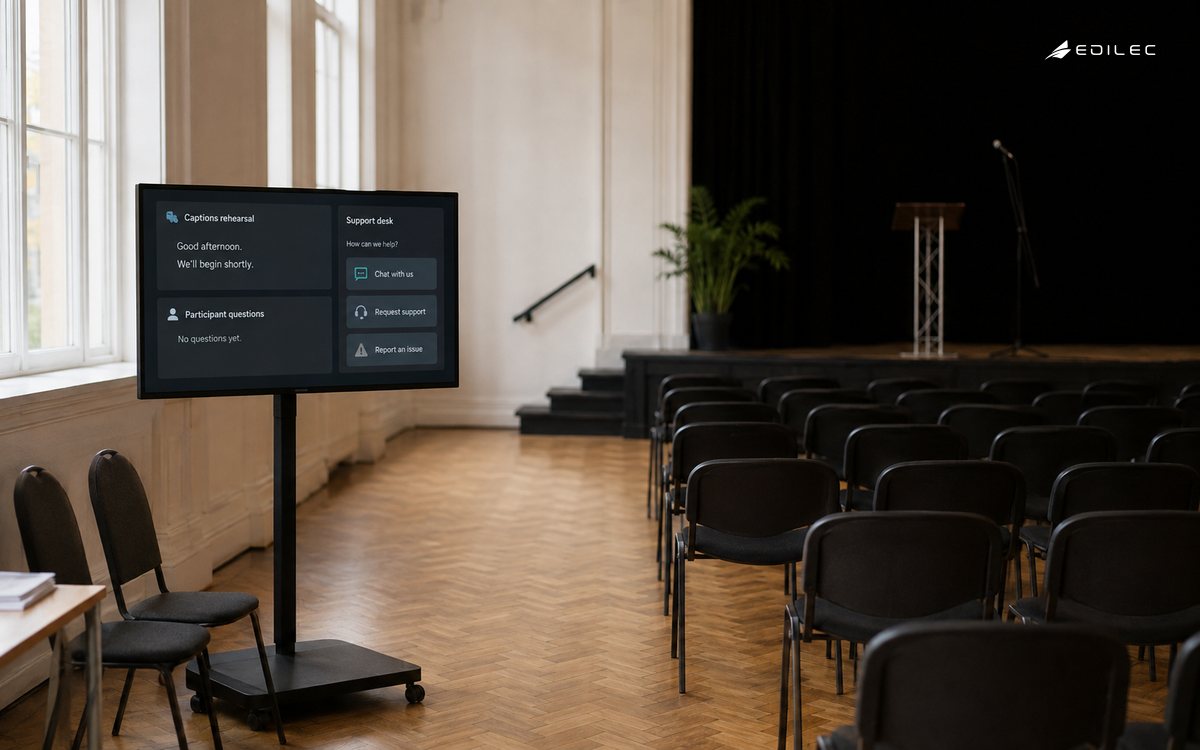
Use a live issue log with time, location, affected journey, immediate action and follow-up owner. Monitor caption failures, blocked routes, room capacity, food labeling, harassment reports, streaming interruptions and waste contamination. Resolve barriers quickly and communicate alternatives in all relevant channels. The record should support learning, not blame. Serious safety, discrimination or privacy matters move through the organization’s formal incident process.
- Confirm the impact boundary and priority groups before procurement.
- Include access, labor, environmental and evidence duties in contracts.
- Test physical and digital journeys with representative users.
- Brief speakers, moderators, suppliers and support staff on observable requirements.
- Monitor live barriers and publish only bounded, supportable results.
Applied example and assurance notes
A useful event brief assigns one owner to each participant journey and requires a decision before procurement closes. For example, a 600-person hybrid conference can set a baseline of step-free venue access, WCAG-tested registration, live captions, accessible speaker files, quiet space and equivalent remote questions. The team then records exceptions, cost and the person accepting residual risk. This is more dependable than asking one accessibility coordinator to repair contracts and content in the final week.
Measurement should influence design while choices remain open. Compare venue and format scenarios using the same travel, energy, food and materials boundary; test registration with disabled users; and ask suppliers for sample evidence before award. After delivery, reconcile estimates with invoices, meter data, waste records and issue logs. Explain missing data plainly. A smaller set of well-defined measures supports better decisions than a large dashboard whose definitions change after results are known.
Consider a participant who requests captions, low-sensory seating and an accessible route from public transport. The request crosses registration, venue, production and customer support, so a single case owner should confirm the complete journey rather than forwarding separate tickets. During rehearsal, test the published route and caption delay. At the event, make the support contact visible without disclosing the participant. Afterward, ask whether the adjustment worked and convert any failure into a dated corrective action.
- Record the accountable owner and the decision the evidence supports.
- Test a normal journey, a denied path and a realistic failure.
- Keep assumptions, versions and unresolved risks visible.
- Require acceptance evidence before expanding scope or authority.
- Review operating outcomes and close corrective actions.
Before approval, the event director should convene registration, venue, production, catering and communications for a scenario review. Walk through ordinary use, a denied request, one unavailable dependency, a partial change and recovery. For each step, identify the authoritative record, person with decision rights, expected signal, time limit and safe alternative. Challenge access barriers, unsupported impact claims and supplier gaps. Record assumptions that could change after launch and assign each one a trigger for reassessment. The review is successful when participants can explain not only the preferred path but also how they recognize an unsafe state, who can stop progress, and how users continue while the issue is resolved. Preserve the participant journey, supplier acceptance and bounded impact report with the configured release rather than in a detached presentation.
For Sustainable and Inclusive Events FAQ: Accessibility, Impact and Evidence, conduct a review thirty days after release or completion. Compare actual demand, quality, exceptions, incidents, cost and user effort with the baseline. Separate design defects from training gaps and changed operating context. Sample complete cases because averages can conceal a rare path carrying most consequence. Confirm that temporary access, duplicate infrastructure, transitional policy and manual workarounds have closed or have an owner and expiry. Reforecast the next period and publish decisions to people who operate or depend on the capability. At each material change, refresh cases, assumptions and risk treatment; assurance is a maintained operating practice, not a certificate inherited from the first release.
Sustainable and Inclusive Events FAQ: Accessibility, Impact and Evidence also needs a concise evidence index that a new reviewer can navigate without oral history. Link the current boundary, named owners, architecture or workflow, decisions, tests, exceptions, operating signals and closure records. Mark superseded artifacts instead of silently replacing them, and protect sensitive material by role. During a review, select one claim from the summary and trace it to its source and observed result. If that trace is slow or ambiguous, improve the index before scale. Good evidence reduces repeated discovery, supports accountable challenge and makes future migration or retirement materially easier.
Key takeaways
- Treat inclusion as a material part of event sustainability and governance.
- Design baseline access first, then provide a confidential route for individual adjustments.
- Measure a balanced set of environmental, social and economic outcomes under a declared boundary.
- Make supplier claims testable through contract evidence and acceptance checks.
- Use rehearsal, live monitoring and corrective action to turn policy into participant experience.
Frequently asked questions
Must an event be certified to ISO 20121?
No. An organization can use the management-system principles without seeking certification. ISO describes several ways to demonstrate conformity, including self-declaration and supplier or third-party validation. Choose the assurance level that matches risk and claims, and never imply certification that was not obtained.
Should organizers wait for accommodation requests?
No. Build common access needs into the event and ask for individual requirements early. Requests are still essential because needs vary, but their absence does not prove that the design is accessible or that potential participants felt able to register.
Is a virtual event automatically more sustainable and inclusive?
No. It may reduce travel and physical barriers, but it introduces device, bandwidth, platform, time-zone, captioning and digital-access barriers. Compare formats against the intended audience, impact boundary and participation quality rather than assuming one channel is universally better.
Conclusion
Sustainable and inclusive events are produced through explicit boundaries, accessible journeys, accountable suppliers, tested operations and honest measurement. Begin with the people affected, connect their needs to environmental and economic decisions, and preserve evidence from design through follow-up. The result is an event that can make credible claims because participation and impact were managed together.