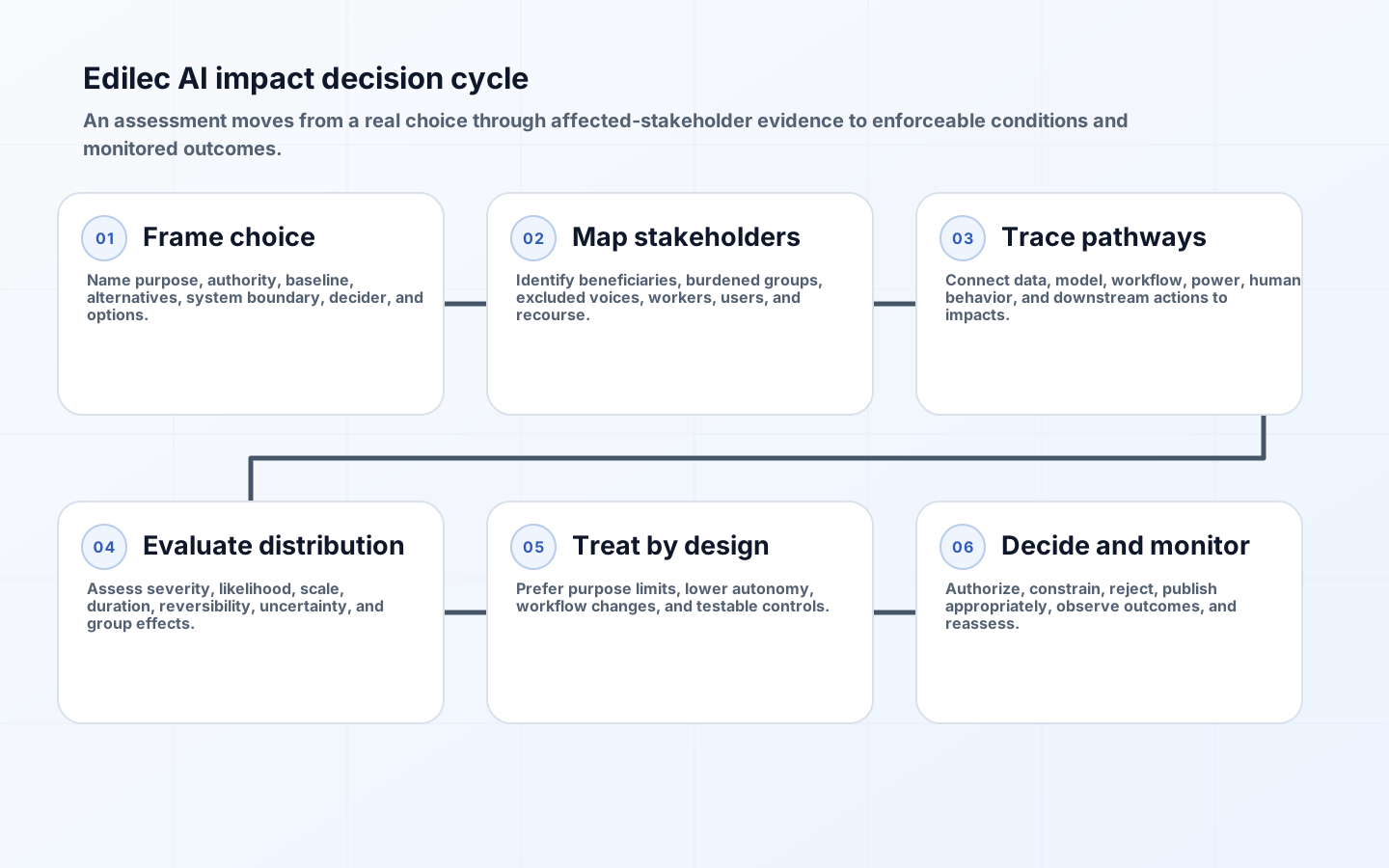
An AI impact assessment should make a design or deployment decision harder to evade and easier to explain. It should reveal who may benefit, who may bear harm, how the system changes power or process, which alternatives exist, what evidence is missing, which controls alter exposure, and who can accept residual impact. If the assessment begins after architecture and procurement are fixed, it will mostly rationalize choices that can no longer change.
NIST's AI RMF asks organizations to manage risks to individuals, organizations, and society throughout AI design, development, use, and evaluation. The AI RMF Core includes mapping impacts to individuals, groups, communities, organizations, and society. An assessment operationalizes that work for one proposed or changed use, but applicable law may impose a specific fundamental-rights, privacy, equality, procurement, or sector assessment with additional content and procedure.
Start with the decision the assessment will govern
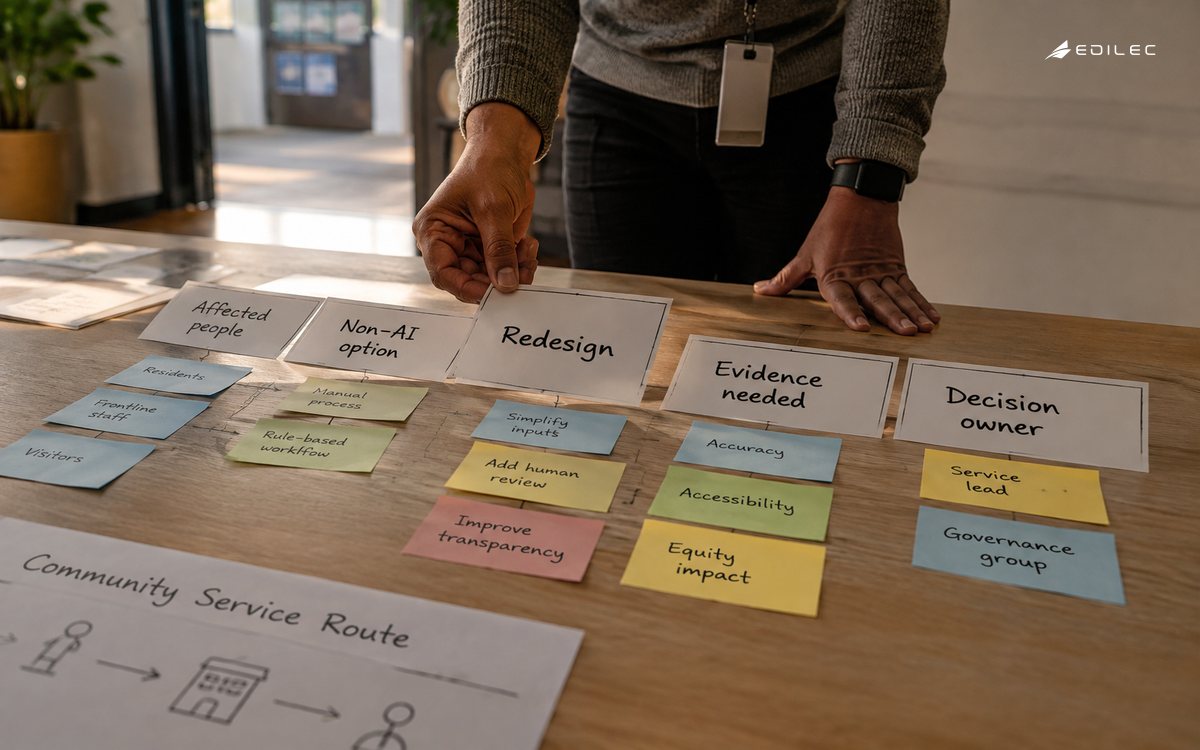
Write the decision before the questionnaire: whether to automate a task, buy a service, proceed to pilot, permit a population or geography, increase autonomy, launch, renew, or retire. Name the decider and available outcomes: reject, choose a non-AI option, redesign, gather evidence, pilot with constraints, launch, or suspend. Set a deadline early enough to influence delivery. An assessment without a decision owner becomes a research memo.
Define scope around the whole socio-technical system: business process, people, AI components, data, interfaces, rules, human roles, downstream actions, vendor services, and appeal route. Record adjacent systems and cumulative effects. A seemingly narrow score can reshape workload, eligibility, surveillance, or service access through the process around it.
Run the AI impact assessment in six decision stages
Frame purpose and alternatives; map stakeholders and impacts; examine data, model, workflow, and power; test severity, likelihood, distribution, and uncertainty; select controls and thresholds; then decide, publish appropriately, and monitor. Revisit earlier stages when evidence changes. Keep facts, stakeholder views, analysis, and decisions distinct so disagreement remains visible and reviewers can reproduce the reasoning.
| Stage | Core question | Required output | Stop condition |
|---|---|---|---|
| Frame | What problem and authority justify intervention? | Purpose, baseline, alternatives, owner | No legitimate or defined purpose |
| Map | Who benefits, is burdened, or lacks voice? | Stakeholder and impact map | Material population is unexamined |
| Analyze | How do data, model, workflow, and humans create impact? | Causal pathways and evidence | System boundary is unknown |
| Evaluate | How severe, likely, distributed, reversible, and uncertain? | Prioritized impacts and thresholds | Critical evidence is missing |
| Treat | What redesign or control changes exposure? | Control plan and residual impact | Control is untestable |
| Decide | Should use proceed, under what conditions? | Signed decision, monitoring, review | No authorized risk owner |
Compare AI with the real baseline and credible alternatives
The baseline is usually an existing human, rules-based, outsourced, or partly automated process with its own errors and inequities. Measure it rather than idealizing it. Compare no action, process redesign, better information, deterministic automation, limited AI assistance, and higher-autonomy options. Include cost, delay, accessibility, staff burden, error distribution, recourse, privacy, security, and long-term dependency. A more accurate model may still create worse institutional outcomes.
State the claimed benefit and who receives it. Time saved by an organization may shift verification work to customers; fraud reduction may increase false challenges for a small group; personalization may reduce user autonomy. The OECD classification framework provides dimensions covering people and planet, economic context, data and input, model, and task and output that help expose these tradeoffs.
Engage affected people with power to change the design
Identify direct subjects, users, workers, indirectly affected groups, people excluded from data, advocates, domain professionals, and operational staff. Choose methods appropriate to vulnerability and access: interviews, workshops, surveys, usability studies, community review, worker consultation, or representative bodies. Compensate participation where appropriate, protect privacy, provide accessible materials, and explain what can change.
Document concerns, supporting evidence, team response, design change, unresolved disagreement, and feedback to participants. Consultation is not consent and a participant list is not proof of influence. Avoid asking affected people to validate a predetermined launch. Where engagement could expose people to retaliation or distress, use trusted intermediaries and safeguards.
Analyze impact pathways, not only risk labels
For each impact, trace source, event, exposed group, consequence, duration, reversibility, scale, likelihood, uncertainty, and existing control. Consider rights and freedoms, equality, dignity, autonomy, health and safety, economic interests, privacy, expression, working conditions, environment, and access to remedy. Include benefits with equal discipline. Distinguish an individual error from a structural shift such as increased surveillance or reduced human discretion.
Canada's public Algorithmic Impact Assessment tool provides a concrete example: it covers project, system, algorithm, decision, impact, data, consultations, and mitigation, and its impact factors include rights, equality, dignity, privacy, autonomy, health, economic interests, reversibility, duration, and intersectional performance. Organizations should learn from its breadth without copying public-sector scoring into unrelated contexts.
Turn findings into thresholds and design controls
Write non-negotiable boundaries and measurable release conditions before final evaluation. Controls should prefer elimination or reduction through purpose limits, data minimization, lower autonomy, changed workflow, improved user notice, accessible recourse, or non-AI alternatives before relying on warnings and training. Name control owner, implementation evidence, effectiveness test, residual impact, monitoring signal, failure response, and expiry.
| Finding | Weak response | Decision-useful response | Evidence |
|---|---|---|---|
| Unequal false negatives | Add fairness statement | Improve data or workflow; set group threshold; provide review | Slice results and appeal outcomes |
| Automation bias | Tell users to check | Redesign interface; require reasons; sample overrides | Usability test and override audit |
| Sensitive-data exposure | Add policy reminder | Minimize fields; isolate access; block transmission | Data-flow test and access logs |
| Opaque adverse outcome | Publish generic notice | Give meaningful reason and accessible contest route | Notice test and recourse records |
| Vendor model drift | Trust release notes | Pin versions; regression gate; rollback | Version ledger and test report |
Record the decision and publish proportionately
The final record should state purpose, scope, alternatives, stakeholders, methods, evidence limits, significant impacts, design changes, residual impacts, dissent, conditions, decider, effective period, monitoring, and review triggers. Publish a summary where law, public accountability, affected-person needs, or organizational commitments warrant it. Protect personal data, security-sensitive details, legal privilege, and legitimate confidential information through reasoned redaction rather than withholding everything.
For certain deployers of high-risk systems, the EU AI Act includes a fundamental-rights impact assessment in specified circumstances; consult the enacted EU regulation and qualified counsel for scope and required content. A voluntary enterprise assessment can support the work but should not be represented as satisfying a legal procedure unless every applicable element is met.
Monitor impacts and reopen the assessment
Track system outcomes, subgroup performance, overrides, complaints, appeals, incidents, near misses, excluded users, workforce effects, and benefit realization. Define who reviews signals and who can restrict or suspend use. Reassess after purpose, population, autonomy, model, data, vendor, interface, geography, law, or impact changes. Periodic review alone is too slow for material release changes.
Connect assessment decisions to threat modeling, compliance-ready delivery, and an audit trail. The AI governance guide can assign escalation and residual-risk authority.
Assure the assessment process independently
Use an independent reviewer for consequential systems to challenge scope, evidence, stakeholder representation, scoring, control feasibility, and decision authority. Independence can come from another team or qualified external reviewer; it does not require ignorance of the domain. Record conflicts and protect reviewers from delivery pressure. The product team should correct factual errors while the reviewer retains responsibility for challenge findings.
Look for warning signs: copied impacts, identical scores across groups, benefits without evidence, mitigations consisting only of training, consultation after design freeze, no non-AI alternative, hidden dissent, and launch conditions without technical enforcement. Measure assessment quality through design changes, conditions met, reassessments triggered, and production findings predicted, not the number of completed forms.
Retain the decision record long enough to support complaints, audits, incidents, and system retirement, subject to privacy and legal retention rules. Keep source snapshots or hashes where external evidence may change. At closure, evaluate whether predicted benefits and harms matched outcomes and feed lessons into methods and thresholds. An assessment program should become more calibrated through experience rather than simply accumulate reports.
Integrate assessment conditions into product telemetry and operating reviews. If approval is limited to a user group, data class, volume, or human-review rate, monitor that boundary directly. Assign alerts and escalation before launch. Quarterly attestations are weak substitutes for configuration controls that prevent expansion. When a condition cannot be observed, treat that as an evidence gap and either redesign monitoring or narrow the approved use until compliance can be demonstrated.
Key takeaways
- Begin with a named decision and decider while architecture and procurement can still change.
- Assess the whole socio-technical system and compare it with the measured current process and non-AI alternatives.
- Give affected stakeholders a credible route to influence requirements, controls, and the proceed decision.
- Trace impact pathways and distribution instead of collapsing everything into one score.
- Set thresholds, monitor real outcomes, and reopen the assessment after material change.
Frequently asked questions
Is an AI impact assessment the same as a privacy impact assessment?
No. Privacy may be one major impact, but AI assessment also considers safety, equality, autonomy, economic interests, workers, service access, security, and broader social effects. Link the assessments to avoid duplication.
Should every assessment produce a numeric score?
No. Scores can route review, but they can hide distribution, uncertainty, and non-compensable harms. Preserve qualitative reasoning, evidence, thresholds, and dissent.
Who can approve residual impact?
An accountable business authority with the mandate to accept consequences should decide, informed by legal, technical, risk, domain, and stakeholder evidence. The assessment author should not approve their own work alone.
Conclusion
An AI impact assessment earns its cost when it changes purpose, data, workflow, controls, scope, or the decision to deploy. Frame a real choice, compare alternatives, engage affected people, trace impact pathways, set thresholds, and give an authorized owner clear options. Then monitor outcomes and reopen the record when reality departs from assumptions. That is decision infrastructure, not paperwork.