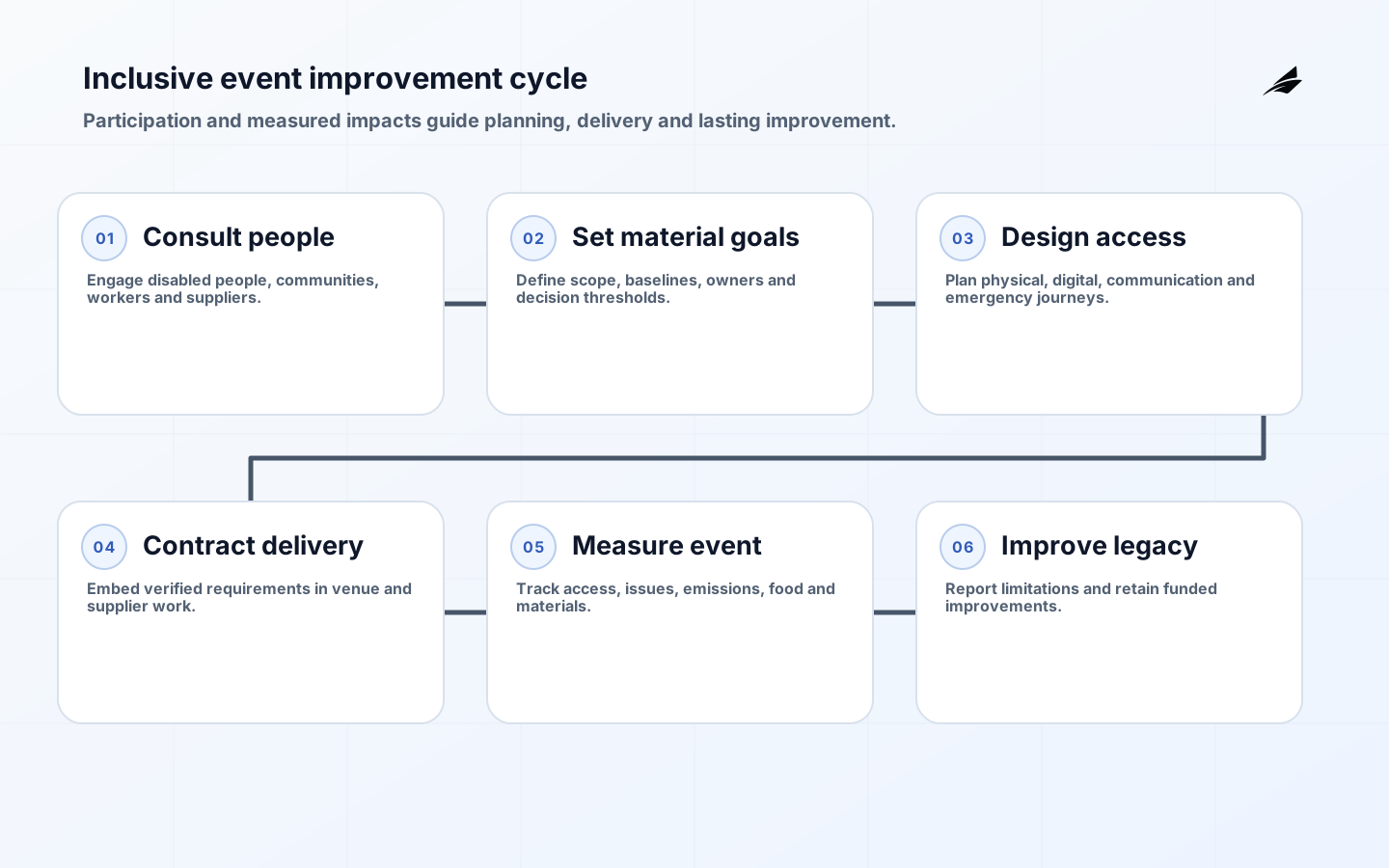
A sustainable and inclusive events checklist must manage environmental, social and economic impacts together. An event is not inclusive because a venue has a ramp, and it is not sustainable because it removes printed programs. The implementation has to involve affected people, define measurable priorities, influence suppliers, make physical and digital participation accessible, prevent waste, protect safety and report limitations honestly.
Use the companion practical guide, implementation FAQ and corporate sustainability event checklist. ISO 20121:2024 provides a management-system reference that covers social, economic and environmental impacts and emphasizes inclusivity and legacy. Local accessibility, safety, employment and environmental duties still require jurisdiction-specific advice.
Set scope, principles and accountable outcomes
Define which event, locations, online components, suppliers and lifecycle stages are in scope. Name an executive sponsor and operational owners for accessibility, procurement, carbon data, waste, safeguarding and complaints. Identify interested parties, including disabled people and their representative organizations, local communities, workers, speakers, attendees, venue staff and suppliers. Engage them before major venue and platform decisions.
Choose a small number of material objectives with baselines and decision thresholds. Examples include accessible end-to-end participation, lower travel emissions, prevention of food waste, fair supplier access and a useful local legacy. Avoid unsupported “zero impact” or “carbon neutral” claims. Record boundaries, methods, exclusions and uncertainty so the report can distinguish measured reductions from estimates and purchased instruments.
| Impact area | Planning question | Evidence |
|---|---|---|
| Accessibility | Can people participate independently and with accommodations? | Access audit, user testing and request log |
| Climate | Which sources dominate within the boundary? | Activity data, factors and calculation method |
| Materials and food | How will demand be prevented before disposal? | Procurement quantities and measured waste |
| Social value | Who benefits or bears burden? | Stakeholder input, supplier and workforce records |
Design physical and digital access from the start
Audit arrival, transport, parking, entrances, circulation, seating, stages, toilets, quiet spaces, catering and emergency egress. Provide clear access information before registration and a private accommodation request channel with named follow-up. Budget for interpreters, captioning, assistive listening, personal-assistant access and alternative formats. Do not make a person repeatedly disclose disability to different suppliers.
Apply WCAG 2.2 to registration, agenda, streaming, mobile and feedback services. Test keyboard navigation, focus, labels, errors, contrast, zoom and captions. Give speakers accessible slide and microphone requirements. Hybrid participation needs facilitation, not only a video link: remote attendees need equivalent context, questions, materials and support. Test with representative users and backup connectivity.
Put sustainability and inclusion into procurement
Issue requirements early enough to influence venue, catering, production, transport, technology, security and staffing. Ask suppliers for evidence relevant to the contract rather than generic policies. Include accessible service, worker conditions, material reuse, food prevention, energy data, delivery consolidation and reporting fields. Make evaluation criteria transparent and proportionate so smaller and local suppliers can compete.
Assign contract owners and verify delivery through site checks, samples and records. Flow requirements to subcontractors. Specify who owns attendee data and accommodation information, how it is protected and deleted, and whether AI tools process registrations, translation or surveillance. AI may assist forecasting or captions, but critical accessibility needs require tested performance, disclosure, human support and fallback.
| Supplier | Contract requirement | Acceptance check |
|---|---|---|
| Venue | Step-free routes, accessible facilities and energy data | Joint access walk and meter method |
| Caterer | Dietary safety, demand plan and food-waste records | Menu review and measured leftovers |
| Production | Reusable design and accessible stage/media | Material inventory and technical rehearsal |
| Digital platform | WCAG support, captions, privacy and export | User test and fallback exercise |
| Transport | Accessible options and activity data | Journey information and usage report |
Measure emissions before making claims
Set an organizational and event boundary, then gather activity data for travel, accommodation, venue energy, freight, catering, materials, waste and digital services where material. Use a documented hierarchy: direct supplier or meter data where reliable, then recognized factors and stated estimates. Avoid false precision. Attendee travel often dominates in-person event footprints, so registration can collect optional origin and mode data with privacy safeguards.
Prioritize avoidance and reduction: location and schedule, remote access, rail-friendly travel, consolidated freight, efficient venue operation, reusable production and lower-impact menus. Track forecast and actual data. If offsets or other instruments are used, report them separately from gross emissions and explain quality criteria. Do not imply that compensation erased operational impacts.
Prevent materials and food waste
Apply a hierarchy beginning with prevention. Reduce giveaways and single-use build, rent or reuse furniture and signage, design modular graphics and require suppliers to take materials back. Provide clearly labeled collection matched to local facilities, but do not treat recycling as the first strategy. Record material destinations and contamination rather than reporting bin presence as diversion.
For food, improve registration forecasting, confirm attendance, choose flexible menus and track preparation and plate waste. EPA guidance prioritizes preventing wasted food before lower-value pathways. Plan safe donation where law, logistics and partners permit, then appropriate organics processing. Include dietary needs without overproducing separate meals and provide ingredient information and trained service.
Rehearse safe, dignified event delivery
Brief staff and volunteers on access, respectful assistance, safeguarding, complaints and escalation. Identify accessibility contacts visibly without forcing public disclosure. Rehearse captioning, interpretation, evacuation, power, streaming and accommodation failures. Emergency plans must include disabled participants and staff. Keep a quiet route for reporting harassment, discrimination, unsafe conditions or environmental incidents.
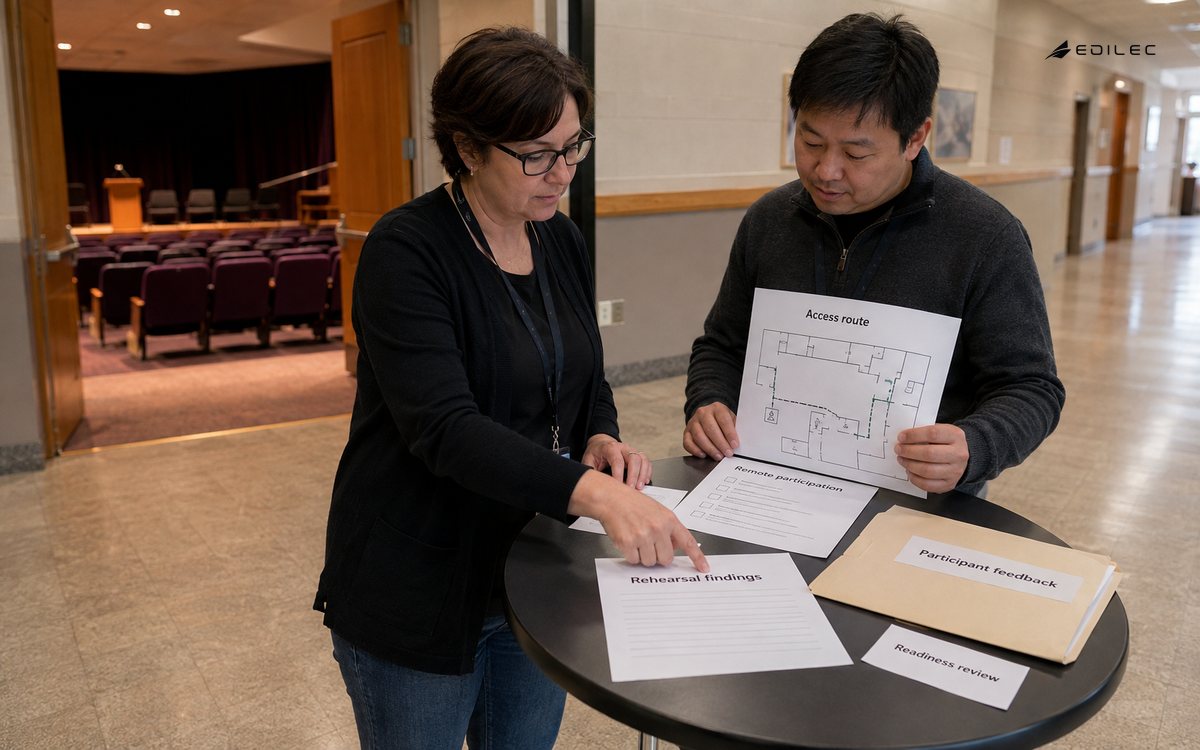
Use a live issue log with owner, severity, response and closure. Make bounded corrections during the event and communicate changes in accessible formats. Do not photograph or publish stories about participants without consent. Monitor queues, room capacity, temperature, caption quality, food demand and waste so operational changes can reduce harm immediately.
- Consult affected stakeholders and define scope.
- Approve material objectives, baselines and owners.
- Contract accessible and sustainable delivery requirements.
- Rehearse participant journeys and failure scenarios.
- Measure activity and resolve issues during delivery.
- Report results, limitations and funded improvements.
Verify results and improve the next event
Reconcile supplier data, attendance, accommodation delivery, access issues, emissions inputs, material flows, food waste and complaints. Segment feedback without exposing individuals. Compare with the baseline and explain methodology changes. Report what was not measured, where estimates were used and which objectives were missed. Independent assurance may be appropriate for material public claims.
Hold a review with affected stakeholders and suppliers, assign corrective actions and transfer reusable assets and knowledge. Evaluate legacy: local supplier capability, accessibility improvements retained by the venue, community benefit and staff learning. A management-system approach treats the event as a cycle of policy, planning, delivery, checking and improvement, not a collection of decorative gestures.
Hold an inclusive readiness review before doors open
Bring event operations, venue, digital platform, accessibility advisers, security, catering, production and participant representatives through the complete journey. Verify published access information, accommodation requests, entrances, seating, stage access, captions, interpretation, quiet space, dietary handling, emergency procedures, remote participation and issue escalation. Assign a named correction owner and deadline for every gap.
At the same review, confirm how energy, travel, materials, food and waste activity will be captured, by whom and in what units. Check supplier reporting templates and chain of custody for reusable or recovered materials. Freeze public sustainability claims until boundaries and evidence are approved. The readiness decision should state residual limitations and how participants will be informed, not simply mark every checklist line complete.
Run a technical rehearsal with speakers and moderators using the actual microphones, caption feed, presentation files, lighting and streaming platform. Confirm that names and specialist terms are available to captioners and interpreters, questions from remote participants reach the room, and recordings preserve captions. Test the fallback when a speaker submits inaccessible material late or a caption service disconnects.
Prepare an evidence-preservation plan before temporary teams disband. Collect supplier activity data, accommodation fulfillment, incident logs, consent records, waste weights and attendee feedback under defined access and retention. Assign the post-event calculation and report owners with dates. Otherwise the organization may publish attractive claims while the people who understand their boundaries have already moved on.
Compensate people with lived experience for substantive design and testing work where appropriate, and make participation formats accessible. Record which recommendations were accepted, deferred or rejected with reasons. Consultation is credible when it changes decisions and participants can see the outcome; it should not become unpaid labor used to validate choices that were already fixed.
Key takeaways
- Manage social, economic and environmental effects in one accountable system.
- Co-design accessibility with affected people before venue and platform commitments.
- Use procurement to influence suppliers and verify delivery evidence.
- Report gross impacts, methods and uncertainty before compensation claims.
- Prevent waste and carry lessons and accessible improvements into future events.
Frequently asked questions
Does ISO 20121 certify that an event is sustainable?
ISO 20121 specifies requirements for an event sustainability management system. Conformity does not make every outcome impact-free; organizations still need objectives, evidence, improvement and accurate claims.
Is a hybrid event always more sustainable?
Not automatically. It can reduce some travel and increase access, but digital infrastructure, production, engagement and accessibility still matter. Compare scenarios using the actual audience and event purpose.
What attendee data should be collected?
Collect only what supports access, safety, service and approved measurement. Explain purpose, limit access, set retention and provide alternatives for sensitive accommodation or travel information.
Can AI provide captions without human support?
Automated captions can help but accuracy varies with speakers, audio, language and terminology. Test the exact setting, disclose limitations, provide correction or human captioning where required, and maintain a fallback.
Conclusion
Sustainable and inclusive events are produced through early participation, enforceable procurement, accessible design, measured impacts and honest improvement. The strongest checklist follows the entire participant and supplier journey, including failure and legacy. When environmental reductions do not exclude people and inclusion is backed by operational evidence, the event can create credible lasting value.