Corporate sustainability events are meetings, conferences, launches, exhibitions and employee gatherings planned to improve environmental, social and economic outcomes while meeting a clear business purpose. A credible program changes choices about travel, venue, access, food, materials, suppliers and legacy, then keeps evidence for the claims it makes. It does not begin with offsets or a generic green badge.
This FAQ complements Edilec's corporate sustainability events planning guide, event implementation checklist and corporate sustainability study checklist. ISO 20121:2024 applies a management-system approach to environmental, social and economic impacts and strengthens attention to inclusion, human rights and event legacy.
What makes a corporate event sustainable?
Sustainability is a decision process, not one format. Define why people must gather, who benefits or may be excluded, material impacts and the positive legacy sought. Compare in-person, hybrid, distributed and virtual formats against participation quality, travel, accessibility, technology and local value. Set objectives before booking because venue and date determine many later constraints. Assign an executive sponsor, event owner and sustainability lead with procurement authority.
| Decision | Evidence before commitment | Outcome to track |
|---|---|---|
| Format | Purpose, audience location and access needs | Participation and avoided burden |
| Venue | Transit, energy, accessibility and waste capability | Actual utilities and access performance |
| Travel | Origin scenarios and feasible alternatives | Mode and distance by attendee |
| Catering | Attendance, diet, sourcing and donation route | Served, leftover and wasted food |
| Production | Reuse inventory and supplier take-back | Materials reused, returned or discarded |
How should the event measurement boundary be set?
Define event dates, venues, organizer activities, attendee travel, accommodation, freight, energy, food, materials, waste and digital delivery. State inclusions and exclusions and keep them consistent between baseline and result. Separate measured activity from supplier data and estimates. The GHG Protocol Scope 3 guidance includes business travel, purchased goods and services, waste and transport categories relevant to events, but the corporate inventory treatment depends on organizational boundaries.
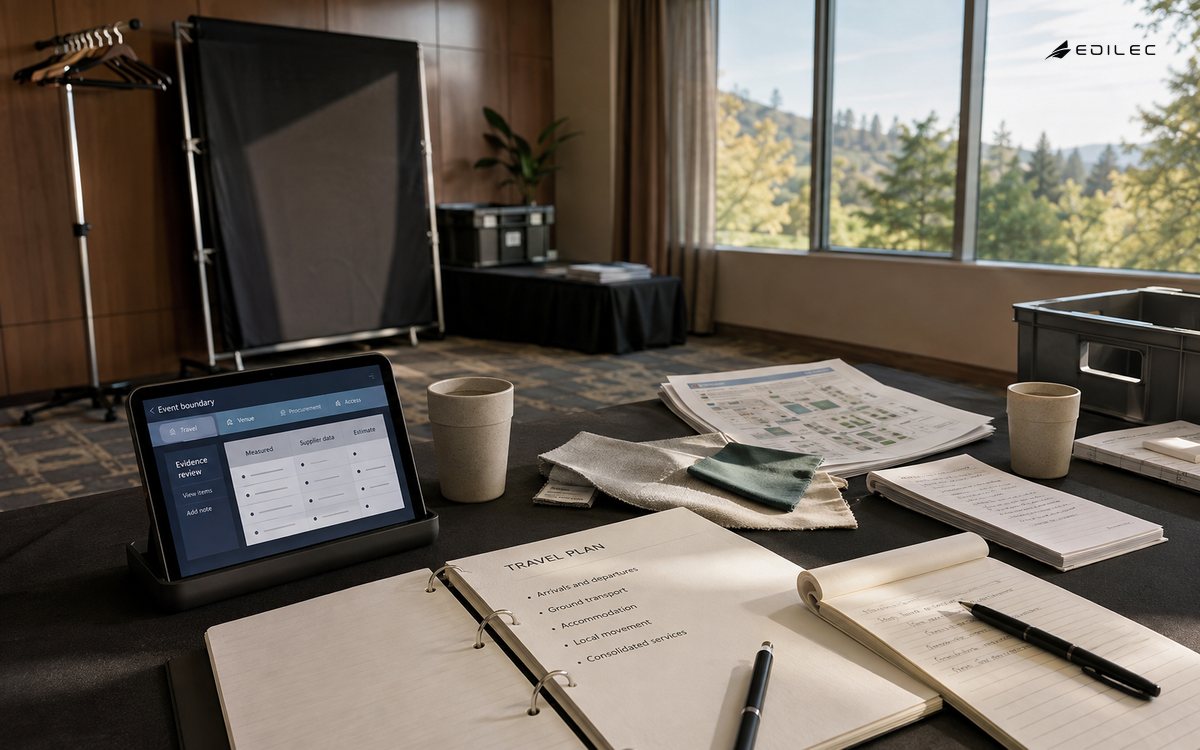
Start with materiality. Travel may dominate an international meeting; venue energy or temporary construction may matter more elsewhere. Gather activity data such as passenger-kilometers, room nights, fuel, electricity, meals and material mass. Apply a current, documented emission-factor source appropriate to geography and year. The UK government publishes annual factors, including 2026 resources; record factor version and assumptions so results can be reproduced.
How can travel impact be reduced fairly?
Reduce the need first: choose an accessible hub, rotate regions, cluster meetings, provide meaningful remote participation and avoid dates that force extra travel. Give rail and public-transport information at invitation time, not after flights are booked. Do not shift cost or journey complexity onto disabled attendees or people with caregiving and visa constraints. Track origin, mode, class and distance using the minimum personal data needed.
What should venue and supplier contracts require?
Request step-free routes, accessible toilets and seating, hearing support, quiet space, transit access, measured energy and water, renewable-energy evidence, waste streams, food-donation routes and emergency procedures. Translate commitments into contract schedules with data deadlines. For stands, signage, furniture and equipment, prefer existing inventory, rental, modular reuse and supplier take-back. Ask who owns each material after the event.
Supplier questionnaires should request evidence proportional to spend and impact. Avoid excluding small local suppliers with an enterprise-sized form; offer clear minimum requirements and support. Include labor conditions, safeguarding, human rights and community effects alongside carbon and waste. ISO 20121's management approach reaches the supply chain and interested parties rather than reducing sustainability to venue certification.
How should food and waste be managed?
Collect dietary needs respectfully, forecast attendance and confirm late changes. Make lower-impact choices attractive and culturally suitable. Record meals ordered, served, donated and discarded by weight where feasible. Follow the local hierarchy and food-safety rules: prevent, safely redistribute, then process remaining waste appropriately. Clearly labeled bins do little if the venue later combines streams, so verify downstream handling.
Does accessibility belong in sustainability reporting?
Yes. Social sustainability includes who can participate safely and meaningfully. Provide accessible registration, captions, interpretation, dietary and access requests, quiet space, seating options and assistance information. Apply WCAG 2.2 to digital registration, agendas and hybrid platforms, then test the complete journey. Budget accommodations centrally rather than treating them as optional attendee extras.
What claims can an organizer make?
State the boundary, method, factor sources, measured and estimated shares, exclusions, reductions and remaining emissions. Prefer specific claims such as a percentage reduction against a comparable baseline over undefined terms like green or zero impact. Do not count planned actions as achieved. If carbon credits are used, report them separately from gross emissions and reductions, identify the program and avoid implying that purchase erased all event impacts.
| Claim element | Evidence | Common weakness |
|---|---|---|
| Baseline | Comparable prior event or modeled scenario | Different boundary |
| Activity | Travel, energy, food and material records | Spend used where primary data exists |
| Factor | Named source, geography and year | Old or undocumented value |
| Reduction | Like-for-like calculation and decision link | Normal attendance change credited |
| Residual | Gross result before credits | Material source omitted |
| Legacy | Owner, beneficiary and follow-up | Vague intention after event |
What is a practical event delivery cycle?
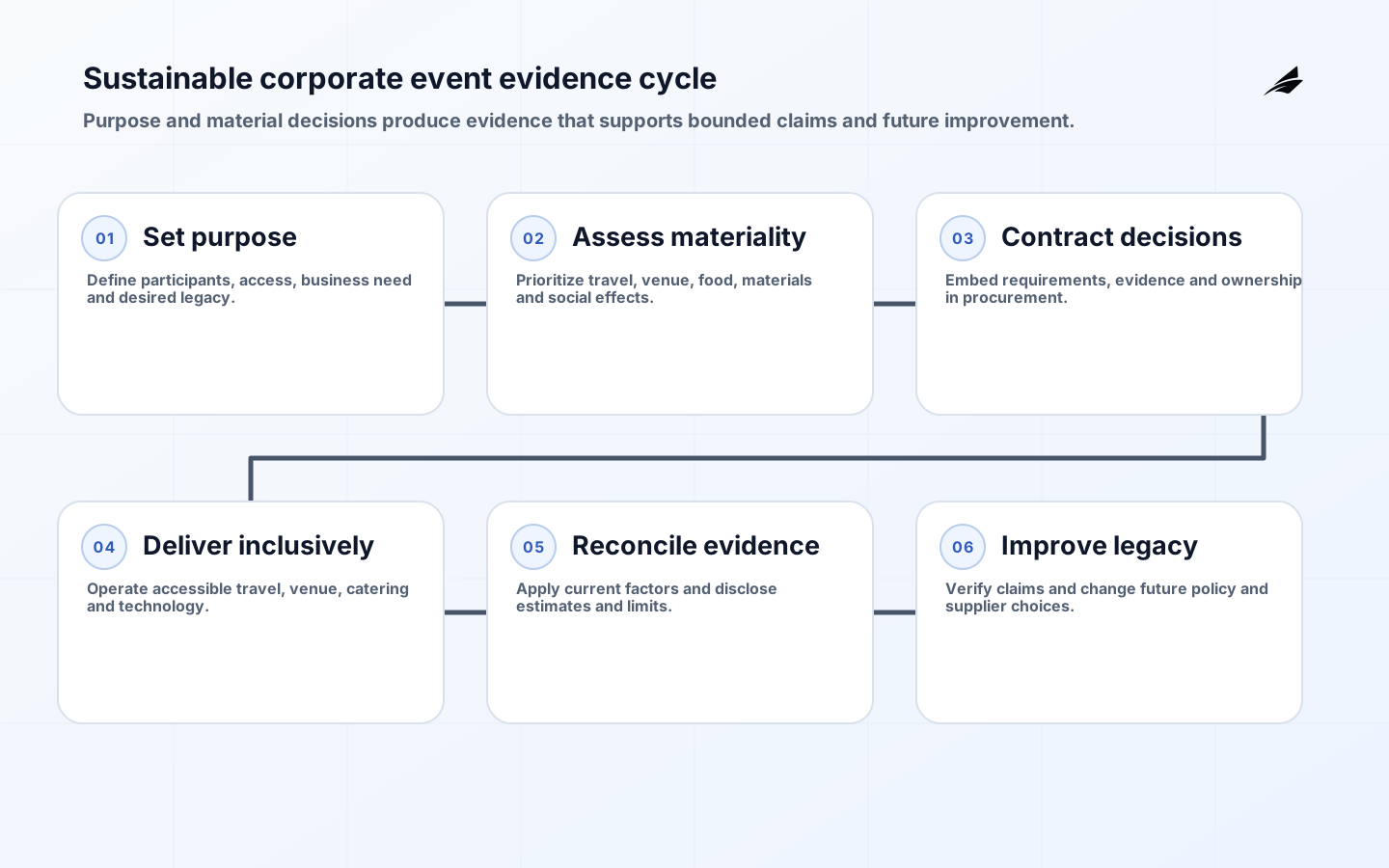
- Approve purpose, boundary, stakeholders and material issues.
- Set measurable objectives and assign decision owners.
- Embed requirements in venue, travel, catering and production procurement.
- Capture activity evidence during registration, delivery and breakdown.
- Reconcile estimates, document limitations and review outcomes with stakeholders.
- Publish proportionate results and carry actions into the next event or business process.
Create a proportionate event evidence register
List each measure, unit, source, supplier, collection time, owner, factor and quality grade. Registration can collect origin and intended travel mode; booking partners can provide route and class; venues can provide meter readings; caterers can report meals and waste. Minimize personal data, aggregate early, explain collection and set retention rather than reusing travel details for unrelated profiling.
Reconcile supplier totals against attendance, invoices and operating records. Investigate impossible or missing values and preserve original submissions. Distinguish primary measurements, calculated activity and spend estimates. Record uncertainty where methods support it. A result with transparent limitations is more useful than false precision built from undocumented assumptions.
Verify legacy after the event
Review delivery with venue, suppliers, participant representatives and budget owners. Compare objectives with participation, accessibility, incidents, procurement, travel, food, materials, waste and cost. Assign corrective actions to standing processes such as travel policy, preferred venues and supplier frameworks, and publish a concise result appropriate to stakeholders.
A legacy claim needs a beneficiary, owner, resource, milestone and follow-up date. Examples include reusable production inventory, accessible event templates or a changed travel approval process. Check whether benefits persist after several months. Retire claims that cannot be evidenced and carry unresolved impacts into the next materiality review.
Key takeaways
- Set event purpose and material impacts before booking.
- Reduce travel, energy, food and material demand before discussing credits.
- Treat accessibility, labor and local value as sustainability outcomes.
- Keep activity data, factor versions and assumptions reproducible.
- Make bounded claims and turn results into procurement and planning changes.
Frequently asked questions
Does an event need ISO 20121 certification?
No. ISO 20121:2024 offers multiple ways to demonstrate conformity, including self-declaration, supplier validation and third-party certification. Choose assurance from stakeholder need, risk and resources; use the management disciplines even without certification.
Is a virtual event always more sustainable?
Not automatically. It usually reduces travel but still has technology, energy, accessibility and engagement effects. Compare formats against the event purpose and material impacts. A distributed hybrid model may improve access while limiting long-distance travel.
Can an event be called carbon neutral after buying offsets?
Claims rules vary. At minimum, calculate a transparent gross footprint, prioritize direct reduction, disclose residual emissions and describe credits separately with their standard and vintage. Obtain legal and assurance review before using broad neutrality claims.
Use event technology proportionately
Registration, badge, mobile app and hybrid platforms should collect only needed data, support accessible use, publish retention and restrict supplier access. Avoid requiring a smartphone for entry or participation. Provide printable or staffed alternatives. Test captions, keyboard access, low bandwidth, time zones and recordings. Decide whether recordings remain available, who can view them and when they are deleted.
AI tools may support translation, captioning, scheduling or evidence classification, but they need human verification where errors affect access or claims. Tell participants when automated transcription is used and handle sensitive discussion appropriately. Do not upload supplier invoices, attendee details or unpublished sustainability data to an unapproved model. Measure whether the tool improves participation or administration relative to its cost and risk.
Budget sustainability as delivery work
Create budget lines for accessible formats, captions, measurement, lower-impact transport, reusable production, supplier evidence and post-event review. Some choices reduce cost while others shift spending toward long-term value. Compare total cost with the conventional baseline and record avoided purchases, not speculative savings. Protect these lines from late-stage cuts that leave only promotional claims.
Set data and decision deadlines in the master schedule. Travel guidance must precede booking, material requirements must precede fabrication and waste routes must be confirmed before delivery. A sustainability lead without authority over those milestones can only report impacts after they are locked in.
For recurring events, keep a comparable core dataset and explain method changes. Trend decisions and impacts across years instead of celebrating isolated totals that cannot be compared.
Conclusion
A sustainable corporate event aligns purpose, inclusion, procurement and measurable impact. Set the boundary early, make reduction decisions while choices remain open, and retain enough evidence to explain results without false precision. The event creates lasting value when its lessons change future travel, supplier and workplace decisions rather than ending with the closing session.