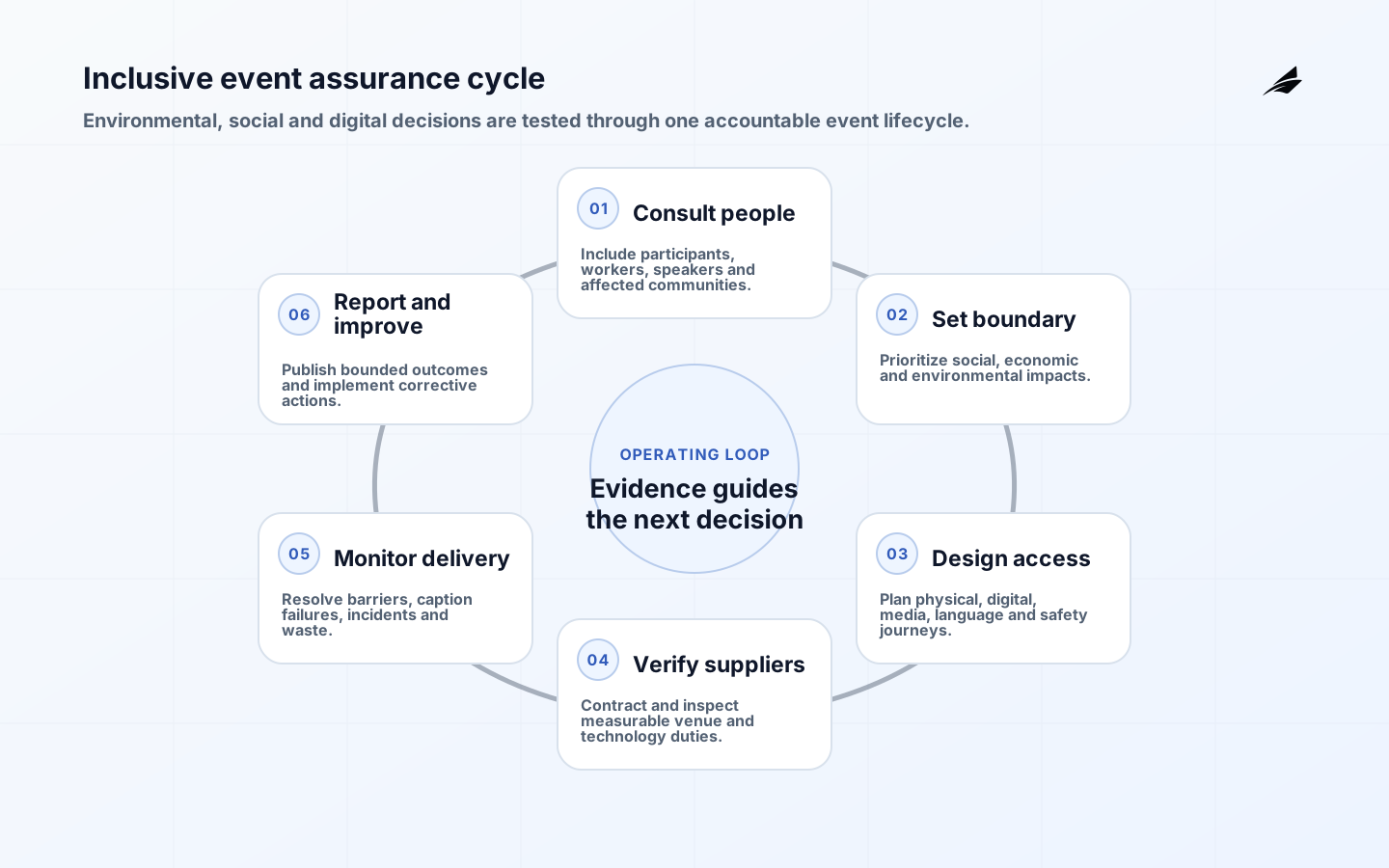
Sustainability events inclusion is one planning problem, not two parallel checklists. Travel, energy, food, materials and waste affect environmental performance; venue, price, language, disability access, digital access and safety determine who can participate. Technology and AI can help with registration, captions, translation, demand forecasting and analysis, but they can also introduce exclusion, surveillance and confident errors. A useful plan begins with affected people and measurable outcomes, then chooses tools and suppliers that support those outcomes.
This guide complements the sustainable and inclusive events checklist, the events inclusion FAQ and the corporate sustainable events planning guide. Apply local equality, accessibility, safety, privacy, employment and environmental law first. ISO 20121:2024 provides a management-system approach across social, economic and environmental impacts, but certification is not a substitute for evidence about one event.
Define purpose, stakeholders and the event boundary
Name the event purpose and the decisions success should enable. Identify attendees, speakers, staff, suppliers, neighbors, remote participants and people likely to be excluded. Consult disabled participants and representative groups early enough to change the design. Set the boundary for measurement: planning office, venue, attendee travel, accommodation, catering, production, digital platform, freight and end-of-life materials. Disclose exclusions so a favorable metric does not hide the largest impacts.
Create a short issues register covering significance, affected groups, owner, objective, action and evidence. Prioritize material impacts instead of collecting dozens of decorative commitments. A hybrid format can reduce some travel while increasing production, streaming and accessibility requirements; it is not automatically sustainable or inclusive. Choose the format after comparing audience need, location, duration, travel alternatives, venue access, digital access and the value of in-person participation.
| Issue | Design decision | Evidence |
|---|---|---|
| Mobility | Venue, schedule and remote option | Step-free route test and transport information |
| Digital access | Platform, keyboard use and assistive technology | WCAG-based test with disabled users |
| Media | Captions, transcript, description and language | Reviewed sample and live fallback |
| Environmental impact | Travel, energy, food and material priorities | Boundary, baseline and measured result |
| Dignity and safety | Code, reporting and response process | Trained owner and exercised route |
Design the full participant journey
Trace discovery, registration, payment, travel, arrival, navigation, sessions, networking, meals, feedback and departure. Publish access information before registration: step-free routes, seating, quiet spaces, toilets, lighting, sound, scent considerations, service-animal policy, dietary process and contact route. Ask only what is needed to arrange support, explain how access information is used, restrict access to it and delete it under a stated retention rule. Never force people to disclose a diagnosis when a practical accommodation request is enough.
Test the website and event app against WCAG 2.2 with keyboard navigation, visible focus, zoom, reflow, labels, errors and screen-reader output. Avoid platform features that require a mouse, phone-only authentication or inaccessible CAPTCHA without an alternative. Make schedules exportable and available in a simple web or document format. Provide a staffed fallback for registration and check-in. Printed signs need readable contrast and placement; digital accessibility does not repair an inaccessible venue.
Use AI for access with human quality control
Automated captions and translation can increase coverage, but quality varies with audio, accents, domain vocabulary, names and language pairs. W3C recommends planning captions, transcripts and other media access according to the content and user need. Use professional human captioning or interpretation where accuracy is consequential. For automated services, test with speakers and vocabulary, display that output may contain errors, provide a correction route, and assign a person to monitor live quality and activate a fallback.
Do not upload attendee lists, accommodation details, private chat or unpublished talks to general AI services without an approved purpose, lawful basis, contract and retention controls. Minimize prompts and logs, disable unnecessary training use, restrict access and review generated summaries before publication. AI should not decide who receives an accommodation, speaking slot or safety intervention. Use it to assist accountable people, preserve source records and make correction possible.
Turn requirements into supplier contracts
Put measurable requirements into venue, catering, production, platform, transport and waste contracts. Ask suppliers for the specific data needed, methodology, accessibility capability, subcontractors, incident route and evidence after delivery. Broad sustainability claims or an accessibility logo are weak assurance. Inspect the venue with the actual room plans; test the production chain with microphones, caption feeds, remote speakers and assistive listening; and confirm who pays for remediation when a requirement is missed.
| Supplier | Required commitment | Acceptance check |
|---|---|---|
| Venue | Accessible routes, rooms and emergency arrangements | Joint walk-through with measured fixes |
| Platform | WCAG support, keyboard operation and data controls | Scenario test on supported devices |
| AV and captions | Audio quality, caption latency and fallback | Live rehearsal with representative speech |
| Catering | Dietary safety, waste data and reusable service | Label review and waste measurement plan |
| Production | Material inventory, reuse and end-of-life route | Asset list and post-event disposition |
Rehearse operations and exceptions
Run a timed rehearsal covering arrival, registration, room change, remote join, live caption failure, inaccessible content, dietary escalation, medical incident, harassment report, evacuation and transport disruption. Give staff role-specific instructions and a rapid route to the accountable lead. Emergency plans must include people who cannot use stairs, hear an alarm, process rapid instructions or leave without support. Do not improvise personal evacuation arrangements at the moment of danger.
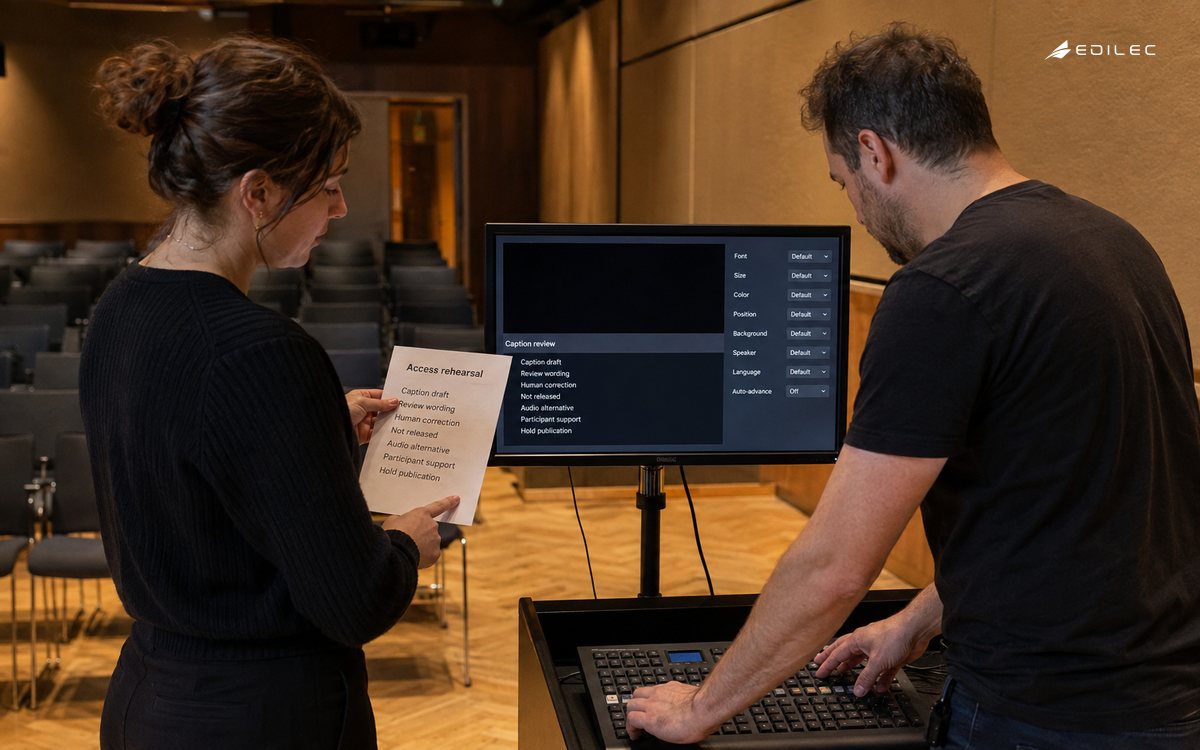
During delivery, record material incidents, accommodation requests fulfilled, caption outages, waste streams, attendance by mode and supplier exceptions without creating unnecessary personal profiles. Make help visible and offer more than one feedback channel. Fix immediate barriers where possible and communicate honestly. A participant should not have to publicly explain a disability to receive support. Preserve enough evidence for review while limiting access and retention.
Measure outcomes and make credible claims
Compare results with the defined boundary and baseline. Useful measures include participation and completion, access requests met, barrier reports, caption availability, attendee travel by mode, energy, food served and wasted, material reuse and supplier compliance. Explain estimates, conversion factors and missing data. Avoid claims such as zero-impact, fully accessible or carbon neutral unless the scope, method and residual impacts genuinely support them. Report both achievements and unresolved barriers.
Hold a review with affected participants, delivery owners and suppliers. Assign corrective actions, dates and changes to reusable templates. Feed confirmed access needs and supplier performance into the next event without retaining sensitive personal details indefinitely. Continual improvement means changing procurement and design, not merely adding lessons to a report. Track whether an action was implemented and whether it reduced the barrier at the next event.
A ten-step event implementation procedure
Run the plan as a controlled project with an accessibility lead, sustainability lead and event owner sharing one risk and action register. Complete these steps early enough that a failed test can still change the venue, platform, supplier or format. Record evidence beside each decision rather than reconstructing it after the event.
- Approve the event purpose, affected stakeholders, legal duties and decision owner before contracts are signed.
- Consult representative participants and workers, pay for expertise where appropriate, and convert barriers into owned requirements.
- Set the social, environmental and economic measurement boundary, baseline, objectives, exclusions and reporting method.
- Compare in-person, remote and hybrid formats against participation, travel, production, safety, cost and event purpose.
- Inspect candidate venues and test registration, payment, schedules, media and support routes with assistive technology.
- Contract venue, platform, AV, caption, catering and production suppliers against measurable acceptance evidence and remediation duties.
- Approve any AI use through purpose, data, accuracy, bias, privacy, human review, correction and fallback checks.
- Rehearse arrival, room changes, remote participation, caption failure, dietary escalation, harassment reporting, evacuation and transport disruption.
- Monitor access, incidents, resource use and supplier exceptions during delivery while protecting personal information and dignity.
- Publish bounded results and limitations, assign corrective actions, verify completion and update reusable event templates for the next cycle.
Key takeaways
- Treat inclusion as part of social sustainability and involve affected people before design decisions harden.
- Test the physical and digital journey, including failures and emergency arrangements.
- Use AI captioning, translation and analysis only with quality monitoring, privacy controls and accountable review.
- Contract measurable supplier commitments and inspect evidence before the event.
- Publish bounded results, limitations and corrective actions instead of absolute claims.
Frequently asked questions
Is a hybrid event always more sustainable?
No. It may reduce some travel but adds production and digital infrastructure, and it can create a second-class remote experience. Compare material impacts and participation needs within a stated boundary.
Are automatic captions sufficient?
They may be suitable for lower-risk contexts after testing, with monitoring and correction. Consequential, technical or multilingual sessions often need professional captioning or interpretation and a rehearsed fallback.
Does ISO 20121 certification prove an event is inclusive?
It can provide assurance about a management system, but participants still need event-specific evidence: accessible journeys, fulfilled accommodations, tested media, incident handling and transparent results.
Budget access and sustainability as core production costs. Include consultation, captioning, interpretation, accessible documents, venue modifications, quiet space, staff, measurement and contingency in the initial budget. A late accommodation should still be addressed, but predictable needs are not surprises. Track which budget decisions created barriers and update the next event's baseline rather than requiring affected participants to negotiate the same support repeatedly.
Keep communications consistent across invitation, website, app, email, signs and staff briefing. Name the access contact, response time and available formats. When a limitation is discovered, publish the practical workaround and expected correction rather than hiding it behind general language. Clear information lets people decide whether and how they can participate without repeated private inquiries.
Conclusion
Sustainable and inclusive events emerge from one accountable operating cycle: consult, define impacts, design access, contract requirements, rehearse, measure and improve. Technology can extend participation when teams test it with real users and keep humans responsible for quality and consequential decisions. Credible reporting then shows not just what was promised, but who could participate and what impact was actually reduced.