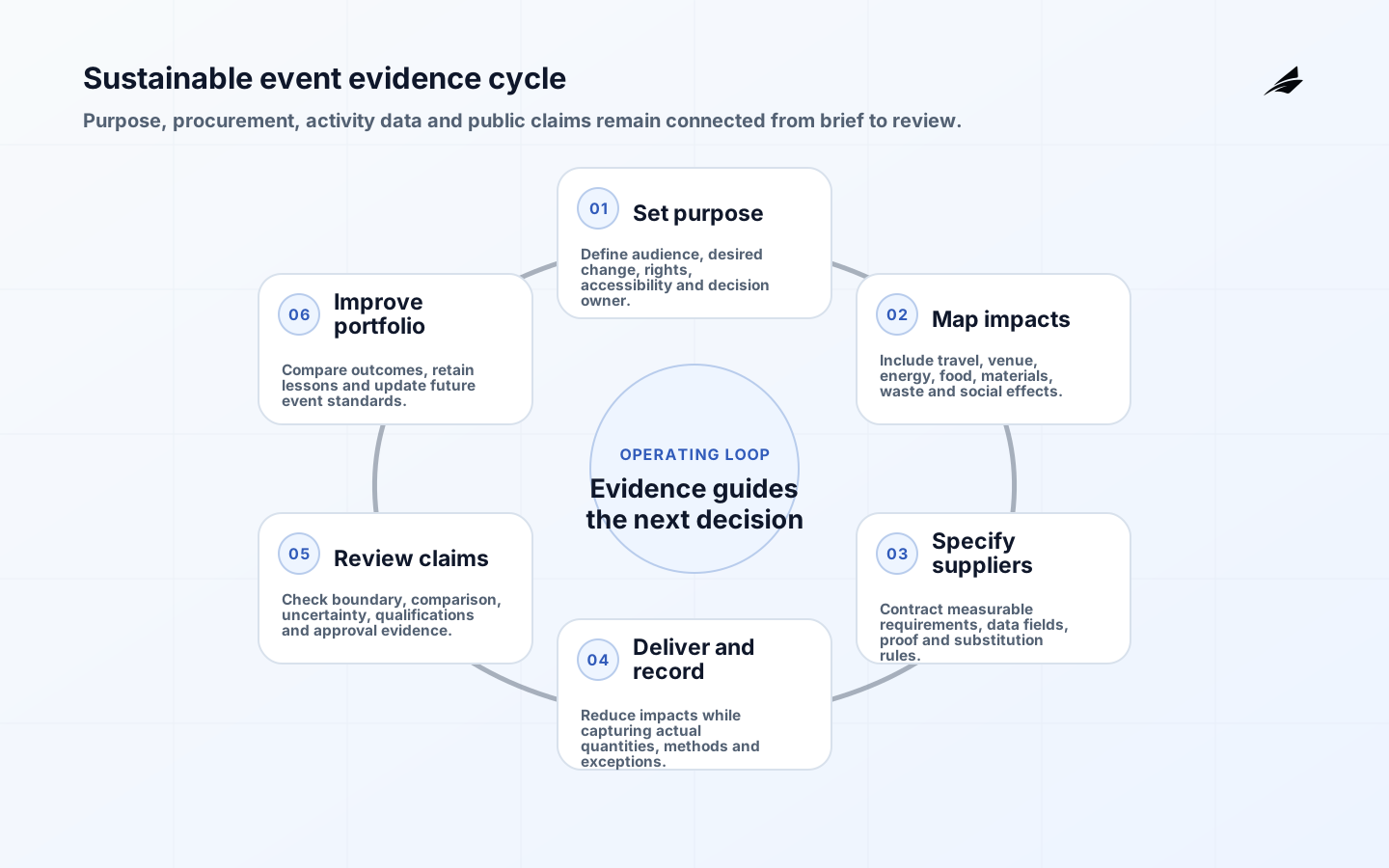
Corporate sustainability events should be designed as business activities with environmental, social and economic impacts, not as themed communications. A credible event starts with purpose, includes material impacts in its boundary, reduces avoidable harm, collects actual activity data and reviews every public claim against evidence. The implementation work begins before venue selection and continues after the final attendee leaves.
Use this corporate sustainability events implementation checklist with the practical event planning guide, sustainability events FAQ, corporate sustainability study guide and study implementation checklist. Applicable carbon, advertising, accessibility, labor, food, waste and reporting rules vary by place, so assign qualified reviewers.
Set purpose, ownership and affected stakeholders
Define the change the event is meant to create: a decision, capability, relationship, consultation or commercial outcome. Challenge whether travel and a physical gathering are necessary for every participant. Name an executive owner, event lead, sustainability lead, procurement owner, accessibility owner, facilities or venue contact, communications approver and data steward. Give them authority early enough to affect format, location, suppliers and budget.
ISO 20121:2024 applies a management-system approach to event sustainability and highlights social, economic and environmental impacts, inclusivity, rights and legacy. Translate that breadth into stakeholder consultation. Consider attendees, staff, contractors, speakers, local residents, venue workers, people with disabilities, remote participants and suppliers. Record material concerns and how they changed the brief. A charity donation or recycling station does not compensate for an event designed without affected people.
| Decision | Evidence before approval | Accountable role |
|---|---|---|
| Format and location | Purpose, audience access, travel scenarios and local impact | Executive and event owner |
| Venue | Energy, water, accessibility, transport, waste and labor information | Event and sustainability leads |
| Suppliers | Measurable requirement, proof, substitution and data fields | Procurement owner |
| Food and materials | Demand estimate, sourcing, accessibility, reuse and waste route | Operations lead |
| Public statement | Boundary, method, comparison, uncertainty and approval | Communications and sustainability leads |
| Post-event report | Actual quantities, limitations, outcomes and corrective actions | Data steward and event owner |
Build a material impact boundary and baseline
Map the event lifecycle: planning, venue preparation, attendee and freight travel, accommodation, energy, temporary structures, digital services, food, water, merchandise, signage, waste, teardown and reuse. Include social effects such as accessibility, worker conditions, community disruption, safety and procurement opportunity. Rank impacts by scale, influence, stakeholder concern and claim relevance. Document exclusions and why they are not material; do not omit a difficult category merely because data are inconvenient.
Choose a comparison that is honest and useful. It may be a previous event with comparable purpose and boundary, or modeled delivery alternatives before booking. Avoid presenting a virtual event, a smaller audience and a different location as a simple year-on-year efficiency gain without explaining those changes. Freeze a baseline version, factors and assumptions, then record revisions. The baseline is a decision tool, not a number to defend at all costs.
Turn priorities into venue and supplier requirements
Put measurable requirements in requests and contracts: accessible routes and services, public-transport information, energy and fuel data, metering, reusable serviceware, food options, surplus handling, waste weights by route, material take-back, worker standards and reporting deadlines. Ask what primary records will be supplied. A certification can be useful context, but it does not replace event-specific quantities or proof that a contracted practice occurred.
Preserve substitution control. Event delivery changes quickly, and a supplier may replace material, menu, transport or disposal routes. Define which substitutions require approval and what evidence accompanies them. Hold a data-readiness review several weeks before the event: templates, units, owners, collection method, sample invoice or meter, privacy requirements and gap escalation. Data requested after closeout is expensive and often unrecoverable.
Measure greenhouse gases without overstating precision
The GHG Protocol Corporate Standard and Scope 3 guidance provide concepts for organizational and value-chain accounting. An event footprint is often a decision-specific inventory nested within broader corporate reporting, so document its purpose and avoid implying formal conformance unless requirements are met. Collect activity data first: passenger distance by mode, room nights, kilowatt-hours, fuel, food mass, freight, purchased materials and waste treatment. Apply disclosed factors with geography and year.
Keep measured, supplier-specific, estimated and proxy data distinguishable. Record factor source, unit conversion, allocation, missing categories and uncertainty. Report emissions by material category rather than only one total; that shows where decisions mattered. Recalculate comparisons when method or boundary changes. If credits are used, report gross inventory, reductions and credit claim separately. Do not describe an event as having no impact merely because certificates were purchased.
| Data category | Preferred activity evidence | Quality check |
|---|---|---|
| Attendee travel | Registration survey with origin, mode and distance rules | Response rate, routing method and extrapolation |
| Venue energy | Event-period submeter or allocated utility record | Meter boundary, renewable claim and allocation basis |
| Accommodation | Room nights by property or booking data | Coverage beyond official booking channel |
| Food | Servings and mass by menu category | Ordered versus served, surplus and waste |
| Materials and freight | Invoices, weights, distance, reuse and return record | Ownership of reused assets and transport legs |
| Waste | Weighed streams and destination evidence | Avoided contamination and unsupported diversion claims |
Operate inclusively and capture exceptions live
Brief staff and suppliers on the handful of controls that must work during delivery: accessible entry and seating, interpretation or captioning, safe work, water access, food information, sorting, energy shutdown, attendance counts and issue escalation. Give every control a named owner and backup. Inspect the venue before opening and at representative operating times. Record exceptions with time, cause, response and consequence rather than reconstructing a perfect story afterward.
Use technology proportionately. Registration and event apps can reduce printing, route attendees and collect data, but they also create device, privacy and accessibility barriers. Provide a usable non-app path. AI can classify invoices, summarize feedback or flag missing fields, yet an accountable person should verify categories, factors and claims. Do not infer sensitive attendee attributes to improve sustainability analytics without a justified purpose and valid authority.
Follow a six-stage sustainable event procedure
At concept approval, agree the purpose, stakeholders and impact boundary. During options analysis, compare format, date, location and venue using consistent assumptions. At procurement, contract requirements and data. Before opening, verify readiness and rehearse accessibility plus incident paths. During delivery, collect actual quantities and exceptions. Afterward, reconcile invoices, supplier records, surveys and operational logs before calculating results or drafting claims.
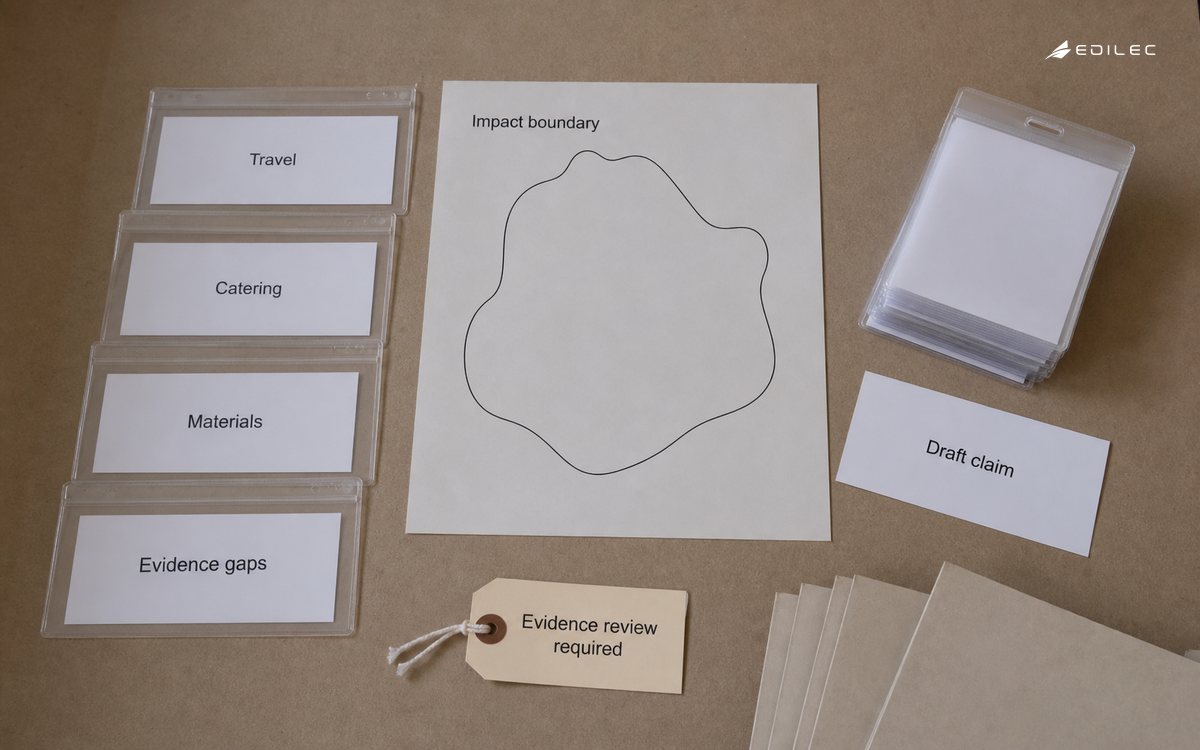
- Approve purpose, target audiences, decision owners, accessibility needs and event legacy.
- Map material environmental, social and economic impacts across the full event lifecycle.
- Compare delivery options and freeze a documented baseline, boundary, factors and assumptions.
- Contract venue and supplier requirements with event-specific evidence and substitution controls.
- Operate controls, capture actual activity data and record exceptions while evidence is available.
- Review outcomes and every external claim, then update standards for the next event portfolio.
Example: a regional leadership meeting compares two cities and a hybrid format. The team models attendee travel, verifies accessible rail and air routes, checks venue energy data, tests remote captioning and estimates staff burden. It chooses the option with lower travel and better access, then contracts meter data and food records. The final report discloses travel survey coverage and a freight estimate rather than claiming an exact footprint unsupported by complete data.
Review sustainability claims as controlled publications
The UK Competition and Markets Authority’s Green Claims Code emphasizes truthful, clear, unambiguous claims, fair comparisons, lifecycle consideration and substantiation. Similar principles are useful globally, while local law must be checked. Build a claims file containing wording, audience, boundary, calculation, evidence, qualifications, reviewer and approval. Broad words such as green, sustainable, zero-waste or carbon-neutral carry assumptions that need immediate explanation.
Prefer specific statements: “The event eliminated single-use delegate badges and returned 92 percent of hired display panels to the supplier” is reviewable if counts and return evidence exist. State what was not measured and avoid implying organizational progress from one event. Keep underlying records for the period required by policy and law. Correct material errors visibly; credibility improves when methods and limitations are treated as part of the result.
Key takeaways
- Start corporate sustainability events with purpose and stakeholder impact, not decorative environmental features.
- Set a lifecycle boundary that includes material travel, venue, food, materials, waste and social effects.
- Contract suppliers to provide activity data and proof; certifications alone do not establish event performance.
- Report gross impact, reductions, estimates, uncertainty and any credits separately.
- Approve public claims from a traceable file and carry lessons into the next event rather than treating each gathering as isolated.
Frequently asked questions
Must an event be certified to ISO 20121?
No. Organizations can use its management principles without claiming certification or conformity. If a conformity claim matters, verify the exact route and evidence with a competent body. Never use a venue or supplier certificate to imply that the entire event was certified.
Should attendee travel be included?
It is often material and highly relevant to format and location decisions. Define whose travel is included, collect proportionate information, disclose response and extrapolation methods and avoid false precision. Privacy review may be needed for origin data.
Can carbon credits make an event carbon neutral?
Claims depend on program quality, boundary, applicable rules and exact wording. Reduce emissions first, publish the gross inventory and limitations, then describe credits separately with project, quantity, standard and retirement evidence. Obtain specialist review before a neutrality claim.
Where can AI help in event sustainability?
AI can extract quantities, detect missing records, summarize feedback and support scenarios. Keep original records, validate units and factors, protect attendee data and require human approval for accounting and public statements. Automation does not make incomplete evidence complete.
Conclusion
A credible corporate sustainability event connects design decisions to actual evidence. Set a meaningful purpose, include material impacts, procure measurable performance, operate inclusively, account transparently and publish only claims the record supports. The strongest legacy is a repeatable standard that improves the organization’s next event, not a one-day sustainability story.