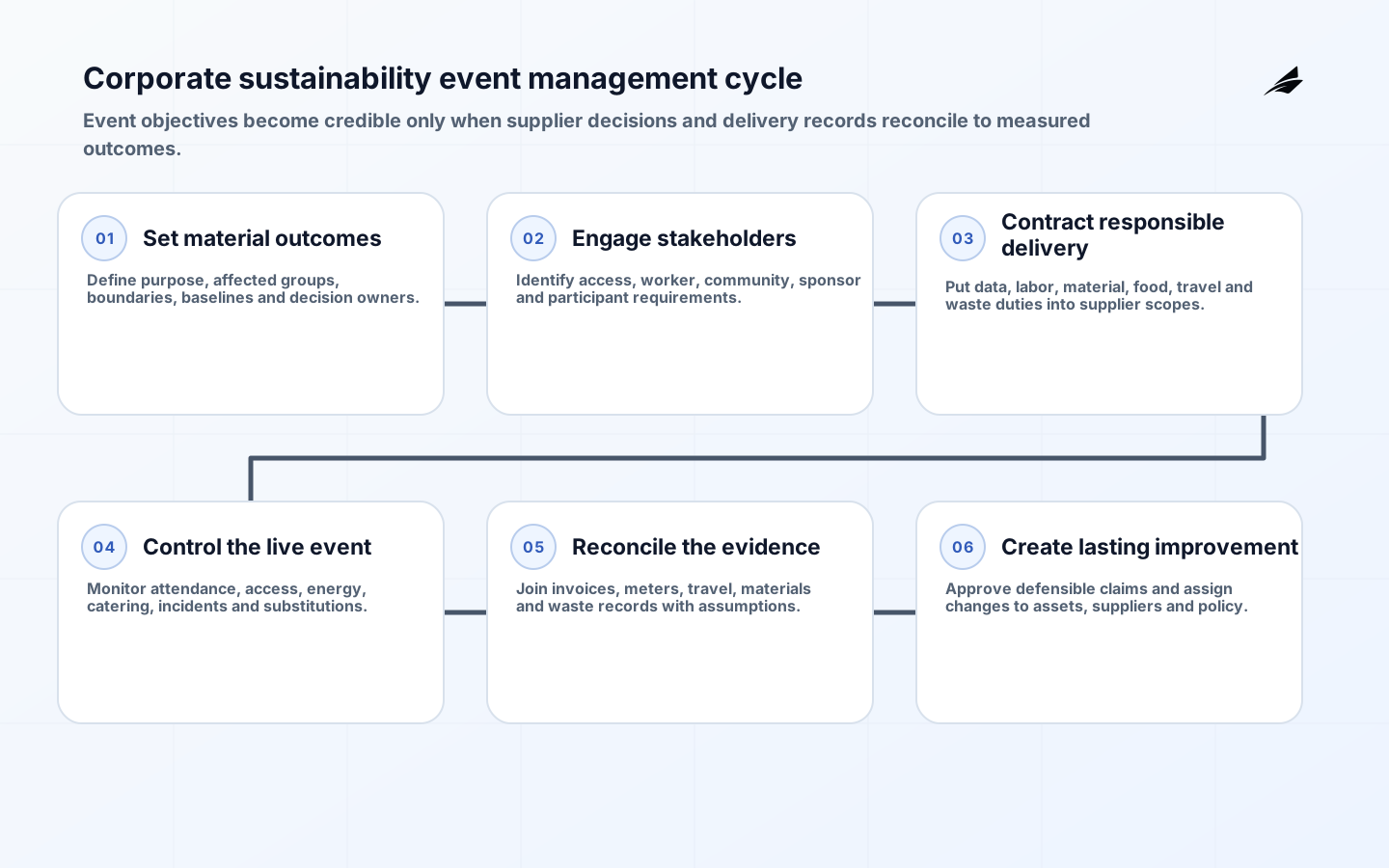
Corporate sustainability events are meetings, conferences, launches, exhibitions, training programs and stakeholder gatherings planned with explicit social, environmental and economic responsibilities. A credible event does more than replace printed agendas or display a recycling sign. It defines which impacts matter, who can influence them, how suppliers will be controlled, what evidence will be collected and how results will be reconciled after the venue closes. ISO 20121 treats this as a management system, which is useful because event decisions begin months before attendance and continue through supplier settlement, waste reporting and lessons learned.
The aim is not to claim that an event is impact-free. Travel, energy, accommodation, food, materials, accessibility and local procurement involve trade-offs. The planning team should make those trade-offs visible and avoid unsupported labels such as green, carbon-neutral or zero-waste. Use the event to demonstrate practical governance: named authority, measurable objectives, responsible purchasing, inclusive participation and transparent reporting. The corporate sustainability events checklist can turn this guide into delivery gates once the event brief is approved.
Set a purpose and material event outcomes
Begin with the event's business purpose and affected groups. A sales conference, supplier summit and community consultation create different impacts and obligations. Identify attendees, workers, speakers, sponsors, venue staff, neighbors, suppliers and remote participants. Ask what could materially improve or harm their experience: safe work, accessibility, travel burden, local economic value, privacy, food choice, waste, energy or credible information. Select a small set of outcomes with owners and baselines. An aspiration such as reduce emissions is incomplete until the team states the boundary, comparison event, calculation method and decision the result will inform.
| Impact area | Useful objective | Evidence | Common weak claim |
|---|---|---|---|
| Access | Remove identified barriers for in-person and remote participation | Accessibility review, requests and resolutions | The venue is accessible |
| Travel | Reduce high-emission travel where participation goals permit | Origin, mode, distance and remote attendance | Attendees were encouraged to travel responsibly |
| Food | Match purchasing to attendance and dietary needs | Orders, covers served, surplus and destination | The menu was sustainable |
| Materials | Avoid single-use build items and recover reusable assets | Bill of materials and recovery log | The event was paperless |
| Local value | Use qualified local suppliers where they meet requirements | Spend and supplier evidence | We supported the community |
Create governance that reaches every supplier
Name an event owner who can approve objectives, budget changes and public claims. Assign leads for venue, production, travel, catering, accessibility, worker welfare, data and communications. Record legal, contractual and corporate-policy requirements, then translate them into supplier briefs and acceptance evidence. Sustainability clauses without verification become decoration. Ask bidders to explain energy data, waste routes, labor practices, material reuse, food sourcing and subcontractors. Evaluate the complete offer, not isolated green features, and preserve reasons for selecting or rejecting trade-offs.
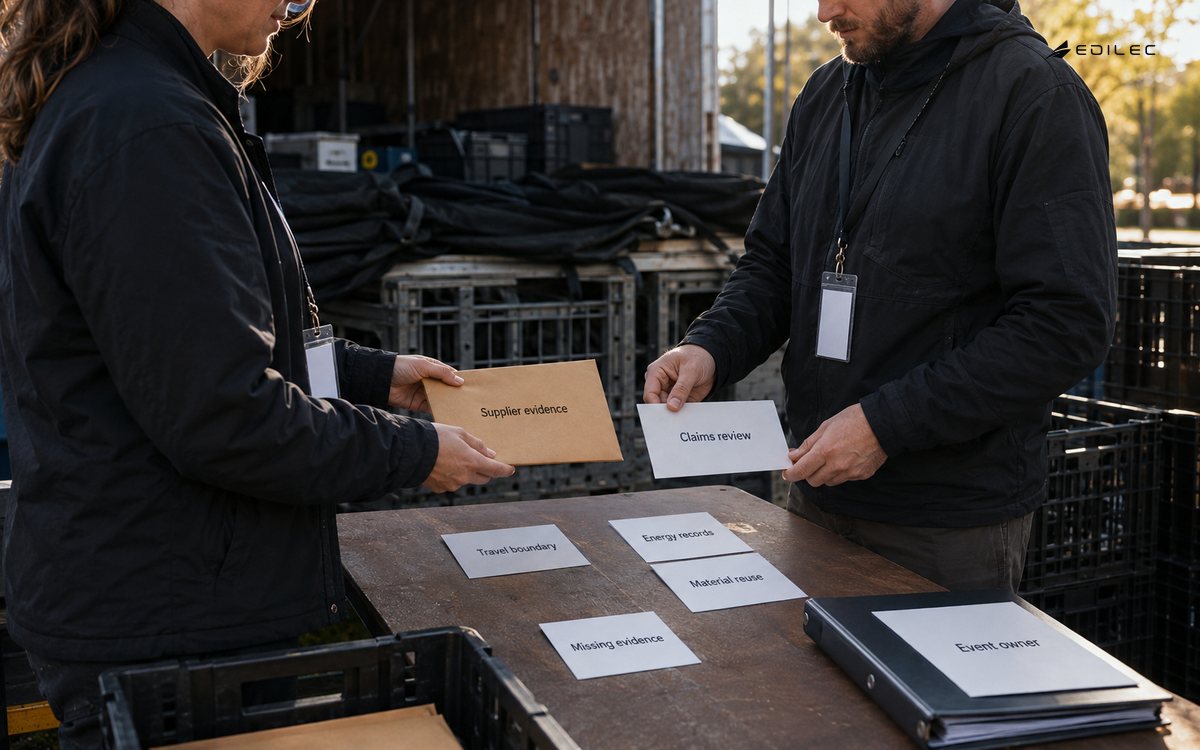
Use a decision log for changes that affect the boundary: venue relocation, attendance growth, extra freight, temporary power or a revised menu. The log should state expected impact, alternatives, authority and follow-up evidence. This creates continuity when agency, venue and internal teams change. Governance also protects truthful communication. Marketing should publish only claims supported by the same records used for management, with limitations and estimation methods visible where material.
Measure emissions without false precision
Define the inventory boundary before collecting numbers. Typical sources include venue electricity and fuel, temporary generation, attendee and crew travel, accommodation, freight, catering, purchased materials, waste treatment and digital participation infrastructure where material. Distinguish activity data from emission factors: passenger-kilometers and kilowatt-hours are observations; factors convert them into estimated greenhouse gas emissions. Keep source, geography, year and assumptions for each factor. Do not mix actual invoices with rough estimates without labeling data quality.
Travel often dominates, but that should be tested rather than assumed. Registration can request origin and likely travel mode with a clear privacy notice; post-event sampling can correct plans that changed. Accommodation and freight need consistent nights, weights and distances. The GHG Protocol provides corporate and scope 3 accounting principles, but an event inventory remains a defined project boundary rather than a separate corporate inventory. Reconcile it to organizational reporting carefully and avoid double counting reductions or offsets.
Design venue, food, materials and access together
Venue selection determines transport options, energy information, accessibility and waste control. Inspect routes from public transport, step-free access, hearing and visual support, quiet space, sanitation, emergency arrangements and remote participation. Catering should use reliable attendance forecasts, smaller replenishment batches and a documented surplus hierarchy. Material decisions should begin with avoidance and reuse: modular signage, rented furniture, digital content that remains accessible, and sponsor rules that prevent unrequested giveaways. Waste sorting is a final control, not a substitute for purchasing less.
| Stage | Control | Record | Review question |
|---|---|---|---|
| Contracting | Supplier requirements and data duties | Signed scope and evidence schedule | Can the supplier produce usable data? |
| Build | Material and safety inspection | Delivery, labor and asset register | Were substitutions approved? |
| Live event | Metering, access and incident response | Readings, attendance and issue log | Are controls working for participants? |
| Breakdown | Reuse, donation and waste chain | Weights, destinations and asset returns | What actually left the site? |
| Closeout | Invoice and inventory reconciliation | Final dataset and decision log | Which claims are supportable? |
Build a practical evidence plan
Create a data register listing metric, definition, unit, source, owner, collection time and quality rating. Test collection before the event: confirm that venue meters can isolate the occupied space, waste contractors report measured weights and registration exports preserve necessary travel fields. Protect attendee information by collecting the minimum needed, restricting access and setting deletion dates. Keep raw evidence separate from calculations so factors and assumptions can be updated without losing provenance. A dashboard is useful only after definitions agree; otherwise polished totals conceal incompatible inputs.
During delivery, use a short daily review for attendance variance, catering demand, access requests, energy anomalies, incidents and supplier substitutions. Correct what can still change. Afterward, reconcile orders, invoices, meter readings, travel data and waste records. Investigate gaps rather than silently replacing them with favorable assumptions. The final report should distinguish measured, estimated and unavailable data and state whether each objective was met.
Turn event results into organizational learning
A sustainability event should improve more than one date in the calendar. Retain supplier performance, reusable assets, accessibility findings, participant feedback and calculation methods for the next team. Compare normalized measures such as emissions per attendee or food waste per cover, but keep absolute impacts visible because a growing event can improve intensity while increasing total burden. Assign actions with dates: change the preferred venue list, revise sponsor rules, improve remote participation or negotiate better supplier reporting. Link material findings to the wider corporate sustainability study guide where they affect company policy.
Set a claims review before public communication. The event owner, data lead and communications reviewer should compare every quantitative or comparative statement with the reconciled inventory, approved boundary and supporting record. If an estimate materially shapes the result, state the method and range rather than converting it into a precise slogan. Explain whether reductions are absolute, intensity-based or measured against a changed attendance profile. This disciplined review protects participants and sponsors from green claims that the delivery record cannot substantiate.
For recurring events, maintain a controlled baseline pack rather than starting from an empty spreadsheet. Preserve venue performance, supplier evidence, material inventories, accessibility findings, participant travel patterns and post-event actions. Reuse only after checking that scale, geography and format remain comparable. A baseline should accelerate better decisions while keeping changed assumptions visible; it should never become a shortcut that carries old estimates into a new event without review.
Participant communication is also an operational control. Publish travel, access, food, conduct and data-use information early enough for people to make choices, and provide a staffed route for accommodation requests. During the event, make responsible options convenient rather than moralizing about individual behavior. Afterward, report material results and limitations in plain language, including where supplier data was unavailable or an objective was missed. Honest communication turns the event into a credible example of corporate practice instead of a promotional claim.
Key takeaways
- Treat sustainability as an event management system, not a theme.
- Choose material outcomes with boundaries, owners and evidence before procurement.
- Carry requirements through venues, agencies, caterers, sponsors and subcontractors.
- Separate activity data, emission factors, assumptions and data-quality ratings.
- Design accessibility, travel, food, materials and worker conditions as connected decisions.
- Publish only claims that the reconciled event record can support.
Frequently asked questions
Does a virtual event have no environmental impact? No. It may avoid substantial travel and venue activity, but participant devices, networks, production and data services still exist. More importantly, virtual access changes inclusion, time-zone and engagement outcomes. Compare formats against the event purpose rather than assuming one is universally better.
Should an event buy offsets? First measure the boundary, avoid unnecessary activity and reduce feasible sources. Any separate climate contribution or carbon-credit claim needs due diligence, clear wording and separation from gross inventory results. Offsets do not repair poor accessibility, waste or labor practice.
Is certification required? ISO 20121 can guide an internal management system whether or not certification is pursued. Certification may add assurance for recurring or high-profile events, but it does not replace specific objectives, reliable data or transparent claims.
Conclusion
Professional corporate sustainability events make choices and evidence visible. Define the purpose, identify affected groups, govern suppliers, set a defensible measurement boundary and use live data to correct delivery. Close the event by reconciling records and assigning improvements, not by selecting a favorable headline. This approach supports environmental performance, participant access, responsible purchasing and organizational trust together. Teams needing answers to common planning questions can continue with the corporate sustainability events FAQ.