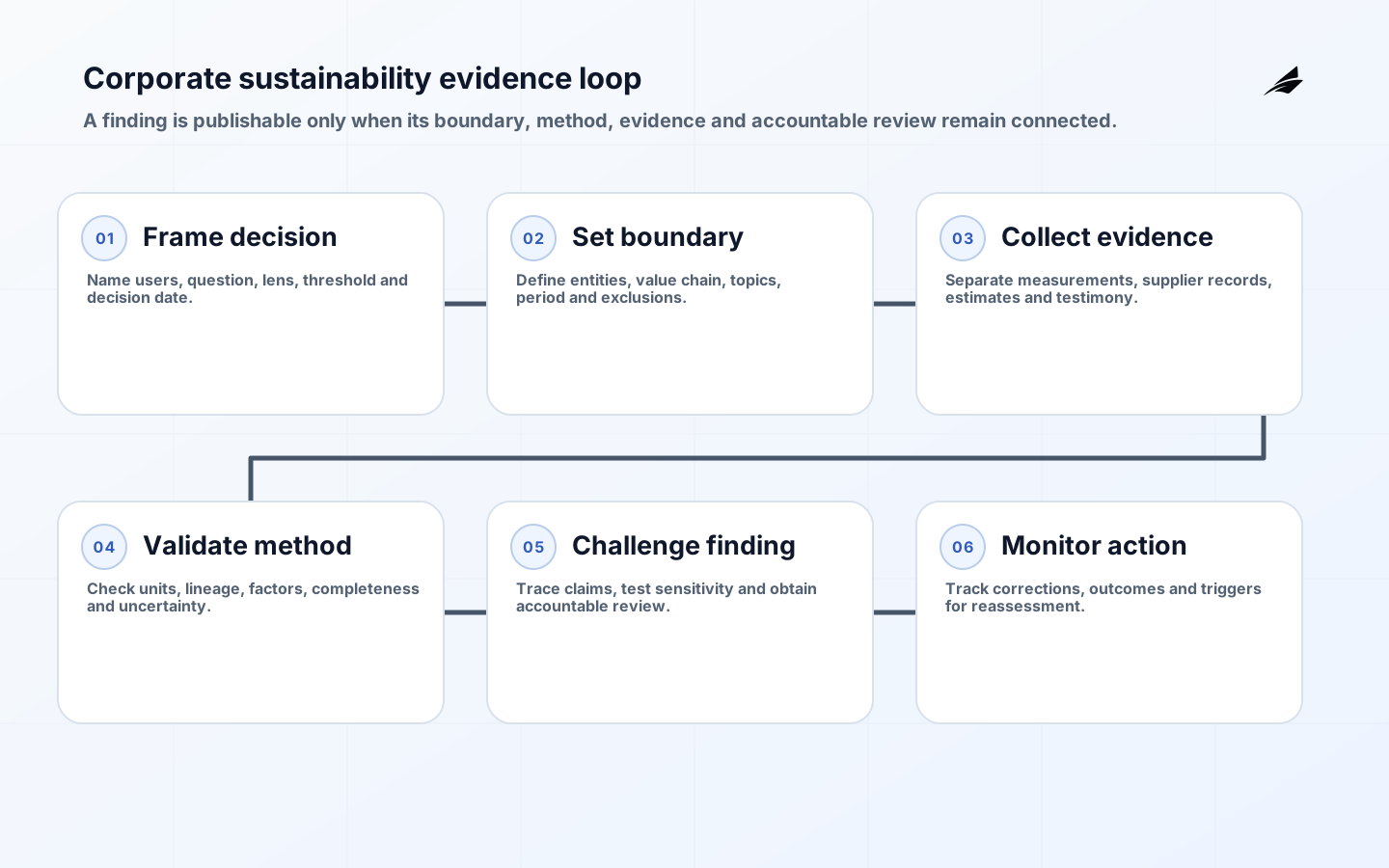
A corporate sustainability studies FAQ should begin with the decision the study must support. A board evaluating climate exposure, a procurement team screening suppliers, and a reporting team preparing disclosures need different boundaries, evidence and review. Calling all three projects a sustainability study hides those differences and encourages a large data request before anyone has defined materiality, users or acceptable uncertainty.
This guide explains how to turn corporate sustainability research into a defensible evidence chain. It complements the practical sustainability study guide, the study implementation checklist and the sustainability events measurement guide. Reporting obligations vary by entity and jurisdiction, so confirm applicability with qualified legal and assurance advisers.
What should a corporate sustainability study answer?
A useful study answers a bounded question: which impacts are most significant, which sustainability-related risks or opportunities could affect prospects, where emissions arise, whether a target is credible, or which intervention changed an outcome. Write the intended user, decision date, organizational boundary, period and threshold for action. A study intended to satisfy a disclosure requirement must trace each conclusion to the applicable requirement; an exploratory study may surface hypotheses but should not be presented as assured reporting.
Materiality is not one universal score. GRI 3 focuses on an organization’s most significant impacts on the economy, environment and people. IFRS S1 focuses on sustainability-related risks and opportunities that could reasonably affect the entity’s prospects. The EU’s ESRS uses double materiality. A team may need more than one lens, but it should document which lens produced each decision.
| Study question | Boundary and evidence | Decision output |
|---|---|---|
| What impacts matter? | Activities, business relationships, affected stakeholders and severity evidence | Prioritized material topics with rationale |
| What could affect enterprise prospects? | Time horizons, financial pathways, dependencies and scenarios | Risks and opportunities linked to governance and strategy |
| Where are emissions produced? | Organizational boundary, scopes, activity data and emission factors | Reproducible inventory with exclusions and uncertainty |
| Did an intervention work? | Baseline, comparison logic, implementation records and outcome measures | Effect estimate with limitations and next action |
How do you set boundaries before collecting data?
Create a study charter that names entities, operations, value-chain relationships, geographies, reporting period, topics and intended uses. Record why each exclusion is immaterial, unavailable or outside scope. For greenhouse gases, select and consistently apply the consolidation approach and classify sources under the relevant scopes using GHG Protocol standards and guidance. Boundary changes, acquisitions, divestments and improved methods need a documented recalculation policy so trends remain interpretable.
Map every requested datapoint to a claim or calculation. If electricity consumption supports a scope 2 inventory, identify the meter, unit, site, period, completeness rule and factor source. If supplier evidence supports a human-rights impact assessment, record the affected group, source method and limitations rather than reducing testimony to an unexplained score. This claim-to-data map controls collection effort and reveals where estimates, proxies or qualitative evidence are legitimate.
What makes sustainability evidence decision-ready?
Evidence quality has several dimensions: relevance to the defined claim, completeness within the boundary, methodological consistency, timeliness, provenance and reviewability. A precise invoice total can still be irrelevant if it covers the wrong entity. A supplier average can be useful for screening but unsuitable for a product-level claim. Label primary measurements, supplier-specific data, modeled estimates and spend-based proxies separately; never let a polished dashboard erase that distinction.
Maintain a data register with owner, source system, collection method, transformation, unit, factor version, reviewer, restrictions and retained evidence. Apply validation rules for missing periods, duplicate facilities, unit conversion, abnormal intensity and unexplained year-over-year movements. Material corrections should be versioned, approved and propagated to calculations, disclosures and targets. The evidence package should allow an independent reviewer to reproduce a sample without relying on the preparer’s memory.
| Evidence class | Appropriate use | Required qualification |
|---|---|---|
| Direct measurement | Operational control and high-confidence inventory | Calibration, coverage, custody and missing-data treatment |
| Supplier-specific record | Value-chain assessment and engagement | Supplier boundary, period, method and verification status |
| Engineering estimate | Planning where measurement is unavailable | Formula, assumptions, sensitivity and replacement plan |
| Spend or sector proxy | Hotspot screening and prioritization | Factor source, price effects and prohibition on false precision |
| Stakeholder evidence | Impact identification and severity assessment | Selection method, consent, context and dissenting views |
Which sustainability standards should the study use?
Start with legal applicability and reporting audience, then select compatible methods. GRI can structure impact reporting; IFRS S1 and S2 provide an investor-focused baseline for sustainability-related financial disclosures; GHG Protocol supports corporate emissions accounting; ESRS applies where EU reporting law requires it. These frameworks overlap but are not interchangeable. Build a requirements matrix showing the governing source, disclosure or calculation, owner, evidence, review status and cross-reference.
For climate targets, separate inventory accounting from target validation. The SBTi Corporate Net-Zero Standard is in a 2026 transition: version 2.0 has been published, validation under it begins in 2027, and the SBTi directs companies setting targets in 2026 to the current version 1.3.1 route. Record the exact standard version and validation pathway used. A target should not silently inherit credibility from a framework it has not actually followed.
How do you run the study from question to approved finding?
- Approve the decision question, users, standard lens, boundary, period and materiality criteria.
- Map claims and required disclosures to source data, methods, owners and evidence-retention rules.
- Collect the minimum relevant evidence; classify measurements, supplier data, estimates and stakeholder input.
- Validate units, completeness, lineage, outliers and methodological consistency before analysis.
- Analyze scenarios and sensitivities; distinguish observed facts, calculations, assumptions and judgment.
- Review findings with data owners, subject experts, affected functions and an independent challenge role.
- Approve claims, limitations, corrections and action owners; preserve a versioned evidence package.
- Monitor changed boundaries, factors, standards and outcomes, then reopen the study when a trigger occurs.

How should teams review claims and assurance readiness?
Review the claim at the same granularity at which it will be published. “Operations are carbon neutral” demands a different boundary and substantiation than “market-based scope 2 emissions fell at three sites.” Check that qualifiers, baseline, period and exclusions travel with the number into charts and executive summaries. Compare narrative claims with the underlying trend and investigate contradictory evidence. Legal review does not replace technical review, and assurance does not create missing evidence.
Run a dry trace on a sample of material disclosures: requirement to claim, claim to calculation, calculation to transformed data, transformed data to source evidence, and each stage to an owner and approval. Track open evidence requests and control failures separately from ordinary methodology limitations. The ESRS regulation also emphasizes connected information; sustainability statements should reconcile with related information elsewhere in corporate reporting.
Example: test a supplier emissions finding before publication
Suppose purchased goods appear to be the largest emissions category. The team should first trace spend categories and supplier records to the reporting boundary, confirm currency and period treatment, and separate supplier-specific quantities from spend-based estimates. It should test whether inflation, acquisition or classification changes explain the movement. A sensitivity showing which categories could change rank is more useful than presenting one precise total without uncertainty.
The resulting finding might support supplier engagement and better primary-data collection, but not a product-level low-carbon claim. Record the responsible procurement owner, target suppliers, requested evidence and review date. At the next cycle, compare improved coverage, supplier response and actual emissions factors with the baseline. This closes the study-to-action loop while keeping the public claim within the evidence actually reviewed.
Key takeaways
- Define the decision, materiality lens and boundary before requesting sustainability data.
- Keep measurements, estimates, proxies and stakeholder evidence visibly distinct.
- Use a versioned requirements matrix rather than treating standards as interchangeable labels.
- Make every material claim traceable to calculation, evidence, owner and review.
- Use automation to support evidence work while reserving materiality and claim approval for accountable people.
Frequently asked questions
Is a materiality assessment the same as a sustainability risk assessment?
No. An impact materiality assessment identifies significant effects on the economy, environment and people; a financially oriented assessment considers sustainability-related risks and opportunities affecting enterprise prospects. They can share evidence and governance, but their users, thresholds and outputs differ. State which perspective applies to each result.
Can estimates be used in a corporate emissions study?
Often yes, when the method permits them and direct data is unavailable. Disclose the source, formula, boundary, assumptions and uncertainty; test whether the estimate could change a material conclusion; and assign a plan to improve high-impact estimates. An unlabeled estimate is a data-quality failure, not a measurement.
Where can AI help safely in sustainability research?
Useful applications include extracting fields from controlled documents, mapping evidence to requirements, detecting unit anomalies and retrieving cited passages. Test against representative records, restrict approved sources, require citations, prevent sensitive-data leakage and route consequential outputs to human review. Measure correction rates rather than assuming fluent text is accurate.
Conclusion
Before final approval, give a reviewer who did not build the model one material claim and its evidence index. If that person cannot identify the boundary, version, method, source and limitation without oral explanation, the study is not yet ready for decision use or external publication.
Credible corporate sustainability studies are evidence systems, not collections of attractive metrics. Begin with a bounded decision and the correct materiality lens, collect only evidence that supports defined claims, preserve methods and uncertainty, and challenge each conclusion before publication. That discipline makes the study useful for action today and defensible when standards, assurance expectations or corporate boundaries change.