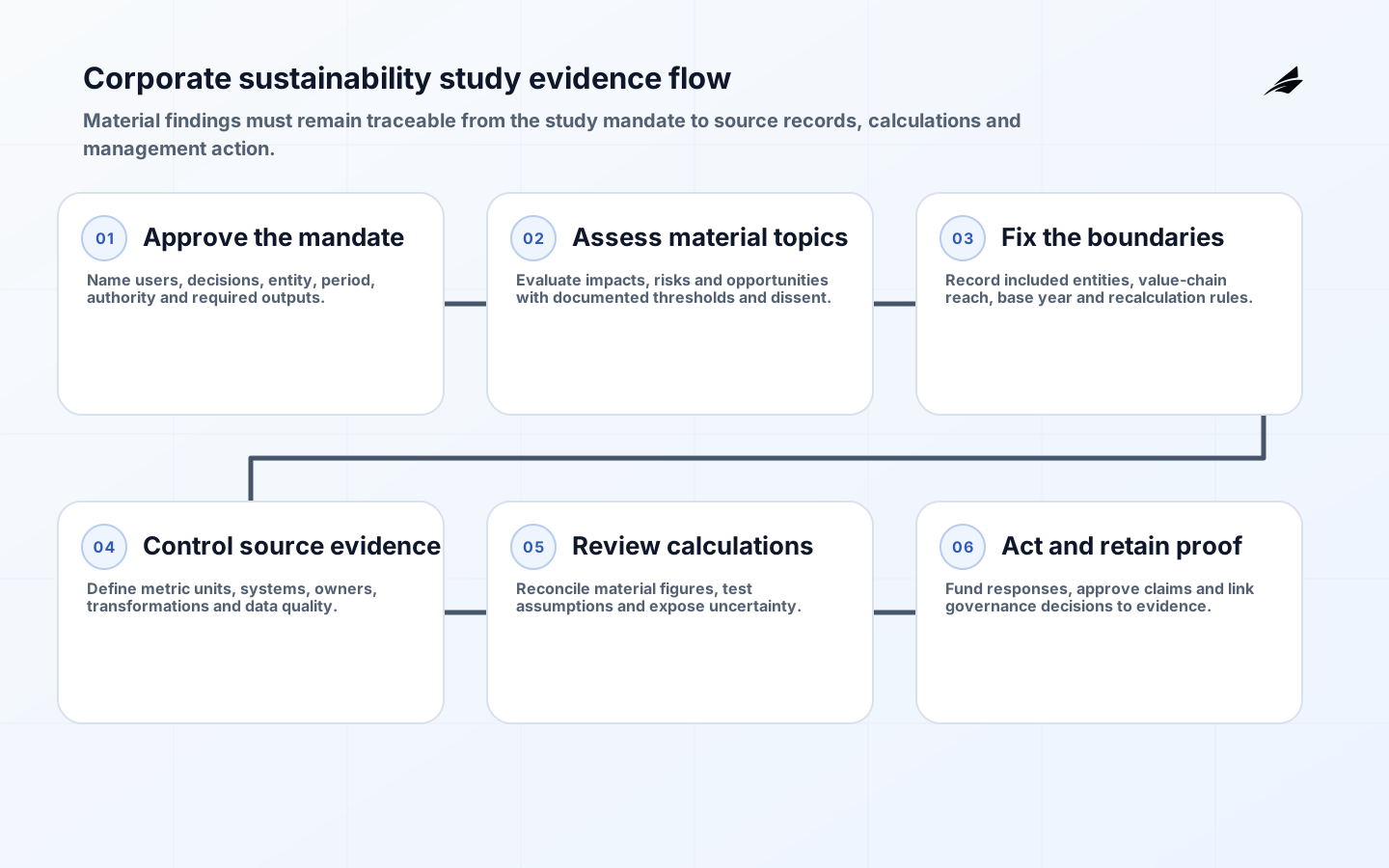
Studies corporate sustainability teams can trust begin with a decision, not a questionnaire. A study may inform capital allocation, risk management, a greenhouse-gas target, supplier engagement, product design or public disclosure. Each purpose requires a different boundary, evidence standard and review process. Before gathering data, name the executive sponsor, study owner, intended users, reporting period and decisions that findings can change. This prevents an attractive report from becoming detached from finance, operations and governance.
A professional corporate sustainability study separates observed activity, calculated estimates, stakeholder judgments and forward-looking assumptions. It preserves provenance so reviewers can reproduce material figures. IFRS S1 organizes decision-useful disclosure around governance, strategy, risk management, and metrics and targets; the GHG Protocol supplies principles and methods for emissions inventories. These sources are anchors, but the organization must document its own reporting entity, value chain and material topics. Start with the practical study guide if the purpose is not settled.
Confirm mandate, users and decision rights
Write a charter stating the business question, reporting entity, period, geographies, operations, value-chain reach and required outputs. Identify who approves methods, resolves disputes and signs external claims. Finance should reconcile results to operational records; specialists should own methodology; business units should own source activity; legal and communications should review obligations and wording. Independence matters where the same team benefits from a favorable result. Establish escalation for missing data, changed boundaries and estimates that could alter a decision.
| Element | Decision | Evidence |
|---|---|---|
| Purpose | Which allocation, risk or disclosure decision changes? | Approved mandate |
| Entity | Which subsidiaries and operations are included? | Organization map |
| Period | What dates and base year apply? | Reporting calendar |
| Topics | Which impacts, risks and opportunities matter? | Materiality method |
| Authority | Who approves methods and exceptions? | Responsibility matrix |
| Output | Which dataset, report and actions are required? | Acceptance criteria |
Run a documented materiality assessment
Build an initial topic universe from business model, sectors, locations, products, workforce, resource dependencies, incidents, stakeholder concerns and applicable standards. Define the perspective. Investor-focused financial materiality asks whether a sustainability risk or opportunity could affect prospects. Impact materiality examines significant effects on people and environment; some regimes apply both. Score only after defining scales, evidence and time horizons. Interviews add context but should not become votes. Preserve dissent, uncertainty and the reason a topic crosses or misses the threshold.
Validate the result with operational owners and affected stakeholders. Look for blind spots from headquarters bias, low response or weak supplier visibility. Connect each material topic to policies, risks, metrics and action owners. A matrix without a management response is incomplete. Reassess after acquisitions, major product changes, new geographies, severe incidents or regulatory change rather than waiting for an annual reporting ritual.
Define organizational and value-chain boundaries
Boundary choices can change findings more than calculation precision. Record how controlled operations, joint ventures, leased assets and outsourced activities are treated. For greenhouse-gas work, state the consolidation approach and distinguish direct emissions, purchased energy and other value-chain categories. For workforce, water, waste or human-rights topics, boundaries may follow different causal relationships. Do not force every topic into one perimeter without explanation. Maintain a register mapping entities, facilities, products and suppliers to inclusion status, rationale and data owner.
Set base-year and comparability rules. An acquisition, divestment, methodology update or corrected error may justify recalculation; ordinary growth usually does not. Record thresholds and apply them consistently. When supplier estimates replace primary information, label the method and limitation. This lets better data represent evidence improvement rather than appear as unexplained performance change.
Create a controlled source-data register
For every metric, define unit, frequency, system, extraction method, owner, reviewer, transformation, factor and retention. Prefer utility bills, fuel logs, purchasing data, payroll, travel bookings, production volumes and waste tickets. Spreadsheets may be practical, but lock formulas, separate inputs from calculations and retain versions. Use stable facility, supplier and category identifiers. Automated collection needs checks for missing periods, duplicates, unit changes, impossible values and unexpected variance. Protect personal and commercially sensitive information through minimization and access control.

| Level | Example | Control | Use |
|---|---|---|---|
| Measured | Metered electricity | Invoice and meter reconciliation | Material totals |
| Transactional | Purchased quantity | ERP extraction and category mapping | Reliable activity |
| Supplier-specific | Verified product data | Method and period review | Compatible categories |
| Modeled | Spend estimate | Factor source and uncertainty | Screening and gaps |
| Proxy | Comparable facility | Approval and replacement date | Temporary use |
Make calculations reproducible
A qualified reviewer should trace every published number to source activity and method. Version emission factors, currency conversion, calorific values and allocation keys. State whether electricity is location- or market-based when relevant and retain both views where required. Avoid false decimal precision: uncertainty in activity and factors often exceeds rounding. Run sensitivity tests for assumptions that could change priorities, especially supplier spend estimates, scenario analysis, avoided-emission claims and long-lived asset exposure.
Apply change control to formulas and methods. Require peer review of material transformations and preserve prior outputs. Reconcile totals to energy cost, purchased volume, headcount, production and revenue to expose missing entities or unit errors. Investigate discontinuities before writing narrative. Software can accelerate checks, but accountable reviewers must understand exclusions and calculation limits.
Translate findings into decisions and controls
Rank actions by impact, feasibility, dependency, cost, timing and risk transfer. A hotspot is not automatically the best first project; it may require supplier collaboration or asset replacement, while a smaller source offers immediate control improvement. For each action name baseline, target, owner, milestones, investment, operational measure and unintended consequences. Separate reductions within the boundary from purchases or claims outside it. Link findings to budgets, procurement standards, product roadmaps and risk registers.
Draft disclosure after management reviews findings and limitations. Explain methods, boundary changes, estimates and omitted information that a reasonable user needs. Cross-check claims against the data register and approved actions. The corporate sustainability events guide shows how the same discipline applies to a bounded operational program.
Prepare the evidence for assurance
Create an index connecting each metric and statement to source, calculation, review and approval. Perform management checks for completeness by entity, period and topic; formula accuracy; consistency with prior periods; and balanced treatment of positive and adverse findings. Track exceptions and remediation. Assurance readiness is not a last-week document exercise. It depends on responsibilities, systems and evidence operating throughout the period. Sample source records early so control weaknesses can be corrected before close.
- Charter and boundary approved
- Material topics linked to management response
- Metric dictionary and source register complete
- Material calculations independently reviewed
- Boundary and method changes documented
- Uncertainty and proxies disclosed
- Actions funded and assigned
- Claims reconciled to the final dataset
Plan quality review in two layers. A technical reviewer should challenge units, factors, formulas, exclusions and reconciliations. A business reviewer should challenge whether the interpretation matches operations and whether proposed actions move the stated outcome without shifting harm elsewhere. Record both reviews independently. Agreement on a total does not prove that the management conclusion is sound, and a persuasive narrative cannot compensate for an unreproducible calculation.
Scenario analysis needs the same control as historical metrics. State the scenario source, time horizon, variables, management assumptions and which decisions the analysis supports. Do not blend a modeled future pathway into an observed baseline. Compare alternatives under consistent conditions and identify thresholds that would change investment, sourcing or product choices. Where uncertainty is high, use ranges and trigger points rather than a single forecast that implies knowledge the organization does not possess.
Close the study with a data-improvement backlog ranked by decision consequence. A missing supplier quantity that dominates a material category deserves earlier work than a minor facility estimate with little influence on action. Give each improvement an owner, source-system change, acceptance rule and due date. At the next reporting cycle, reviewers should be able to see whether uncertainty fell because evidence improved, not because the method silently changed.
Finally, preserve a bridge between the study dataset and the decisions recorded in governance forums. Minutes should identify which finding was considered, what action or risk acceptance followed, the resources committed and the date for review. This makes the study useful after publication and lets future teams distinguish an ignored recommendation from one that was evaluated and consciously deferred. Without that bridge, even technically sound evidence can disappear between reporting, budgeting and operational planning.
Key takeaways
- Begin with a decision and defined users.
- Document materiality perspectives and thresholds.
- Treat boundaries as governed choices.
- Preserve source provenance and calculation versions.
- Use estimates transparently and improve them by priority.
- Connect findings to budgets and accountable owners.
Frequently asked questions
Can software automate the study? It can collect, validate, calculate and preserve evidence, but cannot determine materiality, risk tolerance or acceptable trade-offs alone. Those decisions require accountable business and stakeholder judgment.
How often should it be updated? Maintain source data on its operational cadence, complete formal review at the reporting interval, and reassess materiality after significant business, incident, boundary or regulatory changes.
Must every gap be solved before action? No. Use transparent estimates for non-critical gaps, prioritize better evidence where uncertainty changes decisions, and never present a proxy as measured fact.
Conclusion
A credible corporate sustainability study is a governed evidence system. It defines why the work exists, which entities and impacts are included, how records become metrics and who acts on findings. Strong controls do not eliminate uncertainty; they reveal it and direct improvement. Complete the charter, materiality process, boundary register, data controls and management response before polishing disclosure. Use the study FAQ to resolve recurring questions without weakening the evidence chain.