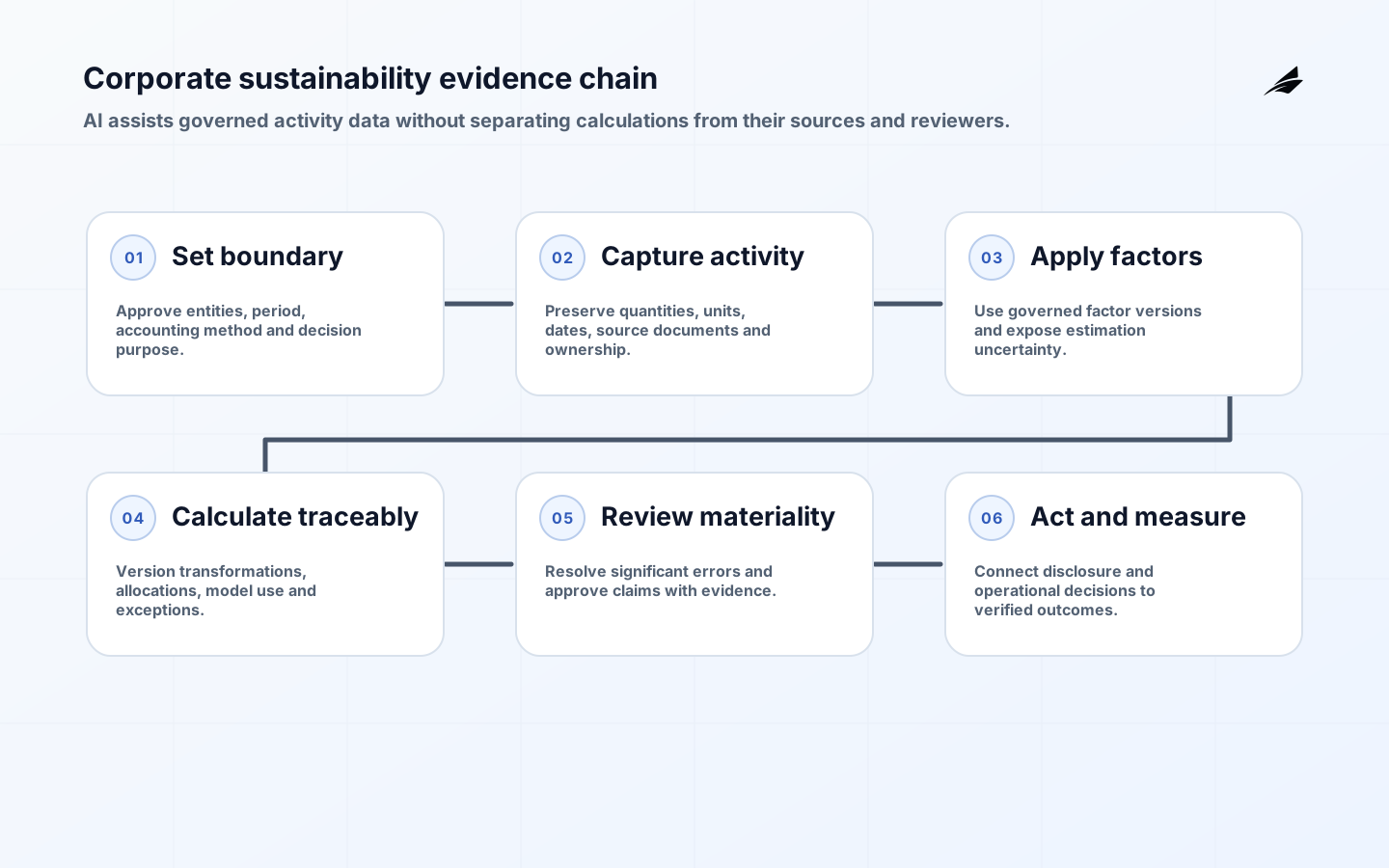
AI for corporate sustainability can reduce the manual effort required to collect evidence, classify transactions, estimate missing activity, detect anomalies, analyze scenarios and prepare disclosures. It cannot make an emissions inventory credible by itself. Credibility comes from an accepted accounting boundary, governed source data, documented factors and methods, traceable transformations, expert review and consistent restatement. AI should strengthen that evidence chain while helping people make better operational decisions.
This guide is for sustainability, finance, procurement, operations, data and AI teams selecting practical use cases. The corporate sustainability implementation checklist turns the approach into delivery controls, and the corporate sustainability FAQ covers common questions. Teams planning engagement and education can also review the corporate sustainability events guide and events implementation checklist.
Start with a sustainability decision
Choose a decision that has an owner, cadence and available evidence: which facilities need investigation, which suppliers require primary data, where an efficiency project should be prioritized, or which disclosure values need review. A reporting assistant with no decision context may generate polished commentary while leaving weak calculations untouched. Define the baseline, intended action, materiality threshold, acceptable uncertainty and harm from a wrong recommendation.
Keep three purposes separate. Accounting quantifies activity according to a stated method. Disclosure communicates material information under applicable requirements. Operational decarbonization changes equipment, procurement, logistics, product design or demand. One dataset may support all three, but their controls and success criteria differ. A model that improves document classification can reduce reporting effort without reducing emissions; state that benefit honestly and measure it separately.
Build a governed evidence model
| Evidence layer | Required fields | Quality control |
|---|---|---|
| Organizational boundary | Entities, ownership method, reporting period and exclusions | Finance and sustainability approval |
| Activity data | Quantity, unit, time, facility, supplier and source system | Completeness, duplicate and reconciliation checks |
| Factor | Value, unit, geography, year, publisher and version | Approved factor library and expiry review |
| Calculation | Method, conversion, allocation, assumptions and code version | Reproducible calculation and peer review |
| AI contribution | Model, prompt or rule, confidence, evidence and reviewer | Evaluation set and override record |
| Disclosure | Metric, narrative, scope, uncertainty and approval | Tie-out to governed records |

The GHG Protocol provides widely used standards for corporate inventories, value-chain emissions, purchased energy and products. Select the applicable method before training a classifier or estimating gaps. Store original units and source documents so transformations can be reproduced. Version emission factors and calculations because publishers update them and organizations change boundaries. A result without factor provenance, period and calculation lineage should not flow automatically into an external claim.
Choose AI use cases by evidence and action
| Use case | Useful AI role | Human decision |
|---|---|---|
| Invoice and utility ingestion | Extract meter, period, quantity and unit with confidence | Resolve low-confidence fields and account mapping |
| Spend classification | Suggest category and likely emissions treatment | Approve method and prioritize primary activity data |
| Anomaly review | Rank unusual usage, factors or duplicate records | Determine correction or operational investigation |
| Supplier outreach | Draft tailored data requests from known gaps | Set contractual demand and accept evidence |
| Scenario analysis | Organize assumptions and compare modeled pathways | Select investment and risk response |
| Disclosure support | Retrieve evidence and draft controlled narrative | Approve materiality, claims and final filing |
Prioritize high-volume work where outputs can be checked against source evidence and where a person can act on the result. Document extraction often offers a safer first use than autonomous estimation. For Scope 3 categories with limited primary data, AI may help classify spend or select a documented proxy, but it must expose method, uncertainty and coverage. It should never invent supplier measurements or imply precision beyond the accounting method.
Implement the workflow in six stages
- Confirm reporting boundary, applicable standards, decision owner and baseline process.
- Inventory source systems, documents, factors, calculation logic, controls and known gaps.
- Create a labeled evaluation set that represents entities, formats, units, languages and difficult exceptions.
- Build a traceable workflow that preserves source evidence and routes low-confidence or material items for review.
- Run in parallel with the accepted process, reconcile totals and analyze errors by financial and emissions materiality.
- Release by entity or category, monitor drift and overrides, then expand only when evidence remains reproducible.
Evaluation should mirror the intended use. For extraction, measure field accuracy and completeness by document class. For classification, use category precision and recall, then quantify emissions or financial effect of errors. For narratives, verify every material statement against an approved record and check that caveats survive summarization. Report performance for the hardest supplier, language and format segments rather than only an aggregate average.
Control claims, access and model change
Apply role-based access because utility bills, travel records, supplier contracts and facility data may contain personal or commercially sensitive information. Limit model context to the task, protect credentials, record retrieval and changes, and define retention. External model providers, hosting region and training-use terms require review. A sustainability workflow is not exempt from AI risk management merely because its intended purpose is beneficial.
Unsupported environmental claims create legal and reputational exposure. Require a claims register linking each published statement to scope, period, method, evidence, uncertainty and approver. Separate measured reductions from avoided-emissions estimates, offsets and future targets. When a model drafts narrative, prohibit stronger language than the source permits. Preserve the approved final text and the evidence version used so later assurance or restatement can reconstruct the decision.
Account for the AI system itself
AI workloads consume data-center resources, and the IEA notes substantial uncertainty around present and future demand. Measure what can be controlled: model and region selection, request volume, context size, caching, batch work, hardware utilization, retention and evaluation frequency. Use the smallest system that meets measured quality. A general model with long retrieved context may be unnecessary for a deterministic extraction problem. Efficiency usually improves cost and latency as well as environmental impact.
Avoid claiming that an AI feature is net-positive based only on its potential to identify savings. Compare implemented operational change with the full service footprint using an explicit boundary and method. More importantly, set a value threshold: if a model generates dashboards nobody uses, its footprint has no corresponding decision benefit. Track successful records processed, verified anomalies, projects implemented and measured reductions, not prompts or generated reports.
Create an operating and assurance model
Assign an executive disclosure owner, accounting-method owner, data owner, AI product owner, security owner and independent reviewer. Define who approves factors, material estimates, model versions and public text. Align the control calendar with monthly close, annual reporting and assurance deadlines. IFRS S2 centers governance, strategy, risk management, metrics and targets for climate-related risks and opportunities; organizations applying it should map system evidence to their jurisdiction's adopted requirements and current amendments.
Monitor source completeness, low-confidence volume, override rate, calculation reconciliation, unresolved material exceptions, model drift, review time and decision impact. Investigate overrides as learning signals. A rising override rate may reflect a new invoice format, changing supplier categories or a weak method. Keep a fallback process for reporting deadlines and rehearse restoring calculations from source data without the AI component.
Example: supplier data prioritization
A procurement team can combine governed spend categories, existing supplier disclosures, contract dates and estimated emissions materiality to rank outreach. The model proposes a category and explains the evidence; an approved calculation method estimates the planning value. Category owners review high-impact or low-confidence records before suppliers receive tailored requests. The workflow records responses, source periods and assurance status, then replaces estimates only through controlled calculation changes. Success is better primary-data coverage in material categories and fewer unresolved records, not the volume of emails generated.
Review the ranking each reporting cycle because spend, suppliers, factors and strategic priorities change. Preserve the previous version so users can explain why outreach moved and whether better evidence changed a decision.
Key takeaways
- Start from an owned reporting or operational decision, not a broad sustainability assistant.
- Choose the accounting boundary and method before automating classification or estimation.
- Preserve source, factor, calculation, model and reviewer lineage for material values.
- Use AI first where outputs can be verified and low-confidence cases can be routed.
- Control external claims and disclose uncertainty rather than generating false precision.
- Measure the AI service footprint and the verified decisions or reductions it enables.
Frequently asked questions
Can AI replace carbon-accounting expertise?
No. It can accelerate evidence handling and surface inconsistencies, but experts remain responsible for boundaries, methods, material estimates and claims. Accounting choices depend on standards and organizational facts that a model cannot authorize. Use AI to make judgment more informed and reviewable, not to conceal where judgment occurred.
How should missing supplier data be handled?
Follow the selected accounting method, document the proxy and its limitations, and prioritize better data based on materiality. AI can classify records and propose a factor from an approved library, but the workflow should display confidence and prevent unsupported specificity. Record when primary data replaces estimates so periods remain comparable.
What is a sensible first pilot?
A bounded utility or invoice extraction workflow is often suitable because source documents, expected fields and reconciliation totals exist. Select representative formats and entities, preserve the original evidence, route uncertain fields and compare with the accepted process. Only expand after measuring material errors and reviewer effort over a complete reporting cycle.
Conclusion
AI can make corporate sustainability work faster and more decision-focused when it sits inside a governed evidence system. Start with the accounting and disclosure context, build traceable data and calculations, automate verifiable tasks, preserve uncertainty and keep accountable review at material points. Measure both operational benefit and system footprint. The result is not effortless reporting; it is a stronger chain from source activity to credible action and disclosure.