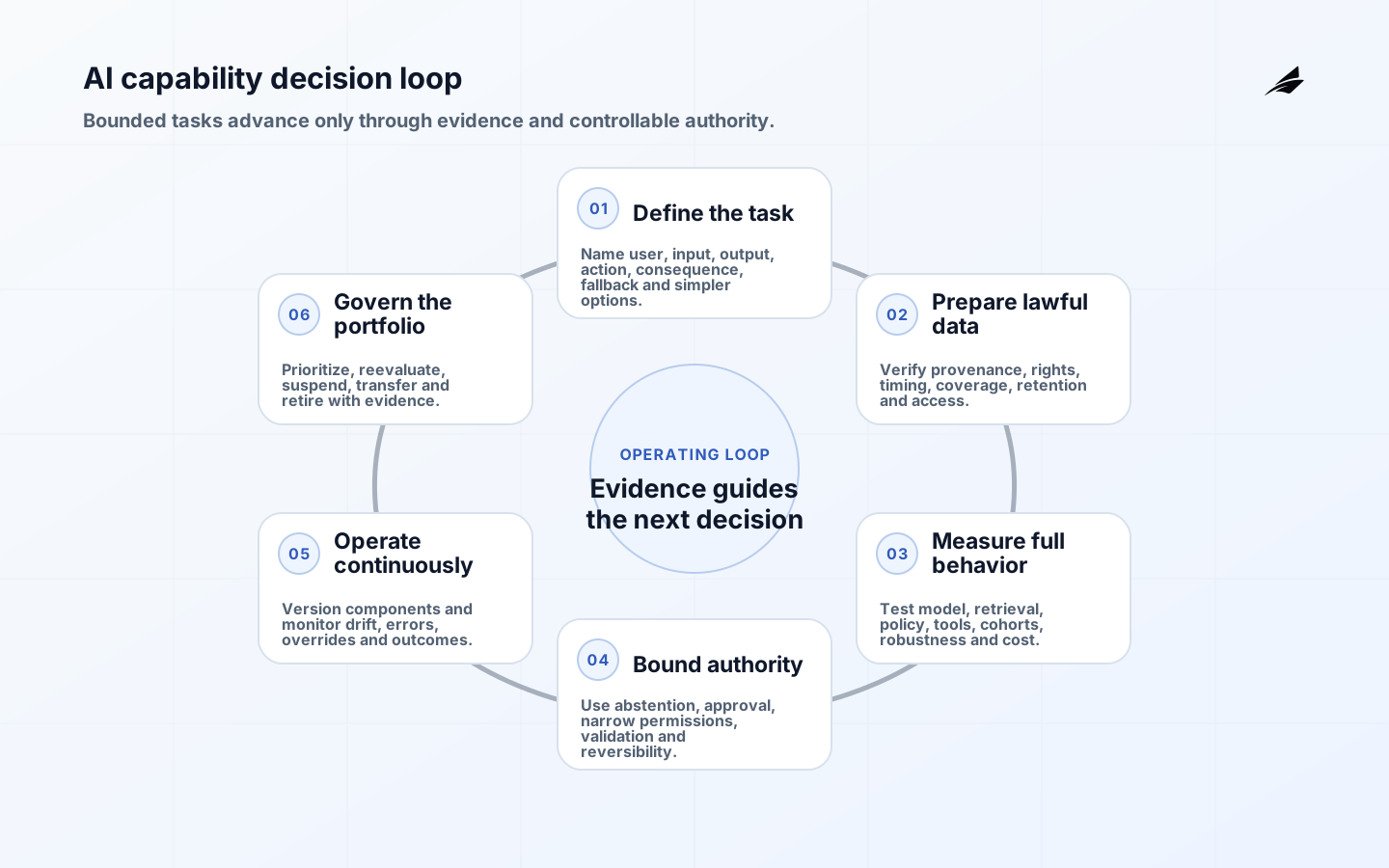
Capabilities artificial intelligence questions are best answered in terms of tasks, evidence and authority. AI can classify, forecast, rank, detect anomalies, generate content, extract information and recommend actions, but capability varies with data, context and consequence. This FAQ helps enterprise teams assess fit without treating a model demonstration as proof of a production system.
For a structured assessment, use Edilec's AI capabilities business guide, AI capability implementation checklist and AI services delivery plan. Begin with a decision or workflow and its failure consequence, then select the least complex method that meets the requirement.
Key takeaways
- Describe the task, user, inputs, action and fallback before comparing models.
- Separate model capability from the data, tools, policy and workflow that make a production system.
- Evaluate against the current process and simple baselines on representative cases.
- Increase authority only when consequence, reversibility, monitoring and evidence justify it.
- Maintain an inventory, change record, incident path and reevaluation triggers throughout the lifecycle.
What can artificial intelligence do reliably?
Reliability is conditional. Classification can route known case types when labels and categories are stable. Forecasting can estimate future values when patterns remain informative. Ranking can prioritize items against an objective. Anomaly detection can surface unusual observations but does not establish cause. Generative systems can draft, summarize and transform unstructured content, yet important claims still need grounding and verification.

A production capability includes input collection, model, retrieval or features, deterministic policy, identity, integration, user interface, monitoring and fallback. Ask what happens when information is missing, conflicting, novel or malicious. The system should abstain, degrade or escalate according to a defined policy instead of projecting certainty.
| Capability | Suitable evidence | Common boundary |
|---|---|---|
| Classify or extract | Representative labeled cases and field-level review | New formats, ambiguous labels and poor source quality |
| Forecast | Backtesting, calibration and cohort error | Regime change and unavailable future inputs |
| Rank or recommend | Outcome lift and constrained action test | Objective mismatch and feedback loops |
| Detect anomalies | Known incidents plus investigation yield | False positives and changing baselines |
| Generate content | Grounded factuality, task quality and reviewer effort | Fabrication, injection and sensitive data |
| Use tools or act | Policy, authorization, simulation and audit | Irreversible or high-consequence side effects |
How do we identify a suitable use case?
Write the current workflow, volume, delay, error, cost and owner. Specify the decision point and smallest useful AI role. Good candidates have repeated work, observable outcomes, accessible inputs and a fallback. Poor candidates depend on tacit context that cannot be captured, have rare catastrophic errors, lack outcome feedback or grant broad irreversible authority.
Compare rules, search, process redesign and conventional analytics before AI. A rule engine may be more transparent and stable for policy. Search may solve knowledge access without generation. Process standardization may remove the variability that made the work expensive. AI earns its place when measured benefit exceeds added uncertainty and lifecycle cost.
What data readiness is required?
Inventory provenance, rights, quality, coverage, timing, retention and representativeness. Define the decision timestamp so evaluation does not leak future information. Segment performance across relevant products, regions, languages, user groups and rare conditions. For generative retrieval, govern source authority, freshness, access filtering and citation.
Do not infer permission from availability. Confirm that training, evaluation, retrieval and logging uses are allowed. Minimize sensitive inputs and outputs, redact where justified and control provider retention. Record datasets, transformations and versions so results can be reproduced and challenged.
What evidence should a capability assessment require?
Build a frozen evaluation set before tuning and retain a separate final set. Include ordinary, difficult, boundary, missing-data and adversarial cases. Measure task quality, calibration, abstention, latency, robustness, security and unit cost. Compare with the current workflow and simple baseline. Evaluate the full system, including retrieval, prompts, policies and side effects.
The NIST AI RMF offers a use-case-agnostic framework for managing risks. Its Core functions govern, map, measure and manage and are continuous rather than a one-time checklist. Define who accepts residual risk and what evidence supports that decision.
| Gate | Required question | Example evidence |
|---|---|---|
| Fit | Does AI outperform a simpler method on useful work? | Baseline comparison and workflow trial |
| Data | Are inputs lawful, representative and timely? | Lineage, rights record and cohort profile |
| Quality | Does performance meet task and subgroup thresholds? | Frozen evaluation with confidence intervals |
| Control | Are unsafe actions bounded and reversible? | Policy tests, approval and fallback exercise |
| Operations | Can degradation be detected and handled? | Monitoring, rollback and incident simulation |
| Value | Does accepted use improve the outcome economically? | Controlled pilot and unit-cost analysis |
When is human oversight meaningful?
Oversight needs authority, evidence, time and competence. A reviewer who sees only a confident answer cannot verify it. Show source material, uncertainty, policy results and alternatives where useful. Define which cases require review, how queues are prioritized and what happens when service levels are exceeded. Measure overrides, corrections and reviewer disagreement.
Increase automation authority by risk tier. Drafting and triage can often begin with review. Financial, employment, safety, legal or physical actions need stronger controls and domain analysis. The OECD robustness, security and safety principle emphasizes traceability and lifecycle risk management. Preserve enough context to investigate outcomes.
Should an enterprise build, buy or use a model API?
Buy an application when its workflow, controls and integrations fit. Use an API when the enterprise can own orchestration, evaluation and operations. Build or fine-tune models when proprietary data or constraints justify the investment and the team can maintain them. In every case, ownership of the use case and its risks remains with the deploying organization.
Evaluate data handling, hosting, model-change notice, service levels, security evidence, subprocessor use, content rights, logging, export and termination. Require the ability to disable the capability and continue the underlying workflow. Avoid contracts that make reproducible evaluation or incident investigation impossible.
How does software security apply to AI?
Apply normal secure engineering to identities, APIs, dependencies, secrets, deployment and monitoring. The NIST SSDF remains relevant to the surrounding application and supply chain. Add AI-specific threats such as prompt injection, data poisoning, insecure tool use, retrieval leakage, model extraction and excessive agency according to architecture.
Use narrow tool permissions, typed inputs, output validation, idempotency and confirmation for side effects. Treat model text as untrusted data, not executable instruction. Separate users and tenants in retrieval and caches. Test failure of model providers and external tools, then verify fallback preserves safety and records incomplete work.
What changes when AI reaches production?
Maintain an inventory of use case, owner, risk tier, model, data, prompts or features, tools, allowed actions, evaluation and monitoring. Version every material component. Monitor inputs, output distribution, calibration where labels return, abstention, override, complaints, latency, provider error, token or compute cost and business outcome.
Define triggers to adjust thresholds, roll back, suspend or reevaluate. Review after data, policy, user population, provider model or operating environment changes. ISO explains that AI management systems use a Plan-Do-Check-Act cycle, which is a useful reminder that governance must continue after launch.
Govern a portfolio of AI capabilities
Use a portfolio register to compare use cases by value, consequence, data readiness, evaluation quality and operational burden. Prioritize bounded capabilities that share governed data or platform controls without forcing one model into every workflow. Stop pilots that cannot produce representative evidence; indefinite experimentation consumes review capacity and creates shadow integrations.
Set minimum controls by risk tier, including accountable owner, documented purpose, data approval, baseline, evaluation, human authority, monitoring, incident response and retirement. Review third-party embedded AI as well as internally named projects. A familiar SaaS product can introduce model processing, retention and changing behavior even when the enterprise did not build the capability.
Report accepted outcomes, material errors, suspended systems, overdue reevaluations and total operating cost to governance forums. Avoid aggregating incompatible accuracy scores. Portfolio governance should help leaders allocate expertise and attention to higher-consequence systems, not turn risk management into a count of completed forms.
Retirement is part of capability control. Define how a model or provider is disabled, how queued work is completed, what records are retained and how users return to the fallback process. Revoke tool permissions and service identities, remove retrieval indexes and document data disposition. Confirm that dependent reports or automations no longer assume the output exists.
Test organizational resilience by simulating unavailable AI. Users should be able to recognize degraded mode and continue essential work without inventing unsafe shortcuts. The exercise also reveals whether an assistive feature has quietly become a mandatory decision path without corresponding service, support and recovery commitments.
Frequently asked questions
Are current enterprise AI capabilities the same as general intelligence?
No. Enterprise systems combine models that perform bounded tasks with data, tools and workflow. Broad conversational fluency does not prove general reliability, current knowledge or authority. Evaluate the exact task and operating context.
What accuracy is good enough?
The threshold depends on error type, consequence, fallback and baseline. Separate false positives and false negatives, examine cohorts and confidence, and include review cost. A lower model score can still improve a workflow if it abstains well and assists users safely.
What should an AI pilot prove?
It should prove data access, representative task quality, user workflow, control behavior, operational feasibility and unit economics. A demonstration on hand-picked examples proves only technical possibility. Use a frozen evaluation and limited real workflow with stop conditions.
Who owns an enterprise AI capability?
A business owner owns the outcome and risk; technical owners maintain data, application and model operations; security, legal, privacy and domain specialists advise according to consequence. Name one accountable decision maker and alternates. Shared participation should not dissolve accountability.
Conclusion
The useful answer to capabilities artificial intelligence questions is conditional and evidence based. Bound the task, compare simple alternatives, prepare lawful data, evaluate the full system, constrain authority and operate it continuously. AI becomes an enterprise capability when teams can explain not only what it can do, but when it should abstain and how they will know it has changed.