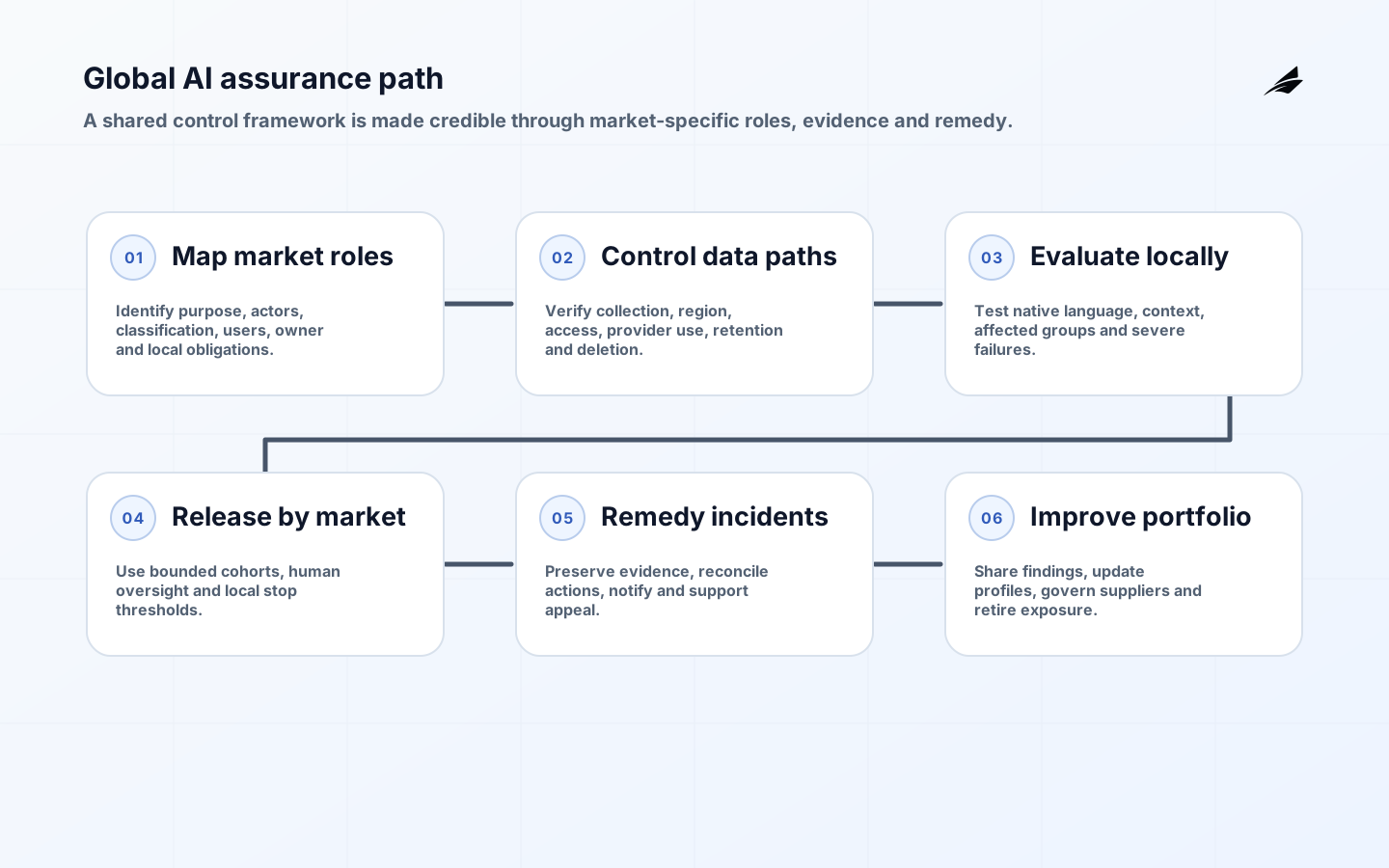
Worldwide AI services are not one deployment copied into many regions. Languages, user expectations, data rules, sector duties, connectivity, accessibility, labor practices and available remedies differ. Providers, deployers, importers, distributors and model suppliers can also carry different responsibilities. A global program needs one accountable control framework plus jurisdiction and market profiles that translate those controls into local evidence, operations and escalation without claiming that a generic certification resolves every use context.
Use this FAQ with the worldwide AI scope and cost plan, the global implementation checklist, the AI workflow automation checklist and the AI workflow automation FAQ. Obtain qualified local legal and domain advice for actual deployments; this operational guide does not determine legal classification.
How should roles be mapped?
Inventory every system, model, supplier, integration, country and affected group. For each market record purpose, users, decision consequence, data flows, provider and deployer roles, local entity, support owner and regulator or customer commitments. The EU AI Act, for example, distinguishes actors and applies obligations by system classification and role; other jurisdictions use different structures. Keep one responsibility matrix that covers model documentation, deployment controls, human oversight, monitoring, incidents, user notices, rights requests and retirement.
| Dimension | Global baseline | Local profile |
|---|---|---|
| Purpose | Approved use and prohibited actions | Sector and country classification |
| Data | Minimization, provenance and access | Transfer, location and retention duties |
| Quality | Common severe-failure labels | Language, dialect and population tests |
| Oversight | Named accountable owner and stop control | Qualified reviewers and remedy channels |
| Incident | Shared severity and evidence process | Notification authority, content and timing |
| Supplier | Audit, change and exit requirements | Local subcontractors and hosting chain |
How is cross-border data handled?
Map collection, model input, retrieval, logs, review queues, support access, analytics, training and backups. Classify personal, confidential, regulated and export-controlled information. Use regional processing or localization only when it satisfies actual requirements and operations can maintain the boundary. Verify provider retention, training use, subprocessors, government request terms, encryption, key ownership, deletion and incident support. A regional endpoint does not prove that every support, telemetry or backup path remains in region. Test access and deletion across the complete chain.
How should multilingual quality be evaluated?
Do not translate an English benchmark and assume equivalence. Build tasks with local domain experts, native speakers and representative users. Test dialect, mixed language, names, formats, cultural context, accessibility and adversarial content. Define severe errors for each workflow and compare outcomes across groups and regions. Preserve source evidence for human reviewers and provide escalation in a language the user can use. Monitor production corrections and complaints by locale, while avoiding rankings based on samples too small to support conclusions.
What global architecture works?
Separate a global control plane for inventory, approved versions, policies, evaluations and incident coordination from regional data planes that enforce residency, identity, retrieval and logging. Keep authorization in deterministic services and give models only minimum tools, permissions and autonomy. Version prompts, models, indexes, policies and locale packs independently but test their combinations. Use regional fallback and a global gateway stop control. Design for supplier or region loss without silently routing restricted data through an unapproved location.

| Release gate | Evidence | Owner |
|---|---|---|
| Market eligibility | Role and risk classification with unresolved questions | Legal and business owner |
| Local quality | Representative task and severe-failure results | Domain and evaluation lead |
| Data control | Verified flow, access, retention and transfer mechanism | Privacy and security owners |
| Human oversight | Staffing, evidence view, authority and appeal | Operations owner |
| Continuity | Provider failure, region loss and stop exercise | Service owner |
| Communication | Notices, limitations and incident templates | Local accountable entity |
How should suppliers be governed?
Contract for model and policy change notice, service locations, subprocessors, security evidence, evaluation support, incident cooperation, data use, intellectual property, audit, export and deletion. Maintain an exit plan for prompts, evaluation sets, retrieval content, logs and integrations. Review changes by consequence rather than accepting every provider release automatically. Record where open models shift more responsibility to the deploying organization. Supplier documentation informs your assessment but does not replace evaluation in the actual language, workflow and authority boundary.
How should rollout and incidents work?
Pilot one or two representative markets, including a harder language or operating environment, before a broad launch. Set local and global promotion and stop thresholds. Run shadow or reviewed modes first for consequential work. Establish round-the-clock escalation according to service impact, preserve versioned evidence and coordinate local notifications without waiting for perfect global certainty. Reconcile downstream actions and provide correction and appeal. Feed local findings into the shared risk register while preserving legitimate country differences.
What drives worldwide AI cost?
Budget model and infrastructure use, regional hosting, data preparation, translation and local evaluation, legal review, security, human review, support, incident coverage, vendor management and repeated releases. Model demand, token or inference units, review minutes and peak concurrency by region. Compare cost per accepted outcome, not only API price. A shared platform can reduce duplicated engineering, but forcing every market into one design may increase exception, compliance and support cost. Re-estimate after each market pilot.
Build and approve a market launch dossier
Create one dossier per service, purpose and market rather than one document per model. Identify the provider, deployer and other relevant actors; intended users; affected groups; decision consequence; local accountable entity; suppliers; data paths; human reviewers; support language and available remedy. Record classification questions and the qualified owner who resolved them. Attach the approved model, prompt, retrieval, policy and locale-pack versions. A change in tool authority or purpose may require a new assessment even when the model is unchanged. Conversely, a provider model update should not enter production automatically simply because its product name stayed the same.
Add a verified data-flow annex covering collection, preprocessing, retrieval, model input, review queues, logs, analytics, support access, training use, backups, retention, deletion and cross-border transfer. Test the actual configured service rather than inferring behavior from a regional endpoint label. Use identities from each operating role to confirm least privilege, and exercise a deletion or correction request through downstream indexes and caches. Record encryption and key responsibility, subprocessors and provider support paths. When a boundary relies on contract rather than technical enforcement, state that dependency and how it is monitored. Do not route around a regional outage through an unapproved location.
The quality annex should use native-language tasks built with local domain experts and representative users. Include dialect, mixed-language input, names, dates, currencies, accessibility, locally sensitive context and credible adversarial cases. Define severe failures and reviewer escalation before testing. Report task success, severe-failure rate, correction effort and uncertainty by case type without claiming differences from samples too small to interpret. Reviewers must see enough source evidence to challenge the proposal and have authority to stop it. Test notices, consent or disclosure where required, plus the correction and appeal journey in language users can understand.
Approve release through a market owner and a global service owner. Start in shadow or reviewed mode with a small cohort, local support coverage and both local and global halt thresholds. Simulate provider loss, regional unavailability, a harmful output and a rights request before promotion. The dossier should specify incident contacts, evidence retention, notification decision paths, user remedy and minimum service. Revisit approval when purpose, actors, data route, model, tool scope, supplier or local rule changes materially. Retire a market by disabling traffic, tools and identities, fulfilling retention and deletion duties, notifying users and closing supplier and support obligations rather than merely hiding the feature.
Maintain a global variance register alongside the dossiers. Each variance should name the baseline control, local implementation, reason, risk owner, evidence, review date and affected markets. Some differences are necessary; others reveal duplicated work or a control that was written too narrowly. Review the register for patterns without forcing local teams to erase legitimate context. When one market reports a severe failure, test whether the same mechanism exists elsewhere even if language or classification differs. Shared learning should accelerate investigation while local owners retain authority over remedy and release. Expire temporary variances automatically into review, and test that central reporting does not expose restricted local data. Aggregate status should link back to bounded evidence, not flatten uncertainty into a universal compliance score.
- Scope the dossier to one service purpose and market with named accountable actors.
- Verify every configured data, support, retention, deletion and transfer path.
- Evaluate native tasks and severe failures with qualified local reviewers.
- Test understandable notices, human escalation, correction and appeal.
- Require local and global approval, monitoring and stop authority.
- Reassess material changes and document complete market retirement.
Key takeaways
- Maintain one global control framework with evidence-backed local profiles.
- Map actor roles, data paths and user remedy for every market.
- Evaluate native language and context, not translated benchmarks alone.
- Separate global governance from regional data and authorization boundaries.
- Expand by market evidence and retain global and local stop authority.
Frequently asked questions
Can one model serve every country?
Possibly, but each locale and use context still needs quality, risk, data and oversight evidence. A common model does not create common outcomes.
Does the EU AI Act apply outside Europe?
Its scope can reach non-EU actors in defined circumstances. Determine applicability and role with qualified advice for the concrete service.
Is data residency enough for privacy?
No. Purpose, minimization, access, transparency, retention, rights, security and transfer controls remain relevant throughout the data lifecycle.
What metric should be compared globally?
Use accepted task outcome and severe-failure rate with local definitions, plus review effort, remedy and unit cost. Avoid league tables built from incomparable samples.
Conclusion
Global AI delivery succeeds when common governance makes local differences visible instead of erasing them. Role mapping, regional data controls, native evaluation, bounded architecture, supplier evidence and local remedy let an organization scale capability while remaining accountable in every market it serves.