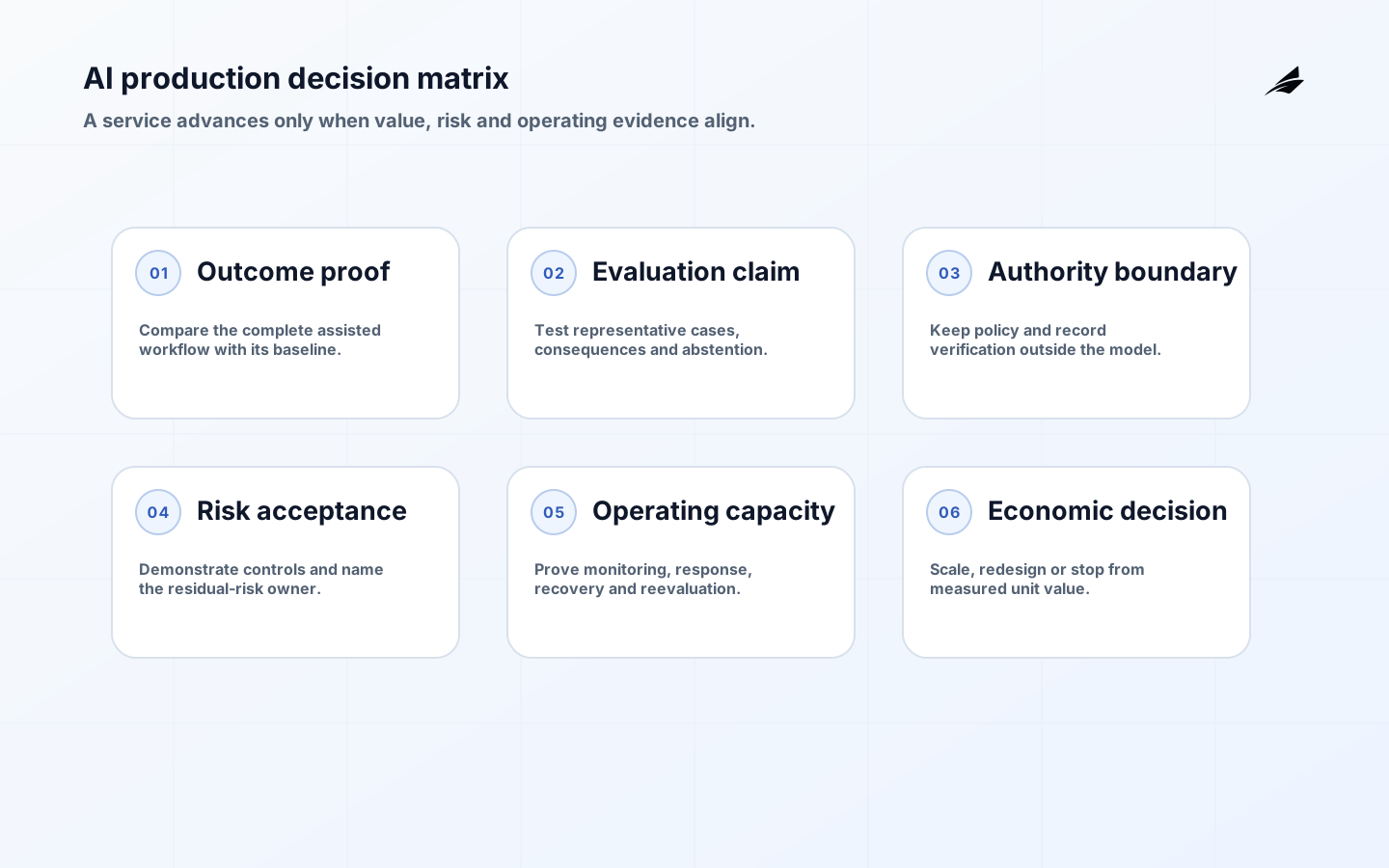
Teams asking how to stop AI services from stalling usually do not need another demonstration. They need an explicit decision about value, authority, evidence, architecture, risk, operations or cost. A pilot stalls when it can keep generating activity without producing the evidence required to scale, redesign or stop. This FAQ helps sponsors and delivery teams identify the blocked decision, assign an owner and run the smallest useful experiment. Production is not the correct destination for every use case; an accountable stop is also progress.
Use Edilec's AI services delivery plan for portfolio and investment scope and the production progress checklist for execution. When the evidence points toward retirement, the enterprise AI stop checklist covers access revocation, records and transition.
Why do AI services stall after a promising pilot?
Common causes are an undefined business outcome, no workflow owner, unapproved data, an evaluation that measures demos rather than decisions, hidden integration work, unresolved risk acceptance, provider constraints, unaffordable review or absent support. Teams often call all of these production readiness, which obscures the next action. Write each blocker as a decision: who must decide what, from which evidence, by when? Separate fact, assumption and accepted residual risk. End meetings that merely repeat that the model needs improvement.
The NIST AI Risk Management Framework structures risk activity around Govern, Map, Measure and Manage and treats context as essential. Use that logic to map purpose, people, data, deployment context and potential impact before demanding another accuracy point. A model can be technically capable while the use case remains weak or unsafe. Conversely, a bounded assistive workflow may be deployable with modest model performance when abstention and human review work well.
| Stall signal | Likely missing decision | Smallest useful evidence |
|---|---|---|
| Demo praise, no adoption | Workflow value and owner | Observed baseline and assisted cohort |
| Endless prompt tuning | Evaluation claim and threshold | Versioned representative test set |
| Security review repeats | Authority and threat boundary | Data-flow and tool-permission test |
| Pilot cannot integrate | Production service boundary | Vertical slice through one real system |
| Budget remains vague | Unit economics and capacity | Measured request and review distribution |
| No launch approval | Residual-risk authority | Decision record with owner and expiry |
How do we prove value rather than usage?
Define the actor, trigger, decision, action and expected change. Measure the current process across representative variation: completion time, quality, rework, delay, harm, revenue or cost. Compare an assisted cohort with that baseline and include review, correction, exception and support work. Adoption and token volume are operating signals, not proof of benefit. A summarization tool that saves drafting time but adds mandatory verification may shift work rather than reduce it.
Choose thresholds before examining final pilot results. Scale when the outcome is repeatable and material after full effort. Redesign when a specific interface, source or review step limits value. Stop when the purpose is weak, a simpler method performs adequately or evidence cannot be collected responsibly. Preserve negative learning. Changing the success definition to protect sunk cost turns an experiment into advocacy and makes later governance less credible.
What makes an evaluation production-relevant?
State the claim: which population, task, conditions, metric and threshold the service supports. Build a versioned set containing ordinary cases and costly edge cases, with legitimate access and clear provenance. Segment by language, role, source, customer or consequence where performance may differ. Include abstention, unsupported requests, stale sources, malformed content, provider refusal and outage. Have domain reviewers label against a rubric and resolve disagreement. Do not use production users as an unannounced evaluation set.

For generative systems, the NIST Generative AI Profile describes risks including confabulation, information integrity, privacy, security and harmful bias. Test the subset relevant to the system and evaluate the complete workflow, not model output alone. The NIST AI Resource Center provides resources for testing, evaluation, verification and validation. Record model, prompt, retrieval, policy and tool versions so results can be reproduced.
How much production architecture should a pilot include?
Include enough of the production skeleton to test the assumptions likely to block deployment: workforce identity, authorized sources, tenant filtering, model gateway, schema validation, tool permissions, workflow state, observability, cost attribution, support and fallback. Full capacity and geographic redundancy can wait. An isolated notebook cannot prove integration latency, access controls, provider limits, incident reconstruction or operating effort. Build a narrow vertical slice through one real workflow instead of a broad mock demonstration.
Keep models outside the authority boundary. A model can propose text, fields or an action, while deterministic policy checks user entitlement, current record state, limits and required approval. Use idempotency for tools and verify results from the system of record. Treat retrieved documents and external messages as untrusted. OWASP's prompt-injection guidance explains why natural-language content can manipulate model behavior; filters alone cannot replace least privilege and independent authorization.
How can governance accelerate a decision?
Use risk tiers based on consequence, affected population and autonomy. Publish required artifacts and decision owners: use-case record, data authority, evaluation, threat model, human role, user notice, monitoring, incident plan and residual-risk acceptance. Reuse platform controls and approved contract terms. Bring legal, security, privacy and domain reviewers into scoping. Governance becomes slow when every project invents its own evidence package or no one has authority to accept a bounded risk.
Keep one evidence and decision record with requirement, implementation, test, limitation, owner and review date. Time-box review work, not unresolved risk into automatic approval. Give high-impact uses independent challenge. Reopen acceptance after meaningful changes to model, provider, data, tool authority, user population or jurisdiction. A proportionate process allows low-consequence assistive uses to move while preserving deeper scrutiny for decisions that affect rights, safety, money or essential services.
What security and delivery controls belong before scale?
Apply the NIST Secure Software Development Framework to application code, prompts, schemas, retrieval configuration and deployment. Protect source and build environments, review dependencies, test security requirements and maintain vulnerability response. Pin versions where possible and run regression evaluation when a managed model changes. Restrict production data and tools by user and service identity. Test indirect injection, data exfiltration, excessive tool authority, malformed output, rate limit, provider outage and logging failure.
Create traces that connect request, source references, model and configuration version, policy decision, tool call, result and correction without logging unnecessary sensitive content. Define alert ownership and a kill switch that revokes model and tool access while preserving the underlying workflow. Stage exposure by user cohort and authority. Prepare rollback for configuration and application changes, and a forward path for records already changed by the service. Security acceptance should be repeatable by the permanent team, not demonstrated once by project specialists.
When do economics and operating capacity block scale?
Measure input and output tokens or equivalent usage, retrieval, storage, model routing, retries, observability, integration, evaluation, human review, exceptions, support and provider governance. Use distributions and peak patterns, not one demo prompt. Calculate cost per completed business outcome and compare it with baseline cost and value. Long context and retries can dominate inference, while mandatory review can dominate total cost. Redesign eligibility, interface or model routing before asking for a larger budget.
Assign a funded service owner and support route. Set quotas, cost anomaly alerts and authority for expensive models or volume increases. Prove source refresh, on-call response, incident handling, evaluation cadence and supplier change management. A team that can build but not operate should not scale. Managed AI reduces some infrastructure work but does not own the organization's workflow, data authority, user communication or risk acceptance.
| Scale gate | Required evidence | Stop or redesign signal |
|---|---|---|
| Value | Outcome beats baseline after full effort | Usage is the only demonstrated benefit |
| Quality | Representative workflow meets thresholds | Severe errors lack safe handling |
| Risk | Controls work and residual risk has an owner | Authority or data use remains unclear |
| Operations | Permanent team monitors and recovers | Project team is the sole responder |
| Economics | Unit cost and funded capacity are credible | Review and exception cost is omitted |
| Change | Regression and reapproval paths exist | Provider changes cannot be evaluated |
How should leaders choose scale, redesign or stop?
Use a concise decision brief comparing predefined thresholds with evidence. Scale one dimension at a time: volume, workflow coverage, user population or autonomy. Redesign when the bottleneck is specific and testable. Stop when purpose is weak, source authority is absent, serious harm cannot be bounded, evaluation is infeasible or economics fail. Revoke pilot access, archive required evidence, notify users and close supplier resources. A clean stop protects data and releases capacity for stronger work.
Never allow a permanent pilot. Set an expiry. An extension must name the exact missing evidence, responsible owner and smallest experiment that can produce it. Portfolio leaders should compare uses by realized value, residual risk and operating burden, retire duplicates and fund shared controls only where demand supports them. Clear stopping discipline increases trust in the services that do advance because production status reflects evidence rather than persistence.
Key takeaways
- Translate vague readiness concerns into a named decision, evidence requirement, owner and date.
- Prove workflow outcomes after review, correction, exception and support effort.
- Build a narrow production skeleton early enough to test real authority and operations.
- Keep deterministic policy and system-of-record verification between models and consequential actions.
- End every pilot with an explicit scale, redesign or stop decision.
Frequently asked questions
Can a better model unstall the project? Only when measured model performance is the actual blocker; it cannot fix unclear purpose or ownership. How long should a pilot run? Until representative variation produces the agreed evidence, with an explicit expiry. Must every AI output be reviewed? No; review should follow consequence, measured reliability and available controls. Can we launch with known limitations? Yes, when they are bounded, communicated, monitored and accepted by an authorized owner. What is the strongest sign of readiness? Permanent operators can explain, monitor, interrupt, recover and reevaluate the service without the pilot team.
Conclusion
To stop AI services from stalling, replace indefinite experimentation with bounded decisions. Clarify the business outcome, evaluation claim, data authority, model boundary, residual risk, operating owner and complete economics. Then run the smallest experiment that resolves the remaining uncertainty. Some services will scale, some will improve through redesign and some should stop; all three outcomes are healthier than a pilot that persists without a decision.