Enterprise AI services need explicit decisions to stop, redesign, contain or scale. Without them, weak pilots linger because they are called experiments, while risky systems expand because early demonstrations looked convincing. An enterprise AI services stop plan makes continuation conditional on evidence: business value, task quality, affected-party impact, security, legal fit, operating capability and total cost. Stopping is then a governed lifecycle outcome, not an admission that exploration was wasted.
Use the enterprise AI stop implementation checklist to execute a review and the continue, pause or stop FAQ for common governance questions. The AI services recovery plan addresses initiatives blocked before a defensible decision.
Define the service hypothesis and decision rights
Write a one-page charter naming the user, decision or task, baseline, intended benefit, affected people, AI role and accountable executive. Separate exploration from production service. Exploration may test technical feasibility with synthetic or controlled data; production requires lawful authority, security, support and measured outcomes. Name who can approve a pilot, expand authority, suspend operation and accept residual risk.
Set review dates and evidence thresholds before enthusiasm or sunk cost distorts the decision. NIST AI RMF organizes risk work around govern, map, measure and manage and explicitly includes decommissioning. GAO emphasizes governance, data, performance and monitoring. Translate those structures into artifacts and owners appropriate to the use case rather than a broad principle statement with no release consequence.
| Decision dimension | Continue or scale evidence | Stop or redesign signal |
|---|---|---|
| Value | Material improvement over baseline for intended users | No measurable benefit or benefit depends on hidden manual work |
| Quality | Performance holds across realistic groups and edge cases | Critical error, unsupported claim or unstable result exceeds tolerance |
| Rights and compliance | Purpose, notice, access and recourse are supportable | No lawful or acceptable path for the intended use |
| Security and resilience | Threats, dependencies, fallback and incidents are controlled | Unbounded tool access or failures cannot be contained |
| Economics | Total cost per successful outcome fits the business case | Review, rework and infrastructure erase expected value |
Build an independent evaluation package
Preserve a representative test set outside routine prompt and model tuning. Include normal tasks, ambiguous inputs, minority or rare cases, malicious content, missing evidence and high-consequence failure. Define scoring rubrics before review. Measure task success and harm, not fluency. Generative AI evaluations should examine unsupported content, sensitive disclosure, harmful bias, information integrity, cybersecurity and human-AI configuration relevant to the context.
Use evaluators who can challenge the delivery team. Domain, security, privacy, legal, operations and affected-user perspectives may all matter. Document uncertainty and what was not measured. Production evidence should include overrides, complaints, incidents, appeal outcomes, latency, fallback use and distribution change. A benchmark result from a vendor is not evidence that the integrated service works in the organization’s workflow.
Calculate full cost and opportunity cost
Model discovery, data preparation, integration, model use, retrieval, evaluation, security, monitoring, human review, support and provider management. Include the cost of failed outputs, escalation and maintaining a non-AI route. Compare the service with a simpler rule, search improvement, process redesign or additional staffing. The relevant question is not whether AI can perform the task but whether this configuration is the best responsible use of resources.
Use scenarios for adoption, model price, review rate and quality. A pilot may appear cheap because experts correct every output without recording their time. At scale, small error and escalation rates can create large queues. Conversely, a high per-task model cost may be acceptable for a rare task that avoids substantial delay or harm. Record which assumptions would reverse the decision.
Set stop, pause and containment thresholds
A stop threshold applies when the purpose is no longer valid, harm cannot be reduced to tolerance, required authority is absent, security is uncontainable or value remains unsupported after an agreed test. A pause preserves the option while a specific dependency or investigation is completed. Containment reduces users, data, features or action authority. Redesign changes the workflow or technical approach and must return through evaluation.
Specify threshold owner, observation window and immediate response. Some events, such as unauthorized production action or material disclosure, may require immediate suspension. Trend thresholds, such as rising override rate, need enough data and guardrails against delayed response. Do not make the delivery vendor the sole judge of whether its system should continue. Preserve appeal and incident channels for people affected by the service.
| Decision | Appropriate when | Required next evidence |
|---|---|---|
| Scale | Value and risk evidence hold under bounded pilot conditions | Capacity, broader-group and operating readiness tests |
| Continue pilot | Uncertainty remains but exposure is controlled | Named experiment with deadline and success threshold |
| Contain | Capability is useful but authority or population is too broad | Retest within reduced boundary |
| Redesign | Problem remains valid but workflow or architecture fails | New hypothesis and independent evaluation |
| Stop and retire | Purpose, safety, legality or economics cannot be supported | Decommission proof and stakeholder communication |
Run an evidence-based portfolio review
Provide reviewers with the charter, architecture, data map, evaluation, incidents, cost model, operating readiness and unresolved risks before the meeting. The service owner presents the user outcome; independent reviewers present limitations. Record decision, rationale, conditions, dissent, owner and next review. Avoid a traffic-light score with no explanation, because different combinations of severe risk and uncertain value should not collapse into one color.

For a scale decision, require production ownership, support, model and prompt change control, security monitoring, fallback, provider exit and budget. For redesign, limit new work to the hypothesis being tested. For stop, end new processing promptly, notify users and downstream owners, revoke credentials, disable tools, handle retained data and records, close contracts where appropriate and confirm that dependent workflows have moved to a supported route.
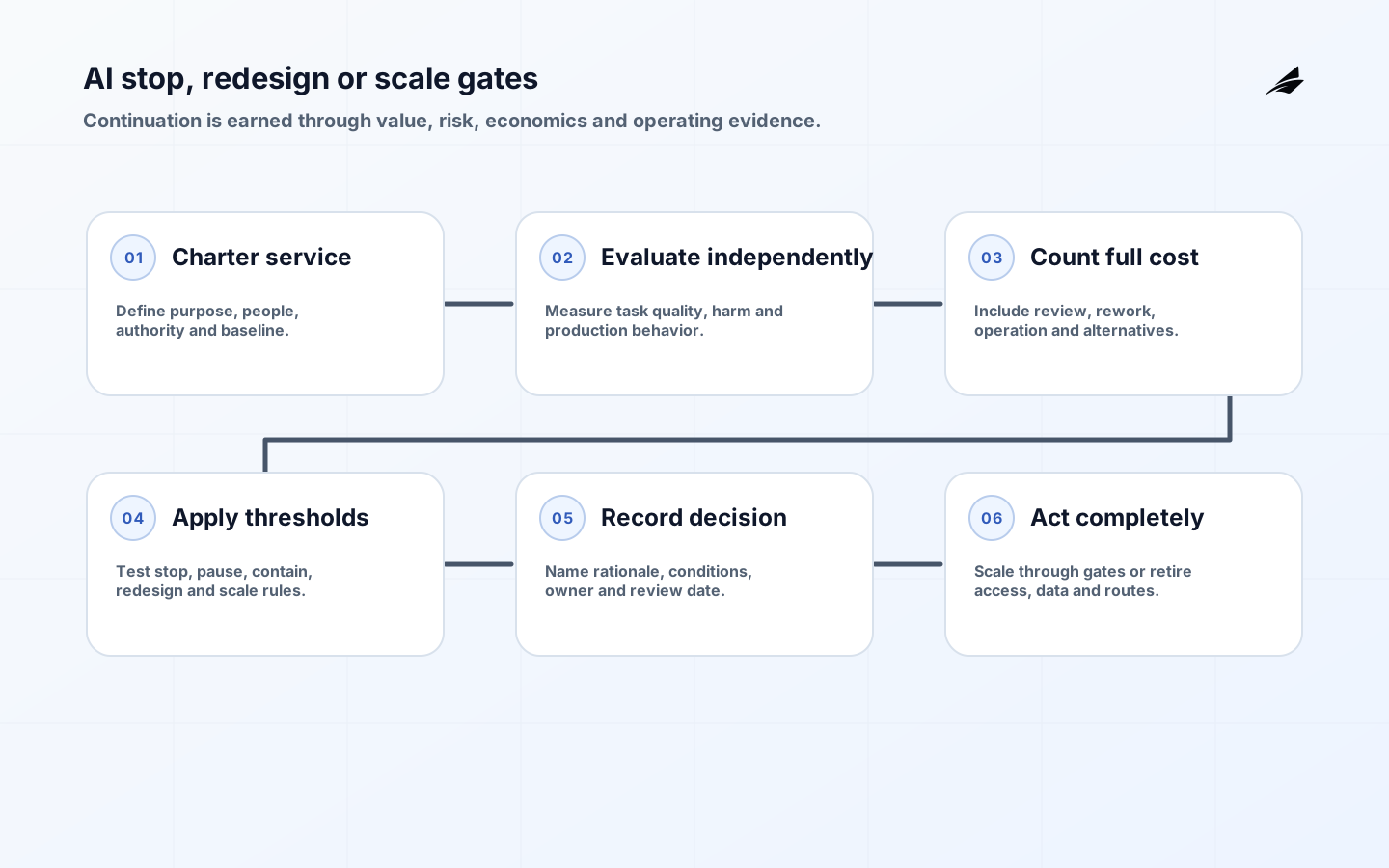
A six-step stop or scale procedure
- Reconfirm purpose, affected people, decision authority and current service boundary.
- Freeze a configured version and assemble independent task, risk and production evidence.
- Calculate total cost and compare AI with credible non-AI alternatives.
- Apply pre-agreed stop, pause, contain, redesign and scale thresholds.
- Record the decision, conditions, owner, review date and communication.
- Scale through new evidence gates or decommission access, data and dependencies completely.
Applied example and assurance notes
A review board should distinguish insufficient evidence from failed evidence. A pilot with too few completed cases may continue under a bounded experiment with a deadline; a pilot that repeatedly exceeds a critical disclosure threshold should stop even if volume is low. Conditions must state the missing question, data needed and maximum exposure. Otherwise “continue learning” becomes an indefinite exception that exposes users without increasing decision quality.
Redesign can remove AI from the consequential part of a workflow while preserving a useful capability. For example, a model that attempted to approve customer claims may instead retrieve policy and draft an evidence summary for a qualified reviewer. The new design needs a fresh baseline and evaluation because authority, user behavior and cost have changed. It should not inherit approval merely because it uses the same provider and interface.
Retirement requires dependency discovery just like launch. Identify API callers, scheduled jobs, embedded links, exported data, credentials, indexes, model-provider storage, dashboards, alerts and user procedures. Move each to a supported replacement or close it, then monitor for residual calls. Record required evidence and deletion outcomes. A disabled user interface is not retirement if background processing or broad production credentials remain active.
- Record the accountable owner and the decision the evidence supports.
- Test a normal journey, a denied path and a realistic failure.
- Keep assumptions, versions and unresolved risks visible.
- Require acceptance evidence before expanding scope or authority.
- Review operating outcomes and close corrective actions.
Before approval, the portfolio risk owner should convene business sponsor, affected users, evaluation, legal, security and operations for a scenario review. Walk through ordinary use, a denied request, one unavailable dependency, a partial change and recovery. For each step, identify the authoritative record, person with decision rights, expected signal, time limit and safe alternative. Challenge sunk-cost continuation, hidden human labor, uncontained harm and incomplete retirement. Record assumptions that could change after launch and assign each one a trigger for reassessment. The review is successful when participants can explain not only the preferred path but also how they recognize an unsafe state, who can stop progress, and how users continue while the issue is resolved. Preserve the independent review, threshold decision and decommission record with the configured release rather than in a detached presentation.
For Enterprise AI Services: A Stop, Redesign or Scale Decision Plan, conduct a review thirty days after release or completion. Compare actual demand, quality, exceptions, incidents, cost and user effort with the baseline. Separate design defects from training gaps and changed operating context. Sample complete cases because averages can conceal a rare path carrying most consequence. Confirm that temporary access, duplicate infrastructure, transitional policy and manual workarounds have closed or have an owner and expiry. Reforecast the next period and publish decisions to people who operate or depend on the capability. At each material change, refresh cases, assumptions and risk treatment; assurance is a maintained operating practice, not a certificate inherited from the first release.
Enterprise AI Services: A Stop, Redesign or Scale Decision Plan also needs a concise evidence index that a new reviewer can navigate without oral history. Link the current boundary, named owners, architecture or workflow, decisions, tests, exceptions, operating signals and closure records. Mark superseded artifacts instead of silently replacing them, and protect sensitive material by role. During a review, select one claim from the summary and trace it to its source and observed result. If that trace is slow or ambiguous, improve the index before scale. Good evidence reduces repeated discovery, supports accountable challenge and makes future migration or retirement materially easier.
Key takeaways
- Make continuation conditional on evidence established before the review.
- Evaluate the integrated service across value, quality, rights, security and economics.
- Use pause and containment deliberately; do not let them become indefinite operation.
- Keep decision authority independent enough to challenge delivery incentives.
- Treat retirement as an engineered transition with access, data and workflow closure.
Frequently asked questions
Does stopping mean the AI initiative failed?
Not necessarily. A bounded experiment can create valuable evidence that the use case, workflow or timing is wrong. Failure is allowing unsupported operation to continue because no one defined a responsible end state.
Can one metric decide whether to stop?
Rarely. A critical legal or safety threshold can be decisive, but ordinary decisions require a balanced view of outcomes, groups, operations and cost. Record why each metric matters and what uncertainty remains.
What if a provider changes the model?
Treat a material model or policy change as a configuration change. Review release information, rerun proportionate evaluations and preserve rollback or an alternate route. Contract terms should support notice, evidence, data handling and exit.
Conclusion
An enterprise AI portfolio becomes stronger when stopping is a normal, evidence-based option. Establish purpose and thresholds, evaluate independently, count full cost and choose among scale, continue, contain, redesign and retire. Clear closure protects people and resources while allowing the organization to invest in services whose value and risks can actually be supported.