Data and AI FAQ
Do we need AI for a data problem?
Often not. Better definitions, collection, metadata, search, rules, or workflow may solve the need with less uncertainty.
What makes human oversight meaningful?
Reviewers need evidence, understandable options, enough time, authority to challenge, and freedom from incentives that make approval automatic.
Data and AI initiatives often start with a tool demonstration, then run into harder questions about data, responsibility, and evidence. This data and AI FAQ is designed to make those questions concrete. It is not legal advice or a substitute for sector-specific requirements; a health, employment, finance, safety, or public-service use may require specialist review. For everyday planning, however, a team can make substantial progress by clarifying the intended decision, the source of truth, the people affected, and the route for correction. The NIST AI RMF Playbook is useful because it connects broad trustworthy-AI aims to activities across governance, mapping, measurement, and management.
For implementation depth, use Edilec’s data and AI guide, data and AI checklist, and agent governance guide.
What question should we start with?
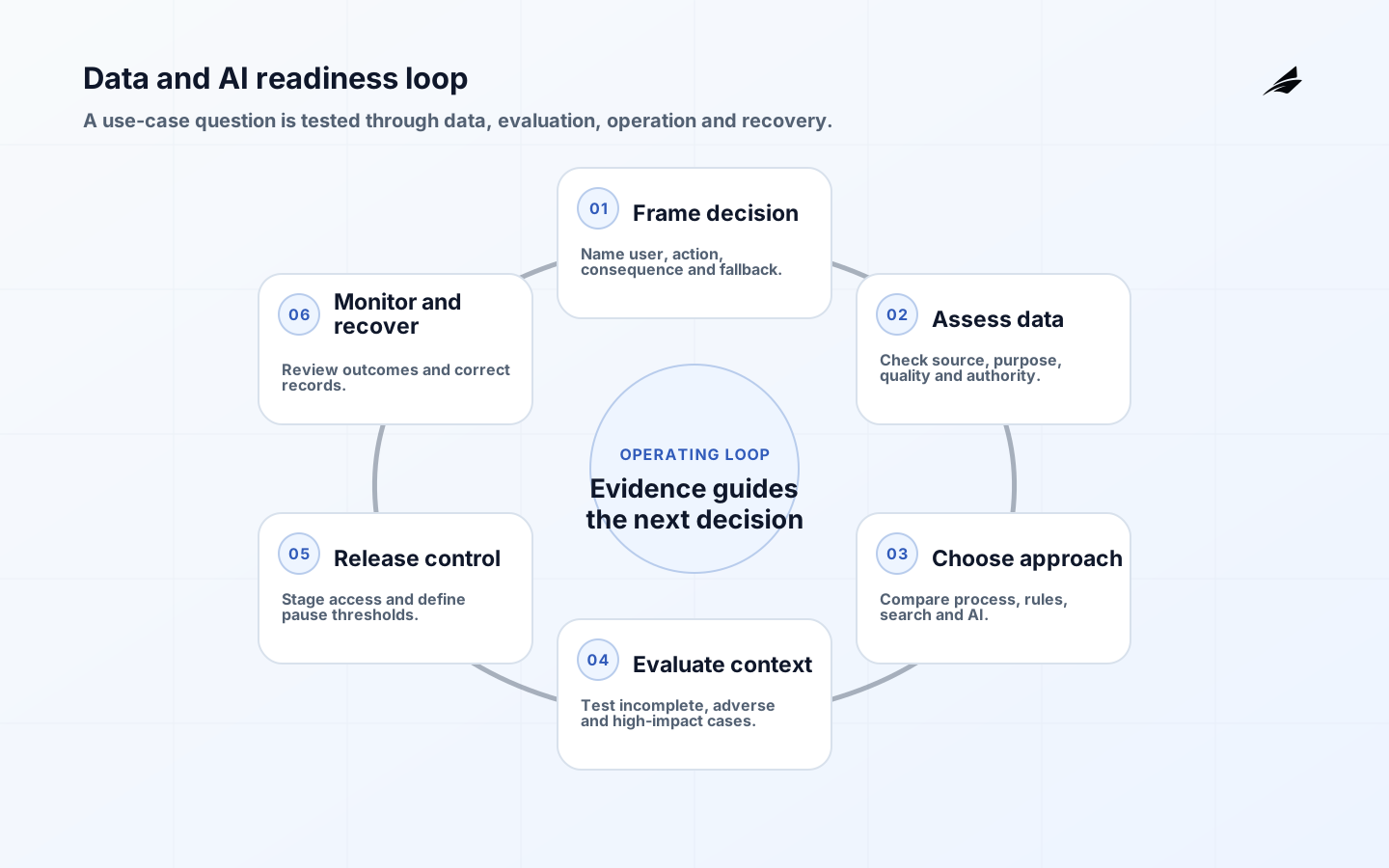
Start with a decision that a person already needs to make or a handoff that is repeatedly delayed. Ask what information would make that work more reliable, not what an AI system could generate in the abstract. A clear starting question names the user, action, time horizon, and consequence of being wrong. For instance, identifying incomplete service requests is different from deciding whether a request should be approved. The first may support a low-consequence prompt for missing information; the second may require policy interpretation and a review route. This distinction guides data selection, evaluation, access, and the level of human oversight. It can also reveal that a process change or search improvement should precede any model work.
| Question type | Suitable early approach | Important boundary |
|---|---|---|
| Find relevant information | Search, retrieval, or better metadata. | Show source material and freshness. |
| Check completeness | Rules or assisted extraction. | Allow correction of uncertain fields. |
| Prioritize a queue | Scoring with reviewer control. | Do not turn priority into an unreviewed denial. |
| Draft an explanation | Constrained generative assistance. | Require human confirmation for consequential communication. |
How good must the data be?
Data must be good enough for the particular claim the system will make. That means understanding the source, purpose, time period, coverage, definitions, and likely error modes. A complete transaction table may be unsuitable for estimating a customer need if it omits key context; a historical decision record may encode earlier practices the organization no longer accepts. Inspect samples with people who understand the work, and preserve the findings in a data note rather than relying on memory. Ask whether any fields are collected for a different purpose, whether they are more sensitive than the use requires, and whether the population in development resembles the population in operation. The NIST Privacy Framework is a practical starting point for that assessment.
- Document source ownership and the date range represented.
- Identify missing, delayed, duplicated, and manually corrected values.
- Define fields consistently across connected systems.
- Keep a record of transformations, joins, and exclusions.
- Do not infer consent or authority from technical access alone.
How do we test AI?
Test the behavior users will actually rely on. Bring together normal cases, awkward cases, cases with incomplete information, and examples designed to expose unsupported claims or unsafe instructions. Have subject-matter reviewers judge outputs against a written rubric, and record disagreement rather than averaging it away. If the system ranks or predicts, compare it with the current process and inspect error patterns where consequences differ. If it generates text, verify source grounding, handling of uncertainty, privacy behavior, and resistance to instruction conflicts. The NIST AI Risk Management Framework emphasizes measurement in context: an appealing model metric cannot answer whether a particular user can safely act on a particular output.
| Evaluation question | Example evidence | Follow-up |
|---|---|---|
| Is the result useful? | Reviewer rubric and task completion observations. | Revise the workflow or interface. |
| Is it reliable enough? | Results on representative and edge cases. | Set a review threshold or restrict use. |
| Can users spot a problem? | Source display and challenge-path testing. | Improve context and escalation. |
| Does it remain stable? | Version comparison and live monitoring. | Stage changes and re-evaluate. |
Who governs the service?
Governance is the allocation of decisions, not a committee name. A business owner should decide the purpose, acceptable trade-offs, and authority for exceptions. Data owners should set source conditions and access expectations. Technical owners should manage versions, integrations, security, and incident response. Users should be able to report confusing or harmful behavior without needing to diagnose the model. Bring in privacy, security, procurement, legal, and domain specialists according to the risk. The organization deploying the system remains responsible for its choices even when a supplier operates components. Clear roles make a useful vendor relationship more likely because both sides can identify which evidence and change approvals are needed.
What about regulation and standards?
Applicable rules depend on location, sector, purpose, and the people affected. Do not assume that a general AI policy settles requirements for employment, credit, medical, education, public-sector, or safety-related use. The European Commission describes the AI Act's risk-based framework, but teams should obtain qualified advice for their own obligations and timing. In any jurisdiction, documentation of purpose, data, testing, oversight, changes, and incidents is operationally valuable. It allows a team to explain what it did and revise the service when assumptions no longer hold. Standards and frameworks can structure that work; they do not replace an informed assessment of the actual use.
Resolve readiness with a case review
Example: prioritizing service requests

A service team wants AI to prioritize requests. Define the outcome: faster attention for urgent eligible cases without silently delaying others. Inspect how urgency is recorded, which facts exist at intake, which groups historically provide less complete information, and who can override ranking. Compare rules, process changes, search, and predictive methods. A score should not become an unreviewed denial, and the interface should not imply certainty the evidence cannot support.
Build an evaluation set with routine, incomplete, ambiguous, rare, and high-consequence cases. Review ranking quality, delay by segment, missing-data behavior, operator explanations, correction effort, and source-failure recovery. Document data period, exclusions, labels, disagreement, version, threshold, and intended use. During rollout, keep a trustworthy baseline and sample decisions. Pause when a source is stale, access fails, behavior shifts, or the challenge route cannot keep up.
Key takeaways
- Use a real decision or handoff to choose the first data and AI use case.
- Assess fitness and authority for data, not just availability.
- Test difficult examples and whether users can challenge outputs.
- Assign business, data, technical, and review responsibilities visibly.
- Treat regulation as use- and jurisdiction-specific, not a checkbox.
Frequently asked questions
Do we need to build a model? Often no. A retrieval layer, rules engine, cleaner data, or better workflow may solve the problem with less uncertainty. Can data be reused for a new AI purpose? Technical possibility is not sufficient; assess purpose, permissions, privacy, contract terms, and organizational policy. What is human oversight? It is not merely placing a person after an output. The reviewer needs enough context, authority, time, and practical ability to challenge, override, or stop the relevant action.
- Can a model explain itself perfectly? Usually not; provide useful context and avoid overstating certainty.
- When should we pause a service? After a material incident, unexplained behavior shift, unsafe output pattern, or loss of a key control.
- What logs matter? Those needed to reconstruct material events while respecting retention and privacy rules.
How do we communicate limits?
Tell users what the service is for, what it is not for, where its information comes from, and what to do when it is uncertain or wrong. Put this guidance in the workflow rather than burying it in a policy page. A clear label can distinguish a draft from an approved record, while a source link can let a user verify an important claim. Training should include examples of tempting misuse, such as treating a prioritization score as a final decision or entering information outside the approved purpose. Invite users to flag errors without framing reports as user failure. Good communication does not transfer responsibility to the user; it gives them the context and route needed to apply their judgment safely.
A useful operating metric has an owner and a response rule. Data freshness, output rejection, unresolved corrections, access denials, queue delay, and user reports can all matter, but none should be watched in isolation. Set a baseline and agree what change is meaningful enough to inspect. Pair numbers with a case review so the team can tell whether a trend reflects a product change, a source failure, a seasonal shift, or a new workflow. Publish the metrics that users need to understand the service, but do not expose sensitive operational detail unnecessarily. The point of monitoring is to find and correct a degraded assumption early. It is not to create a scorecard that disguises the uncertainty of a complex decision.
When teams disagree about readiness, return to cases rather than debating general confidence. Compare the proposed output, source information, user action, and fallback for a small set of representative examples. This makes uncertainty concrete and often identifies the missing evidence or owner needed for a responsible decision.
A documented uncertainty is easier to manage than an assumption that never reaches the decision-maker.
Conclusion
Responsible data and AI delivery begins with good questions. Define the decision, test whether data is fit and permitted, evaluate difficult cases, assign real authority, and design monitoring and recovery before scale.