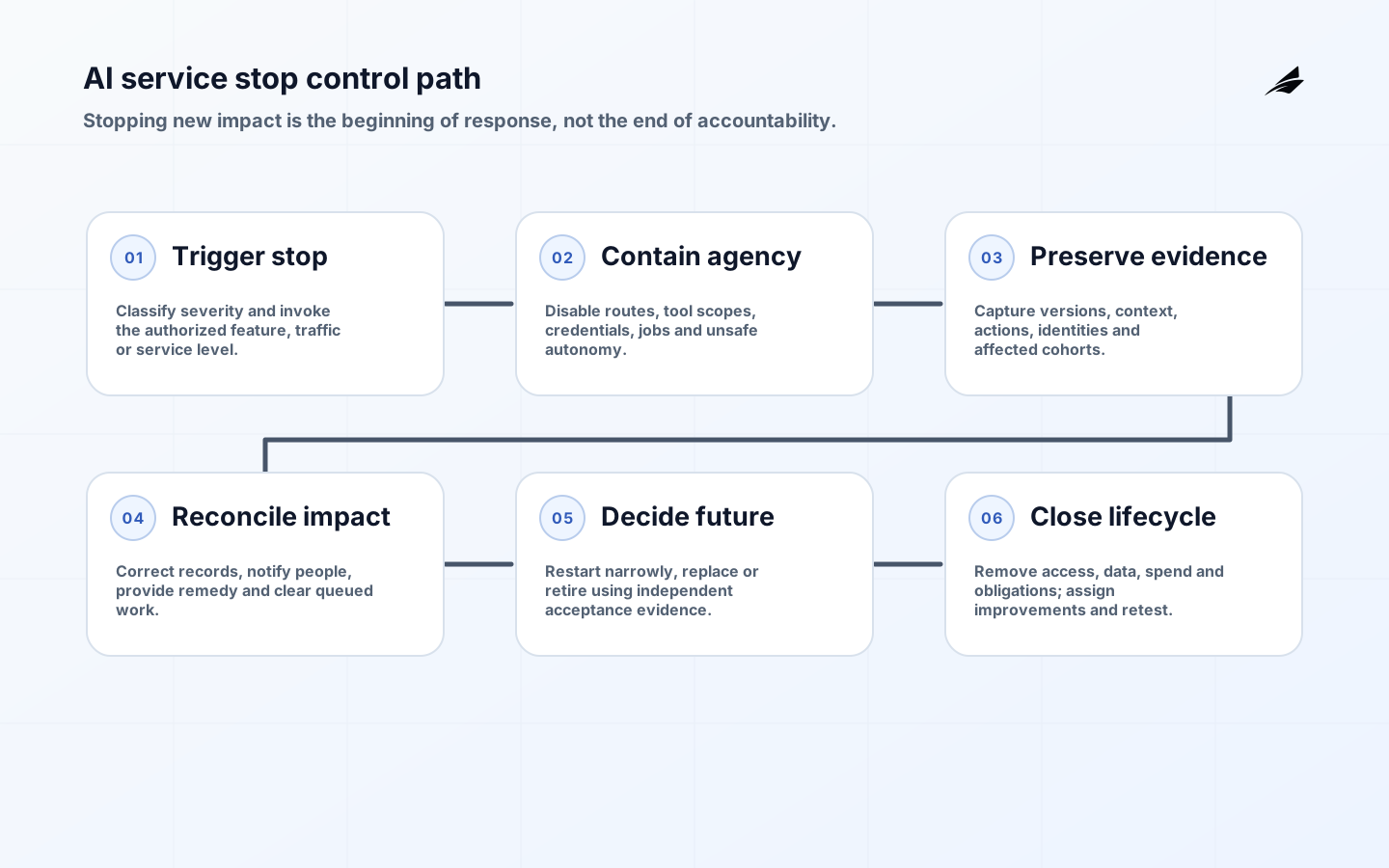
An enterprise AI services stop is an operating control, not an admission that every AI initiative failed. Teams need a rehearsed way to pause or retire a service when observed harm, unlawful use, security compromise, supplier loss, unacceptable error, missing value or cost exposure exceeds tolerance. The goal is to stop new impact, preserve trustworthy evidence, support affected people and reconcile actions already taken without creating a second incident through a rushed shutdown.
Use this checklist with the AI stop scope and cost plan, the continue-pause-stop FAQ, the AI service recovery guide and the production progress checklist. Name an incident commander or lifecycle owner with authority to disable capability while legal, security, product, data and operations owners assess consequences.
1. Define stop levels and triggers
Create controls before launch. A feature pause disables a risky tool or intent; a traffic stop blocks new requests; a containment mode removes write access or uses a deterministic fallback; retirement ends the service and its dependent obligations. Set observable triggers for severe user harm, unauthorized action, data exposure, material discrimination, evaluation regression, provider incident, unbounded spend or inability to meet oversight duties. Include who may trigger each level, how quickly, and which minimum service remains available.
| Signal | Immediate level | Decision evidence |
|---|---|---|
| Unauthorized external action | Remove tool permission and contain traffic | Action log, affected records and credential scope |
| Sensitive data exposure | Stop processing and preserve evidence | Data classes, recipients, legal duties and deletion state |
| Quality below release threshold | Route to reviewed fallback | Representative evaluation and user impact |
| Supplier outage or material change | Activate continuity mode | Contract, dependency, export and replacement options |
| Value or cost failure | Freeze expansion | Outcome baseline, unit cost and opportunity cost |
2. Contain new impact
Disable capability at a policy or gateway boundary that does not depend on the model behaving correctly. Revoke tool scopes, API keys, service accounts and queued jobs; stop ingestion and scheduled retraining where appropriate. Preserve a read-only path to relevant logs and artifacts. Keep deterministic customer and staff fallbacks available, clearly marking limitations. OWASP’s excessive-agency guidance supports minimizing functionality, permissions and autonomy; the stop design should be able to remove each independently rather than requiring a full platform outage.

3. Preserve and scope evidence
Record the trigger, detection time, model and prompt versions, retrieval snapshot, policies, tool calls, identities, outputs, approvals and downstream effects. Protect chain of custody and access while minimizing unnecessary personal data. Do not continue broad testing in production to reproduce harm. Build an affected cohort from trustworthy system events, then validate it against business records. Separate confirmed impact, suspected exposure and unaffected traffic; communicate uncertainty instead of inventing precision. Preserve supplier notices and configuration because hosted behavior can change without an internal deployment.
4. Reconcile people, data and actions
Identify decisions, messages, payments, tickets, files or account changes influenced by the service. Prioritize irreversible and high-consequence effects. Assign human reviewers with authority to correct outcomes, notify affected people, restore access and escalate disputes. Avoid asking the same model to judge its own errors. Reconcile queues and retries so disabled actions cannot execute later. Correct derived data and downstream caches, document what cannot be reversed, and retain a route for appeal. Apply breach, safety, employment, consumer or sector notifications according to applicable law and counsel.
| Workstream | Required output | Acceptance condition |
|---|---|---|
| Containment | Disabled entry points, tools, jobs and credentials | No unapproved new model-driven effect |
| Evidence | Versioned incident package and affected cohort | Independent reviewer can reconstruct key events |
| User remedy | Notice, correction and appeal route | High-impact cases have accountable owners |
| Data | Retention, correction, export and deletion record | Downstream copies are reconciled or disclosed |
| Commercial | Supplier duties, credits, exit and continuity | No hidden dependency blocks the decision |
| Restart or retire | Signed rationale, residual risk and conditions | Approver accepts evidence and ownership |
5. Decide whether to restart, replace or retire
Use the NIST AI RMF functions Govern, Map, Measure and Manage to revisit purpose, context, measured performance and response. Restart only after the cause is understood, controls are implemented, representative tests pass and residual risk has a named acceptor. A narrow restart may remove sensitive data, reduce autonomy, constrain users or require human approval. Replace when a simpler deterministic workflow or different supplier better satisfies the need. Retire when value no longer justifies exposure or the organization cannot exercise required oversight.
A deadline is not evidence. Use a blinded or independent review for consequential systems, test both expected and adversarial cases, and compare against the previous approved baseline. Define a small release cohort, monitoring window and automatic re-stop criteria. Communicate changes to operators and affected users. Do not erase incident evidence in the name of a clean deployment, and do not silently reactivate old integrations whose permissions were intentionally revoked during containment.
6. Complete retirement and learn
Remove routes, keys, agents, indexes, scheduled jobs, data copies and unused infrastructure according to retention and legal holds. Export required records in usable formats, confirm supplier deletion where contracted, update inventories and architecture diagrams, close monitoring and renewals, and preserve minimal audit evidence. Tell users what service ended and what alternative applies. Review procurement, evaluation, change detection, incident response and fallback design. Assign improvements with dates and test the stop mechanism during future exercises.
Exercise the stop path before an incident
Choose a credible scenario tied to the service’s most consequential capability. For an AI-assisted accounts-payable workflow, the exercise might begin with evidence that a retrieval source was poisoned and the system recommended changed bank details for a subset of invoices. Supply enough facts to force decisions but withhold perfect certainty. The incident lead should classify severity, choose a stop level and identify who can authorize it. Time how long it takes to disable new recommendations, revoke payment-tool access, pause queued jobs and place the workflow into a documented manual mode. A dashboard toggle is not sufficient unless downstream credentials and asynchronous paths are contained.
Ask engineering and operations to reconstruct the affected cohort from immutable business events. The incident package should identify the model, prompt, retrieval snapshot, policy and tool versions; the initiating identities; generated proposals; approvals; writes; retries and later corrections. Test whether an investigator can distinguish a displayed suggestion from an executed transaction. If correlation identifiers disappear at a queue or vendor boundary, record that as a control gap. Preserve only evidence necessary for response and obligations, restrict access and document collection decisions. Do not send sensitive production content back through the model merely to reproduce the failure.
The business owner must then reconcile every affected action. Place suspect payments on hold, validate supplier details through an established independent channel, clear or quarantine queued work and give reviewers the source evidence needed to correct records. Communications should describe confirmed impact, possible exposure and current protective action separately. Include an appeal route and a named owner for high-consequence cases. Supplier notification, legal assessment, privacy review and customer support should proceed in parallel according to severity rather than waiting for a single final narrative. Track people who cannot use the manual fallback so containment does not quietly remove an essential service.
End the exercise with a restart hearing. The service owner presents cause, corrective controls, regression results, residual risk, monitoring thresholds and rollback or renewed-stop criteria to an approver who was not responsible for the failed release. Restart first in replay or shadow mode, then with a bounded cohort and reduced tool scope. If the system is retired, prove that endpoints, credentials, jobs, indexes, retained content, supplier commitments and spend are removed while required records remain accessible. Assign every exercise finding an owner, severity, due date and retest. The measured time to contain and reconcile is more useful than a claim that a kill switch exists.
Record two clocks during the tabletop: time to stop new impact and time to reconcile affected people and records. They measure different capabilities. A fast gateway shutdown can coexist with days of unclear downstream effects, while careful remedy may continue after the service is safely contained. Set objectives for both, review delays by ownership boundary and fund the evidence needed to shorten them. Report unresolved exposure separately from confirmed harm so executives do not confuse an incomplete investigation with a clean result.
- Select a scenario that reaches a real downstream action, not only a bad answer.
- Measure containment across gateways, tools, credentials, queues and scheduled work.
- Reconstruct versions and effects from business events with protected chain of custody.
- Test manual service, affected-user remedy and independent restart approval.
- Restart through shadow and bounded modes with explicit halt thresholds.
- Retest every severe finding and record retirement evidence when restart is rejected.
Key takeaways
- Predefine graduated stop levels, authority and minimum service.
- Contain through deterministic policy boundaries and revoke agency first.
- Preserve versioned evidence without extending harmful production experiments.
- Reconcile downstream effects and provide human remedy before declaring closure.
- Restart by bounded evidence; retire data, access, cost and obligations completely.
Frequently asked questions
Is a kill switch enough?
No. It may stop requests but leave queued actions, credentials, copied data and affected decisions. A complete stop control includes containment, evidence, reconciliation, communication and lifecycle closure.
Should all prompts be retained?
Retain only what is justified by security, quality, legal and audit purposes. Protect sensitive content, define access and expiry, and preserve incident evidence under an approved hold.
Can a vendor decide when to restart?
A vendor supplies evidence and remediation, but the deploying organization retains accountability for its use context, affected people and downstream integrations.
Can the service return as a pilot?
Yes, if the pilot has a bounded cohort, reduced consequence, informed operators, passing acceptance evidence, close monitoring and explicit re-stop criteria.
Conclusion
A mature enterprise can stop AI safely because authority, technical controls, evidence and user remedy were designed before the incident. The disciplined path is to detect, contain, preserve, reconcile, decide and close. That protects people and creates a trustworthy basis for a narrower restart, a replacement or a final retirement.