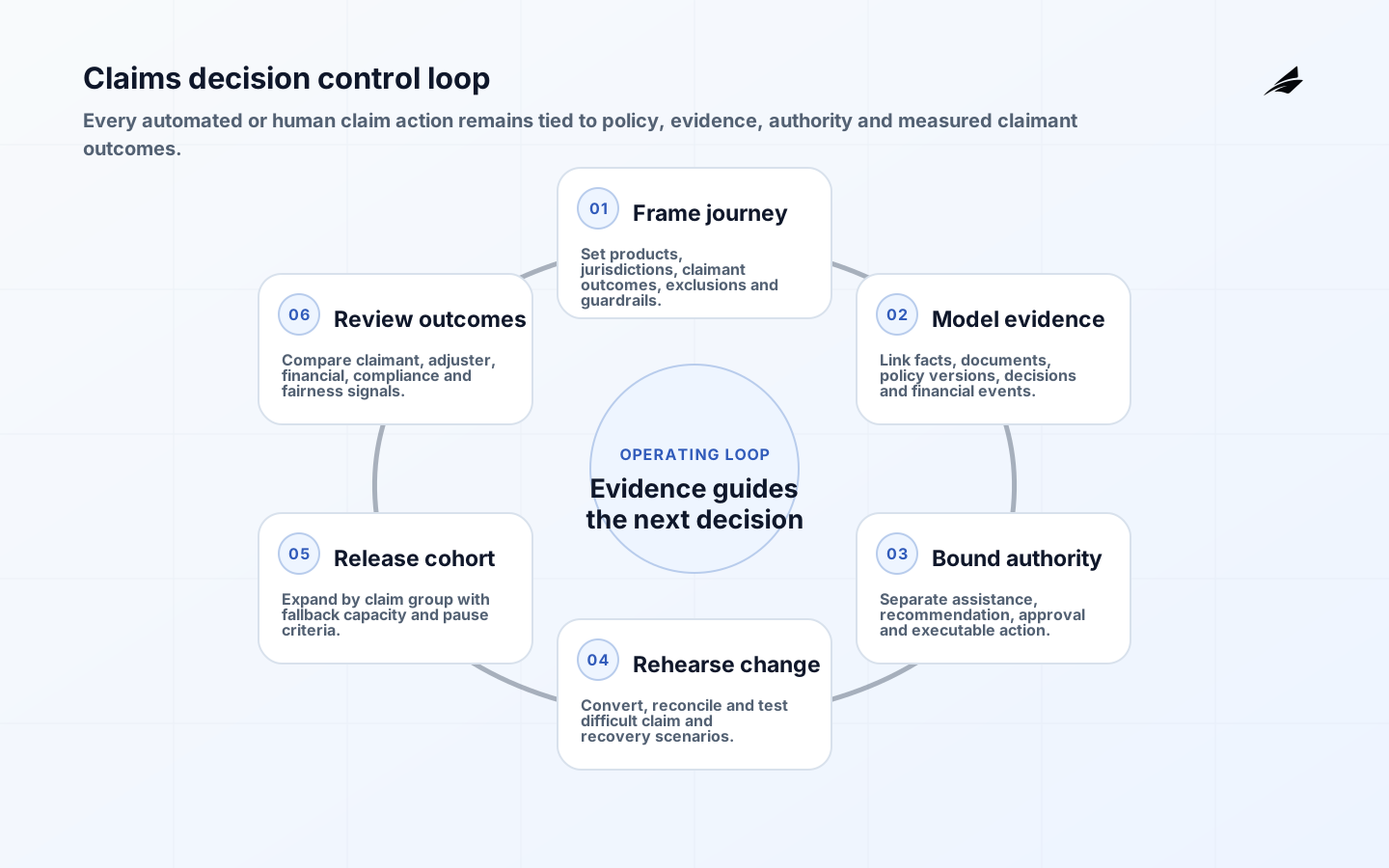
A claims management implementation succeeds when it improves a claimant outcome without weakening coverage interpretation, fairness, privacy or financial control. The system is not merely a new adjuster screen. It is the operational path from first notice of loss through triage, investigation, reserving, communication, payment, recovery and closure. Each step combines policy facts, evidence, judgment, regulated notices and accounting events. That is why the first implementation question should be which claim decisions will change, not which product modules can be switched on.
This claims management implementation FAQ gives business, claims, compliance, data and engineering leaders a common delivery plan. It complements the claims solution scope and cost guide, the claims implementation checklist and the business process automation plan. Requirements vary by jurisdiction and line of business, so counsel and claims leadership must translate applicable obligations into testable rules.
What belongs in the first claims implementation scope?
Choose a coherent claim journey rather than a grab bag of features. A useful first scope might be low-complexity personal auto claims from digital intake to payment, or commercial property intake through assignment and reserve review. Define included products, jurisdictions, channels, claimant types, catastrophe conditions and handoffs. Record exclusions explicitly. A pilot that silently excludes represented claimants, severe injuries or missing policy data can look excellent while proving little about normal operations.
Baseline the journey before designing it. Measure elapsed and touch time, reopen rate, reassignment, supplement frequency, leakage indicators, complaint rate, payment accuracy and claimant contact performance. Segment results by meaningful cohorts rather than relying on one average. The accountable claims owner should approve the target, guardrails and stopping conditions. A faster cycle time is not a win if denials rise, adjusters must correct more work, or vulnerable claimants receive worse service.
| Decision area | Evidence required | First-release choice | Acceptance signal |
|---|---|---|---|
| Journey boundary | Claim volume, severity, variants and legal duties | One product and a defined set of jurisdictions | At least 90% of pilot cases follow a documented path |
| Automation | Task frequency, decision risk and exception history | Automate collection and routing before final adverse decisions | Lower handling effort without higher correction or complaint rates |
| Data migration | Open-claim inventory, document quality and reconciliation rules | Migrate active claims plus required history | Counts and financial balances reconcile to approved tolerances |
| Rollout | Team readiness, partner dependencies and fallback capacity | Cohort release with parallel controls | Service, fairness and financial guardrails remain within limits |
Model the claim as decisions, evidence and financial events
Create a canonical claim model that distinguishes reported facts, verified facts, estimates, allegations, model outputs and adjuster conclusions. Preserve source, time, author, applicable policy version and correction history. Documents should not become untraceable text blobs: link extracted fields to the page or message that supports them and retain the original. Financial events need effective date, accounting date, currency, authority, reason and reversal relationships so reserves and payments can be reconstructed.
Define record authority for policy coverage, party identity, repair estimate, medical evidence, payment status and litigation state. An integration may copy data, but it should not create a second undisclosed master. Use stable identifiers and explicit matching confidence for people, vehicles, properties and vendors. Keep sensitive categories out of general analytics unless the purpose, access and retention rule are approved. The NIST Privacy Framework supports treating privacy risk as an enterprise design concern rather than a notice added at launch.
Where can AI assist, and where must people decide?
Good early uses include document classification, duplicate detection, extraction with citations, contact summarization, assignment suggestions and missing-information prompts. Higher-consequence uses include fraud escalation, reserve recommendation, coverage interpretation, settlement range and denial support. For each use, document the decision affected, model and data version, eligible population, confidence treatment, prohibited inputs, reviewer role, override path and evidence retained. A generic statement that a human is in the loop is not a control unless that person has time, authority and usable evidence.

The NAIC describes AI use across claims handling and emphasizes that AI-supported consumer decisions remain subject to applicable insurance law. Its model-bulletin work also makes governance, risk controls and examination evidence practical implementation concerns. Apply the NIST AI RMF functions across the lifecycle: establish accountability, map the claim context, measure performance and harmful variation, then manage issues. Test representative cohorts, rare but severe cases, missing data, distribution shifts and adversarial documents before production.
Build integrations around ownership and failure behavior
Map policy administration, billing, identity, document, payment, fraud, repair, medical, legal and general-ledger connections. For every interface define producer, consumer, schema, freshness, authorization, reconciliation, retry, duplicate handling and outage behavior. Claims work continues during supplier or network disruption, so queues need visible age, bounded retries and an owned manual path. Payment instructions require stronger identity, approval, tamper evidence and callback controls than a status notification.
Design access from job purpose and claim relationship. Adjusters, supervisors, special investigation, counsel, vendors and contact-center staff should see only the records and actions needed. Time-bound catastrophe access and emergency elevation. Log views of sensitive evidence, exports, authority changes, payment actions, model recommendations and overrides. Protect logs from routine alteration and avoid placing unnecessary claimant data in telemetry. Test departed staff, transferred claims, vendor termination and legal holds, not just normal sign-in.
Rehearse migration and prove claim behavior end to end
Profile active and recently closed claims before mapping. Resolve invalid codes, missing relationships, duplicate parties, unsupported document types and inconsistent reserve histories through approved rules. Run repeated conversions with immutable inputs and versioned mapping. Reconcile claim counts by state, open features, reserves, payments, recoveries, deductibles and authority exceptions. Sample records from every important cohort and compare source documents, screens, notices and ledger outcomes. Business sign-off should name residual defects and their operational treatment.
| Test layer | Representative scenario | Evidence to retain | Release blocker |
|---|---|---|---|
| Coverage and workflow | Amendment, cancellation timing, multi-feature loss and reopened claim | Rule version, expected decision and actual trace | Incorrect coverage path or mandatory notice |
| Financial | Reserve change, partial payment, recovery and reversal | Before-and-after balances and ledger reconciliation | Unexplained imbalance or duplicate payment |
| AI and automation | Low confidence, missing evidence, cohort variation and malicious attachment | Dataset version, metrics, citations and reviewer action | Unsafe action, material disparity or absent fallback |
| Resilience | Partner outage, queue backlog, regional failure and restored service | Timers, alerts, manual procedure and reconciled replay | Lost work, uncontrolled duplication or untested recovery |
Test with production-shaped concurrency and realistic documents, including poor scans, multiple languages and contradictory updates. Exercise complaint, litigation hold, subrogation, catastrophe and suspected-fraud paths. Security tests should include cross-claim access, malicious files, altered payment details and excessive exports. Run a restore drill and prove that replay does not resend payments or notices. The result is a claim-level evidence pack, not a collection of isolated pass rates.
Roll out with claim-level guardrails and accountable review
Release by adjuster group, jurisdiction or claim cohort with a named command structure. Publish the fallback process and criteria to pause automation, revert a rule or route work manually. During early life, review daily queue age, payment exceptions, integration failures, recommendation overrides, complaint signals and cohort outcomes. Keep sufficient trained capacity to handle exceptions. Do not force migration volume through a team whose training, authority or vendor channels are not ready.
Measure a balanced scorecard: claimant effort and communication; indemnity and expense accuracy; cycle and touch time; adjuster workload; compliance timeliness; model quality and override; security and availability; and cost per resolved claim. Define each denominator and eligibility rule. Compare with the baseline and a suitable control cohort where possible. Investigate movement by product, jurisdiction, severity and claimant group before declaring value. Benefits should be attributable to changed behavior, not merely to closing a project milestone.
Key takeaways
- Scope one complete claim journey with explicit products, jurisdictions, exceptions and outcome guardrails.
- Preserve the relationship among claim facts, source evidence, policy versions, decisions and financial events.
- Use AI first for bounded assistance, and make consequential recommendations reviewable, overridable and measurable.
- Rehearse migration, financial reconciliation, resilience and claim-level behavior before increasing volume.
- Judge success through claimant, adjuster, financial, compliance and fairness outcomes together.
Frequently asked questions
How long does a claims management implementation take?
Duration depends on product breadth, jurisdictional variation, active-claim migration, partner integrations and operating change. A bounded journey can be designed and piloted in months, while a multi-line core replacement is usually a staged multi-release program. Estimate discovery, data remediation, rehearsals, training and early-life support explicitly instead of presenting only build time.
Should every open claim be migrated?
Not automatically. Compare active migration, read-only legacy access and managed runoff by claim duration, data quality, operational burden, legal retention and platform cost. Whatever boundary is chosen, staff need one reliable way to find a claim, and financial totals must reconcile across old and new systems.
Can AI approve or deny a claim?
That depends on applicable law, risk appetite, product and the evidence available, but technical capability is not sufficient authority. Consequential automation requires approved rules, validated data, consumer-impact testing, explanation and appeal paths, monitoring and accountable human governance. Many programs should begin with assistive uses and earn broader authority through evidence.
Before procurement closes, ask finalists to demonstrate one representative claim using the insurer's own redacted scenarios. Require the team to show source evidence, rule version, permissions, reserve and payment events, exception handling, telemetry and audit reconstruction. Then change a policy fact, interrupt an integration and revoke a user's authority. This reveals whether the solution supports governed claims work or only a polished nominal path.
Conclusion
A dependable claims platform makes the right work easier while preserving the evidence behind every important action. Start with an owned journey, model decisions and financial events explicitly, constrain AI, test the difficult cases and scale only when claimant and control outcomes hold. That approach turns claims modernization from a software installation into a governable operating improvement.