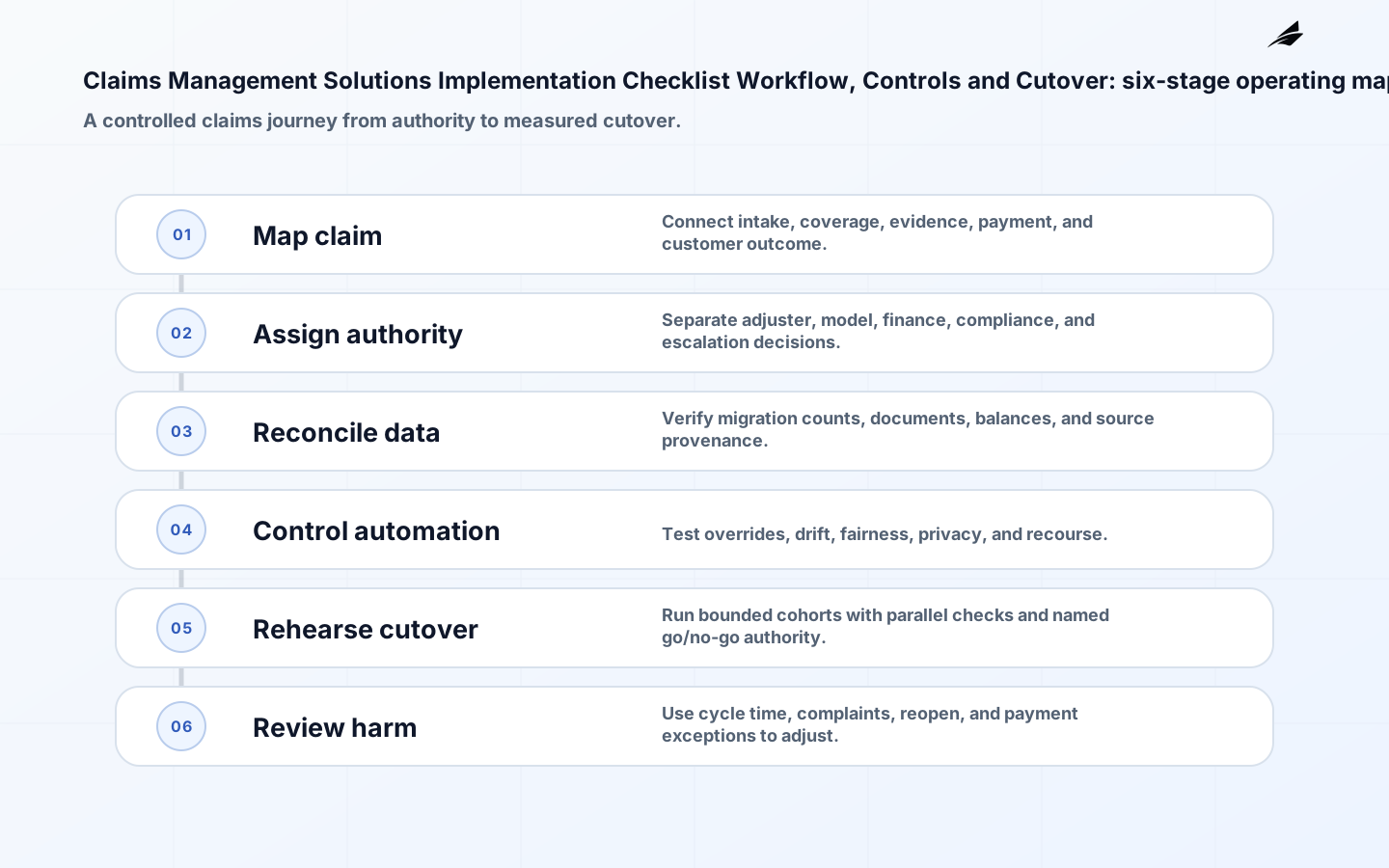
Define claims outcomes before platform scope
Baseline by line, peril, severity, channel and jurisdiction. Map the moments where delay or error changes customer and financial outcomes. Select a release slice that includes a whole journey, such as digital first notice through triage and adjuster handoff for one product. Avoid starting with a generic enterprise data model detached from operational acceptance.
| Outcome | Primary measure | Required guardrail | Evidence owner |
|---|---|---|---|
| Faster intake | Time to complete valid first notice | Abandonment, accessibility and duplicate rate | Claims operations |
| Better triage | Correct route and timely assignment | Bias, override and high-severity misses | Claims quality |
| Accurate payments | Correct amount and payee on time | Duplicate, authorization and reconciliation breaks | Claims finance |
| Consistent handling | Required activities completed by segment | Unfair rigidity and exception aging | Compliance |
| Improved experience | Clear status and reduced repeat contact | Complaint, vulnerable-customer and channel outcomes | Customer operations |
| Lower loss cost | Segment-adjusted leakage and recovery | Denial fairness and litigation indicators | Claims executive |
Model the claim as explicit states and authority
Map loss report, identity, policy lookup, coverage verification, exposure creation, assignment, investigation, evidence, reserve, payment, supplier, recovery, litigation and closure. Define transitions, prerequisites, actor and audit event. Keep reported facts, documents, estimates, recommendations, decisions and financial postings distinct. A prediction should never overwrite original evidence.
Design exceptions as first-class work: missing policy, duplicate claim, catastrophe surge, suspected fraud, disputed coverage, vulnerable claimant, litigation hold, payment return and reopened claim. Provide queues with owner, age, reason and bounded action. Direct database correction bypasses authority and destroys explainability.
Design the claims system of record and integrations
Choose the authoritative source for claim, party, policy snapshot, exposure, reserve, payment and document status. Modern platforms such as Guidewire ClaimCenter illustrate broad lifecycle capability, but product selection does not decide the insurer’s workflow, data, integrations or control model. Test fit on representative claims and exceptions, then verify selected capabilities against current vendor documentation.
Contract policy administration, billing, payments, document management, fraud, repair, medical, legal, finance and data-platform interfaces. Define schema, source authority, authentication, idempotency, ordering, timeout, retry, reconciliation and correction. Preserve a pending state when a dependency fails; do not tell a customer payment succeeded until authenticated provider and ledger evidence agree.
| Integration | Authoritative question | Failure design | Reconciliation |
|---|---|---|---|
| Policy | What coverage and terms applied at loss time? | Retain request and route manual review | Claim snapshot to policy version |
| Payment | Was value authorized, sent, settled or returned? | Idempotent intent and visible pending state | Claim, payment provider and ledger totals |
| Documents | Which immutable evidence and version support action? | Quarantine unsafe or unreadable files | Metadata, storage object and claim link |
| Supplier | What work was assigned, accepted and completed? | Timeout and alternate routing | Claim task to supplier status and invoice |
| Fraud service | What signal was returned and when? | Never auto-deny from unavailable score | Input, version, score and investigator outcome |
| Analytics | Which approved fields leave operations? | Minimize and queue failed extracts | Source counts, transformations and access |
Plan data migration around active handling
Inventory open, closed, litigated, catastrophe and long-tail claims with notes, documents, financial transactions, recoveries, parties, tasks and policy context. Decide migrate, archive or retain with integrated access by segment. Active claims require usable history and next action, not just header fields. Preserve legal holds, retention and evidential integrity.
Profile source quality and approve transformation rules with claims and finance owners. Rehearse extract, load, document linking, access and reconciliation at production scale. Validate counts and financial totals independently, then sample complex cases. During coexistence, define one authority for every mutable field and prevent double payment, duplicate correspondence and lost work.
Build financial, access and audit controls into workflow
Separate claim handling, reserve authority, payment creation and payment approval according to risk and organizational policy. Apply thresholds, delegation dates, conflict checks and emergency procedures. Log actor, role, claim, previous state, new state, reason, time and outcome for consequential actions. Review bulk exports, administrator activity and unusual payment changes.
Use current OWASP ASVS requirements to structure application security verification. Test direct-object and cross-claim authorization, session recovery, file upload, API access and audit protection. The NAIC Insurance Data Security Model Law is a model rather than universal law; adopted jurisdiction requirements and incident duties must be mapped specifically.
Govern AI and automation at each claims decision
Classify automation as extraction, prioritization, recommendation or decision. Record model owner, purpose, data, version, threshold, affected population, human authority and prohibited use. The NAIC’s current AI topic guidance notes that AI-supported insurance actions remain subject to applicable law and highlights governance, risk mitigation and regulatory examination. State adoption and requirements must be checked.
Apply NIST’s AI RMF to govern, map, measure and manage risk. Evaluate false positives and negatives by relevant claim and consumer segments, data drift, override, explanation, security and vendor change. Do not let a fraud, severity or document model become an unreviewed coverage denial. Preserve decisive factors and recourse in language a policyholder and regulator can understand where required.
Design policyholder and adjuster experience together
Policyholders need clear evidence requests, status, contact, consent, payment and appeal paths across mobile, web, phone and assisted channels. Avoid asking for information already held unless verification is necessary. Design for distress, low connectivity, language and disability. Use WCAG 2.2 as a technical accessibility reference and verify applicable legal requirements.
Adjusters need a prioritized work view that explains why an item is urgent, preserves chronology and reduces duplicate entry. Show model recommendations as evidence with confidence and limits, not authoritative facts. Managers need workload, quality, exception age and authority views. Test catastrophe volume and reassignment so work does not disappear when teams change.
Deliver in controlled claim cohorts
Start with process and data discovery, then configure a production-shaped vertical slice. Run migrated or synthetic representative claims through intake, coverage, reserve, payment, correspondence, documents and reporting. Operate in parallel or shadow mode where automated triage or decisions need comparison. Train users on workflows and judgment, not button locations alone.
Rehearse cutover with migration, identity, integrations, queues, financial reconciliation, reports, monitoring, support and customer communication. Define go/no-go authority and thresholds. Release by a bounded product, region or claim cohort, then stabilize exceptions and data quality before expansion. Keep a rollback or containment strategy that accounts for financial and customer actions already completed.
Estimate total cost and operating capacity
Include licenses, configuration, custom extensions, integration, data remediation, document migration, environments, testing, security, model evaluation, training, business backfill, partner services, hypercare and legacy retirement. Ongoing cost includes platform usage, releases, data and model operations, support, control testing and supplier management. Separate transition and steady-state assumptions.
Estimate effort from claim variants, jurisdictions, integrations, historical data and evidence requirements. Fund operations early: product owner, platform engineering, claims configuration, data stewardship, security, release management and support. A transformation that depends indefinitely on the implementation project has not established ownership.
Measure customer, financial and control outcomes
Create cohort reporting for intake completion, time to contact, assignment, coverage, reserve changes, payment, closure, reopen, complaint, litigation and recovery. Segment by relevant product, peril, severity, channel and jurisdiction. Pair averages with distributions and exception age. Monitor manual workarounds and spreadsheet exports as indicators of workflow failure.
For AI and rules, track recommendation, acceptance, override, downstream outcome, drift and complaints without treating historical adjuster choices as perfect truth. Review unintended disparities with qualified specialists. Link each metric to an owner and intervention. A dashboard that cannot change staffing, workflow, model, training or policy is reporting overhead.
- Baseline claim outcomes and choose a bounded product or claim cohort.
- Map states, authority, exceptions and authoritative records.
- Contract policy, payment, document, supplier, finance and analytics boundaries.
- Prove data migration, access, financial and audit controls.
- Evaluate automation by decision impact and preserve human authority and recourse.
- Rehearse cutover, release narrowly and expand from reconciled outcomes.
Make claims implementation auditable at each handoff
A claims management implementation should make a claim’s journey reconstructable. Define the authoritative record for notice, coverage, evidence, decision, payment, and communication. For each handoff, capture who acted, what information was available, which rule or policy version applied, and what remains unresolved. That audit trail supports service quality and review; it is not a substitute for accountable judgment.

Start with intake variations that change the work: missing documents, conflicting loss dates, duplicate notices, suspected fraud signals, accessibility needs, and urgent hardship. Route each condition to a named queue or owner. An AI extraction step can propose structured fields, but the workflow should preserve source evidence and show confidence or uncertainty where a person must verify before a consequential decision.
Coverage and liability decisions need explicit separation between facts, policy interpretation, and approval authority. Store the fact with provenance, the applicable policy version, and the human or rule that made the decision. Avoid letting a model-generated summary become the only record. When the claim is escalated, the reviewer should be able to inspect the original document, extracted field, correction history, and downstream effect.
Payments and recoveries need idempotency and reconciliation. Use a claim or payment operation identifier, hold duplicate submissions, and compare the approved amount with the settlement and ledger records. A timeout must produce a pending state until the external result is confirmed. Retain exceptions in a work queue with a service level and owner rather than silently retrying a potentially consequential effect.
Cutover is a controlled change in decision rights. Reconcile open claims, map legacy statuses, verify document access, train users on exception paths, and run parallel samples before retiring the old workflow. Measure cycle time, reopen rate, missing evidence, manual override, complaint signals, and payment reconciliation—not just automation volume. Those measures tell leaders whether the system is improving outcomes or merely moving work out of sight.
| Handoff | Required evidence | Human decision |
|---|---|---|
| Intake to coverage | Source document and extracted fields | Is the loss in scope? |
| Coverage to assessment | Policy version and facts | What remains to establish? |
| Approval to payment | Approved amount and operation ID | Is the effect authorized and unique? |
| Cutover to operations | Reconciled sample and open-work map | Can the team safely retire the old path? |
Key takeaways
- Scope around complete claim outcomes, not a catalog of screens.
- Keep evidence, recommendations, decisions and financial postings distinguishable.
- Design integrations and migration for idempotency, reconciliation and active handling.
- Govern AI according to its effect on consumers and claim authority.
- Claims-side, release by controlled cohorts and measure quality, fairness, cost and customer experience.
Frequently asked questions
Should an insurer build or buy a claims platform?
Buy mature commodity lifecycle capability when it fits, then configure differentiating products and workflows through supported mechanisms. Build when a material need cannot be met and the insurer can own its lifecycle. Compare data control, integration, upgrades, evidence, exit and total operating cost, not features alone.
Which claims suit straight-through processing?
Start with low-complexity, well-evidenced segments where coverage, identity, amount and fraud controls can be verified and exceptions are safely routed. Define eligibility and stop conditions, sample completed cases and monitor drift. Do not infer suitability from low claim value alone.
How much claim history should be migrated?
Migrate what active handling, customer service, finance, analytics, legal hold and retention require; archive the rest with secure usable access. Decide by claim segment and jurisdiction. The test is whether an authorized user can understand and act on the record, not whether a row exists.
Conclusion
Implementing claims management solutions is an operating-model change supported by technology. Define balanced outcomes, make authority and state explicit, reconcile every financial and integration boundary, and govern automation as part of the claim decision. A controlled cohort and evidence-led expansion protect policyholders while building a platform the insurer can sustain.
For a related decision, compare this approach with Claims Management Solutions: Scope, Cost, Risks and Delivery Plan, Claims Management Implementation FAQ: Workflow, AI Controls and Rollout, AI Document Intake Workflows: A Practical Guide to Reliable Review. Claims-side, each adjacent article treats a different boundary; use the links to test whether the same ownership, evidence, and recovery expectations hold in the surrounding system.
Claims Management Solutions Implementation Checklist: Workflow, Controls and Cutover FAQ
What is the first decision for claims management solutions implementation checklist: workflow, controls and cutover?
For claims management solutions implementation checklist: workflow, controls and cutover, begin by naming the user or operational outcome, the accountable owner, and the evidence that will show whether the outcome is safe. Claims-side, that boundary determines the smallest useful first implementation and gives the team a shared test for scope.
How should a team handle failure in claims management solutions implementation checklist: workflow, controls and cutover?
In claims management solutions implementation checklist: workflow, controls and cutover, classify each failure by its next safe action: correct, retry, reconcile, escalate, or stop. Claims-side, preserve state and a correlation record so a person does not guess whether the first attempt took effect, especially when the boundary can create an external side effect.
When is the implementation ready to expand?
Expand claims management solutions implementation checklist: workflow, controls and cutover after a representative path works with realistic data, known exceptions, observable ownership, and a rehearsed recovery. Claims-side, a larger rollout should add confidence, not conceal unresolved ambiguity in a wider queue.
Conclusion: operate claims management solutions implementation checklist: workflow, controls and cutover with evidence
The durable version of claims management solutions implementation checklist: workflow, controls and cutover is not the one with the most components. Claims-side, it is the one whose promise is explicit, whose boundaries are understandable, whose failure states preserve a safe next action, and whose evidence reaches the people responsible for the result. Claims-side, start with one complete path, measure what users and operators actually experience, and let observed risk decide where the next investment belongs.