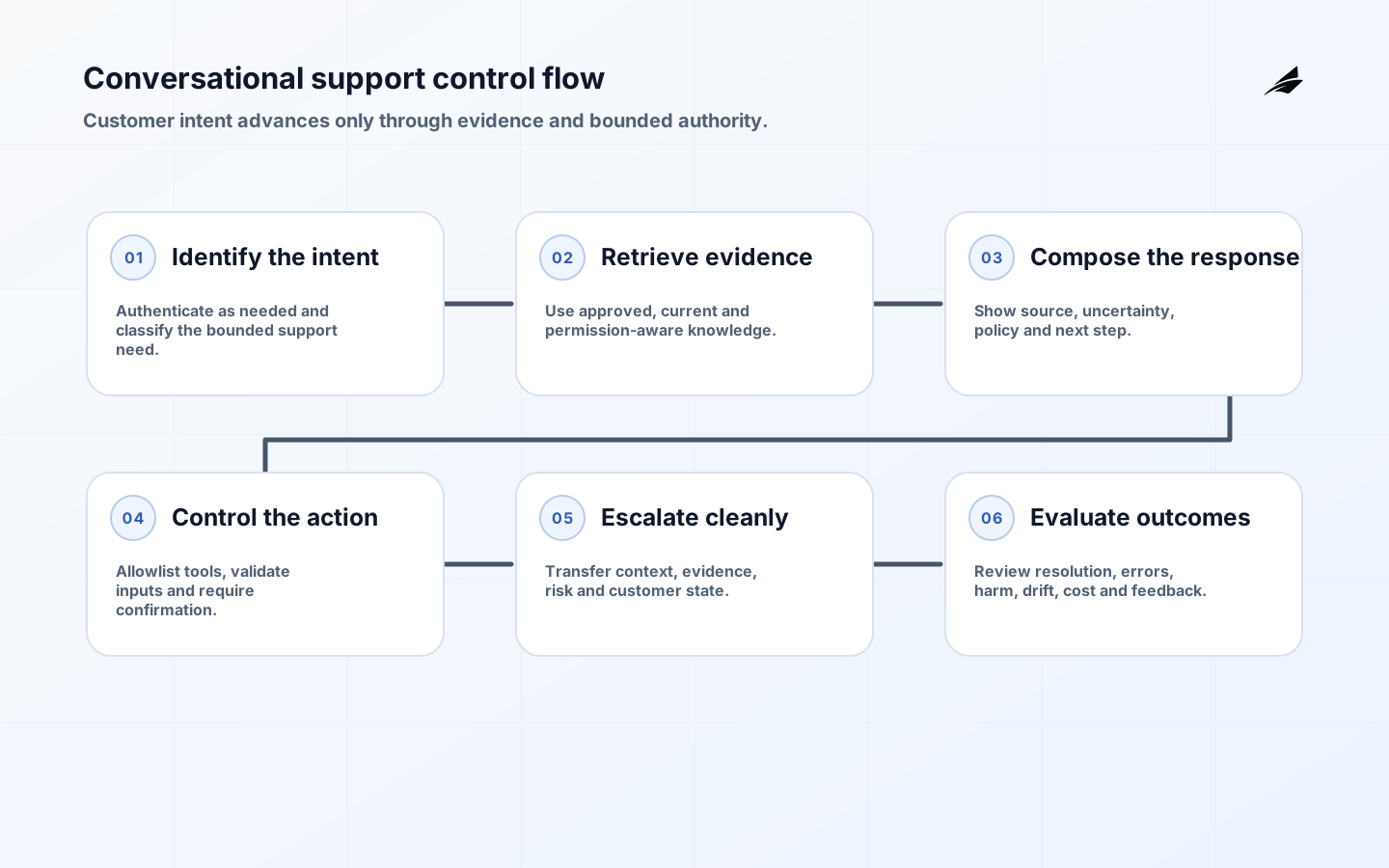
Conversational AI for customer support should be designed as a service workflow, not as a chat window attached to a language model. A dependable system identifies the customer, understands a bounded intent, retrieves approved evidence, proposes an answer or action, and knows when to transfer the case. The result should be a resolved customer need with an auditable record. Fluency is useful, but resolution accuracy, safe authority and a clean human handoff are what make the investment operationally valuable.
This implementation checklist is for support, product, security and engineering leaders defining a first production release. Start with the conversational AI support scope and cost plan, use the conversational support FAQ to resolve design questions, and compare the university AI support checklist when policy, accessibility and safeguarding make escalation especially consequential.
Govern the implementation with the NIST AI Risk Management Framework, its Generative AI Profile and the AI RMF Playbook. Use the OWASP Top 10 for LLM and GenAI to threat-model prompt injection, sensitive disclosure, excessive agency and unbounded consumption. For personal data, the UK ICO's AI and data protection guidance provides an authoritative privacy reference; teams must still apply the laws and policies governing their users and jurisdictions.
Define the support outcome and authority
Begin with customer intents rather than channels or model features. Pull several weeks of contact reasons, transfer reasons, repeat contacts, handle times and quality findings. Group them into intents such as order status, password recovery, invoice explanation or eligibility questions. For each intent, write the correct outcome, the evidence needed, the systems touched and the harm caused by a wrong answer. This produces a useful scope and exposes policy ambiguity before it becomes model behavior.
| Interaction tier | AI may do | Required boundary |
|---|---|---|
| Inform | Answer from approved policies and account-neutral knowledge | Cite the source and refuse when evidence is missing |
| Assist | Draft a personalized explanation for an agent | Agent sees evidence, uncertainty and suggested next step |
| Transact | Perform an allowlisted reversible action | Authenticate, validate policy, confirm intent and log the effect |
| Escalate | Package context for a specialist | Preserve the conversation, customer state and reason for transfer |
A strong first release normally covers a small number of high-volume, low-harm intents. It may answer delivery questions and prepare a return, while disputes, hardship cases, regulated advice and irreversible account changes remain with specialists. Write that boundary in a decision register. Scope creep often arrives as one apparently harmless tool call at a time; an explicit authority matrix prevents the assistant from accumulating privileges without review.
Build a controlled resolution architecture
The runtime should separate probabilistic language work from deterministic business controls. A channel adapter normalizes the message and locale. Identity services establish who is asking. An orchestrator selects the approved intent path. Retrieval obtains permission-filtered passages with version metadata. The model returns a typed proposal. Policy code validates the proposal before any customer-facing answer or system action. This separation makes failures easier to test and keeps a persuasive answer from becoming authorization.

Treat conversation memory as scoped application data. Keep only the fields needed for the active case, distinguish customer statements from verified records, and expire temporary context. Do not place credentials, payment data or unrestricted case histories into a prompt. If retrieval returns conflicting policies, the assistant should expose the conflict to an agent instead of blending them into a plausible compromise. Every response should retain the policy version, retrieved passages, model and prompt version, decision outcome and action receipt.
Prepare knowledge, integrations and handoffs
Knowledge readiness is usually more important than model selection. Give each article an owner, effective date, audience, jurisdiction and retirement state. Break content at decision boundaries rather than arbitrary token lengths, and preserve headings and exceptions. Retrieval tests should include near-duplicate policies, obsolete documents, multilingual queries and customers who lack permission to see a record. An answer without adequate evidence must become a clarifying question or escalation.
| Component | Production requirement | Failure response |
|---|---|---|
| Knowledge index | Approved, current and permission-aware content | Suppress stale or inaccessible passages |
| CRM and case service | Idempotent reads and writes with correlation IDs | Retry safely or create an agent task |
| Identity | Step-up authentication for sensitive requests | Continue with public information only |
| Action tools | Narrow schemas, allowlists and transaction limits | Reject invalid calls before execution |
| Agent handoff | Transcript, evidence, intent and completed steps | Route by skill and preserve queue priority |
Design the handoff before automating an answer. The receiving agent needs a concise summary, but also the original messages and evidence because summaries can omit decisive details. Show what the assistant attempted, what succeeded and why it stopped. Never make the customer repeat identity checks or the entire story when the same assurance can be transferred securely. Measure transfer acceptance and post-transfer resolution, not merely how often the assistant avoided a handoff.
Evaluate complete conversations before launch
Create an evaluation set from consented, de-identified cases and deliberately authored edge cases. Label the expected intent, acceptable evidence, prohibited claims, allowed action and escalation condition. Run the same set whenever the model, prompt, retrieval configuration, policy or tool changes. Score the final workflow rather than isolated sentences: a correct answer tied to the wrong account is still a severe failure, while a cautious escalation can be the correct result.
- Test ordinary requests, ambiguous wording, spelling errors, code switching and abrupt topic changes.
- Include prompt injection in customer text and retrieved documents; confirm that instructions in evidence cannot override system policy.
- Replay tool timeouts, duplicate callbacks and partial downstream failures to verify idempotency and reconciliation.
- Have support specialists review a stratified sample for correctness, tone, policy compliance and missing context.
- Set launch thresholds separately for each intent and risk tier; do not hide a dangerous intent behind a high aggregate score.
Online measures should combine containment with customer outcomes. Track verified resolution, repeat contact within a defined window, escalation quality, incorrect-action rate, evidence coverage, latency, cost per resolved case and customer effort. Containment alone creates an incentive to block access to people. Add a stop mechanism that disables an intent or action independently when monitoring detects a policy breach, vendor incident or sudden evaluation regression.
Control privacy, security and customer harm
NIST organizes AI risk work around Govern, Map, Measure and Manage, while its generative AI profile emphasizes risks that can be intensified by generative systems. Apply those ideas to the support case: assign accountable owners, map affected customers and failure impacts, measure behavior with representative tests, and maintain incident and change processes. Data protection review should establish purpose, minimization, retention, access and customer rights before transcripts are reused for analytics or training.
| Risk | Preventive control | Detection or recovery |
|---|---|---|
| Unsupported answer | Require adequate approved evidence and calibrated refusal | Sample groundedness and review repeat contacts |
| Prompt injection | Treat messages and retrieved text as untrusted data | Log policy rejections and isolate poisoned content |
| Excessive agency | Use least-privilege tools and deterministic approval rules | Reconcile every side effect and revoke the tool quickly |
| Sensitive disclosure | Filter retrieval by identity and redact prompt data | Audit unusual access and notify through incident procedure |
| Automation bias | Show uncertainty and source context to agents | Compare agent overrides with downstream outcomes |
Plan delivery, cost and operating ownership
Cost is driven less by a single model price than by integration, knowledge remediation, evaluation and support operations. Estimate demand by intent, turns per conversation, context size, tool calls and peak concurrency. Add the cost of labeling tests, security review, observability, agent training and ongoing policy changes. A cheaper model that causes more transfers or repeat contacts can raise total cost; compare cost per verified resolution and cost of error, not cost per token.
| Stage | Exit evidence | Primary cost drivers |
|---|---|---|
| Discovery | Intent inventory, baseline and authority matrix | Process analysis and policy cleanup |
| Prototype | Grounded answers on a fixed evaluation set | Knowledge pipeline and model experiments |
| Agent assist | Useful drafts with measured acceptance and quality | CRM integration, interface and training |
| Limited self-service | Low-risk intents meet safety and resolution thresholds | Identity, tools, monitoring and support |
| Scale | New intents pass repeatable gates | Evaluation upkeep, localization and operations |
Give one product owner responsibility for customer outcomes and one operational owner authority to pause the service. Knowledge owners approve content; security owns threat review; support leads define escalation and quality; engineering owns reliability and tool controls. Review changes through an evidence gate, then operate a weekly loop for defects and a monthly review for intent expansion. The business process solutions delivery guide is useful when the assistant is one part of a broader workflow redesign.
Key takeaways
- Scope conversational support by customer intent, failure impact and permitted authority.
- Keep identity, policy validation and side effects outside the model in deterministic services.
- Make current, owned and permission-aware knowledge a release prerequisite.
- Evaluate full conversations and downstream outcomes, including correct escalation.
- Fund monitoring, policy maintenance and agent operations as part of the product, not as post-launch overhead.
Frequently asked questions
Should we start with the most capable model?
Start with the quality, latency, privacy and tool-use requirements for each intent, then test candidate models on the same cases. A smaller model may be sufficient for classification while a stronger model handles complex drafting. Routing by task can control cost, but every route needs its own thresholds and fallback.
What is a healthy containment target?
There is no universal percentage. A healthy target includes only contacts that are actually resolved without avoidable repeat contact or customer harm. Set it by intent and pair it with resolution, escalation quality, customer effort and incorrect-action measures.
Does retrieval eliminate hallucinations?
No. Retrieval can provide better evidence, but it can return stale, irrelevant, conflicting or unauthorized text, and the model can still misstate it. Use content governance, retrieval evaluation, citations, answer validation and refusal behavior together.
When must a human take over?
Escalate when identity assurance is insufficient, required evidence is missing, the customer disputes a material decision, the request falls outside approved authority, or the workflow detects distress, vulnerability or repeated failure. The handoff should carry context and preserve the customer's place in the process.
Conclusion
A useful support assistant is a controlled resolution system with conversation as its interface. Narrow intent scope, governed knowledge, least-privilege actions, rigorous evaluation and humane escalation let the service improve speed without concealing risk. Launch one measurable path, verify real outcomes, and expand only when the operating evidence supports more authority.