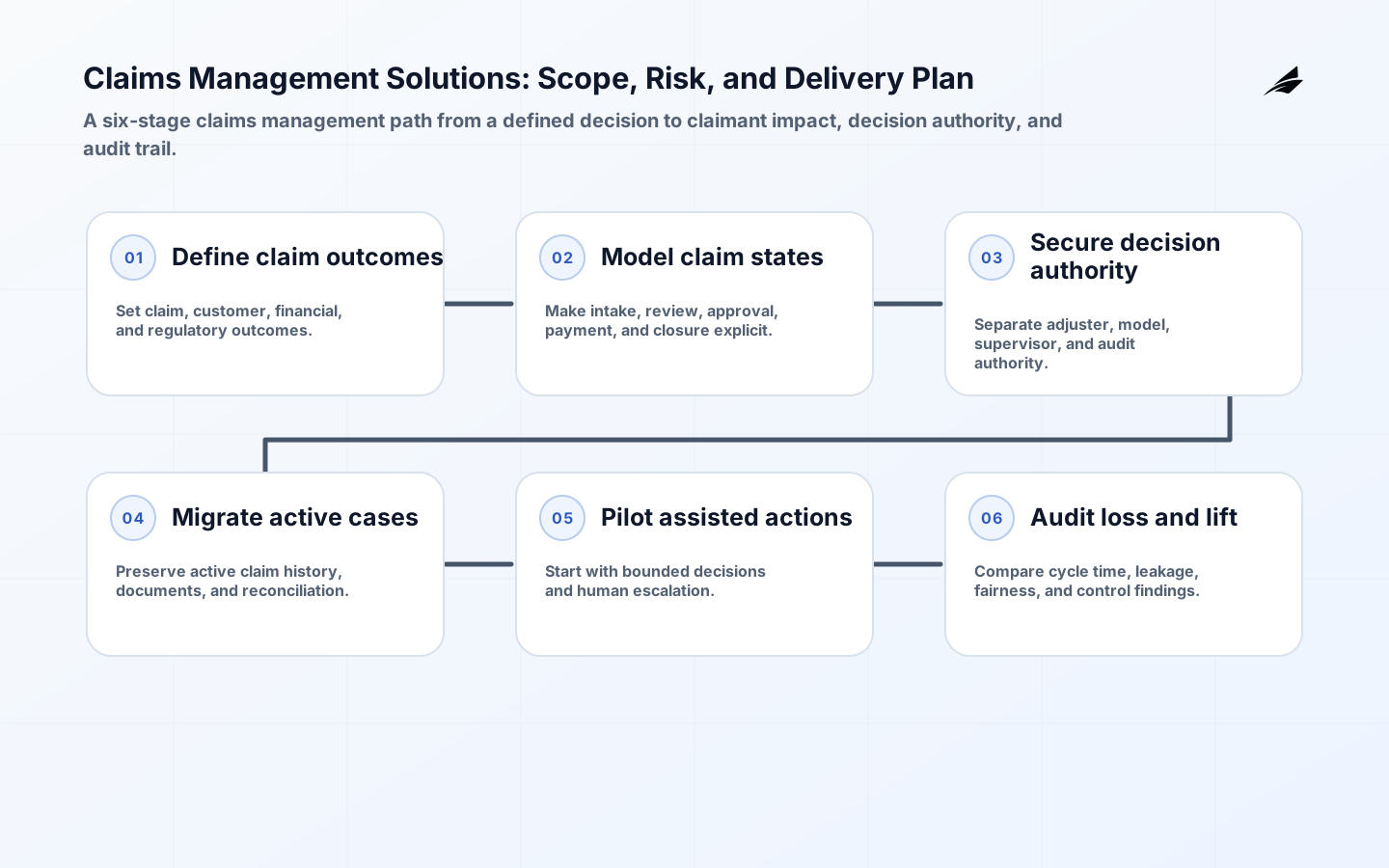
Claims management solutions coordinate the insurer’s promise from first notice of loss through coverage, investigation, reserves, payments, recovery and closure. Implementation is not a form-replacement project. It changes how policyholders, adjusters, suppliers, finance, legal, fraud and regulators see and act on the same claim.
This guide is for claims executives, product owners, architects, data leaders and control functions defining scope or selecting a platform. Use the claims implementation checklist, claims solution FAQ and business process solutions plan as companion references. Insurance law varies by jurisdiction and line; qualified counsel and claims specialists must approve applicable rules.
Define claims outcomes before platform scope — claims management
Set outcomes by claim segment: reporting effort, contact timeliness, coverage-decision quality, cycle time, reserve accuracy, payment correctness, leakage, recovery, complaint and adjuster workload. Balance speed with fairness and accuracy. A lower average cycle time can be harmful if complex or vulnerable customers are rushed, denied or repeatedly asked for evidence.
| Outcome | Primary measure | Required guardrail | Evidence owner |
|---|---|---|---|
| Faster intake | Time to complete valid first notice | Abandonment, accessibility and duplicate rate | Claims operations |
| Better triage | Correct route and timely assignment | Bias, override and high-severity misses | Claims quality |
| Accurate payments | Correct amount and payee on time | Duplicate, authorization and reconciliation breaks | Claims finance |
| Consistent handling | Required activities completed by segment | Unfair rigidity and exception aging | Compliance |
| Improved experience | Clear status and reduced repeat contact | Complaint, vulnerable-customer and channel outcomes | Customer operations |
| Lower loss cost | Segment-adjusted leakage and recovery | Denial fairness and litigation indicators | Claims executive |
Model the claim as explicit states and authority — claims management
Model the claim file as a sequence of decisions, not a single status field. Show when a loss report becomes a claim, when coverage is checked, when an exposure is opened, when evidence is requested, and when reserve or payment authority changes. Preserve the original notice, document provenance, adjuster assessment, model suggestion, approved decision, and ledger posting as separate records. That separation lets a policyholder challenge a result and lets a reviewer reconstruct which fact supported it.
Give the exception queue the same design attention as intake. Missing policy data, duplicate loss notices, catastrophe volume, suspected fraud, disputed coverage, vulnerable customers, litigation holds, returned payments, and reopened claims each need a reason, owner, age, permitted action, and escalation clock. Do not resolve them with direct database edits. A controlled correction changes the claim state through an authorised workflow and records the evidence that explains why the normal route did not apply.
Design the claims system of record and integrations — claims management
Name one authority for each mutable claim fact: claim identity, party, policy snapshot, exposure, reserve, payment, document receipt, and litigation status. A suite may provide screens and lifecycle modules, but it cannot decide which insurer policy wins when policy administration, billing, finance, and claims disagree. Test vendor fit with ordinary, litigated, catastrophe, and reopened claims; verify the selected release’s controls and integrations against current supplier documentation before treating a feature as an operating capability.
Design each claims boundary around a business consequence. Policy lookup needs a dated snapshot; payment needs provider acknowledgement and ledger posting; document exchange needs checksum, classification, and retention; repair or medical suppliers need consent, scope, and response status. Specify authentication, idempotency, ordering, timeout, retry, reconciliation, and correction for every interface. Keep a visible pending state when a dependency fails so a claimant is not told that money or coverage is settled before the authoritative evidence exists.
| Integration | Authoritative question | Failure design | Reconciliation |
|---|---|---|---|
| Policy | What coverage and terms applied at loss time? | Retain request and route manual review | Claim snapshot to policy version |
| Payment | Was value authorized, sent, settled or returned? | Idempotent intent and visible pending state | Claim, payment provider and ledger totals |
| Documents | Which immutable evidence and version support action? | Quarantine unsafe or unreadable files | Metadata, storage object and claim link |
| Supplier | What work was assigned, accepted and completed? | Timeout and alternate routing | Claim task to supplier status and invoice |
| Fraud service | What signal was returned and when? | Never auto-deny from unavailable score | Input, version, score and investigator outcome |
| Analytics | Which approved fields leave operations? | Minimize and queue failed extracts | Source counts, transformations and access |
Plan data migration around active handling — claims management
Segment the migration by handling need and legal obligation. An open bodily-injury claim, a closed household claim, a litigated file, a catastrophe cohort, and a long-tail recovery record do not need the same cutover treatment. Inventory notes, documents, financial postings, recoveries, parties, tasks, policy context, legal holds, and retention dates. For active work, prove that an adjuster can see the chronology, evidence, authority, and next action—not merely that a claim number imported successfully.
Build financial, access and audit controls into workflow — claims management
Make authority visible at each consequential step. The person who investigates may not be the person who approves a reserve increase or releases payment, especially above a threshold or where a conflict exists. Encode delegation dates, emergency handling, separation of duties, and second review in the workflow. Record actor, role, claim, prior state, new state, reason, time, and outcome, then review bulk exports and unusual payment changes as claim-control signals rather than as generic administrator logs.
Use OWASP ASVS as a test structure, then make the cases claims-specific. Attempt cross-claim access, unauthorised document download, unsafe file upload, session recovery abuse, API replay, audit tampering, and privilege escalation through bulk payment or reserve actions. Treat the NAIC Insurance Data Security Model Law as a model reference, and map the insurer’s adopted jurisdictions, breach duties, and retention obligations before accepting the control design.
Govern AI and automation at each claims decision — claims management
Label each automated claims feature by what it is allowed to do: extract a document field, prioritize a queue, recommend an investigation step, or make a decision. Record the model or rule owner, purpose, inputs, version, threshold, affected claimant population, human authority, and prohibited use in the claim workflow. Use the NAIC AI topic guidance as a governance reference, but check state adoption, product rules, and examination expectations before relying on automation.
Apply the NIST AI RMF to the claim decision points where an error changes treatment or payment. Measure false positives and negatives by product, peril, geography, language, vulnerability, and severity; monitor drift, overrides, vendor changes, security, and explanation quality. A fraud, severity, or document model may inform an adjuster, but it must not silently become a coverage denial. Preserve decisive factors and a comprehensible recourse path.
Design policyholder and adjuster experience together — claims management
An adjuster workspace should make the next safe action obvious without hiding the file’s history. Prioritize by deadline, claimant need, severity, missing evidence, and catastrophe impact; show the reason for priority and the age of each exception. Place model suggestions beside their inputs, confidence, limits, and override control, never in the same visual role as an approved fact. Test reassignment, surge staffing, and supervisor views so a claim remains owned when teams or territories change.
Deliver in controlled claim cohorts — claims management
Begin implementation with a production-shaped claim cohort, not a polished generic demo. Run ordinary and difficult cases through notice, policy lookup, coverage, triage, evidence, reserve, payment, correspondence, documents, and reporting using migrated or representative synthetic data. Shadow automated triage beside experienced adjusters before changing authority. Train users on evidence, exception ownership, recourse, and judgment boundaries so the workflow remains safe when the screen or supplier configuration changes.
A claims cutover needs a case-file rehearsal. Include identity and role access, migrated documents, policy and payment integrations, work queues, financial reconciliation, notices, reports, monitoring, support, and claimant communication. Set go/no-go thresholds for lost work, duplicate payment, missing evidence, reserve divergence, and contact delay, with a named authority to stop. Release by product, region, or claim cohort and use containment rather than pretending a rollback can erase completed customer or financial actions.
Estimate total cost and operating capacity — claims management
Claims cost is dominated by the operating perimeter around the platform. Include configuration, product and jurisdiction rules, integrations, data remediation, document migration, security and audit storage, model evaluation, test environments, adjuster training, backfill, supplier services, hypercare, and legacy retirement. Steady-state cost must cover platform usage, release regression, data and model operations, support, control testing, regulatory response, and vendor management. Separate one-time conversion assumptions from the cost of handling each active claim.
Measure customer, financial and control outcomes — claims management
Build cohort reporting around the claim lifecycle: notice completion, first contact, assignment, coverage decision, reserve movement, payment, closure, reopen, complaint, litigation, and recovery. Segment by product, peril, severity, channel, jurisdiction, and claimant need. Pair averages with distributions, backlog age, rework, and unresolved evidence. Treat spreadsheet exports, manual reminders, and repeated status calls as signals that the workflow is failing to expose state or provide a safe next action.
For claims automation, connect each recommendation or rule outcome to what happened next: accepted, overridden, escalated, paid, reopened, complained about, or found wrong in review. Do not treat historical adjuster choices as perfect labels; have qualified specialists inspect drift and disparities across relevant segments. Every metric needs an owner and an intervention, such as retraining, threshold change, staffing, workflow correction, or policy review. A dashboard is useful only when it can change how a claim is handled.
- Baseline claim outcomes and choose a bounded product or claim cohort.
- Map states, authority, exceptions and authoritative records.
- Contract policy, payment, document, supplier, finance and analytics boundaries.
- Prove data migration, access, financial and audit controls.
- Evaluate automation by decision impact and preserve human authority and recourse.
- Rehearse cutover, release narrowly and expand from reconciled outcomes.
Key takeaways — claims management
- Scope around complete claim outcomes, not a catalog of screens.
- Keep evidence, recommendations, decisions and financial postings distinguishable.
- Design integrations and migration for idempotency, reconciliation and active handling.
- Govern AI according to its effect on consumers and claim authority.
- Release by controlled cohorts and measure quality, fairness, cost and customer experience.
Frequently asked questions — claims management
Should an insurer build or buy a claims platform? — claims management
Buy commodity claims capabilities when they fit the insurer’s control model, and configure product-specific workflows through supported mechanisms. Build only where a material claims need cannot be met and the insurer can own testing, security, evidence, and change. Compare authority, integration, upgrade behavior, data portability, auditability, supplier access, exit effort, and total operating cost. A long feature list does not compensate for a payment or coverage process the insurer cannot explain during review.
Which claims suit straight-through processing? — claims management
How much claim history should be migrated? — claims management
Conclusion — claims management
Claims management implementation succeeds when the insurer changes an operating model with evidence, not when it merely replaces screens. Define balanced outcomes for policyholders, adjusters, finance, and control functions; make claim state and authority explicit; reconcile every payment and integration boundary; and govern automation as part of the claim decision. A bounded cohort, visible exceptions, and evidence-led expansion protect customers while giving the insurer a platform it can operate, challenge, and improve.
Implementing Claims Management Solutions: Scope, Cost, Risks, and Delivery Plan: a decision example
Make the claims-management decision inspectable
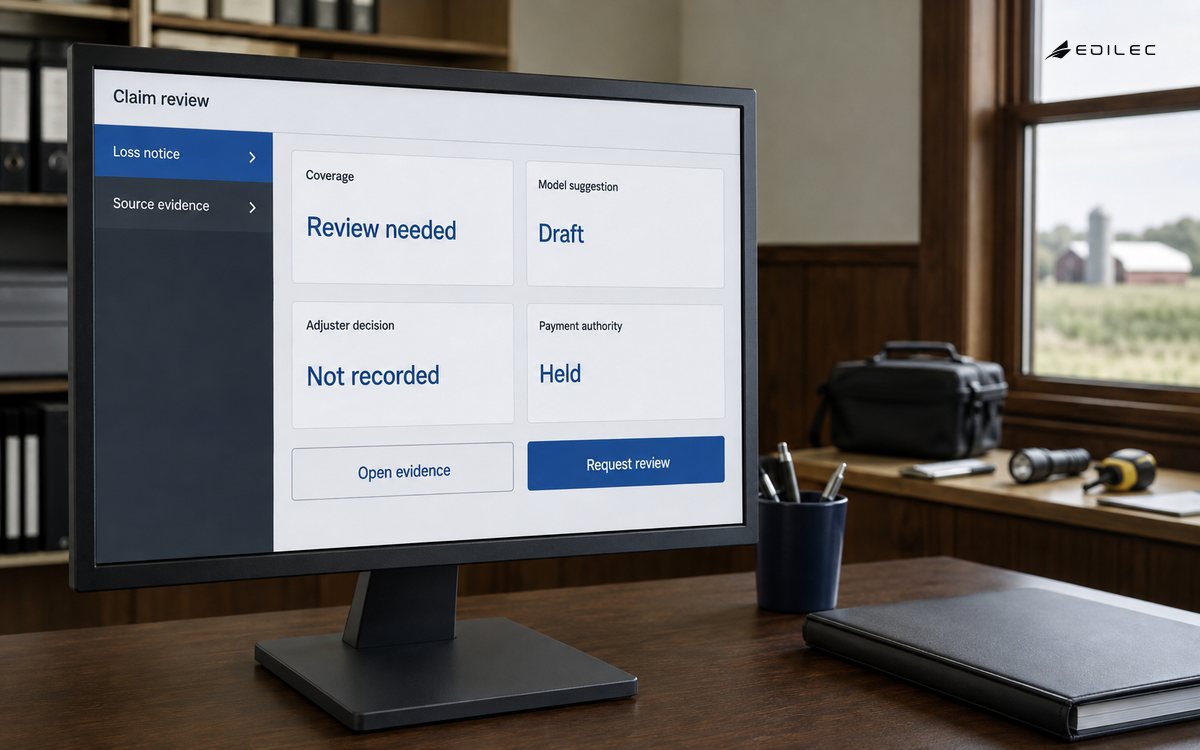
Cost estimates should include the operating system around the software. Budget integrations, data quality work, policy and rules configuration, model evaluation, security, audit storage, training, change management, support, and ongoing vendor review. A low implementation quote can conceal manual exception handling or expensive reconciliation. Build a thin slice with representative claims, including incomplete documents, conflicting facts, suspected fraud, and a claimant who challenges the outcome. Measure cycle time and rework alongside accuracy and cost.
Governance is not optional when automation influences claims handling. NAIC materials emphasize that existing unfair claims settlement standards still apply when AI systems are used. Maintain an inventory of models and rules, intended use, prohibited use, data provenance, validation results, human authority, monitoring, and an incident route. Separate assistance from adjudication in the workflow and make it possible to reconstruct the inputs and version that influenced a recommendation. Privacy, access, retention, and vendor controls should be tested with the same seriousness as the happy path.
Delivery should move from assisted work to broader automation only when evidence supports it. Start with drafting, classification, or retrieval where a trained adjuster reviews the result, then evaluate error patterns by product, geography, language, and claim type. Give staff a clear override and escalation path; log why it was used. Review complaints, adverse outcomes, turnaround, manual touch time, and drift at a named governance forum. A claims solution earns trust when it makes accountable decisions easier to perform and easier to challenge.
Frequently asked questions — claims management — part 2
A claims-management delivery review should include a case file that was not selected for its neatness. Use missing documents, conflicting policy data, a language variation, a potential conflict of interest, and a claimant question. Trace how the solution records evidence, routes uncertainty, supports a human decision, and communicates the next step. This exposes whether automation is improving the regulated process or merely shifting work into an invisible exception queue. Keep the case in the evaluation set so later model or rules changes remain comparable.
Conclusion — claims management — part 2
Claims modernization is credible when lifecycle states, decision authority, migration evidence, and human review remain auditable.