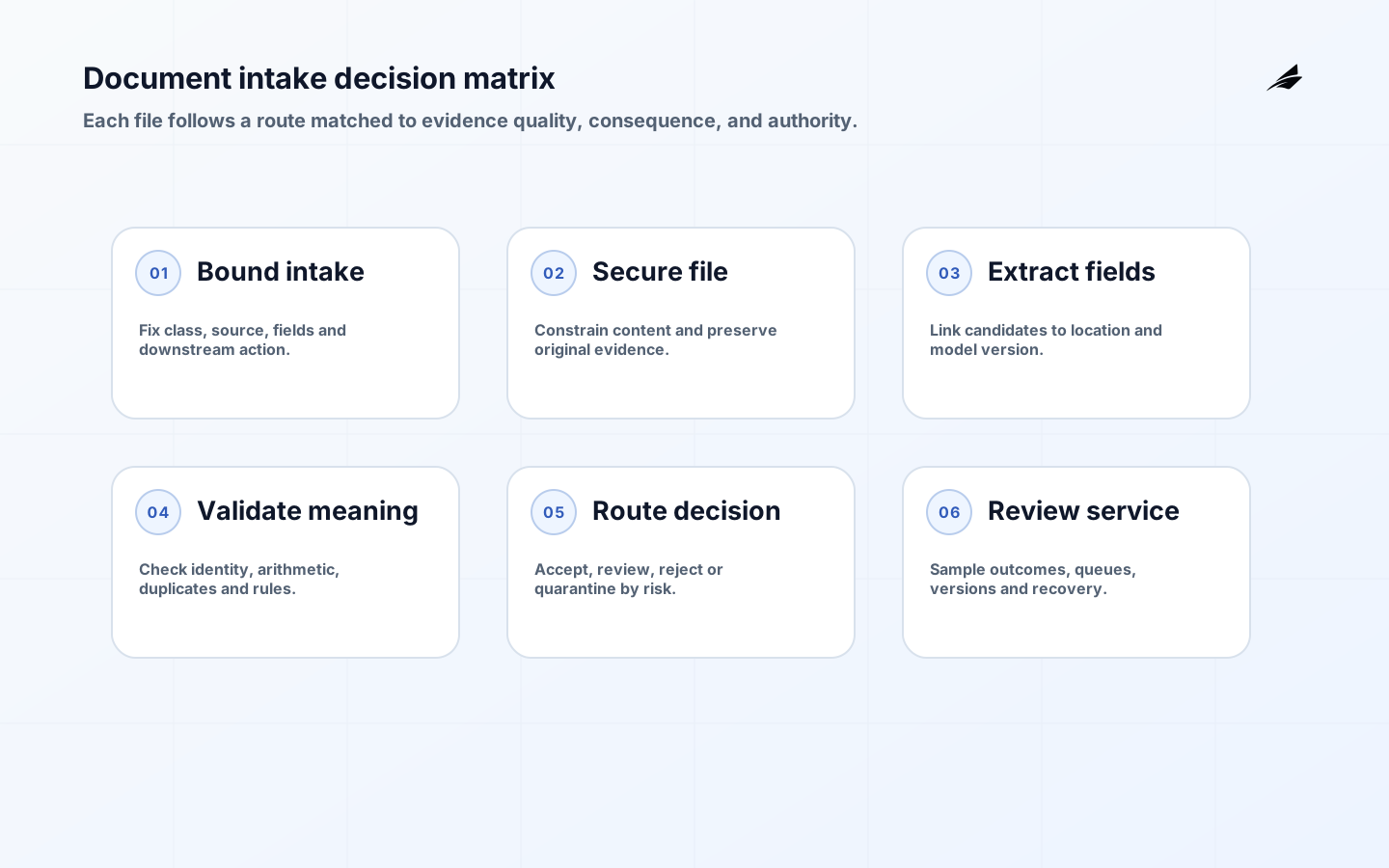
An AI document intake workflow turns files into proposed structured records. The difficult part is not extracting text; it is deciding which documents are accepted, which fields matter, how uncertainty is measured, who resolves conflicts, and when data may enter an authoritative system. These answers keep automation useful without making an opaque model the final authority.
This AI document intake workflow FAQ addresses the questions teams encounter between demonstration and production. Related Edilec guides cover document intelligence for finance, common intake mistakes, and human-in-the-loop automation.
Key takeaways
- Begin with one document class, known sources, a fixed field schema, and a reversible downstream action.
- Measure precision and recall per field and cohort; calibrate confidence on representative documents.
- Preserve the original, extraction evidence, model and rule versions, reviewer action, and posting result.
- Route uncertainty by consequence and deterministic validation, not a universal confidence threshold.
- Design quarantine, queue capacity, idempotent posting, replay, sampling, and rollback before launch.
AI document intake FAQ: scope and value
What is a good first document intake use case?
Choose a frequent, bounded document type with a stable schema, clear owners, enough labelled examples, and a reversible next step. Extracting fields from one region's standard invoices into a pending review record is stronger than processing every attachment into final financial postings. Avoid identity, legal, medical, or payment-changing workflows until control and expertise match their consequence.
What baseline should we establish?
Measure current volume, arrival channels, handling time, rework, error types, queue age, downstream correction, and cost. Sample the actual document mix, including poor scans, rare layouts, languages, handwriting, and missing pages. The value case should include reviewer and exception work, platform operation, retention, integration, and incident response, not only model price.
| Scope decision | Minimum answer | Reason |
|---|---|---|
| Document class | Defined examples and exclusions | Prevents silent expansion |
| Fields | Schema, type, consequence, owner | Enables field-level tests |
| Source | Authenticated channel and trust level | Supports security and routing |
| Outcome | Pending record, recommendation, or final post | Sets authority boundary |
| Fallback | Manual route and queue objective | Keeps work moving during failure |
Accuracy and routing questions
How should extraction accuracy be measured?
Use a locked, labelled test set and report precision, recall, and F1 per important field and document cohort. Google's evaluation guidance derives these measures from predictions and annotations and supports threshold analysis. Add exact business checks for totals, identifiers, duplicates, dates, and master-data matches. Report end-to-end posting correctness separately from model extraction.
Can confidence decide straight-through processing?
Confidence can inform routing after calibration, but it is not probability of business correctness. A high-confidence supplier name can still match the wrong account. Microsoft's transparency guidance recommends representative pilots and scenario-specific thresholds. Combine calibrated score, source, document quality, validation, novelty, and consequence.
| Route | Typical evidence | Required control |
|---|---|---|
| Auto-accept | Known source, strong calibration, all checks pass | Independent output sampling |
| Field review | One uncertain or conflicting field | Page highlight and focused authority |
| Full review | Novel layout or several conflicts | Complete document verification |
| Reject | Unsupported or unreadable file | Reason and resubmission route |
| Quarantine | Integrity or security concern | Restricted investigation path |
Security, privacy, and evidence questions
How should uploaded documents be handled?
Treat every file as untrusted. Authenticate channels, inspect real file type, limit size, pages, decompression, and processing time, scan for malware, and isolate rendering or parsing. Reject unsupported encryption and active content safely. NIST SP 800-53 provides a broad control catalogue for access, audit, integrity, incident response, and system protection that teams can tailor.
What evidence should be retained?
Retain the intake ID and hash, original under policy, source identity, received time, page locations, raw and normalized fields, model and prompt or processor version, validation results, reviewer decision, posting key, and downstream result. Apply purpose, access, residency, and retention requirements. The NCSC AI security guidance stresses documenting and protecting data, models, prompts, logs, and assessments.
Human review and authority questions
What should a reviewer see?
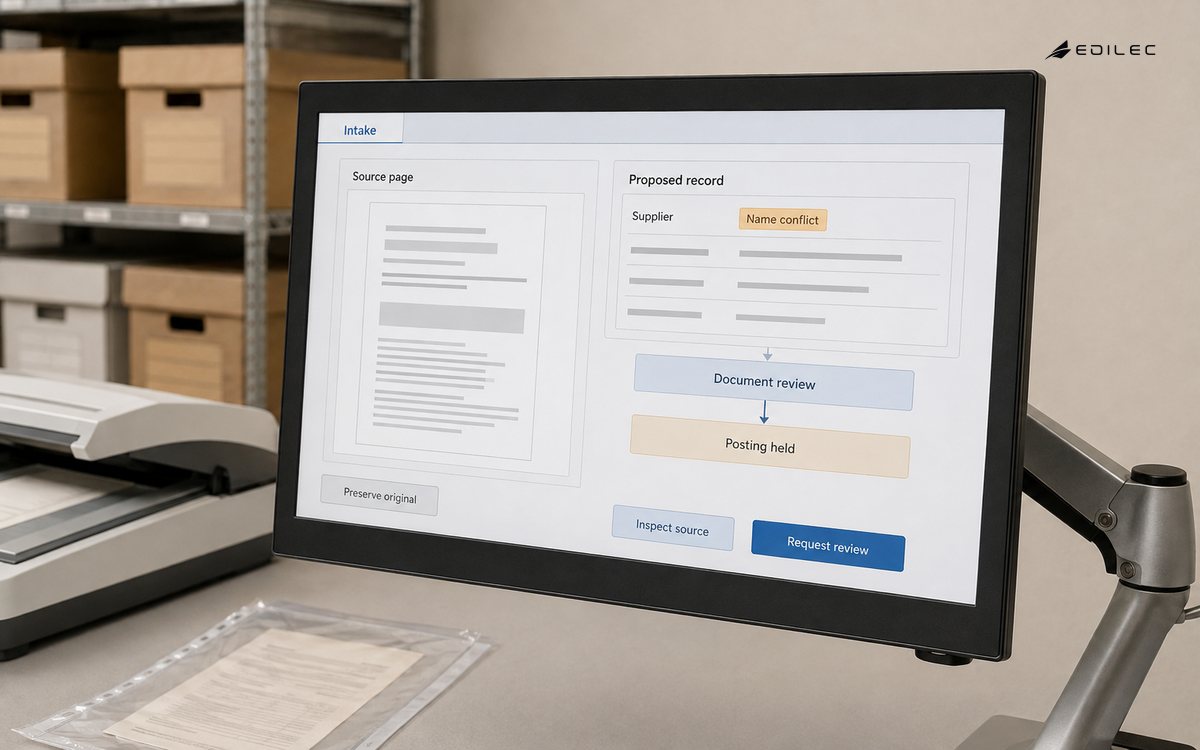
Show the original page with evidence highlighted, proposed and normalized values, confidence, validation conflicts, relevant authoritative data, and permitted actions. Do not show only the answer, which encourages automation bias, or require full re-keying, which wastes attention. Separate extraction correction from approval of consequential actions such as payment or identity changes.
How should review capacity be planned?
Forecast by document cohort and route using measured review rates and handling times. Set priority by business deadline and consequence. Monitor arrivals, age percentiles, abandonment, reassignment, and correction reason. Provide surge and outage procedures. A straight-through target that depends on an overloaded hidden queue is not a service improvement.
Release and operations questions
How should a pilot run?
Begin with historical replay, then shadow live intake without changing outcomes. Compare against the locked evaluation set, test negative and malformed cases, and canary one source or document cohort. NIST's AI RMF supports mapping context, measuring performance, and managing observed risk across the lifecycle. Require owners to approve both quality and operational readiness.
- Test duplicate files, delayed retries, corrected documents, and a downstream timeout.
- Seed unsupported types, large files, malware test artifacts, and ambiguous identities.
- Verify a reviewer cannot access another queue or exceed posting authority.
- Stop the processor, use the manual route, then replay pending work idempotently.
- Rollback model and rule versions and reconcile records created during the canary.
What should production monitoring include?
Track field quality from reviewed and sampled records, automation and review rates, queue age, rejection reasons, duplicate prevention, posting failures, source drift, cost, and downstream corrections. Segment by document class, source, language, and model version. Alert on integrity and service risks; use periodic review for slower quality changes.
Where should business rules live?
Keep deterministic validation and authority outside the model. Date ranges, arithmetic, duplicate keys, required fields, supplier status, purchase-order balance, and posting permission can be implemented as versioned rules with explicit outcomes. The model may extract or suggest; it should not silently waive a failed control. Record the rule version and result on the case so a reviewer can distinguish uncertain extraction from a genuine policy exception.
Rules also require governance. Name an owner, effective date, test cases, and exception authority. Run historical documents through proposed changes to show how routing volume and outcomes would differ. When regulation or policy changes, preserve which rule applied at the business time rather than recalculating old records with today's logic. This matters during disputes, audits, and downstream correction.
How do we detect document drift?
Watch changes in source mix, layout fingerprints, page count, image quality, language, extraction confidence distribution, field missingness, validation failures, and reviewer corrections. Segment by supplier, channel, document class, and processor version. Drift may come from a redesigned form, a new scanner, a changed upstream export, fraud, or a legitimate new population. Each cause needs a different response.
Do not retrain automatically because corrections increased. First confirm annotation quality and whether the new population belongs in scope. Add reviewed examples to a curated candidate set, protect sensitive information, and run the proposed processor against both new cases and the locked regression set. A fix for one supplier can reduce quality elsewhere. Release by cohort and retain the previous version until recovery is proven.
How do we protect downstream systems?
Use a staging record with schema validation and an idempotency key. The downstream adapter should authenticate independently, verify current approval, enforce allowed fields, and return a durable system identifier. Timeouts are ambiguous: query by idempotency key before retrying. Reconcile the intake ledger with created records and surface partial failures to an owner; never mark a document complete merely because extraction succeeded.
Plan correction after posting. Define which values can be amended, which require reversal and reposting, and who notifies affected teams. Link the correction to the original intake and preserve both states. If the workflow triggers payment, customer communication, or another external side effect, separate that authority and include compensation or manual remediation. An editable database row is not the same as a reversible business consequence.
How should we compare providers?
Use the same representative evaluation set and workflow for every provider. Compare field-level quality, calibration, supported formats and regions, throughput, latency, retention, training use, security, version pinning, change notice, export, support, and total cost including review. Test the provider's failure and rate-limit behavior. Keep the canonical schema, intake ledger, validation, and posting authority under organisational control where possible so switching models does not erase evidence or rewrite the whole service.
What does incident response look like?
First stop or narrow the affected processor, rule, source, or posting route while keeping manual priority work available. Identify affected intake IDs by model, rule, source, time, and downstream action. Preserve files, logs, reviewer evidence, and provider notifications. If confidentiality may be involved, follow the organisation's security and privacy incident process rather than treating the event as an extraction-quality issue.
Classify consequences: incorrect pending data, posted records, payments, customer messages, or disclosure each require different remediation. Correct through documented system-of-record procedures and link reversals to original actions. Re-run affected files only after the fix passes the locked test set; use existing idempotency keys so replay cannot compound harm. Independently sample the repaired cohort.
The review should update more than the model. Improve intake limits, evaluation cases, validation, queue alerts, change gates, provider terms, reviewer guidance, or fallback capacity according to root cause. Record detection and decision time separately from technical restoration. A quick model rollback is not complete recovery if reviewers remain overloaded or downstream owners have not reconciled incorrect records.
Conclusion
A dependable AI document intake workflow keeps every extracted value connected to source evidence, validation, authority, and recovery. Narrow the scope, evaluate real variation, secure files, equip reviewers, and make posting idempotent. Automation can then increase only where measured evidence shows that uncertainty is being handled before it reaches the record.