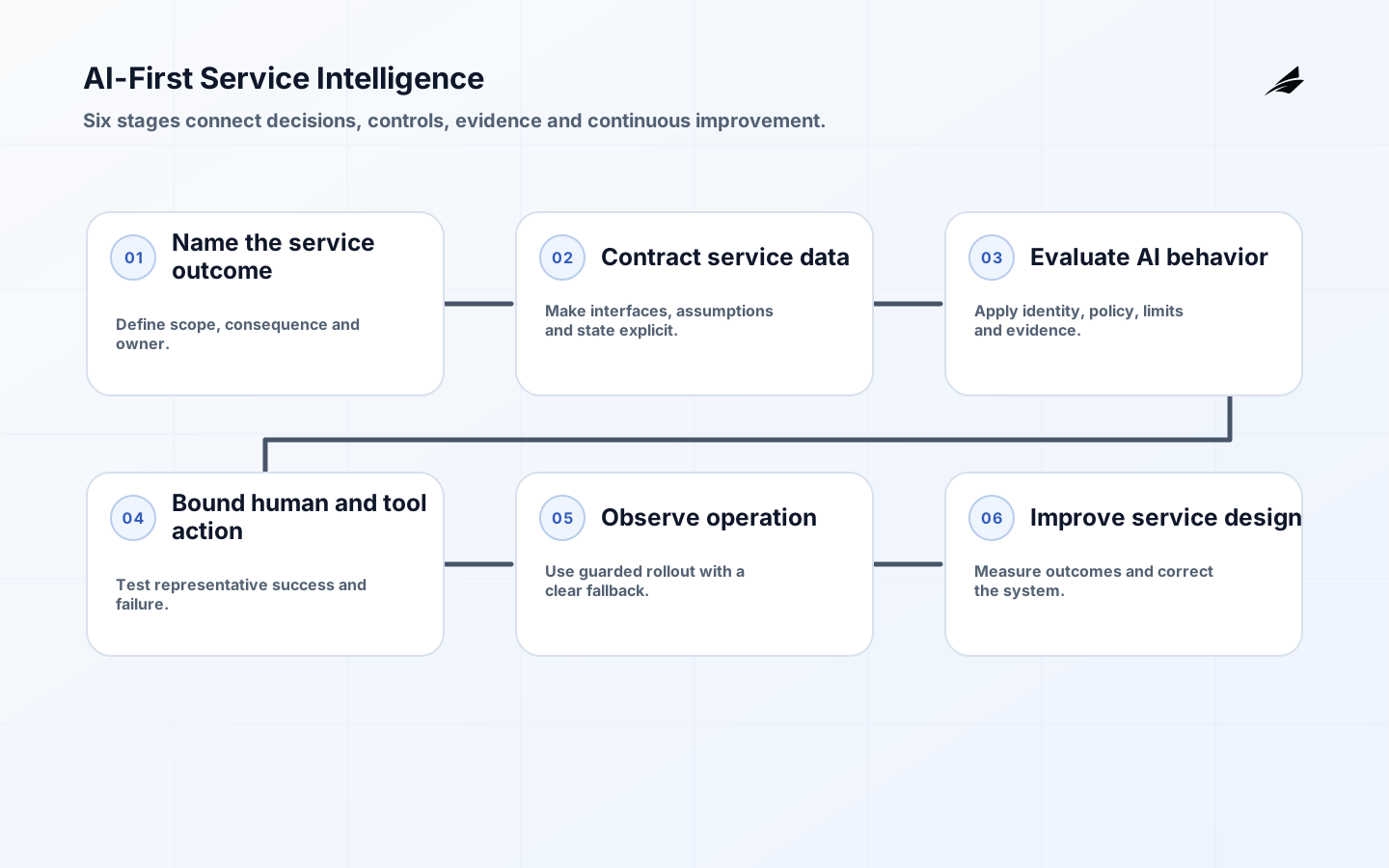
AI-first service intelligence combines service records, conversations, operational signals and business context to help teams understand demand, prioritize work and improve outcomes. “AI-first” should describe a deliberate operating capability, not a requirement to automate every interaction. The safest design begins with a service decision, preserves authoritative records and expands model authority only when evidence supports it.
Use this FAQ with the AI-first service intelligence delivery plan, implementation checklist, enterprise service intelligence guide and enterprise checklist. Distinguish descriptive dashboards, predictions, generated assistance and autonomous action because each needs different evidence and control.
What AI-first service intelligence includes
Salesforce introduced Service Intelligence as analytics integrated into service work, including dashboards and conversation-derived insights. The broader pattern is platform-independent: combine case state, channel interactions, customer context, workforce capacity and outcome data, then present insights where agents and managers decide. A unified screen is useful only if identity, definitions and freshness are trustworthy.
Classify each capability by output and authority. Descriptive analytics summarizes what happened; prediction estimates an outcome; generation drafts content; recommendation proposes action; automation changes state. Record which person or system remains accountable. A model that predicts escalation may prioritize review, while compensation, closure or adverse customer action should remain behind explicit policy and authorized approval.
Build a service data contract before a model
Define case identifiers, channel events, timestamps, status semantics, ownership, customer consent, outcome and quality fields. Reconcile duplicated customers and transferred cases. Document lineage, retention and permitted uses. Missing contacts, inconsistent closure reasons and selectively captured satisfaction can bias apparent performance. Data preparation is an operating responsibility, not a one-time model task.
Separate event time from processing time and preserve the original record. Use a semantic layer for measures such as first response, resolution and reopen, with exclusions visible. Monitor source freshness and schema drift. Conversation data may contain sensitive information, authentication details and third-party content; minimize collection, restrict access and prevent model or analytics logs from becoming uncontrolled copies.
| Capability | Typical output | Control boundary |
|---|---|---|
| Descriptive analytics | Queue and outcome trends | Definition, freshness and access |
| Prediction | Escalation or demand estimate | Calibration, threshold and review |
| Generation | Summary or reply draft | Grounding, disclosure and approval |
| Automation | Case or customer state change | Policy, identity, reversibility and audit |
Govern impact, risk and human control
The NIST AI RMF organizes work through Govern, Map, Measure and Manage, while noting that risk management continues across the lifecycle. Apply it to the service context: affected customers, agent reliance, error consequence, third parties, appeal and monitoring. NIST also notes that version 1.0 is under revision, so track framework updates rather than treating a mapping as permanent.

An ISO/IEC 42001 AI management system provides an organizational structure for policies, objectives and continual improvement. Connect AI governance to service quality, privacy, security and vendor management. Give agents a clear indication of generated or predicted content, the evidence needed to challenge it and a safe fallback. “Human in the loop” is ineffective when workload or interface design makes review nominal.
Evaluate the real service task
Build representative evaluation sets by channel, language, product, issue type and consequence. Measure classification errors, unsupported summaries, retrieval accuracy, calibration, subgroup effects and refusal behavior. For generated replies, assess factual support, tone, policy compliance and whether required disclosure or authentication steps remain intact. Do not use customer satisfaction alone as ground truth.
Run shadow evaluation before recommendations affect queues, then a bounded pilot with independent outcome review. Compare against current process and include agent time, overrides and downstream rework. Define stop conditions for harmful output, performance drift, unavailable grounding or privacy breach. Preserve model, prompt, retrieval source and policy versions needed to reconstruct a material case.
Observe both service and AI behavior
OpenTelemetry signals cover traces, metrics, logs and baggage for understanding distributed systems. Use correlated telemetry across channel intake, retrieval, model call, policy check and case update, while redacting sensitive content. Track latency, availability, token or inference cost, grounding failures, tool errors and fallback, not only model response.
Operational dashboards should pair system health with service outcome: queue age, transfers, reopened cases, escalation, resolution quality and customer effort. A faster draft is not valuable if agents spend longer correcting it. Alert on source-data staleness and sudden changes in acceptance, override or outcome. Review samples after model, prompt, knowledge or workflow changes.
| Measure | Pair with | Reason |
|---|---|---|
| Handle time | Resolution quality and reopen | Speed can hide rushed work |
| Acceptance rate | Override reason and later outcome | Automatic acceptance is not accuracy |
| Model accuracy | Error consequence and subgroup result | Averages hide material harm |
| Cost per case | Customer and agent outcome | Cheap inference may create rework |
Bound automation and incident response
Automate low-consequence, reversible actions first, such as tagging or draft creation. Require deterministic validation before state changes and least-privilege identities for tools. High-impact actions need policy gates, approval and idempotency. Treat untrusted message content as data, not instructions; prevent it from selecting tools, credentials or hidden context.
Microsoft’s incident management guidance emphasizes preparation, response, post-incident review and improvement. Extend incident plans to model defects, harmful recommendations, compromised knowledge and provider outage. Predefine disablement, queue restoration, customer correction, evidence preservation and vendor escalation.
Measure value without driving harmful behavior
Use balanced measures: service outcome, customer effort, quality, fairness where relevant, agent workload, cycle time, rework, cost, control exceptions and resilience. Avoid optimizing average handle time in ways that discourage careful resolution. Segment outcomes and inspect tails. Compare AI-assisted and baseline work using equivalent case mix.
Review whether insights change decisions. A dashboard viewed frequently may still create no action. Track recommendation acceptance with reason, override quality and later outcome, but do not reward automatic acceptance. Retire models and reports that no longer support a decision. Continual improvement includes simplifying the underlying service process and knowledge, not only tuning AI.
Example: predict and prevent complaint escalation
A service team uses case history and current conversation signals to estimate escalation risk. The model can prioritize supervisor review but cannot deny remedies or close a case. The interface shows contributing service facts, confidence and data freshness. Agents can reject the recommendation and record a reason without slowing urgent work.
- Define escalation and the review action before model training.
- Exclude fields that encode irrelevant or impermissible treatment.
- Test by language, channel, product and complaint severity.
- Route uncertain and high-consequence cases to experienced reviewers.
- Log model, feature, threshold and human decision versions.
- Compare customer outcome and supervisor workload with the baseline.
Pilot in one queue and audit false positives and false negatives. If predicted risk increases supervisor work without improving resolution or customer effort, narrow or stop the use. Feed repeated escalation causes into product and process improvement so the system does not merely become better at predicting avoidable service failures.
Review evidence before expanding scope
Before expanding AI-first service intelligence, the accountable owner should review representative outcomes, exceptions, access, changes, operating cost, user feedback and recovery evidence. Confirm that metrics still reflect the intended business result, that known limitations are visible to users and that suppliers have not changed material behavior without evaluation. Exercise one realistic failure and reconcile the resulting records. Record the decision to scale, narrow, correct or retire the capability, including assumptions and a review date. This review keeps implementation evidence connected to authority and prevents a successful pilot from becoming an unmanaged dependency.
Procurement and change control should cover the entire service intelligence chain, not only the model. Record CRM and channel connectors, identity services, data transformations, knowledge sources, model providers, analytics components and subcontractors. Contract for permitted data use, model or feature change notice, security evidence, incident notification, service levels, export and deletion. Before accepting a provider update, rerun representative service evaluations and confirm that definitions, permissions and fallback still work. Maintain a manual route for priority cases when analytics or AI is unavailable, and test its capacity during peak demand. Quarterly governance should review customer complaints, agent challenge, model drift, unresolved data defects, supplier changes and whether automated authority remains proportionate. Publish material limitations to the people relying on the system and keep a dated decision record when the team accepts an exception. Confirm that supervisors can suspend recommendations by queue while preserving ordinary case handling and customer communication.
Key takeaways
- Start with a named service decision and classify the AI output and authority.
- Create reliable service definitions, lineage, freshness and permitted-use controls.
- Evaluate representative cases, human review and reconstruction before deployment.
- Correlate AI telemetry with service quality, workload, cost and resilience.
- Use insight to improve the service process, not only to optimize model metrics.
Frequently asked questions
Is AI-first service intelligence the same as a chatbot?
No. A chatbot is one interaction channel. Service intelligence can analyze demand, cases, conversations, capacity and outcomes across channels, and may support agents or managers without speaking directly to customers. Evaluate each capability by data, decision and authority.
Can a model assign case priority automatically?
It can for bounded, reversible cases when policy permits and evaluation supports the threshold. Preserve deterministic overrides for safety, legal or contractual priority, monitor missed urgent cases and let authorized staff correct routing. High-consequence prioritization deserves stronger review.
How often should a service model be reviewed?
Monitor continuously for source and operational failures, and review performance on a scheduled cadence appropriate to impact. Reassess after material data, model, prompt, policy, knowledge or workflow change and after incidents. Some low-volume cases need accumulated evidence before a reliable comparison.
Conclusion
AI-first service intelligence should make service decisions more informed and accountable. Build it on reliable case and event data, separate insight from authority, give people genuine control and measure customer and operational outcomes together. Expand automation only where representative evidence, observability and recovery fully support the consequence.