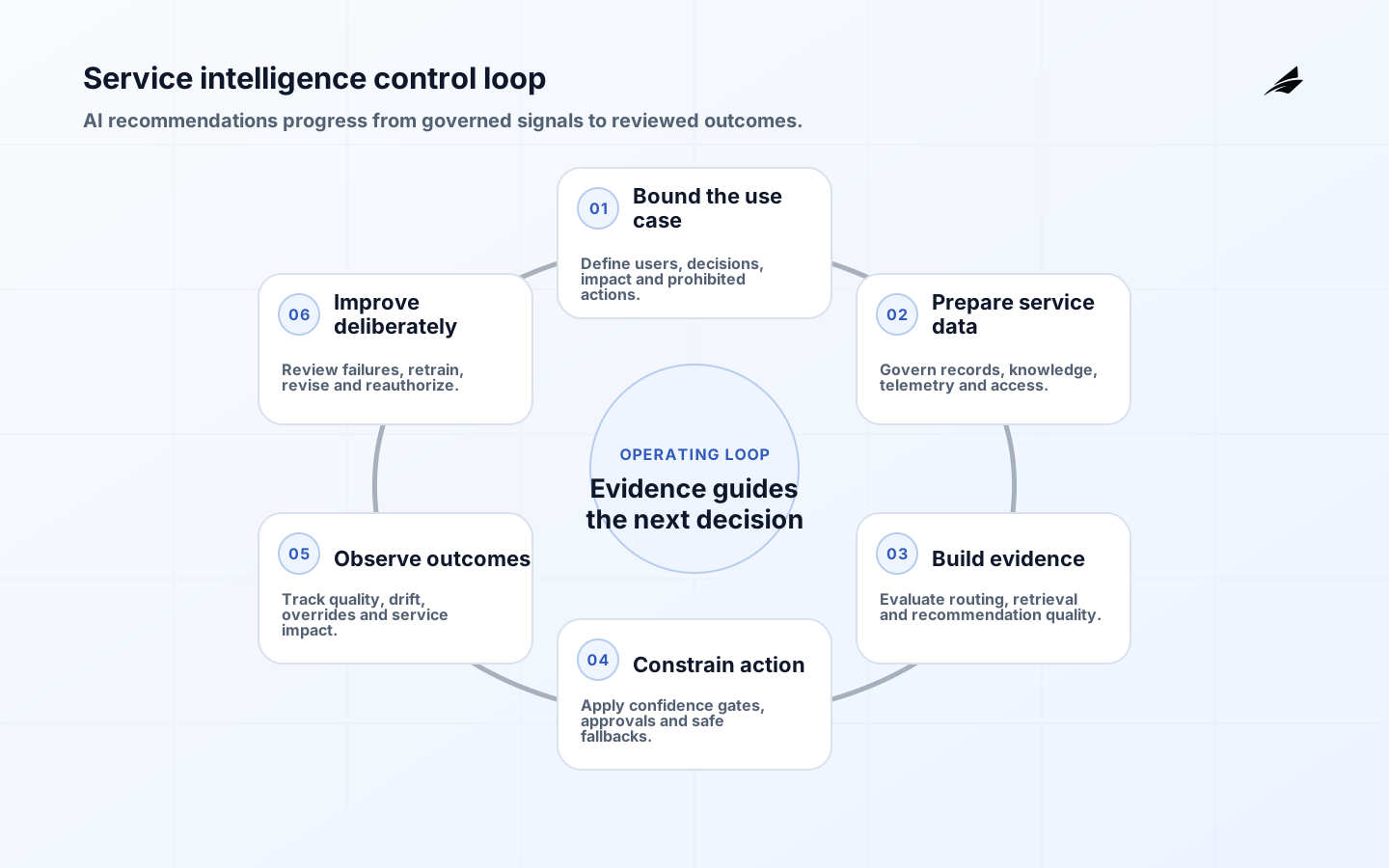
Enterprise service intelligence AI applies machine learning, retrieval and generative capabilities to service records and telemetry so people can find knowledge, classify work, detect patterns, summarize context and recommend or execute constrained actions. Its value depends less on a broad AI label than on the quality of each decision and the safety of its operating boundary. This implementation checklist covers use-case selection, service data, evaluation, human authority, integration and production governance.
Use the enterprise service intelligence delivery plan and enterprise service intelligence FAQ for procurement and architecture. The related service intelligence AI plan and safe-action implementation checklist go deeper on governance. Treat classification, similarity, search, summarization, forecasting and action as separate use cases with separate evidence; one model score cannot authorize all of them.
1. Select bounded service decisions
Map the service journey from user request or machine signal through triage, assignment, diagnosis, change, resolution and learning. Identify a measurable decision with enough repeated evidence: suggest an assignment group, retrieve a knowledge article, cluster related incidents, summarize a case or recommend a runbook. Name the user, frequency, delay, error consequence and existing baseline. Start with assistance where a reviewer can cheaply correct output. Avoid autonomous action where blast radius, authorization or recovery is not understood.
NIST’s AI Risk Management Framework organizes work through Govern, Map, Measure and Manage and defines trustworthy characteristics including validity, safety, security, accountability, transparency, explainability, privacy and fairness. Create an impact assessment for affected employees and customers. Define prohibited uses, such as inferring disciplinary intent from support language or exposing another tenant’s records. Assign a business owner, service owner, data owner, model owner and risk approver before development.
| Use case | Useful evaluation | Minimum control |
|---|---|---|
| Ticket classification | Precision and recall by class and service | Confidence threshold and manual correction |
| Assignment recommendation | Top-k accuracy and transfer reduction | Authorized group list and fallback queue |
| Knowledge retrieval | Relevant supported answer in ranked results | Access filtering and source citation |
| Incident clustering | Cluster purity and useful lead time | Analyst confirmation before major-incident declaration |
| Case summarization | Factual completeness and unsupported-claim rate | Source links and editable draft |
| Automated action | Task success and harmful-action rate | Policy gate, scoped credential and rollback |
2. Prepare service data and knowledge
Inventory incidents, requests, changes, problems, configuration items, service maps, knowledge, telemetry and user feedback. Record source ownership, retention, sensitivity, completeness and access policy. Historical tickets contain copied secrets, personal data, inconsistent labels, reopened work and closure codes selected for convenience. Remove or protect sensitive fields, deduplicate templates, distinguish requester text from agent notes, and preserve time ordering. Split evaluation data by time to reveal drift and avoid training on future information.
Knowledge retrieval needs lifecycle controls. Give articles an owner, audience, service, effective date, review date and retirement state. Index only content users are authorized to read, and enforce permissions before retrieval rather than after generation. ServiceNow’s current AI Search documentation describes natural-language, typo-handling, personalization and actionable results. Verify equivalent behavior in the chosen product with low-permission personas, stale content, ambiguous queries and empty-result cases.
3. Design an evidence-preserving architecture
Separate ingestion, feature or index preparation, model inference, policy evaluation, user experience, action execution and audit. Version data selection, labels, prompts, retrieval configuration, models, thresholds and policies. Carry a correlation identifier from the source case through inference and any downstream write. Store the output, confidence, evidence references, reviewer decision and resulting service outcome according to retention needs. Do not log sensitive prompts or records indiscriminately; observability itself requires access and minimization controls.
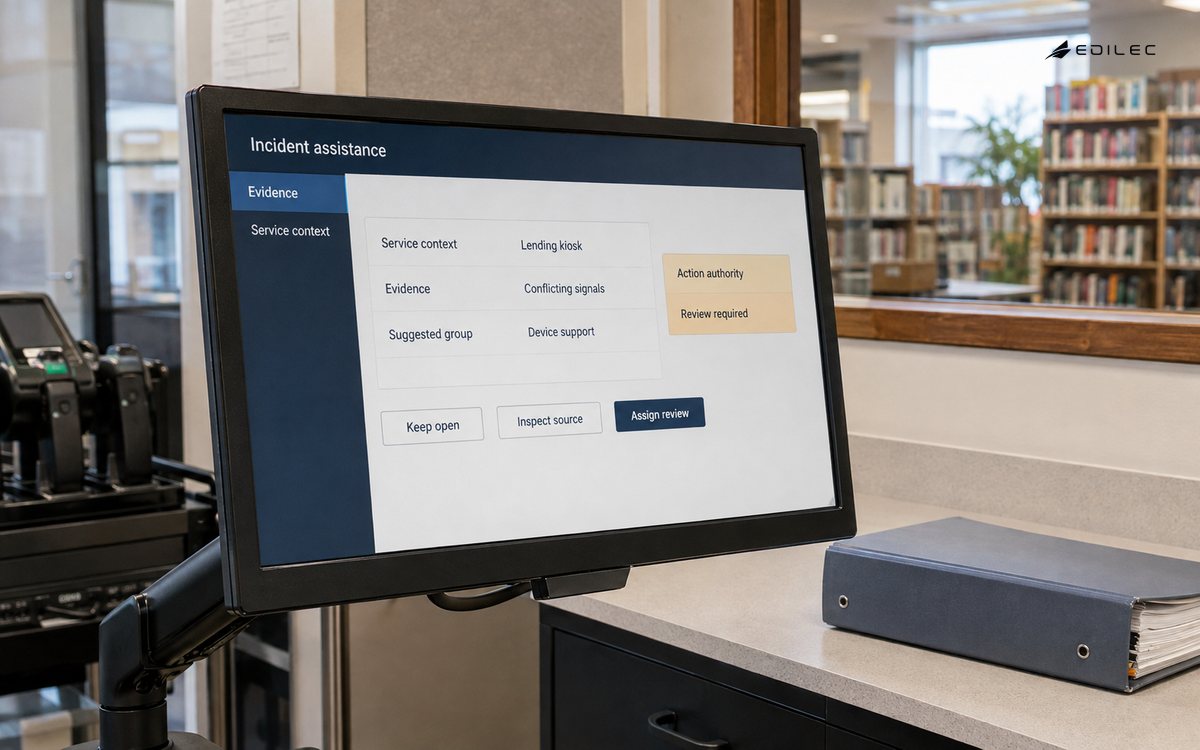
ServiceNow’s Predictive Intelligence frameworks distinguish classification, similarity and clustering. Preserve those distinctions in architecture and evaluation. Classification sets categorical values; similarity retrieves related records; clustering finds groups. A generative layer may explain or summarize their outputs, but should not conceal provenance. Use service identities with least privilege, allow-listed tools, schema validation, idempotency and explicit timeouts for any action.
| Gate | Question | Evidence required |
|---|---|---|
| Data readiness | Are records representative, governed and correctly labeled? | Profile, lineage, access tests and sampling |
| Offline quality | Does the model beat the current baseline by cohort? | Frozen test results and error analysis |
| Workflow fit | Can users understand, correct and recover? | Usability study and exception rehearsal |
| Security | Can inputs or tools cross authorization boundaries? | Threat model and low-privilege tests |
| Pilot impact | Does service performance improve without hidden harm? | Controlled outcome comparison |
| Production | Can drift, incidents and rollback be managed? | Monitoring, runbook and accountable on-call |
4. Evaluate by cohort, failure and service outcome
Build a frozen evaluation set containing common, rare, ambiguous, multilingual, sensitive and adversarial cases. Measure per-class precision and recall rather than accuracy alone when queues are imbalanced. For retrieval, judge relevance, authority, freshness and access correctness. For summaries, compare every material statement with source records and count omissions as well as unsupported additions. ServiceNow’s current incident predictive intelligence documentation lists assignment, categorization, service, configuration-item and similarity uses; each requires its own acceptance criteria.
Run a shadow period before recommendations affect records. Then pilot with a bounded service and visible reviewer controls. Compare transfer rate, time to correct assignment, resolution time, first-contact resolution, knowledge usefulness, reopen rate and user effort. Track overrides with reasons and inspect automation bias: reviewers may accept plausible output without checking. The NIST Generative AI Profile identifies risks including confabulation, data privacy, information integrity and human-AI configuration; include these in tests where generation is used.
5. Constrain action and preserve human authority
Define a confidence-and-impact matrix. Low-impact, reversible actions such as suggesting a category may proceed with easy correction. High-impact actions such as disabling an identity, restarting a production service or communicating an outage require policy checks and named approval unless a narrow emergency runbook has been pre-authorized. A confidence score is not authorization. Verify requester identity, service scope, change state, maintenance window and action parameters at execution time.
Design safe abstention. When evidence is weak, data is missing, policy conflicts or a tool fails, route to an owned queue with context rather than inventing certainty or retrying forever. Rate-limit actions, prevent recursion, cap cost and duration, and make every write idempotent. Provide a kill switch that operators have rehearsed. Notify users when AI materially influences a recommendation, show evidence appropriate to the task, and preserve a route to challenge or correct the record.
6. Govern production learning and change
Monitor input distribution, label drift, class coverage, retrieval freshness, unsupported output, override, latency, tool failure and service outcomes. Segment by service, language and user group where lawful and statistically meaningful. Establish alert thresholds and owners before launch. Review samples of accepted and rejected output. Feed confirmed corrections through an approved data process; do not let every user edit silently retrain a model. Revalidate after model, prompt, index, workflow or policy changes.
Maintain an AI system inventory, impact assessment, change history, supplier record, evaluation pack and incident procedure. ISO/IEC 42001 specifies an AI management system for establishing, implementing, maintaining and continually improving responsible AI use. Use that management-system discipline to connect local service experiments to enterprise oversight. Retire models and indexes when their use case ends, revoke credentials, remove scheduled jobs and preserve records needed to explain past decisions.
Evaluate supplier and model changes as part of the system, not as invisible maintenance. Record provider, model identifier, hosting region, data-use terms, retention, safety settings, supported context, availability and deprecation policy. Contract for incident notice, material subprocessor changes and usable service records. Test a replacement or degraded mode for critical assistance. When a hosted model changes behind a stable name, rerun the frozen evaluation pack and compare output distributions before expanding use. Procurement assurance cannot replace local testing with the organization’s service data and policies.
Design user feedback so it captures actionable evidence without becoming a popularity score. Separate wrong classification, missing source, stale knowledge, unsafe suggestion, unclear explanation and workflow friction. Preserve the input and system version necessary to reproduce the issue, subject to privacy limits. Route safety and access incidents immediately rather than waiting for model review. Product teams should publish what changed after material corrections and monitor whether the same failure recurs. Closing the loop requires engineering, knowledge management and service-process changes, not retraining by default.
Calibrate confidence against decisions users actually make. Raw model probabilities are not automatically reliable confidence estimates, and thresholds can behave differently across services with different label balance. Plot quality and abstention by threshold, validate calibration on recent held-out cases, and monitor it after rollout. Present confidence only when users understand its meaning and it improves review. Otherwise show the evidence and a clear uncertainty state. Revisit thresholds when costs, classes, data or workflow consequences change.
Key takeaways
- Implement one bounded service decision at a time and measure its existing baseline.
- Govern historical tickets, knowledge and telemetry before training or indexing them.
- Preserve evidence, model and policy versions through every recommendation and action.
- Evaluate cohorts, rare failures and service outcomes, not one aggregate model score.
- Treat confidence as evidence, never as authority; constrain tools and rehearse abstention.
Frequently asked questions
Is service intelligence AI the same as AIOps?
They overlap. AIOps often emphasizes operational telemetry, event correlation and remediation. Service intelligence also covers user requests, knowledge, routing and agent assistance. Define the actual records, decisions and actions rather than relying on either category label.
How much historical data is needed?
Enough representative, correctly labeled cases to evaluate the chosen task across important cohorts and time periods. More data does not repair inconsistent process or labels. Start with profiling and learning curves, then collect targeted evidence for weak classes.
When can the system act automatically?
When the action is authorized, bounded, observable and recoverable; evaluation demonstrates acceptable failure; and policy defines conditions and escalation. Increase autonomy by action class, not by declaring the whole system autonomous.
Conclusion
Enterprise service intelligence AI is useful when it makes service evidence easier to find and decisions easier to execute without obscuring authority. Build from governed data, task-specific evaluation, visible evidence and constrained action. Production monitoring and deliberate reauthorization then turn a promising model into an accountable service capability.