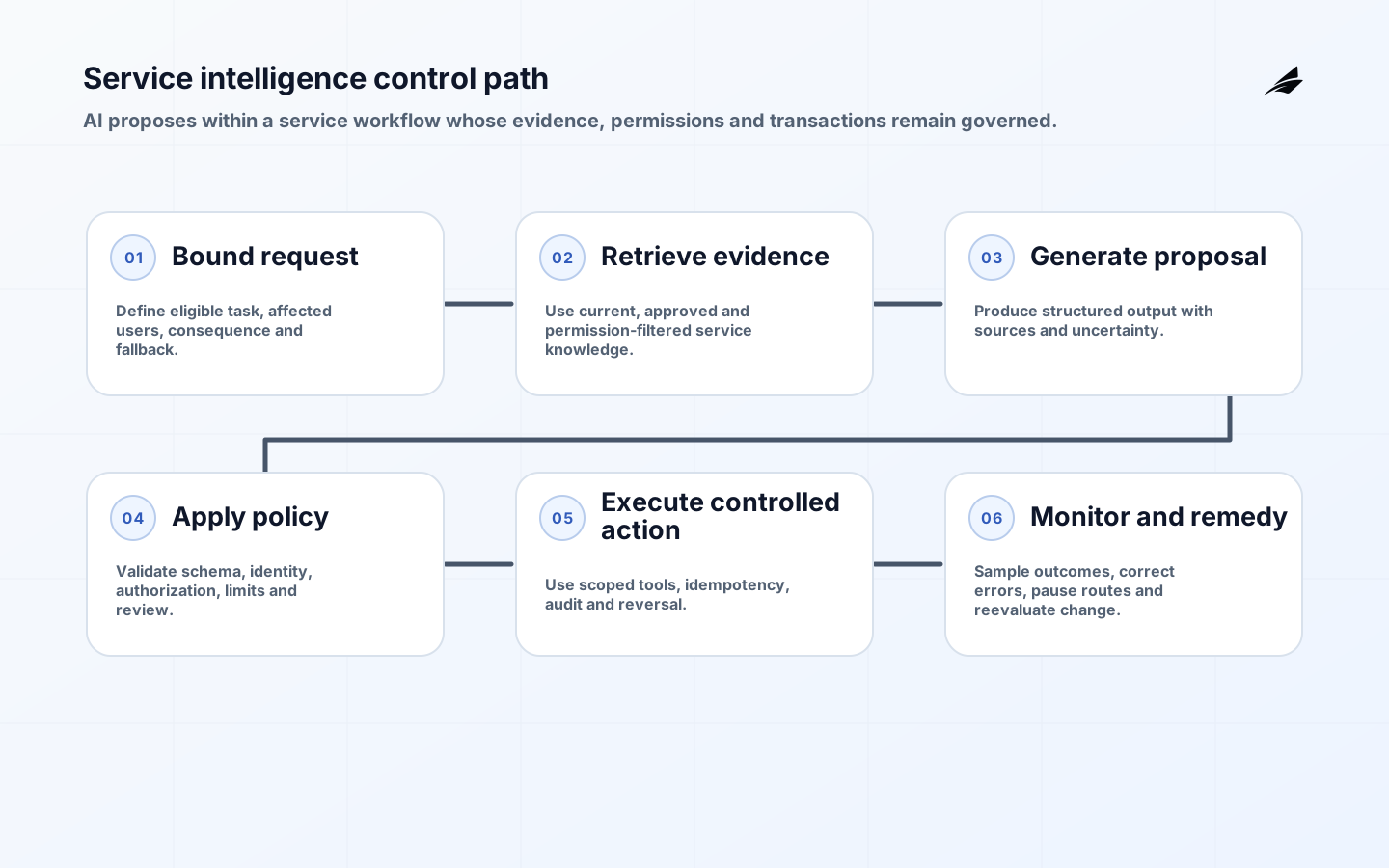
Enterprise service intelligence AI applies machine learning or generative AI to internal or customer service workflows: classifying requests, finding approved knowledge, summarizing cases, recommending next actions, forecasting demand or executing tightly controlled steps. The valuable product is not a conversational interface. It is a governed service change that improves resolution while preserving permissions, evidence, escalation and remedy.
This plan complements the service intelligence AI scope guide, the Enterprise Service Intelligence AI Implementation Checklist, the enterprise service intelligence FAQ and the service intelligence implementation checklist. It focuses on selecting a bounded first release and carrying it through architecture, cost, assurance and operation.
Scope enterprise service intelligence AI by task and consequence
Map the request lifecycle from intake through identity checks, classification, assignment, knowledge use, approval, action, communication and closure. Baseline volume, wait, touches, transfers, reopens, quality, satisfaction and cost. Select one task where sufficient evidence exists and an error can be caught or reversed. Drafting a response for agent review is a different risk from resetting credentials or changing a payroll record.
Define eligible request types, user groups, languages, channels, systems and hours. State prohibited or deferred cases such as safety, employment, legal advice, vulnerable users or high-value transactions. The NIST AI RMF supports context-aware risk management through Govern, Map, Measure and Manage. Create a use-case record with owner, affected people, intended benefit, severe failures, oversight and retirement.
| Capability | Appropriate first boundary | Required control |
|---|---|---|
| Classification | Recommend category and priority | Confidence route and agent correction |
| Knowledge retrieval | Return permitted approved passages | Source, version, access and no-answer behavior |
| Summarization | Draft from one authorized case | Evidence link and sensitive-data handling |
| Next action | Suggest from an approved playbook | Policy validation and human approval |
| Execution | Low-impact reversible action | Scoped tool, authorization, idempotency and audit |
Design a permission-aware service architecture
Keep the system of record authoritative. The orchestration layer authenticates the user and service, obtains case purpose and retrieves only content they may access. A knowledge layer stores approved content with owner, effective date, classification and access metadata. The model produces a structured proposal. A deterministic policy layer validates schema, permissions, limits and required review before any tool call. The transaction system records the final state.

Separate development, test and production data. Register model, prompt, retrieval configuration, tool schema and policy versions. Protect secrets and service identities, and constrain outbound network paths. Do not assume a model will follow a textual instruction when code can enforce the boundary. Preserve enough trace to reconstruct sources, versions, reviewer and action, while minimizing retention of sensitive conversation content.
Prepare service data and approved knowledge
Resolve duplicate categories, inconsistent closure codes and stale articles before model tuning. Define which fields represent user intent, resolution and outcome, and check whether agents used them consistently. Sample by team, language, product, channel and time. Historical handling can encode poor policy or unequal treatment; it should not automatically become the target behavior.
Create an approval lifecycle for knowledge. Each article needs an owner, audience, permissions, effective date, review date and supersession link. Chunking and retrieval should preserve meaning and access. Test questions that require multiple sources, contain obsolete terminology or have no approved answer. The system should cite current evidence or abstain, not fill a gap from model memory.
| Evaluation layer | Example measure | Release gate |
|---|---|---|
| Retrieval | Relevant approved evidence in top results | No unauthorized source in any test |
| Generation | Grounded correctness and material omission | Severe unsupported claim below threshold |
| Workflow | Resolution quality, rework and transfer | Improvement against baseline cohort |
| Control | Permission, injection and tool-abuse tests | No unapproved consequential action |
| Operation | Latency, availability and cost per resolved case | Fits service and budget objective |
Evaluate end-to-end behavior before automation
Build a versioned test set from real, de-identified cases and deliberately difficult scenarios. Include ambiguity, conflicting documents, prompt injection inside attachments, hidden instructions, sensitive data, language variation, unavailable systems and requests outside scope. Score retrieval and generated content separately, then run workflow simulations with agents. Compare against current handling and a simpler rules or search baseline.
Measure severe failures explicitly, not only an average rubric. The NIST Generative AI Profile identifies lifecycle risks relevant to generative systems. The OWASP LLM Top 10 2025 includes prompt injection and excessive agency. Test indirect content as hostile, validate output, grant minimum tools and permissions, and require approval where consequence rises.
Make human review meaningful
Reviewers need the source, uncertainty, changed fields and policy reason, not a polished answer alone. Allocate time and training, and avoid interfaces that make acceptance easier than correction. Route low-confidence or high-impact cases to experienced roles. Capture correction reason without using acceptance as automatic proof of quality; users may accept because of workload or automation bias.
Define remedy for affected people: correction, appeal, escalation and restoration of an incorrect action. The GAO artificial intelligence resources emphasize accountability across governance, data, performance and monitoring. Review authority, evidence and remedy belong in those controls. AI should not decide whether its own serious error is acceptable.
Model cost by resolved service outcome
Include discovery, data and knowledge remediation, integration, identity, evaluation, security, change management and support. Recurring cost includes model input and output, embeddings or indexes, storage, monitoring, quality sampling, human review, vendor support and periodic retesting. Forecast by case volume, context size, model calls, retries, concurrency and growth. Separate demonstration pricing from production architecture.
Track cost per accurately resolved case and incremental benefit, not only tokens. A cheaper model that drives transfers and rework can cost more. Use routing: deterministic rules for known cases, smaller models for classification and more capable models only where needed. Cache only where permissions and freshness allow. Set usage and anomaly controls, but protect critical service continuity from blunt automated shutdown.
Deliver through bounded release gates
Start with shadow mode to compare proposals without affecting users. Move to agent assist for a selected queue, then automate only a reversible action with strong evidence. Each gate requires task quality, severe-failure, permission, security, accessibility, latency, cost and support evidence. Use a representative cohort, publish fallback, and give operations authority to pause by route, model or tool.
Monitor input and outcome shifts, retrieval misses, correction reasons, overrides, escalations, incidents and cost. Reevaluate after model, prompt, knowledge, policy or workflow changes. ISO/IEC 42001 provides a management-system approach for responsible AI. Also map applicable law by role and market; the EU AI Act is risk- and role-specific, so classification needs qualified legal analysis rather than a generic vendor claim.
Worked release: knowledge-assisted request resolution
A practical first release helps service agents answer one product's configuration questions. The system authenticates the agent, reads the case, retrieves only published knowledge permitted for that customer and drafts an answer with citations. It cannot close the case, change configuration or contact the customer without agent approval. Success is measured by grounded answer quality, handling time, reopen rate, agent correction and customer outcome against a comparable queue.
Build tests from current and recently superseded articles, ambiguous product names, unavailable evidence, restricted customer content, multilingual phrasing and malicious instructions inside attachments. Verify that obsolete content is excluded, permissions are enforced before retrieval, citations support every material instruction and no-answer behavior is useful. Reviewers see quoted evidence and changed text. Corrections are labeled by retrieval, source, reasoning, tone or policy so owners can fix the right layer.
Release in shadow mode, then to trained volunteers, then to a representative cohort. Monitor evidence access, quality samples, acceptance, edits, reopens, escalation, latency and cost. Exercise model outage, index delay, unsafe output and emergency disablement. Scale only after support can diagnose source, model, prompt and policy versions and after the knowledge team can meet review dates. Tool access, such as changing configuration, remains a separate future use case with its own authority and evaluation.
Create an incident taxonomy specific to the service. A wrong answer corrected before sending is a quality event; unauthorized retrieval is a security and privacy event; an approved but harmful instruction may require customer remedy and broad review; a systematic omission may affect a cohort. Define who can pause retrieval, generation or a particular knowledge collection, and how queued cases return to ordinary handling. Preserve the versions and affected-case query needed to determine scope.
Review supplier changes against this evidence. A new model version, safety policy, region, retention term or subcontractor can alter behavior and obligations even when the API name is unchanged. Require notice where contractually feasible, maintain an evaluation route independent of the vendor, and keep an export of prompts, knowledge metadata, test cases and workflow policy. Exit should return cases to a usable service, not merely return model configuration files.
Key takeaways
- Scope one task, affected population, consequence and fallback before selecting a model.
- Preserve system-of-record authority and enforce permissions and actions deterministically.
- Govern knowledge with owners, versions, access and no-answer behavior.
- Test real workflows, adversarial content, severe failures and meaningful human review.
- Scale only when outcome, controls, service quality and cost remain acceptable.
Frequently asked questions
Is retrieval-augmented generation enough to prevent hallucination?
No. Retrieval can improve grounding but may return irrelevant, stale, unauthorized or malicious content, and generation can still misstate it. Evaluate retrieval and generation separately, preserve citations, enforce access before retrieval and provide an abstention route.
When can service AI act without review?
When the action is explicitly authorized, low impact, reversible, idempotent, bounded by deterministic policy and proven under representative tests and monitoring. Increase review with uncertainty and consequence. Authentication, entitlement, financial and employment changes usually need stronger independent controls.
Conclusion
Enterprise service intelligence AI should make service work more effective without weakening permission, evidence or remedy. A bounded task, permission-aware architecture, governed knowledge, realistic evaluation and staged authority create that balance. The result is not autonomous intelligence; it is an operated service capability whose decisions and limits remain accountable.