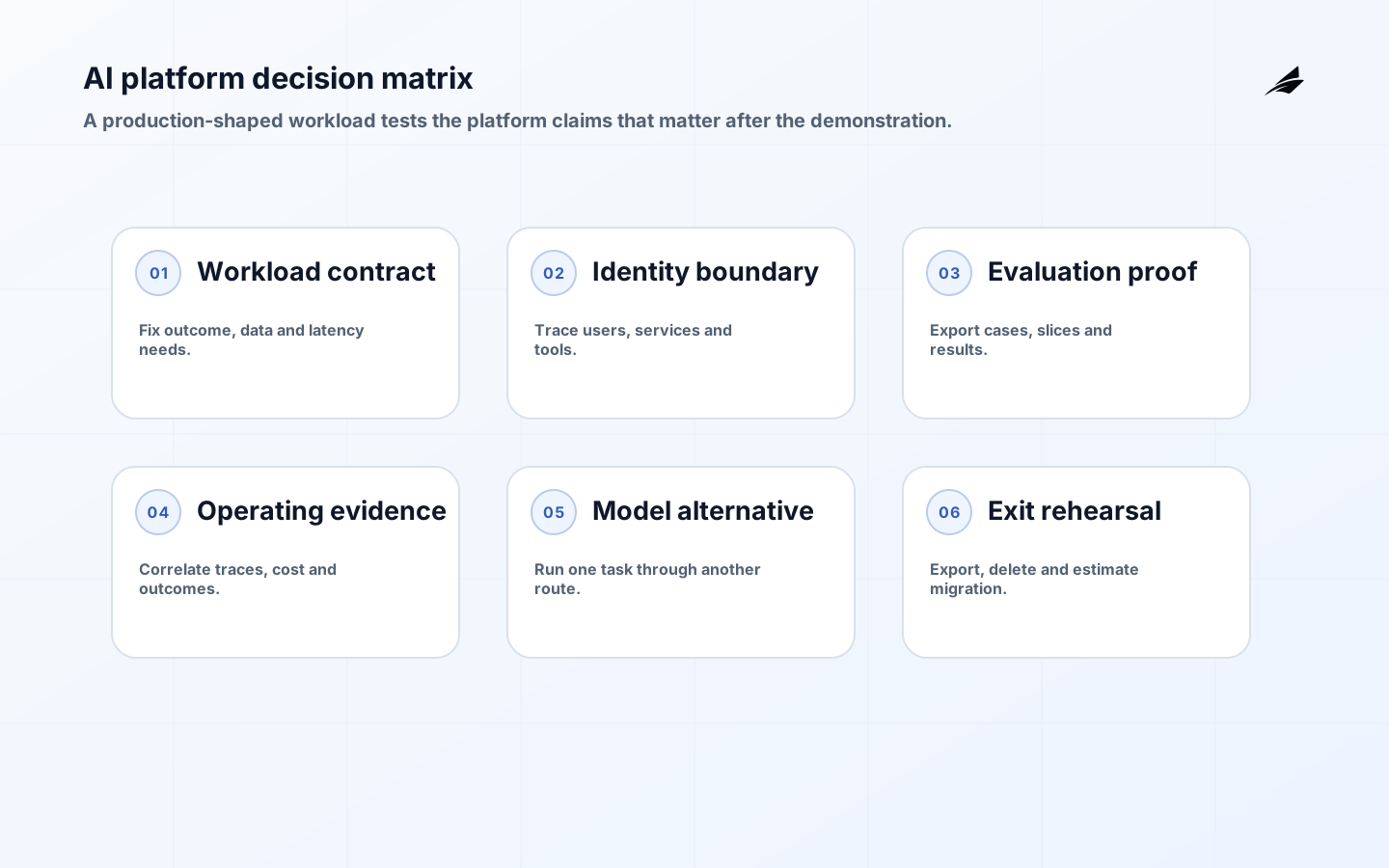
An AI implementation platform is the collection of services used to build, evaluate, release and operate AI-enabled applications. It may include model access, prompt and version management, retrieval, vector search, tool execution, safety controls, evaluation, telemetry, identity and deployment. The useful buying question is not which vendor has the longest feature list. It is which architecture can support a defined workload with acceptable evidence, operating effort and exit cost.
This AI implementation platforms FAQ is for teams moving from experiments to supported products. Read it alongside the AI services implementation checklist, Edilec's AI governance operating model and the LLM cost controls guide. Those guides help turn platform capability into explicit product and governance decisions.
Key takeaways
- Evaluate a platform against one real workload and its failure modes, not a generic feature score.
- Keep application policy, evaluation data and business state outside proprietary prompt consoles where possible.
- Require tenant, identity, network, encryption, logging and regional boundaries to be testable.
- Measure model portability by running the same contract and evaluation set through an alternative route.
- Price the complete operated service, including review, retrieval, observability and incident work.
What should an AI implementation platform provide?
At minimum, a production platform should give an application controlled access to approved models; bind requests to identities and environments; version prompts, model configuration and tools; protect secrets; collect usable telemetry; and support evaluation before and after release. Retrieval and agent orchestration are optional capabilities, not universal requirements. The platform should make the approved path easier without preventing application teams from understanding what actually happens.
Use the NIST AI Risk Management Framework to translate broad trustworthiness concerns into platform evidence. For example, governance requires inventory and decision rights; measurement requires evaluation and monitoring; management requires incident response and change controls. A dashboard that counts requests but cannot identify the model, prompt, source set and tool policy behind a harmful result is not sufficient observability.
| Platform layer | Capability to verify | Evidence to request |
|---|---|---|
| Model access | Approved models, regions and versions | Inventory export and change history |
| Application gateway | Authentication, quotas and routing policy | Policy tests and request trace |
| Knowledge | Access-aware ingestion and deletion | Permission and freshness tests |
| Evaluation | Versioned data, graders and human review | Reproducible run with failures |
| Operations | Telemetry, incidents and rollback | Trace, alert and recovery exercise |
Managed service, self-hosted stack or a hybrid?
A managed service can reduce infrastructure work and provide access to several models, safety features and elastic inference. It also creates dependencies on supported regions, provider identity, quotas, pricing and release behavior. A self-hosted stack offers more control over runtime, weights and data paths, but the organization assumes capacity planning, upgrades, security hardening, model serving and reliability. Hybrid designs commonly keep sensitive business policy and state in the application while using managed inference behind a gateway.

Do not equate container portability with service portability. A self-hosted model still depends on accelerators, drivers, kernels, serving software and model licenses. Conversely, a managed model can be replaceable when the application uses a stable internal contract and task-specific evaluations. If Kubernetes is part of the plan, use the project's official documentation to define the control-plane and workload responsibilities rather than treating orchestration as a managed AI feature.
How should security and identity be evaluated?
Trace one request end to end. Identify the user, application, service principal, model endpoint, retrieved sources, tool credentials, logs and administrators that can inspect the data. Verify tenant isolation, private networking where required, encryption, key ownership, regional processing, retention and deletion. Apply separate permissions for experimentation, evaluation, production configuration and incident access. The current NIST Digital Identity Guidelines provide a useful vocabulary for assurance; each action still needs authorization based on business context.
Model output must not inherit application authority. Put a deterministic authorization layer between generated tool arguments and business systems, and validate third-party responses as untrusted input. Test prompt injection, data exfiltration, unrestricted resource use, poisoned retrieval, unsafe output handling and excessive agency using the OWASP Top 10 for LLM and generative AI as a threat-model prompt rather than a compliance badge.
What evaluation capabilities matter?
The platform should store versioned evaluation cases, expected outcomes, grader configurations, model and prompt versions, source snapshots and run results. It should support deterministic assertions, task-specific metrics and human review. Look for slice analysis by language, customer group, intent, source and consequence. Confirm that raw cases and results can be exported in documented formats; evaluation history is valuable organizational evidence, not disposable vendor telemetry.
Run the same representative set against at least two configurations. Compare task success, unsupported claims, dangerous actions, latency, throughput and cost. Inspect failures rather than ranking one composite number. Require a release gate that can prevent a model alias or prompt update from reaching production when a critical slice regresses. Integrate these controls with normal software delivery; the NIST Secure Software Development Framework provides practices for preparing, protecting, producing and responding across the software lifecycle.
| Decision | Strong platform evidence | Weak substitute |
|---|---|---|
| Model change | Comparable run on frozen cases and slices | Vendor benchmark |
| Retrieval release | Recall, authorization and freshness tests | A relevant-looking demo |
| Tool permission | Typed contract and denied-action tests | Prompt instruction |
| Production readiness | Load, failure and rollback exercise | Successful playground session |
| Portability | Export plus alternative-provider rehearsal | Standards claim without test |
What should observability capture?
Capture correlation identifiers, application operation, model and prompt version, retrieval sources, tool decisions, latency, token or compute usage, cache behavior, safety outcomes and final business status. Protect prompts and outputs according to their data classification; indiscriminate content logging creates a new sensitive store. Use sampling and redaction deliberately, and keep enough metadata to investigate without retaining every secret.
Prefer telemetry that joins existing traces, metrics and logs. OpenTelemetry provides a vendor-neutral framework for generating, collecting and exporting these signals. Platform-specific attributes may still be useful, but the application should be able to follow a customer request through retrieval, inference, tool calls and downstream systems. Alert on user-impacting outcomes and policy failures, not token counts alone.
How should cost and exit risk be assessed?
Build a workload model using request volumes, input and output distribution, retrieval, embeddings, reranking, caching, tool calls, evaluation, storage, data movement, observability and human review. Include reserved capacity commitments and overage behavior. Compare cost per verified outcome at realistic quality and latency. A cheaper model that increases escalation or rework can raise total cost.
Write an exit plan before procurement. List export formats for prompts, evaluations, indexes, logs and configurations; identify proprietary APIs; test deletion; and estimate the work to move one representative workflow. Keep business rules, tool contracts and user state in application-owned components. Apply source control, review and provenance to platform integration code so that the move is an engineering exercise rather than archaeology.
Run a production-shaped proof of value
A useful proof of value exercises one complete journey rather than a collection of disconnected platform features. Use representative identities, approved data, realistic concurrency and the same network boundaries expected in production. Include retrieval, tool calls, evaluation, tracing, support access and deletion where the workload needs them. Deliberately trigger an unavailable model, a quota response, a malicious retrieved instruction, a denied business action and an evaluation regression. Record which controls belong to the platform, which belong to the application and which require an operating process. This exposes responsibility gaps that a successful playground response cannot reveal.
Score the exercise against pre-agreed thresholds and observations. Mandatory gates may include no cross-tenant retrieval, deterministic denial of unauthorized tools, complete trace correlation, reproducible evaluation export and successful fallback. Comparative measures may include verified task success, latency distribution, operator effort and cost per accepted result. Include the effort to configure, review and diagnose the system, not only inference price. Ask a team that did not build the prototype to follow the runbook and investigate a seeded failure. Their experience is a stronger test of operability than the vendor-led demonstration.
End with a written decision: adopt, reject, narrow the use case or run a named follow-up test. List unresolved risks, owners and dates. Preserve the cases, traces and configuration so another candidate can be assessed against the same workload. A platform choice should remain explainable months later when pricing, models and organizational priorities have changed.
AI platform proof-of-value checklist
- One production-shaped workload has explicit outcome, data and authority boundaries.
- Identity, tenant, region, key, retention and administrative access claims are tested.
- Evaluation cases and results can be exported and reproduced.
- Application traces connect model behavior to downstream business status.
- A model or provider alternative has been exercised through the same internal contract.
- The commercial model includes capacity, support, telemetry, review and exit work.
Frequently asked questions
Does every organization need an AI gateway?
Not always. A gateway becomes useful when several applications need consistent identity, quotas, routing, policy and telemetry. A small team with one tightly integrated provider may keep those controls in the application until coordination cost justifies a shared layer.
Is a vector database a required platform component?
No. It is useful for some semantic retrieval workloads. Structured queries, conventional search or no retrieval may better fit other tasks. Choose from measured information needs and permission behavior.
Can standards eliminate AI platform lock-in?
Standards and internal contracts reduce switching cost, but model behavior, safety controls, embeddings and managed features still differ. Portability is proved by an alternative-path rehearsal, not by an architecture diagram.
Conclusion
A good AI implementation platform makes governed delivery repeatable while leaving the organization able to understand, test and change its systems. Evaluate one real service across identity, data, evaluation, observability, economics and exit. The winning platform is the one that produces reliable operating evidence with proportionate effort, not the one that makes the fastest demonstration.