AI-first service intelligence uses data and models to improve how service demand is understood, routed and resolved. It may summarize contact, retrieve knowledge, classify intent, predict escalation, recommend a next action or automate a low-risk step. The phrase should not mean placing a chatbot in front of an unchanged operation. A useful program begins with a service decision, its evidence and its consequence. It then designs AI as one component in a controlled case lifecycle with human authority, deterministic policy and an observable customer outcome.
This delivery plan covers customer service, employee support and operational service desks. It separates analytics from assistance and action because their risks and economics differ. The NIST AI Risk Management Framework offers a cross-sector structure for governance, context, measurement and treatment. Teams should tailor legal, employment, consumer and sector obligations to their setting. The practical goal is evidence that service quality improves without hiding errors, overloading agents or granting a probabilistic system authority it cannot safely exercise.
Scope service intelligence around decisions and outcomes
Map one request family from intake to verified resolution. Identify who asks for help, required identity, authoritative records, decisions, handoffs, waiting states, exception types and completion evidence. Baseline time to qualified ownership, resolution quality, repeat contact, transfer rate, reopen rate, customer effort and agent effort. Select a constraint that AI can plausibly change. Summarizing a case may reduce reading time; it does not by itself improve resolution. Link every feature to a decision or action and define counter-metrics for quality, safety and workload.
Distinguish three scopes. Intelligence surfaces trends and risk to leaders. Assistance gives an agent a draft, retrieval result or recommendation. Automation performs a bounded step. Each has a different authority model, evaluation threshold and fallback. Prioritize high-volume, evidence-rich tasks where errors are detectable and reversible. Defer uses that depend on unavailable records or subjective outcomes. The service intelligence implementation checklist supports build acceptance, and the service intelligence FAQ helps stakeholders compare design options.
| Candidate | Potential value | Key acceptance condition |
|---|---|---|
| Case summarization | Reduce orientation and transfer effort | Material facts and unresolved actions remain accurate and attributed |
| Intent classification | Reach qualified ownership sooner | Severe misroutes stay below a defined threshold by segment |
| Knowledge retrieval | Improve answer consistency | Sources are authorized, current and support the suggested answer |
| Next-best action | Reduce missed process steps | Eligibility is rechecked by deterministic policy |
| Low-risk automation | Remove repetitive handling | Action is reversible, idempotent, monitored and safely recoverable |
Prepare service data and knowledge for accountable use
Service records contain rich but biased operational history. Closed cases reflect past routing, policy, staffing and agent behavior; a label such as escalated may describe urgency, customer persistence or process failure. Define each target label and examine how it was produced before training or evaluation. Preserve channel, timestamp, language, product, region and outcome where lawful because these attributes help investigate performance differences. Remove or protect credentials, payment data, health information and unrelated personal content. Set retention and model-use permissions separately from ordinary case retention.
Govern knowledge by source authority, audience, effective date and applicability. Retrieval must enforce the user's permissions and avoid mixing customer records across cases. Answers should cite the evidence agents need to verify, and stale sources should be removed within a defined target. Conversation transcripts may contain untrusted instructions; isolate them from system policy. Use synthetic data cautiously because it can improve coverage but cannot prove production representativeness. Build evaluation examples with qualified service specialists and maintain an adjudication process for disputed labels.
Design a service-intelligence architecture with controlled action
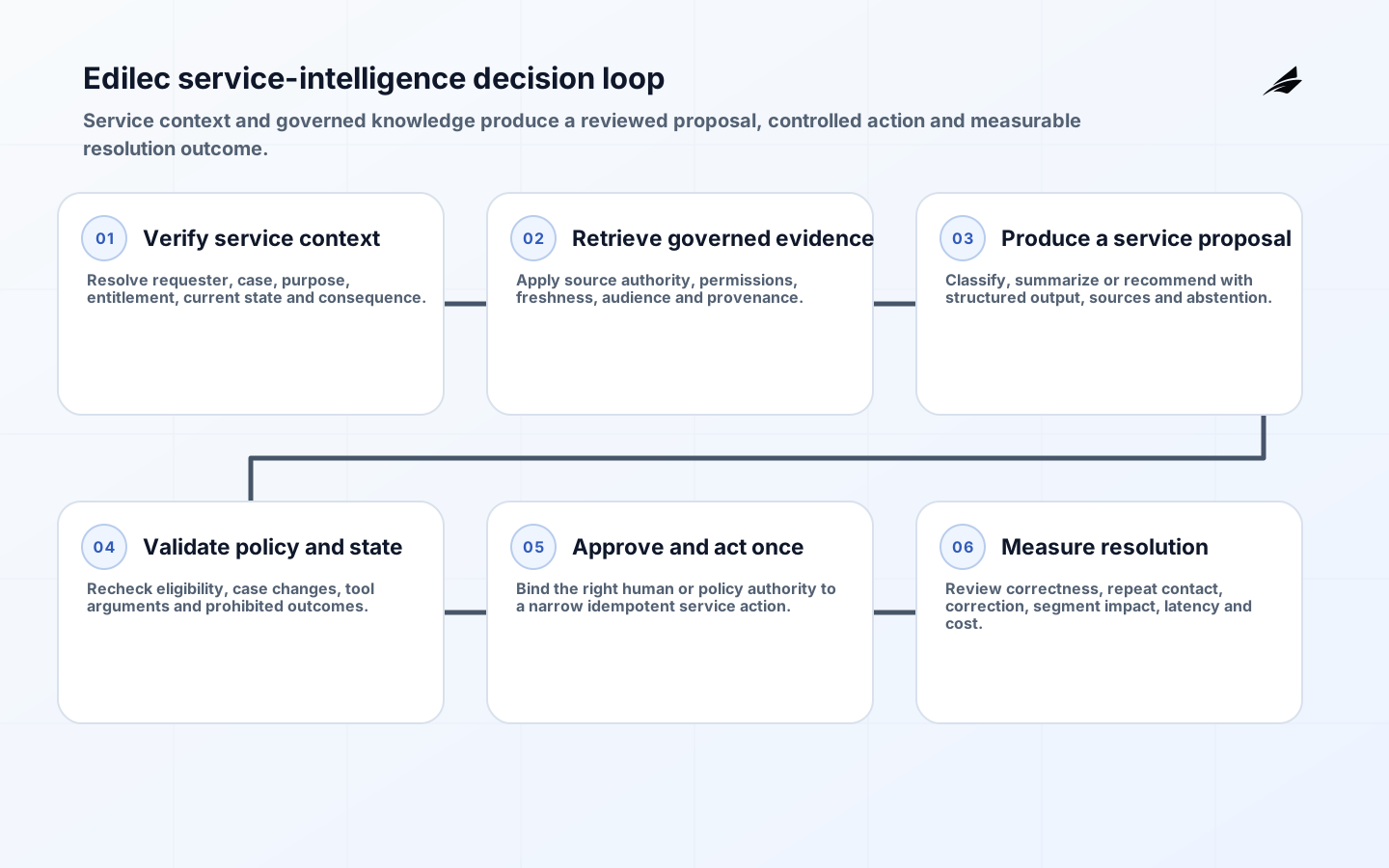
Resolve identity, case state and purpose before invoking a model. Retrieve minimum authorized context and record source versions. Require structured output for classification, routing or tool calls. Validate fields, confidence or abstention, references and policy. Re-read current case state immediately before an action because queue, entitlement or customer status may have changed during generation or review. Tool permissions should match one service action, not a broad platform role. Bind human approval to exact arguments and use idempotency to prevent duplicate messages, credits or closures.

Separate the operational system of record from model memory. Maintain conversation continuity only for the defined case and retention period. Protect prompts and model logs based on the data they contain. Define timeouts, provider quotas, cost limits and graceful degradation so agents can complete work without AI. The six-stage Edilec service-intelligence decision loop at this heading moves from verified service context to grounded proposal, policy validation, human authority, action and outcome learning. That boundary allows models to assist while ordinary software retains accountability.
Evaluate service quality, harm and operator usability
Build a representative evaluation by request family, consequence, channel, language and customer segment. Include incomplete records, conflicting sources, novel requests, frustrated language, policy exceptions and known historical failures. Score factual support, material omission, routing consequence, tone, privacy, policy compliance and appropriate abstention. Measure the complete task: a correct classification that sends work to an unavailable queue does not improve service. Compare with the current process and with deterministic baselines. Set hard thresholds for high-consequence errors before launch.
Human-factors testing matters because agent assistance can create anchoring and automation bias. Observe whether agents inspect evidence, correct drafts and understand uncertainty under realistic volume. Track the time and cognitive burden of review, not just generation latency. NIST's Generative AI Profile identifies risks and suggested actions specific to generative systems. Release evaluation should preserve model, prompt, retrieval, tool, data and rubric versions so later changes and incidents can be compared reproducibly.
| Measure | Why it matters | Guardrail |
|---|---|---|
| Time to qualified owner | Shows whether routing improves real access to help | Misroute severity and transfer rate |
| Resolution correctness | Captures the service result, not fluent output | Repeat contact and reopen rate |
| Agent correction rate | Reveals where assistance adds or removes work | Sample corrected and accepted outputs |
| Customer effort | Detects loops, repeated identity checks and channel switching | Segment and accessibility review |
| Cost per resolved request | Connects model and operating spend to value | Quality and human-work counter-metrics |
Control security, privacy and human authority
Threat-model customer input, attachments, retrieved knowledge, model provider, orchestration, tools and output consumers. Treat all model output as untrusted and validate it before display or execution. The OWASP LLM application guidance covers prompt injection, sensitive information disclosure, insecure output handling and excessive agency. Scan files, isolate instructions from evidence, restrict network destinations and monitor unusual retrieval or tool use. Redact logs where possible while retaining enough correlation for investigation.
Define when an agent, supervisor, specialist or compliance role must decide. Reviewers need the original request, relevant record state, supporting sources and a clear representation of the proposed action. Do not require approval at a volume that makes review ceremonial. For low-risk drafting, sampling and correction may be appropriate; for refunds, entitlement changes or sensitive disclosures, stronger approval and verification may be necessary. Record overrides as signals for evaluation, but do not penalize them in a way that discourages correction.
Build the cost model and staged delivery roadmap
Model discovery, data preparation, integration, evaluation, security, change management and operations as well as inference. Unit economics depend on request length, retrieved context, model choice, retries, review time, escalation and downstream savings. Estimate ranges from real service samples. A cheaper model that increases correction can cost more per resolved request. Include provider rate changes and peak demand. Track cost by request family and successful outcome rather than average token use alone, and define budgets that degrade safely instead of failing silently.
Deliver in stages: workflow baseline, offline prototype, shadow evaluation, limited agent assistance, controlled cohort and broader service. Automation follows only after assistance evidence supports the authority increase. Set exit criteria and stop conditions for every stage. Instrument the complete request with traces, metrics and logs; the OpenTelemetry observability primer explains how those signals support investigation. Review outcomes after each stage, update the risk assessment and retire legacy rules or dashboards only when the replacement is proven.
AI-first service intelligence takeaways
- Start with one service decision and baseline the complete request-to-outcome journey.
- Separate intelligence, agent assistance and automation because their authority and evidence differ.
- Treat historical service data as operational evidence with bias, provenance and privacy constraints.
- Keep current state, policy and side-effect authorization outside probabilistic model behavior.
- Evaluate service results and human usability across request families and affected segments.
- Scale through shadow and limited cohorts using cost per successful resolution and quality guardrails.
Frequently asked questions
Should an AI-first program begin with a chatbot? Usually not by default. Begin where service evidence shows a constraint. Internal summarization, retrieval or routing may create more measurable value with less customer risk, and can improve the operation a future conversational channel would depend on.
Can service intelligence train on all historical cases? Access to records does not establish permission or fitness for model use. Review purpose, privacy, retention, quality, representativeness and embedded sensitive content. Exclude or transform data where use is not justified.
When is autonomous service action appropriate? Only for bounded, low-consequence, reversible or safely recoverable actions with deterministic eligibility, narrow permissions, idempotency, monitoring and a tested fallback. Increase authority from production evidence, not demonstration confidence.
Conclusion
AI-first service intelligence should make a service operation more informed and accountable, not merely more automated. A sound plan connects governed evidence to a bounded decision, protects human authority and evaluates real resolution outcomes. With staged delivery, complete observability and honest unit economics, teams can expand assistance that works, constrain risky behavior and keep customer service functional when the AI layer is uncertain or unavailable.