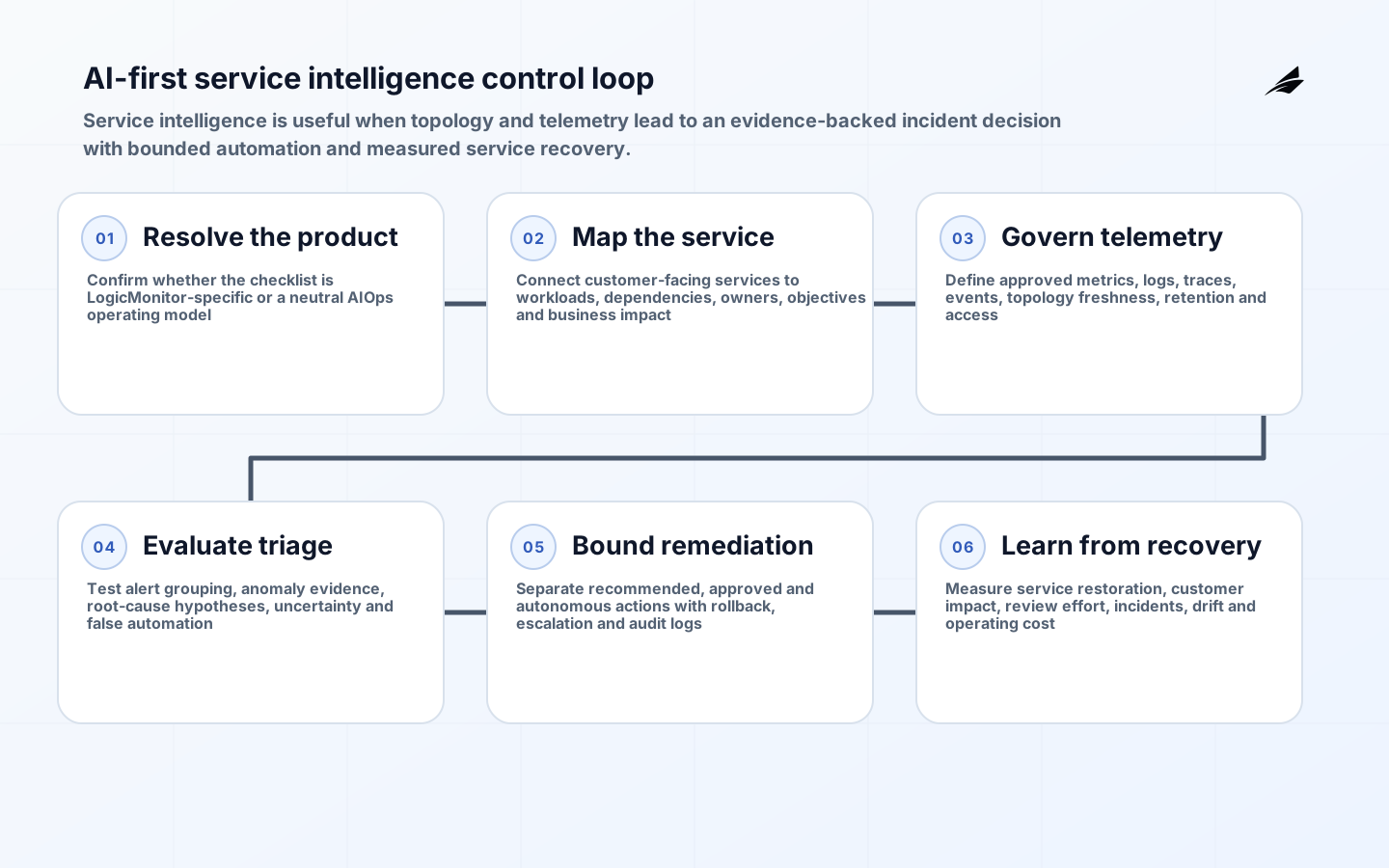
A service intelligence AI-first implementation checklist should improve how a service team understands demand, routes work, supports agents and learns from outcomes without making AI the default answer to every problem. Useful capabilities include intent classification, forecasting, anomaly detection, knowledge retrieval, summarization, quality review and next-best-action support. Each capability has different data, evaluation and human-control requirements. Begin with the service decision to improve, not a model demonstration. The final system must preserve customer context, explain operational state and provide a safe route when confidence or availability is insufficient.
This checklist extends the service intelligence scope and delivery plan and service intelligence FAQ. It uses the NIST AI RMF as a practical lifecycle frame. Governance must shape mapping, measurement and management continuously; approval at project start cannot account for later model versions, data drift, expanded authority or new customer populations.
Define the service decision and customer outcome
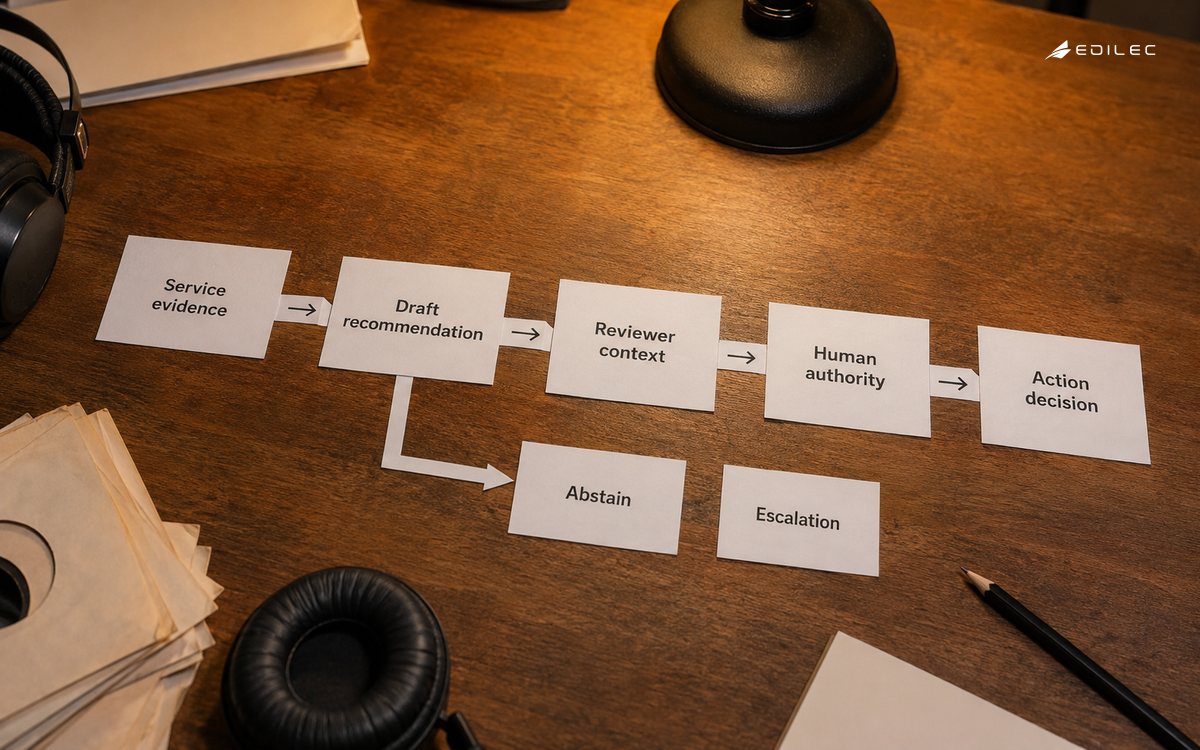
Name the user, moment of use, input, output, downstream action and accountable role. A routing classifier should reduce time to qualified ownership without increasing harmful transfers. A summarizer should reduce reading effort while preserving critical commitments and uncertainty. A quality model should identify review candidates without becoming an opaque employee score. Establish the current baseline and a target across speed, accuracy, customer outcome, agent effort and exception handling. Reject use cases where the output has no owner or no measurable influence on the workflow.
Map authority explicitly. Analytics may describe a pattern, predict an outcome, recommend an action or execute one; these are not interchangeable. High-impact actions such as denying service, changing an account or communicating a binding commitment require stronger deterministic checks and human authority. Design abstention and escalation before optimizing automation. Tell users when AI materially shapes their work, provide source context where feasible and avoid interface patterns that encourage automatic acceptance. Human review is a control only when reviewers have time, information and authority to disagree.
| Capability | Primary success measure | Material risk | Required control |
|---|---|---|---|
| Intent routing | Qualified ownership time and transfer rate | Systematic misrouting of a language or request type | Segmented thresholds, fallback queue and correction feedback |
| Case summarization | Critical-fact recall and agent time | Invented or omitted commitments | Source links, review and prohibited automatic send |
| Knowledge retrieval | Relevant supported answer rate | Unauthorized or outdated content | Access-aware index, ownership and freshness |
| Forecasting | Calibrated demand error by horizon | Understaffing from unexamined regime change | Scenario range and operations override |
| Quality analytics | Useful review yield and issue detection | Opaque worker surveillance or biased scoring | Purpose limit, appeal, sampling and governance |
Create a service data contract
Inventory case fields, messages, transcripts, recordings, knowledge, customer attributes, agent actions and outcome labels. For each source, record owner, purpose, provenance, quality, access, retention and allowed AI uses. Operational status is not automatically a valid outcome label: a case marked closed may be reopened or unresolved for the customer. Build labels with domain experts, document ambiguity and measure reviewer agreement. Preserve raw source lineage while limiting sensitive content. Remove unnecessary identifiers and prevent production data from leaking into ad hoc notebooks or prompts.
Define training, evaluation and runtime datasets separately. Avoid leakage across repeated customers, related conversations or time periods. A chronological holdout can reveal whether performance survives policy and product changes. Segment by request family, channel, language, complexity and other operationally relevant conditions, using protected attributes only with lawful purpose and safeguards. Retrieval pipelines must enforce the requesting user's permissions, propagate deletion and remove expired documents. Feedback data needs classification because a correction, preference, complaint and policy exception have different meaning.
Separate model inference from workflow authority
Put deterministic validation around model outputs. Check schemas, eligible actions, required evidence, policy constraints and authorization before a workflow changes state. Use stable case and request identifiers so retries cannot create duplicate messages or actions. Record model, prompt, retrieval and policy versions for material outputs. A confidence score is not universally calibrated and should not be treated as a probability without validation. Choose thresholds from error cost and fallback capacity, not an arbitrary percentage. Keep a manual continuity path for provider outage or broad model suspension.
Threat-model prompt injection in customer text and retrieved documents, data exfiltration, malicious attachments, unsafe tool calls, poisoned feedback and excessive agency. Treat content as untrusted input. Restrict tool permissions and arguments, isolate retrieval domains, scan files and cap loops, spend and time. Runtime identities should access only the cases and actions required. The NIST AI RMF Core emphasizes ongoing Govern, Map, Measure and Manage outcomes; connect each risk to an owner, control signal and response rather than relying on model-level safety claims.
Evaluate service behavior before each release
Build a versioned evaluation set covering routine, rare, ambiguous, adversarial and high-impact cases. Define task metrics and operational thresholds before testing. Classification may need precision, recall, calibration and cost-weighted error; summarization needs critical-fact coverage, groundedness and harmful omission; retrieval needs relevance, permission correctness and freshness. Aggregate scores can hide failure, so publish segmented results and sample errors. Calibrate human reviewers with a rubric. The NIST AI Resource Center provides testing, evaluation, verification and validation resources that support this evidence-led approach.
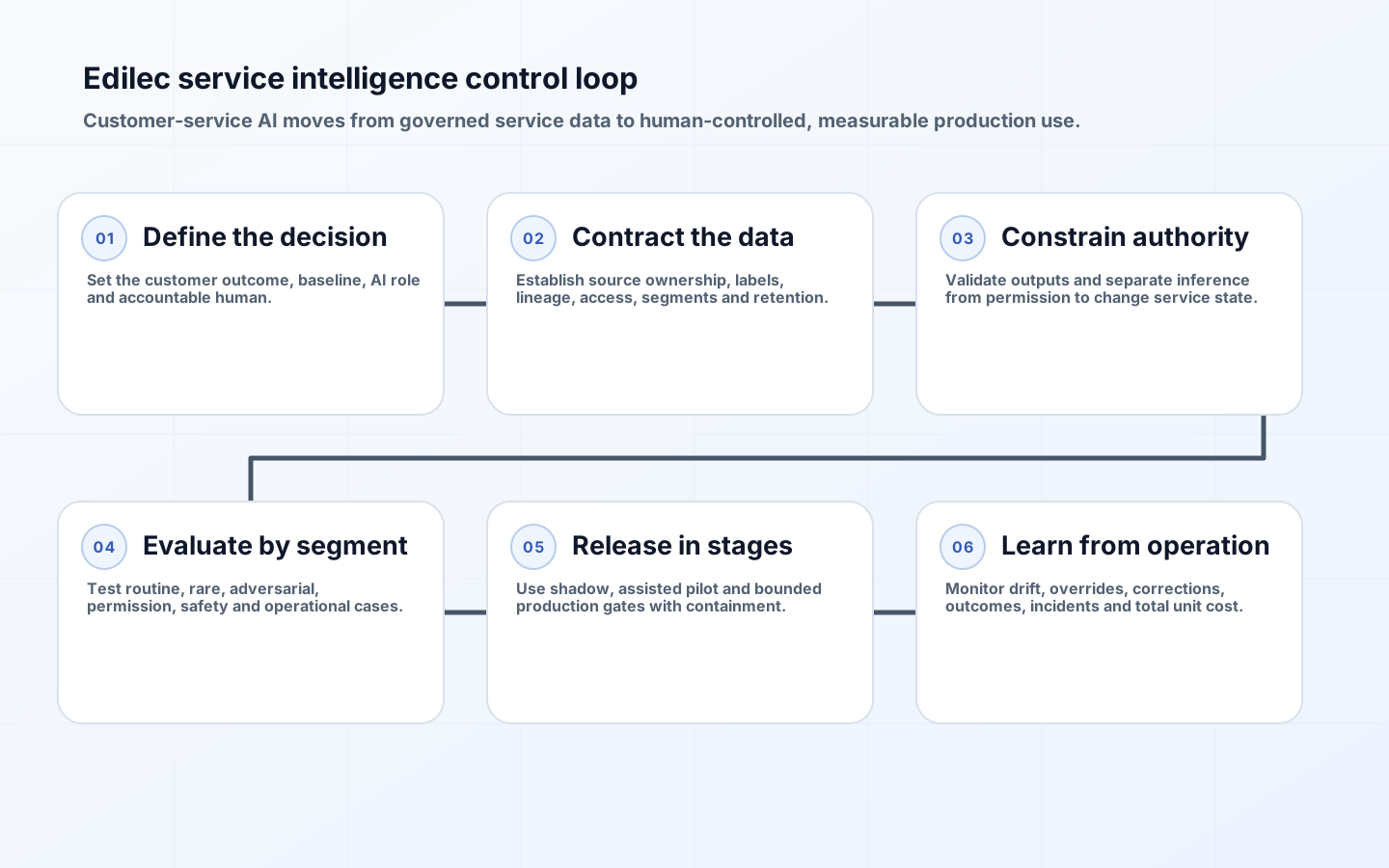
Progress through offline evaluation, shadow mode, assisted pilot and bounded production. Shadow mode tests live distribution without influencing agents. During pilot, measure acceptance, override, correction, transfer, handle time, repeat contact and customer outcome. Compare against the baseline and inspect whether agents over-rely on confident presentation. Every gate needs an approver, threshold and stop action. Re-run evaluation after model, prompt, knowledge, policy, channel or population changes. The NIST AI RMF FAQ reinforces that trustworthiness should be considered across design, deployment, use and evaluation.
| Release gate | Minimum evidence | Approver | Rollback or containment |
|---|---|---|---|
| Offline | Segmented task, safety and permission thresholds pass. | Domain and AI owners | Revise data, model or scope; no live exposure. |
| Shadow | Live distribution, latency, cost and drift remain bounded. | Service operations owner | Stop shadow processing and inspect pipeline. |
| Assisted pilot | Users verify outputs and outcomes improve safely. | Product and risk owners | Disable feature, preserve manual workflow and review cases. |
| Bounded production | SLOs, monitoring, support and fallback are exercised. | Service owner | Route affected request families to controlled handling. |
| Expansion | Evidence holds across new segment, channel or authority. | Governance forum | Return to prior boundary and re-evaluate. |
Design the agent and customer experience
Place assistance at a decision point and show the evidence needed to judge it. A summary should link to source messages; a recommendation should state relevant constraints; a routing suggestion should expose category and correction. Avoid flooding the interface with low-value generated text. Ensure keyboard and assistive-technology operation, readable uncertainty and a consistent manual path. For customers, preserve clear authorship, escalation and complaint routes. Do not imply a human reviewed content when none did, and do not use empathetic language to obscure that an automated system is handling the request.
Train teams on purpose, limitations, data handling, verification and incident reporting with real scenarios. Involve agents in design without converting consultation into blanket consent for surveillance. Define how model analytics may be used in performance management, and separate process-quality signals from individual evaluation unless governance explicitly justifies it. Measure workload redistribution: automation may reduce routine reading while concentrating difficult, emotionally demanding exceptions. Staffing and wellbeing plans should account for that shift. The enterprise service intelligence checklist adds cross-business governance considerations.
Operate models, knowledge and costs together
Monitor input distribution, segmented quality samples, latency, failure, fallback, token or compute use, override, corrections, complaints and downstream outcomes. Distinguish model drift from policy change, data-pipeline failure and demand shift. Set alerts that lead to a defined action. Version prompts, models, retrieval indexes, evaluation sets and workflow rules in one release record. Maintain runbooks for provider outage, elevated hallucination, permission leakage, corrupted knowledge, bad deployment and unauthorized action. Exercise the kill switch and manual continuity path before production expansion.
Track total unit cost: inference, retrieval, storage, moderation, evaluation, human review, observability and incident response. Apply budgets, request limits and anomaly alerts with named owners. Route work to simpler models or deterministic rules when they meet the requirement. Cache only where access, privacy and freshness remain correct. Retire models and indexes deliberately, including data and credential cleanup. Review whether the capability still improves service; an accurate feature that agents bypass or that moves error downstream is not delivering value.
Service intelligence AI takeaways
- Anchor each AI capability to a service decision, baseline and accountable human.
- Treat case status and feedback as evidence to validate, not automatic ground truth.
- Keep probabilistic inference separate from deterministic authorization and irreversible action.
- Evaluate segmented, rare and adversarial cases through explicit release gates.
- Give agents source context, correction controls, practical training and a stable manual path.
- Operate model, knowledge, workflow, security and unit cost as one production system.
Frequently asked questions
What does AI-first mean for service intelligence? It should mean that teams consider where AI can materially improve a service decision and design data and evaluation accordingly, not that every interaction is automated. Deterministic workflow and human service remain preferable where they are safer, clearer or more economical.
Can human review make any service AI safe? No. Review can reduce some risks, but only when reviewers receive evidence, time, training and authority. High output volume, automation bias or hidden downstream actions can make nominal review ineffective. Reduce model authority and redesign the workflow where review cannot work.
How often should service AI be re-evaluated? Re-evaluate on a risk-based schedule and whenever a material model, prompt, knowledge, policy, data, channel, user group or authority change occurs. Production sampling and outcome monitoring should continue between formal evaluations.
Conclusion
Service intelligence becomes dependable when AI evidence is connected to customer work, human authority and operational response. Governed service data, constrained workflow integration, segmented evaluation, usable agent controls and continuous monitoring let teams gain speed and insight without losing accountability. Completing this checklist creates a production service that can be challenged, corrected and improved as conditions change.