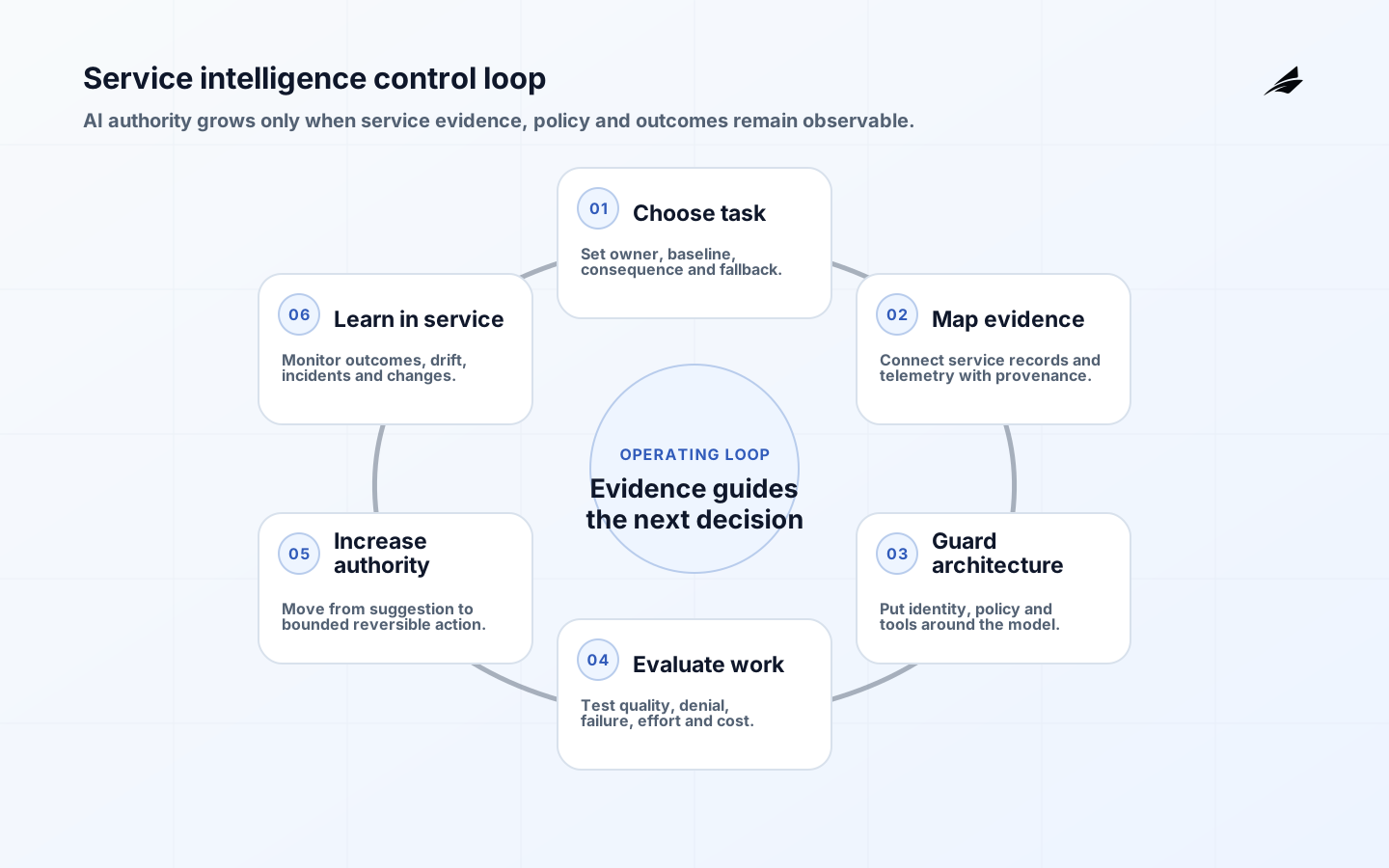
Enterprise service intelligence AI applies machine learning or generative AI to service operations: classifying requests, finding related incidents, summarizing evidence, detecting anomalies, forecasting demand and recommending or executing actions. Its value depends less on a demonstration chatbot than on data authority, workflow design and operational controls. This enterprise service intelligence AI FAQ explains how to choose use cases, connect observability and service-management records, constrain automation, and evaluate the system in production.
Use the enterprise service intelligence delivery plan for scope and economics, the enterprise implementation checklist for execution, and the service intelligence plan for a narrower operating model.
Which use cases are suitable for enterprise service intelligence AI?
Begin with a decision or task that has enough historical evidence and a measurable outcome. Useful early cases include ticket classification, duplicate detection, knowledge retrieval, incident timeline construction, change-risk hints and demand forecasting. They assist people without silently changing production. Autonomous remediation requires a much stronger case: the action must be bounded, reversible, observable, authorized and safer than waiting for a human.
Avoid selecting a use case solely because a model can generate plausible text. Define the user, trigger, authoritative inputs, expected output, prohibited behavior, review point and fallback. Baseline today’s cycle time, error rate and workload. If the organization cannot identify the service owner or determine whether the output was correct, it is not ready to automate that decision. NIST AI RMF frames this as mapping context before measuring and managing risk.
| Use case | Recommended initial authority | Primary evaluation |
|---|---|---|
| Ticket routing | Suggest queue; agent confirms | Routing precision and reassignment rate |
| Incident summary | Draft from linked evidence | Factual completeness and time saved |
| Anomaly detection | Alert with contributing signals | Useful detection rate and alert burden |
| Knowledge answer | Cite approved sources; user decides | Grounded-answer rate and unresolved tasks |
| Remediation | Execute allow-listed reversible action | Success, rollback and unintended-change rate |
What data does the system need?
Typical inputs include service catalog records, configuration relationships, incidents, changes, requests, knowledge articles, deployment events, metrics, logs and traces. OpenTelemetry distinguishes telemetry signals such as metrics, logs and traces; none is automatically an authoritative business record. Preserve source identity, timestamp, service, environment, version and access classification so a recommendation can be reconstructed.
More data is not always better. Old tickets can encode obsolete procedures, inconsistent categories and sensitive personal information. Establish retention and permitted-use rules, remove secrets, control model access, and document transformations. Separate training or retrieval corpora from evaluation sets. Build a representative test set that includes rare high-impact cases, denied access, missing context, conflicting records and newly changed services.
How should enterprise service intelligence AI fit the architecture?
Place an orchestration layer between models and operational systems. It should authenticate the user or service, retrieve only authorized context, validate inputs, invoke approved tools, enforce action policy, record evidence and return a structured result. Keep the model away from unrestricted production credentials. A recommendation can contain an action proposal, but a deterministic policy component should decide whether the caller, target, environment and change window permit execution.
Version prompts, retrieval configuration, models, tools and policy together. Correlation identifiers should connect a user request to retrieved records, model output, approval, tool call and observed result. Design for model and dependency failure: timeouts, unavailable telemetry, stale indexes and rate limits should lead to a known degraded path. The service desk must still operate when AI assistance is unavailable.
How much human review is necessary?
Review intensity follows consequence and reversibility. Low-risk drafting can be sampled after use; customer communication, access changes, financial commitments and production actions need review before execution unless a narrowly tested policy allows otherwise. NIST guidance emphasizes continuous risk management, while GAO organizes accountability around governance, data, performance and monitoring. Both point toward named owners and evidence, not a generic disclaimer that a human remains involved.
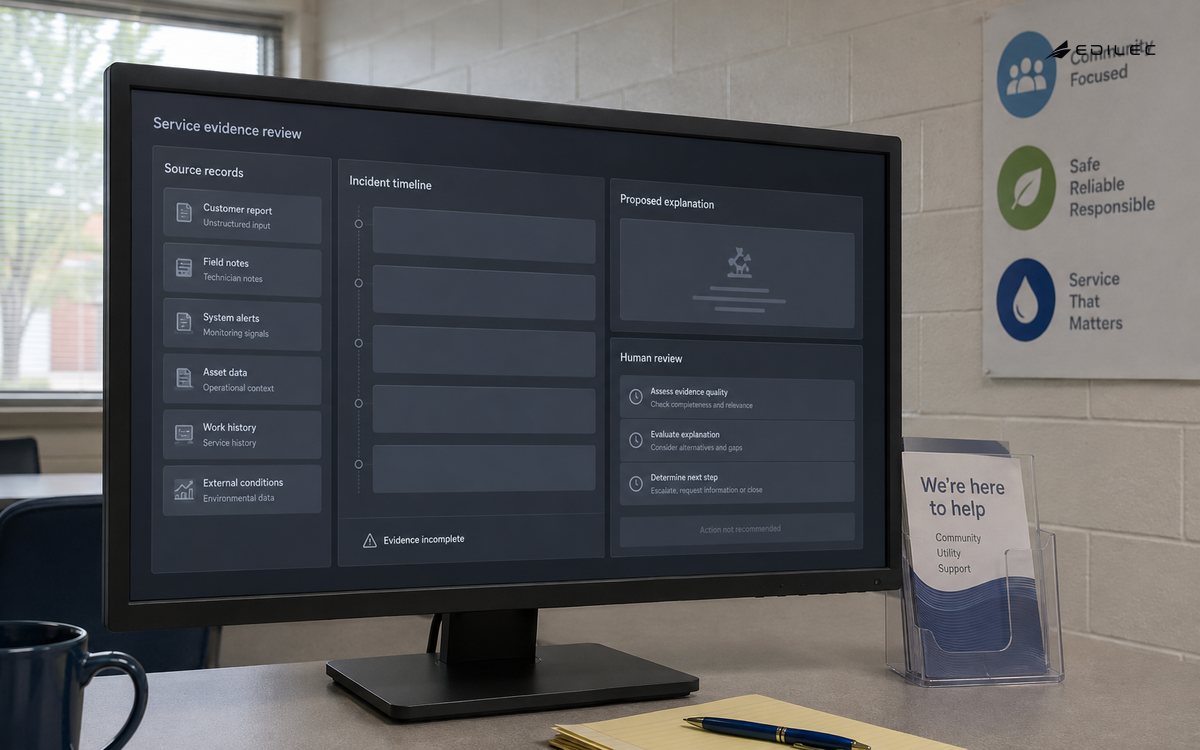
Design the review interface so the person can challenge the result. Show relevant sources, uncertainty or rule failures, intended action, affected assets and rollback. Measure whether reviewers actually detect defects; a required click can become ceremonial. Capture overrides with reason codes and feed them into evaluation, but do not automatically retrain on every correction without data review and change control.
| Control point | Question | Evidence |
|---|---|---|
| Identity | Who requested and who may approve? | User, role, session and approval record |
| Context | Which records were used and were they current? | Source IDs, versions and retrieval time |
| Model | Which configured system produced the result? | Model, prompt and parameter version |
| Action | Was the tool and target allow-listed? | Policy decision and validated arguments |
| Outcome | Did the service improve without harm? | Telemetry, user confirmation and rollback status |
How should performance and value be measured?
Evaluate offline before launch and online after launch. Offline tests support repeatability across known cases; production monitoring reveals distribution change, new services and human behavior. Track task quality, unsafe or unsupported outputs, latency, availability, override rate, escalation, user effort and cost per completed task. For anomaly systems, precision alone is insufficient; an alert stream can be statistically accurate and operationally unusable.
Connect AI metrics to service outcomes such as mean time to acknowledge, restoration time, repeat incidents, change failure, self-service completion and support effort. Google SRE guidance favors signals that indicate user-visible symptoms and actionable causes. Use a controlled pilot or phased comparison where practical. Report uncertainty and denominator changes, and investigate whether gains for common services conceal poor performance on a smaller critical service.
A practical adoption procedure
- Name the service owner, user, task, baseline and unacceptable outcome.
- Map authoritative records, telemetry, sensitive fields and retention rules.
- Define model, retrieval, orchestration, tool and policy boundaries.
- Build test cases for normal, ambiguous, denied, stale and high-impact situations.
- Pilot with recommendation-only authority and instrument reviewer behavior.
- Expand authority only after quality, rollback and operating ownership are proven.
Applied example and assurance notes
A service desk pilot can begin with password-reset and access-request routing while excluding privileged-account changes. Historical tickets provide candidate labels, but current catalog ownership and access policy remain authoritative. Operators review suggestions for four weeks, recording reassignment and missing context. The team then compares queue time, correct routing and operator effort with the baseline. Only stable categories advance; ambiguous cases continue to route through ordinary triage. This keeps learning useful without making the model the owner of access decisions.
Incident summarization needs a stricter evidence contract than conversational assistance. The system should link each timeline statement to an event, deployment, alert or operator note and distinguish observation from interpretation. Reviewers need to see omitted high-severity events and contradictory clocks. If the trace is incomplete, the summary should say so. Production monitoring can then track corrected statements, missing sources and time saved, revealing whether polished prose actually improves command decisions.
Ownership should be split deliberately. The service owner accepts workflow outcomes; the data owners authorize records; security owns threat requirements; the model owner controls configuration; and operations owns availability, incident response and suspension. A change that swaps a model, expands retrieval or adds a tool may cross several owners. One release record should therefore identify behavioral change, evaluation evidence, access impact, rollback and the person authorizing expanded authority.
- Record the accountable owner and the decision the evidence supports.
- Test a normal journey, a denied path and a realistic failure.
- Keep assumptions, versions and unresolved risks visible.
- Require acceptance evidence before expanding scope or authority.
- Review operating outcomes and close corrective actions.
Before approval, the service owner should convene service desk, observability, security, data owners and platform operations for a scenario review. Walk through ordinary use, a denied request, one unavailable dependency, a partial change and recovery. For each step, identify the authoritative record, person with decision rights, expected signal, time limit and safe alternative. Challenge misrouting, stale evidence, excessive automation and alert burden. Record assumptions that could change after launch and assign each one a trigger for reassessment. The review is successful when participants can explain not only the preferred path but also how they recognize an unsafe state, who can stop progress, and how users continue while the issue is resolved. Preserve the task trace, override record and service-outcome dashboard with the configured release rather than in a detached presentation.
For Enterprise Service Intelligence AI FAQ: Architecture, Controls and Operations, conduct a review thirty days after release or completion. Compare actual demand, quality, exceptions, incidents, cost and user effort with the baseline. Separate design defects from training gaps and changed operating context. Sample complete cases because averages can conceal a rare path carrying most consequence. Confirm that temporary access, duplicate infrastructure, transitional policy and manual workarounds have closed or have an owner and expiry. Reforecast the next period and publish decisions to people who operate or depend on the capability. At each material change, refresh cases, assumptions and risk treatment; assurance is a maintained operating practice, not a certificate inherited from the first release.
Enterprise Service Intelligence AI FAQ: Architecture, Controls and Operations also needs a concise evidence index that a new reviewer can navigate without oral history. Link the current boundary, named owners, architecture or workflow, decisions, tests, exceptions, operating signals and closure records. Mark superseded artifacts instead of silently replacing them, and protect sensitive material by role. During a review, select one claim from the summary and trace it to its source and observed result. If that trace is slow or ambiguous, improve the index before scale. Good evidence reduces repeated discovery, supports accountable challenge and makes future migration or retirement materially easier.
Key takeaways
- Choose an operational decision with a baseline, owner and testable result.
- Treat service records and telemetry as governed evidence with different authority.
- Keep production actions behind identity, deterministic policy and reversible tools.
- Evaluate end-to-end task outcomes, not model fluency in isolation.
- Preserve fallback service operation and review the system as models and services change.
Frequently asked questions
Is service intelligence the same as AIOps?
They overlap. AIOps often emphasizes telemetry analytics, anomaly detection and event correlation. Service intelligence may also include requests, knowledge, customer communication, workflow recommendations and generative interfaces. Define capabilities rather than relying on either label.
Does it replace the IT service-management platform?
Usually no. The service-management platform remains the authoritative workflow and record system. AI augments classification, retrieval, analysis or actions through controlled interfaces. Replacing established ownership and audit behavior is a separate transformation.
What usually drives operating cost?
Telemetry volume, indexing, model inference, retrieval infrastructure, evaluation, integration maintenance and human review all matter. Cost per successful task is more informative than token or alert cost because it includes failures, escalations and rework.
Conclusion
Enterprise service intelligence AI works when it is part of the operating system for services rather than an ungoverned model beside it. Select bounded tasks, preserve authoritative context, mediate every action, test realistic failures and measure service outcomes. Authority can then grow with evidence while human operators retain a usable fallback and clear accountability.