An artificial intelligence digital implementation checklist should begin with a decision or workflow that deserves improvement, not with a model demonstration. AI may classify, retrieve, forecast, generate or recommend, but the surrounding product must still resolve identity, enforce policy, manage exceptions and produce a measurable business result. The implementation is ready only when its benefits, affected people, failure consequences, data rights and operating owner are understood. This checklist gives business, product, data, security, legal and engineering teams one acceptance path from candidate use case to controlled production service.
Use a risk-proportionate method rather than labeling every AI feature equally. The NIST AI Risk Management Framework organizes work through Govern, Map, Measure and Manage, while the European Commission describes the EU AI Act as a risk-based legal framework. Applicable duties depend on role, system and jurisdiction, so obtain qualified advice. The engineering objective is broader than formal compliance: make the system's behavior, evidence, authority and change process understandable enough to operate safely.
Define the AI outcome, baseline and risk tier
Write the current workflow before proposing automation. Identify the trigger, actors, inputs, decisions, systems changed, completion evidence, exception path and present performance. Select one bounded intervention, such as prioritizing service requests for review or drafting a response from approved knowledge. State what remains deterministic and what remains human. Measure the baseline using outcome, quality, cycle time, cost and workload distribution. If the team cannot observe the current process, it cannot credibly attribute improvement to AI or detect harm shifted to another role.
Classify consequence independently from model type. Consider effects on rights, health, employment, finance, access to services, safety, privacy, security and material business commitments. Document affected groups, plausible misuse, scale, reversibility and how errors are discovered. Define prohibited outcomes and a safe fallback. The neighboring artificial intelligence digital practical guide supports stakeholder framing, while the AI digital FAQ addresses common program questions.
| Gate | Decision required | Minimum evidence |
|---|---|---|
| Business value | Is a specific workflow constraint worth changing? | Baseline, target, owner and counter-metrics |
| Consequence | Who can be affected and how reversible is failure? | Impact map, risk tier and prohibited outcomes |
| AI necessity | Does probabilistic behavior add value over rules or search? | Alternative comparison and decision rationale |
| Authority | What may the system propose, decide or execute? | Permission boundary and human decision points |
| Fallback | How does work continue when AI is unavailable or uncertain? | Tested manual or deterministic path |
Govern data, knowledge and permitted use
Inventory training, tuning, retrieval, evaluation, prompt and operational data separately. For each source, record ownership, origin, collection context, license or legal basis, permitted purposes, sensitivity, geography, retention and deletion obligations. Assess representativeness against the deployment population rather than assuming a large dataset is adequate. Keep a reproducible version of data and transformations used for each evaluation or model release. The NIST Privacy Framework helps teams address privacy risk as an enterprise outcome rather than equating privacy with access control.
For retrieval-augmented systems, build an approved knowledge lifecycle. Enforce source authorization before retrieval, preserve provenance in responses, define freshness and removal targets, and prevent one user's prompt from exposing another user's records. Separate instructions from untrusted content and sanitize documents that can carry hidden commands. When a source conflicts with policy, identify which authority wins. Evaluate whether citations actually support claims. A model can quote a retrieved document fluently while misapplying its date, audience or exception, so evidence use needs scenario testing.
Design an AI architecture with deterministic control points
Place model inference inside a conventional application boundary. Authenticate the requester, resolve purpose and permissions, retrieve only allowed context, construct a versioned request and require typed output where downstream software depends on fields. Validate schema, ranges, references and current system state after generation. Apply deterministic policy before any side effect. Give tools narrow actions and short-lived credentials; do not let a general model inherit broad user or service-account authority. Use idempotency keys for retried actions and make partial failure visible.

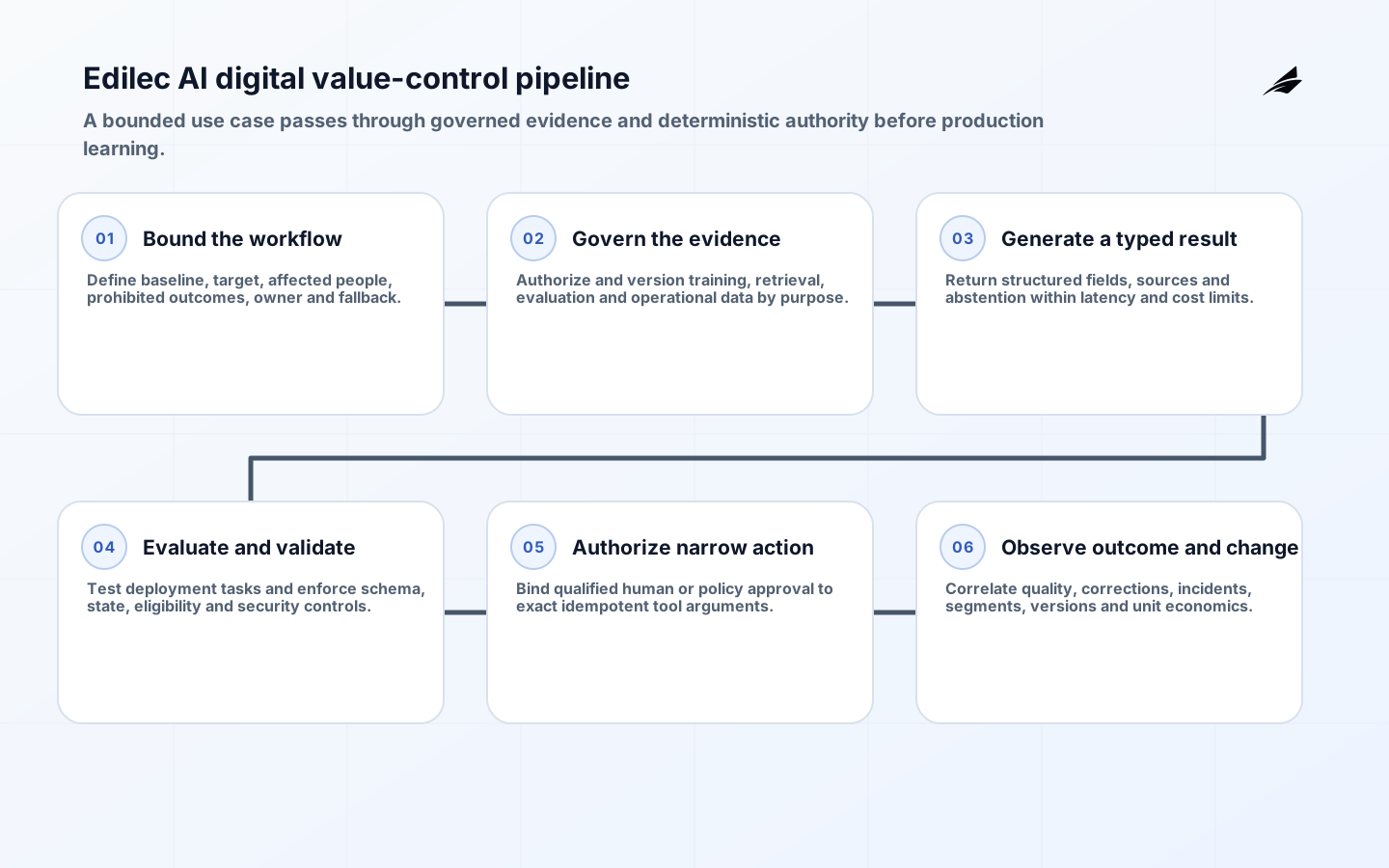
Build provider and model portability where it protects a real risk, but avoid pretending all models are interchangeable. Isolate provider APIs, record model and configuration versions, set latency and cost limits, and define behavior for safety refusal, quota exhaustion and regional outage. Protect prompts, logs and output according to their data content. The six-stage Edilec AI digital value-control pipeline at this heading connects a qualified use case to governed context, evaluated output, authorized action and outcome monitoring, keeping product authority outside the model.
Evaluate behavior against deployment conditions
Create an evaluation set from real task categories, difficult boundary cases, known failure modes and affected segments. Keep a protected holdout for release comparison. Measure task-specific correctness and error severity, not one generic score. For generated content, use structured criteria and blinded human review where judgment matters; calibrate automated graders against qualified reviewers. Test abstention, unsupported claims, citation use, privacy leakage, harmful bias, adversarial inputs, multilingual behavior, latency and cost. Compare against the current process and a simpler non-AI alternative.
Set release thresholds before seeing final results. Averages can hide severe but infrequent failures, so define hard stop conditions for prohibited outcomes and segment floors. Record dataset version, code, model, prompts, tools, environment and evaluator instructions. The NIST AI Resource Center provides resources for testing, evaluation, verification and validation, and NIST's Generative AI Profile adds risks specific to generative systems. Acceptance should include end-to-end workflow tests, not model tests alone.
| Evaluation area | Example evidence | Release response |
|---|---|---|
| Task quality | Error taxonomy by request family and consequence | Block if critical class exceeds threshold |
| Grounding | Claim support, source relevance and stale-source cases | Restrict scope or improve retrieval |
| Fairness | Performance and harm review across relevant segments | Investigate cause and redesign before expansion |
| Security | Prompt injection, data extraction and excessive-agency tests | Remove unsafe tools or strengthen boundaries |
| Operations | Latency, availability, token use and fallback completion | Set capacity, timeout and degradation policy |
Secure the system and preserve meaningful human control
Threat-model the entire AI application: users, data sources, model service, orchestration, memory, plugins, tools, output consumers and monitoring. The OWASP LLM application project highlights risks including prompt injection, insecure output handling, sensitive information disclosure, supply-chain weakness and excessive agency. Treat model output as untrusted. Restrict network and data paths, validate tool arguments, scan retrieved files, protect system instructions and monitor anomalous use. Rate and budget limits should contain both abuse and accidental cost escalation.
Human review is meaningful only when the reviewer has time, context, competence and authority to disagree. Show source evidence, uncertainty and material policy checks; do not bury an approval inside a high-volume click path. Match review rigor to consequence, and sample accepted as well as rejected cases for quality. Bind approval to an exact action and revalidate current state before execution. Track overrides and corrections without treating human agreement as proof of model correctness. Where work volume makes genuine review impossible, narrow the system's authority or redesign the process.
Release progressively and operate AI as a changing service
Start with offline evaluation, then shadow mode, a limited internal cohort or advisory output before granting broader authority. Define stop conditions, rollback or fallback behavior and who can invoke them. Version every material component and maintain a release record that links risk assessment, evaluation and approval. Monitor model-provider changes even when the application code is static. A model alias moving to a new underlying version is a production change. Re-run targeted evaluations after prompt, retrieval, policy, tool, data or model changes according to impact.
Production monitoring should combine service health with outcome quality. Track failures, refusals, corrections, escalations, unsupported claims, segment performance, tool errors, latency and unit cost. Review samples because many quality problems are not visible in infrastructure metrics. Create an incident path for harmful output, unauthorized action, data exposure and provider outage. Preserve enough input, context, version and decision evidence to investigate within privacy limits. Feed findings into the risk register and evaluation suite, and retire systems whose benefit no longer justifies their cost or risk.
AI digital implementation takeaways
- Select a bounded workflow with a measurable baseline, owner, risk tier and safe fallback.
- Document data provenance, permission, representativeness, retention and deletion for every AI data role.
- Keep identity, policy, validation and action authority in deterministic application controls.
- Evaluate deployment tasks, severe errors, segments, security, abstention, latency and cost before release.
- Design human review around real context and authority rather than ceremonial confirmation.
- Treat model, prompt, retrieval, tool and provider changes as governed production changes.
Frequently asked questions
When is a proof of concept ready for production? Only when the team has moved beyond impressive examples to representative evaluation, security boundaries, data rights, operating ownership, failure handling and outcome measurement. Production readiness belongs to the complete workflow, not the model endpoint.
Must every AI output receive human approval? No. Review should follow consequence and reversibility. Low-impact suggestions may use monitoring and sampling; material decisions or actions may need qualified approval. Some uses should remain prohibited regardless of approval because a reviewer cannot reliably detect the failure.
How often should AI systems be reevaluated? Use impact-based triggers plus a scheduled baseline. Reevaluate after material model, data, prompt, retrieval, tool, policy or workflow changes, after incidents, and when monitoring shows population or performance shift. Provider-side changes also need detection.
Conclusion
A reliable AI implementation is a governed digital product, not an isolated intelligence layer. Its value comes from a well-chosen workflow; its trustworthiness comes from controlled data, explicit authority, representative evaluation, secure integration and observable operations. Working through this checklist gives decision makers evidence to expand a useful system, constrain an uncertain one or stop an intervention whose benefit does not justify its consequences.