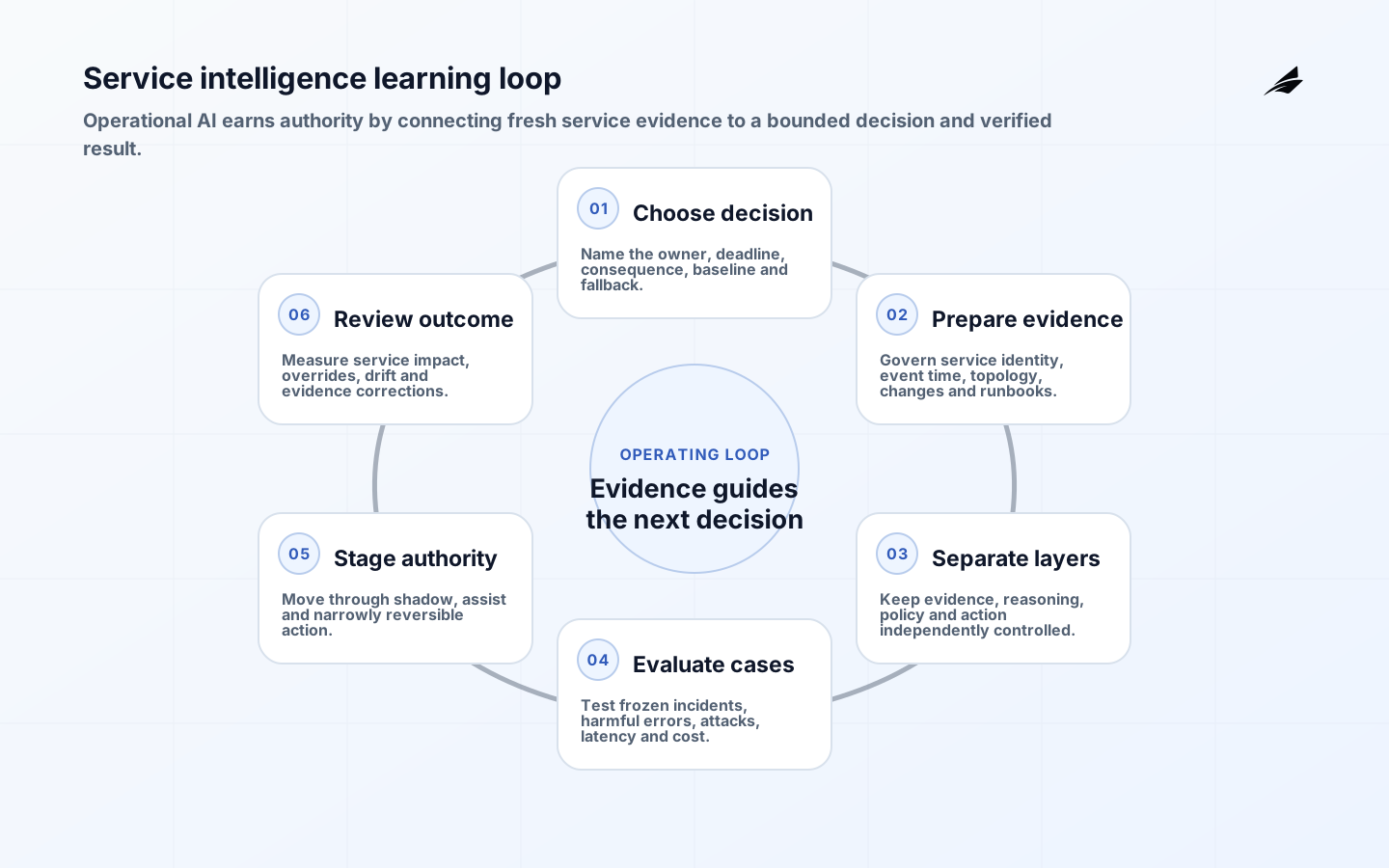
Service intelligence AI turns operational evidence into a recommendation or action for people who run a service. It may cluster alerts, summarize an incident, suggest a resolver group, retrieve a runbook, estimate customer impact or flag an emerging problem. The value is not the sophistication of the model. It is the time and error avoided in a real decision while service owners retain authority, evidence and a safe fallback.
This guide covers scope, architecture, cost, risk and rollout for service intelligence AI. It complements the enterprise service intelligence plan, its implementation checklist and the service intelligence checklist. The design is vendor-neutral because the hardest work lies in service ownership, telemetry meaning, evaluation and operational change.
Choose a service decision, not an AI feature
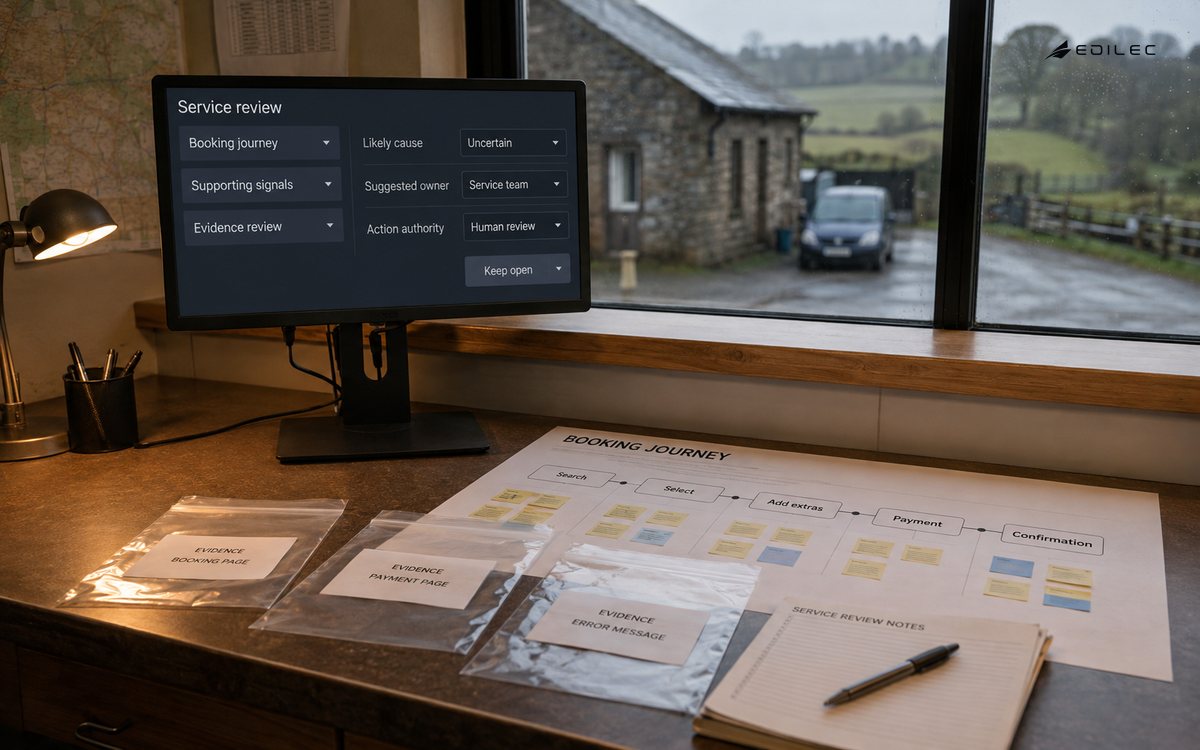
Frame the first use case as a decision with an owner, deadline and consequence. For example: within five minutes of a high-severity alert, recommend the affected customer journey, likely owning team and three supporting signals. Define eligible services, event sources, operating hours and exclusions. A broad objective such as reduce incidents encourages a platform build before anyone can show which decisions improve.
Baseline current performance using case review. Measure alert volume, duplicate rate, time to acknowledge, time to identify impact, reassignment, recovery, recurrence and operator effort. Include false escalation and missed-impact costs. DORA's current software delivery metrics separate throughput and instability and emphasize measuring one service in its context. Service-intelligence metrics should follow the same principle: compare a stable unit over time, not unrelated teams in a league table.
| Candidate use | Decision latency | Primary risk | Good first authority |
|---|---|---|---|
| Alert grouping | Seconds to minutes | Unrelated symptoms merged | Recommend cluster with visible members |
| Incident summary | Minutes | Incorrect chronology or unsupported cause | Draft from cited events for operator approval |
| Resolver routing | Minutes | Delay through confident misrouting | Rank teams and allow immediate override |
| Automated remediation | Seconds to minutes | Expanded outage or data loss | Only pre-approved reversible actions within limits |
Build a trustworthy operational evidence layer
Inventory metrics, logs, traces, topology, deploys, feature flags, tickets, runbooks and customer signals. Assign an owner, retention, access class and quality expectation to each. OpenTelemetry distinguishes traces, metrics and logs and provides conventions that reduce arbitrary naming, but instrumentation still needs service identity and domain meaning. Correlate evidence through stable service, environment, version, request and change identifiers. Avoid copying sensitive payloads into a central AI store merely because they are available.
Represent time honestly. Preserve event time, collection time and processing time; mark late or missing sources. Keep topology and ownership effective-dated because the responsible team at incident time may differ from today's catalog. Treat tickets and postmortems as partly subjective evidence, not ground truth. Normalize severity, status and resolution labels before training or retrieval. Give operators a path to correct ownership, causal links and runbook metadata so the evidence layer improves through use.
Separate evidence, reasoning, policy and action
Use four explicit layers. The evidence layer collects and queries governed operational data. The reasoning layer ranks, clusters, retrieves or generates. The policy layer determines which tools, services, data and actions are allowed for the current user and incident. The action layer executes through narrow APIs with idempotency, timeouts and audit. This separation allows the model or retrieval method to change without silently changing production authority.
Return evidence with every recommendation: affected signals, time window, source links, model or rule version and confidence treatment. Do not present a probability as certainty. Cache carefully because operational state expires quickly. Define behavior when evidence is conflicting, telemetry is unavailable, the model times out or a downstream action fails. The service desk must remain usable in degraded mode, with operators able to inspect raw signals and follow a known manual runbook.
Evaluate recommendations in production-shaped cases
Create an evaluation set from resolved incidents, near misses, routine alerts and synthetic failure exercises. Freeze the evidence as it existed at the decision time to prevent future information leaking into the test. Have qualified reviewers label acceptable outputs, relevant evidence and harmful actions, allowing disagreement where diagnosis was genuinely uncertain. Measure retrieval coverage, unsupported assertions, routing accuracy, impact detection, action safety, latency and cost.
The NIST AI RMF organizes risk work through govern, map, measure and manage. Apply those functions to service operations by naming accountable owners, mapping users and failure consequences, measuring technical and human outcomes, and defining response thresholds. Test prompt injection in tickets and logs, poisoned runbooks, adversarial identifiers, access-boundary leakage and model drift. Re-evaluate after model, prompt, tool, topology or major service changes.
| Evaluation dimension | Metric | Operational guardrail | Review cadence |
|---|---|---|---|
| Evidence quality | Relevant cited signals among displayed evidence | No unsupported root-cause claim presented as fact | Every release and sampled weekly |
| Decision quality | Correct routing or useful recommendation rate | No material increase in missed critical impact | Weekly by service and severity |
| Human outcome | Time saved and override reason | Operators can reject without workflow penalty | Monthly with user interviews |
| System outcome | Latency, availability and cost per assisted case | Manual workflow remains available | Continuous with quarterly value review |
Control authority, privacy and operational blast radius
Authorize access at query and action time using the operator's role and service scope. Redact secrets and unnecessary personal data before model processing and telemetry export. Log tool requests, policy decisions, evidence references and outcomes without storing hidden credentials or unrestricted prompts. Set retention according to incident, employment and legal needs. Third-party model processing requires an approved data-flow, region, retention and incident-response assessment.
Classify actions by reversibility and impact. Read-only search can have broader authority than restarting a workload, rotating a credential or changing traffic. For action-capable systems, allowlist tools and parameters, set concurrency and rate limits, require approval for higher-risk operations and verify the resulting service state. Use dry-run and canary execution where possible. A stop control should disable action while leaving evidence available to responders.
Model full cost and stage the investment
Cost includes instrumentation, ingestion, retention, search, model calls, evaluation, integration, security review, operator training and ongoing curation. Estimate by service count, event volume, retention tier, assisted cases, context size, model choice and peak concurrency. Add non-production and replay workloads. Unit costs such as cost per incident assisted or per useful recommendation are more actionable than one platform total.
Stage funding through evidence gates: establish service identity and baseline; prove retrieval and recommendations offline; run shadow mode; assist a bounded operator group; then consider narrow automation. At each gate compare saved handling time, reduced reassignment, faster impact identification and avoided recurrence with incremental operating cost. Stop or simplify when the data foundation costs more than the decision warrants. Rules and better instrumentation may outperform a generative model for stable, repetitive cases.
Roll out through shadow, assist and bounded action
In shadow mode, produce recommendations without showing or executing them and compare with actual handling. In assist mode, show evidence and collect accept, edit, reject and reason signals. Train operators on limits and escalation, not just interface use. Expand service by service after quality, access, latency and manual fallback pass. Reserve bounded action for deterministic, reversible operations with strong state checks and clear ownership.
Operate the capability like a production service. Version prompts, retrieval configuration, policies, tools and evaluation sets. Monitor recommendation acceptance with caution because compliance can mask poor quality. Review misses, overrides, latency, model changes, data-source gaps and incidents caused or worsened by the system. Run failure exercises and periodically prove that responders can work without it. Retire stale runbooks, labels and integrations before they become confident misinformation.
Example: assist database latency incidents
A bounded assistant for database latency begins when a service-level indicator breaches. It gathers the current deployment, trace exemplars, query saturation, dependency health and recent configuration changes. It ranks likely owning teams, retrieves approved diagnostic steps and drafts an incident update with citations. It cannot execute writes. The operator may run approved read-only diagnostics and records whether each suggestion was useful.
Evaluate it against incidents with connection exhaustion, lock contention, a downstream slowdown and misleading coincident deploys. Confirm tenant isolation, secret redaction and correct behavior when tracing is absent. Compare time to identify impact and reassignment with the baseline. Only after sustained evidence might the team permit one reversible action, such as scaling a read replica within approved bounds, with human approval and verified post-action state.
Key takeaways
- Anchor the initiative to one time-bound service decision and baseline its current cost and quality.
- Create reliable service identity, event time, topology and ownership before expecting useful intelligence.
- Keep model reasoning separate from policy and action authority.
- Evaluate frozen decision-time evidence, harmful errors, operator outcomes, latency and unit cost.
- Earn automation through shadow and assist stages, retaining an exercised manual path.
Frequently asked questions
Is service intelligence AI the same as AIOps?
They overlap. AIOps often emphasizes analytics and automation across operations data, while service intelligence can include support, experience, ownership and business-impact decisions. Define the required decision and evidence rather than relying on either label.
How much historical incident data is required?
There is no universal count. Coverage of relevant services, failure modes and decision-time evidence matters more than raw volume. Retrieval and rule-based assistance can begin with curated runbooks and recent cases; predictive models need representative, correctly labeled history and drift monitoring.
How should return on investment be measured?
Use attributable changes in operator effort, reassignment, impact-identification time, recovery, recurrence and customer harm, minus full operating cost. Segment by service and severity. Recommendation volume or token use is activity, not value.
Conclusion
Service intelligence earns trust by connecting fresh evidence to a bounded decision and observable result. Teams that invest in operational semantics, independent policy, realistic evaluation and gradual authority can make responders faster without creating a new opaque dependency at the center of an incident.