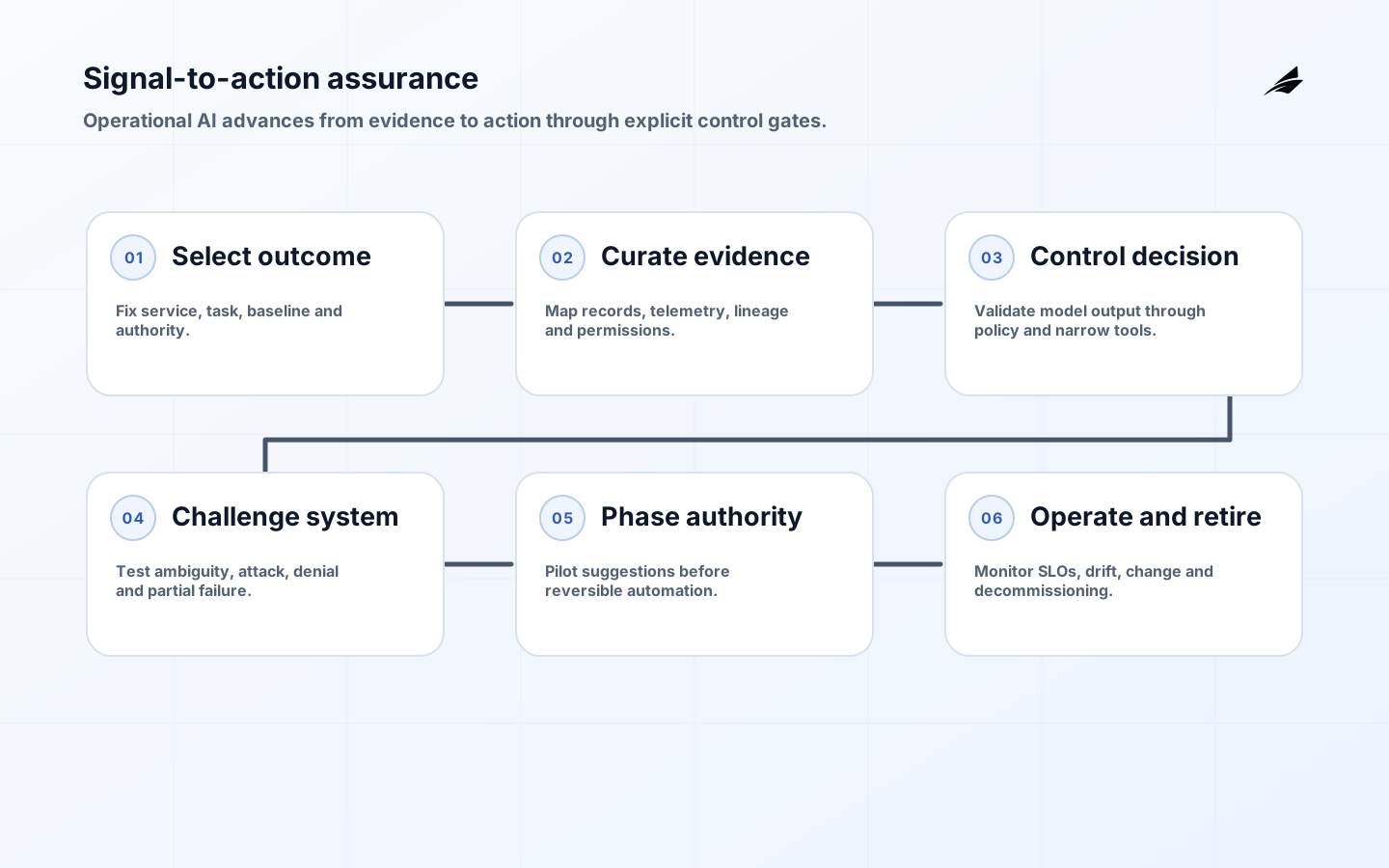
A service intelligence AI implementation turns operational signals and service records into prioritized insight, assistance or controlled action. The implementation challenge is connecting a probabilistic model to authoritative workflows without obscuring ownership. This checklist moves from a measurable service problem through governed evidence, architecture, evaluation, phased release and continuing operations. It applies to classification, knowledge assistance, incident analysis, forecasting and bounded remediation.
Review the service intelligence scope and cost plan before funding a build. The enterprise service intelligence FAQ answers architecture and control questions, while the enterprise implementation checklist covers portfolio-scale dependencies.
1. Select one service outcome and authority boundary
Name the service, users, task and accountable owner. Describe the trigger, current procedure, decision, possible action and definition of completion. Baseline task volume, cycle time, quality, escalation and operational consequence. Use the NIST AI RMF functions to connect governance, context, measurement and risk treatment, but tailor them to the use case rather than treating the framework as an undifferentiated checklist.
Set an initial authority level: retrieve, draft, recommend, approve or execute. Most implementations should begin with recommendations because reviewers expose missing context and policy. List prohibited outcomes, such as revealing restricted records, changing production outside a window, closing incidents without evidence or contacting a customer without approval. Define stop criteria and a non-AI path that remains documented and staffed.
| Implementation artifact | Minimum content | Acceptance test |
|---|---|---|
| Use-case brief | Owner, users, baseline, authority and exclusions | Operator can explain the intended decision |
| Evidence map | Sources, authority, sensitivity, freshness and lineage | Known record is retrieved with correct permissions |
| Action policy | Allowed tools, targets, arguments and approvals | Denied scenario cannot execute |
| Evaluation set | Normal, ambiguous, rare and harmful cases | Results are reproducible by version |
| Operating plan | SLO, incident, rollback, change and retirement | Support team rehearses a failure |
2. Build an authoritative evidence layer
Inventory service catalog data, configuration relationships, incidents, changes, requests, knowledge, deployment events and telemetry. Decide which system is authoritative for each fact and how conflicts are shown. Metrics, logs and traces describe behavior, while ticket text describes human interpretation; keep both provenance and timestamp. Normalize service, environment, owner and version identifiers across sources before adding a model.
Apply access at retrieval time and again before display or action. Remove credentials and unnecessary personal data, define retention, and protect indexes and evaluation sets. Test delayed telemetry, duplicated incidents, missing service mappings and an obsolete knowledge article. An apparently comprehensive corpus can be less reliable than a small curated one when old procedures dominate retrieval.
3. Implement a controlled decision architecture
Use a gateway or orchestrator to authenticate requests, assemble authorized context, invoke the model, validate structured output and call tools. Tool interfaces should be narrow: restart one approved service instance is safer than arbitrary command execution. Validate target, environment, change window and argument schema outside the model. Store policy decisions and correlation identifiers with each transaction.
Keep model, prompt, retrieval, tool and policy versions deployable and reversible. Separate development, evaluation and production data paths. Protect administrative access using least privilege and review, following security controls appropriate to the system. Set timeouts, retries and idempotency for tool calls. If a response is interrupted, the system must know whether an action occurred before retrying.
4. Evaluate realistic tasks and failures
Create test cases from real task distributions and deliberate edge cases. Measure classification correctness, evidence grounding, unsafe disclosure, action selection, argument validity, abstention, latency and cost. Have domain reviewers score outputs using a written rubric. Report performance by service and consequence tier, because an aggregate can hide failure on a small critical population.
Test prompt injection or malicious ticket content, unavailable dependencies, stale context, conflicting telemetry, access denial, policy rejection and partial tool failure. For anomaly detection, include alert burden and time-to-diagnosis rather than only benchmark accuracy. For summaries, verify omitted and fabricated facts. For actions, verify both successful execution and safe refusal. Retain the exact configured version and test evidence.
| Scenario | Expected behavior | Production signal |
|---|---|---|
| Insufficient evidence | Abstain or request specified context | Abstention and escalation rate |
| Unauthorized record | Exclude content and log denial | Access-policy decision |
| Malicious instruction in data | Treat it as data, not authority | Injection test result |
| Tool timeout after request | Reconcile state before retry | Transaction and target state |
| Outcome worsens | Stop automation and restore prior state | SLO impact and rollback completion |
5. Release through increasing authority
Pilot with representative operators and recommendation-only authority. Compare against the baseline and collect override reasons, missing context, user effort and workflow friction. Do not infer safety from low use. Require enough completed tasks and high-impact cases to support a decision. Fix interfaces and evidence before tuning presentation style.

Expand to approval-assisted action, then narrow auto-execution only where consequences are bounded and rollback is proven. Use canaries, rate limits, circuit breakers and observation windows. Communicate model limitations and changes to operators. Record who can suspend the system and make that control available outside the AI path. Release acceptance includes support, dashboards, runbooks and cost ownership.
6. Operate, review and retire responsibly
Define service-level indicators for the AI-enabled workflow: successful task completion, latency, availability, unsafe-output rate, action failure and rollback. Pair them with the underlying service SLO so automation cannot appear healthy while users suffer. Review model and data drift, access changes, knowledge freshness, provider updates, incidents and cost per completed task.
Run periodic challenge tests and sample production traces. Feed confirmed defects into evaluation before changing the system. Apply change management to prompts and retrieval rules when they materially alter behavior. Maintain an inventory and owner, as NIST AI RMF recommends, and define decommissioning: remove credentials, disable tools, archive required evidence, communicate the fallback and verify that no abandoned integration continues acting.
Applied example and assurance notes
For a change-risk assistant, define the output as a ranked explanation rather than a release decision. Inputs may include service dependency, recent incidents, test evidence, deployment size and change window. The assistant cites those records and identifies missing evidence; the authorized change owner still approves. Evaluation includes changes that succeeded, failed and were rolled back, plus new services with little history. The team measures useful warnings, unsupported claims, approval effort and whether operators begin treating a score as authority.
Production traces should answer a reconstruction question without exposing unnecessary content: who requested assistance, which service and version were involved, which records were retrieved, what configuration produced the proposal, which policy applied, what the reviewer decided, whether a tool ran and what the service did afterward. Retention can differ by field. This trace supports incident analysis and evaluation while avoiding an indiscriminate archive of prompts containing sensitive operational data.
When quality degrades, the response should be staged. First suspend affected automation or reduce it to recommendation-only authority. Then identify whether the change came from input distribution, retrieval freshness, model configuration, tool behavior or underlying service semantics. Add confirmed cases to an isolated evaluation set, correct the responsible layer and rerun release tests. Do not compensate for missing evidence with a longer prompt or retrain directly from unreviewed production corrections.
- Record the accountable owner and the decision the evidence supports.
- Test a normal journey, a denied path and a realistic failure.
- Keep assumptions, versions and unresolved risks visible.
- Require acceptance evidence before expanding scope or authority.
- Review operating outcomes and close corrective actions.
Before approval, the AI service owner should convene operators, data owners, security, model engineering and support for a scenario review. Walk through ordinary use, a denied request, one unavailable dependency, a partial change and recovery. For each step, identify the authoritative record, person with decision rights, expected signal, time limit and safe alternative. Challenge unsafe action, missing context, drift and unavailable fallback. Record assumptions that could change after launch and assign each one a trigger for reassessment. The review is successful when participants can explain not only the preferred path but also how they recognize an unsafe state, who can stop progress, and how users continue while the issue is resolved. Preserve the versioned evaluation, action trace and suspension rehearsal with the configured release rather than in a detached presentation.
For Service Intelligence AI Implementation Checklist: From Signal to Safe Action, conduct a review thirty days after release or completion. Compare actual demand, quality, exceptions, incidents, cost and user effort with the baseline. Separate design defects from training gaps and changed operating context. Sample complete cases because averages can conceal a rare path carrying most consequence. Confirm that temporary access, duplicate infrastructure, transitional policy and manual workarounds have closed or have an owner and expiry. Reforecast the next period and publish decisions to people who operate or depend on the capability. At each material change, refresh cases, assumptions and risk treatment; assurance is a maintained operating practice, not a certificate inherited from the first release.
Service Intelligence AI Implementation Checklist: From Signal to Safe Action also needs a concise evidence index that a new reviewer can navigate without oral history. Link the current boundary, named owners, architecture or workflow, decisions, tests, exceptions, operating signals and closure records. Mark superseded artifacts instead of silently replacing them, and protect sensitive material by role. During a review, select one claim from the summary and trace it to its source and observed result. If that trace is slow or ambiguous, improve the index before scale. Good evidence reduces repeated discovery, supports accountable challenge and makes future migration or retirement materially easier.
Key takeaways
- Begin with one measurable service decision and an explicit authority level.
- Preserve evidence authority, permissions, freshness and lineage across every result.
- Keep model output behind deterministic action policy and narrow reversible tools.
- Test ambiguity, attack, dependency loss and partial execution before release.
- Increase authority only with production evidence and keep suspension and fallback usable.
Frequently asked questions
How much historical data is required?
There is no universal amount. Coverage, relevance and labels matter more than volume. A retrieval assistant can start from a curated knowledge base, while forecasting needs enough history to represent cycles and changes. Always reserve independent evaluation cases.
Should the model be fine-tuned first?
Usually not. First prove the workflow using prompt, retrieval and policy controls. Fine-tuning may help stable specialized behavior, but it adds data, evaluation and lifecycle obligations and does not fix missing authority or unsafe tool design.
When is automatic remediation appropriate?
When the trigger is reliable, target and action are tightly bounded, consequence is acceptable, rollback is tested, the result is observable and an owner can suspend it. Start with a small allow-list rather than broad production authority.
Conclusion
Service intelligence AI becomes dependable through evidence and operating discipline. Define the decision, curate authoritative context, mediate action, evaluate real failures and release authority gradually. Continued monitoring, challenge testing and retirement planning keep the system aligned as services, models and risk change.