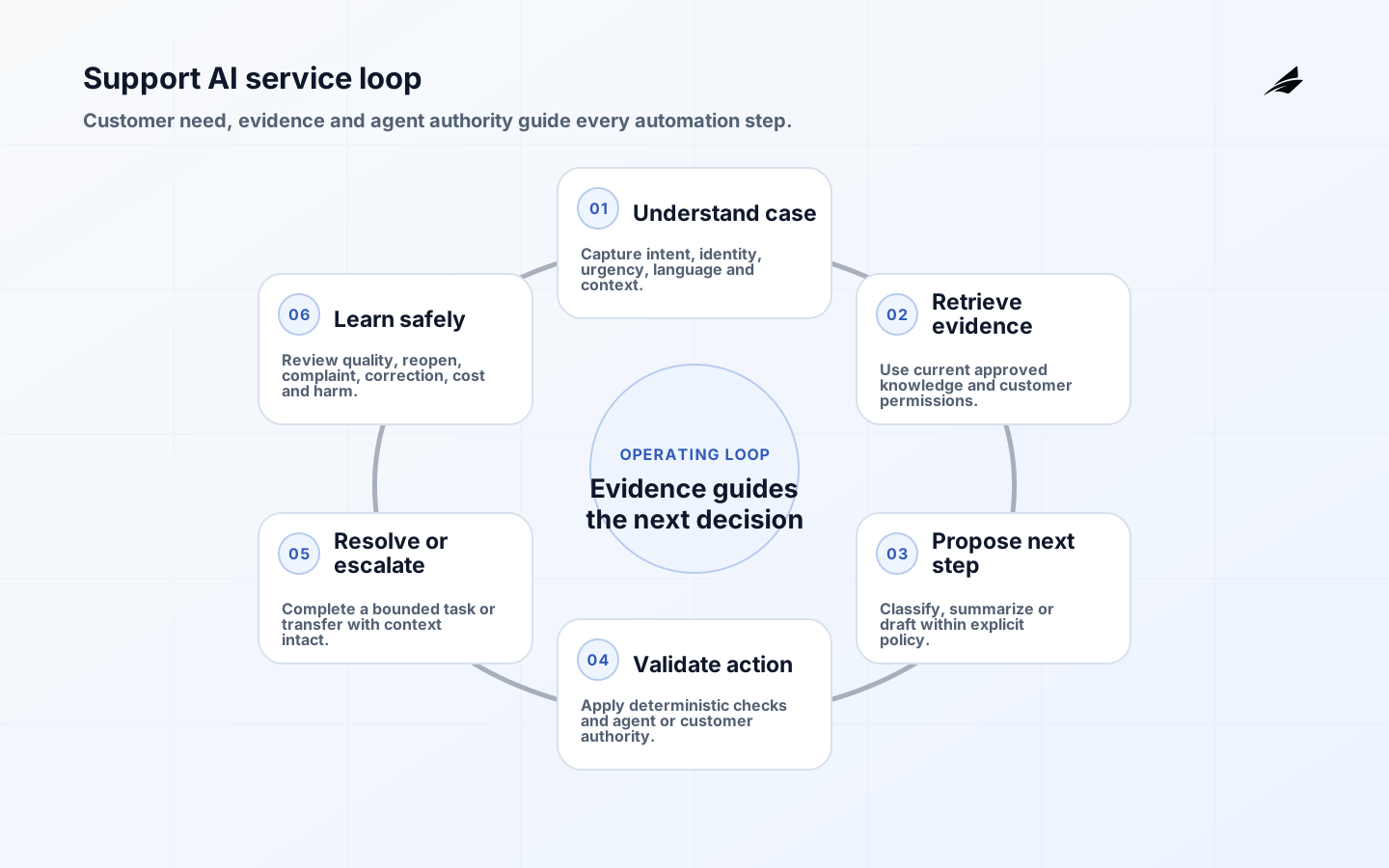
AI business process automation for support teams can reduce triage delay, find relevant knowledge, prepare summaries, draft replies and complete tightly bounded case updates. It should not make customers fight an unaccountable bot or push unresolved work out of measured queues. The right scope protects access, refunds, safety, complaints and vulnerable customers while improving ordinary service. Buyers should define customer outcomes, case segments, knowledge sources, tool authority, human escalation, service operations and unit economics before selecting a platform.
This guide supports commercial evaluation and delivery planning. Use the support implementation checklist for build gates, the support automation FAQ for detailed questions, and the support ROI guide for the financial case. NIST's AI RMF provides a use-case-neutral structure for governing, mapping, measuring and managing AI risk.
Scope support automation by case and action
Map demand by contact reason, channel, language, customer tier, sensitivity, complexity, volume, seasonality and current outcome. Separate tasks: intake validation, intent classification, priority suggestion, duplicate detection, knowledge retrieval, summarization, draft response, translation, workflow update and autonomous resolution. Each task has different evidence and risk. Starting with agent assistance often creates safer learning than customer-facing autonomous resolution because staff can inspect sources and corrections.
Exclude or tightly supervise cases involving account takeover, payment dispute, legal complaint, safety, self-harm, protected rights, vulnerable users, material refunds, termination or uncertain identity. Define transfer behavior so customers do not repeat context and agents can see the transcript, evidence and attempted actions. A visible escalation must be accessible; review the experience against WCAG 2.2 and test with assistive technology where relevant.
Define service outcomes and guardrails
Baseline first response, resolution, reopen, transfer, backlog, abandonment, customer effort, satisfaction, quality review and cost. Segment metrics because faster closure can hide repeat contact or suppressed escalation. Set goals such as reducing triage queue age while holding severe misprioritization below a threshold. Track customer and agent outcomes together. A system that saves handling time but increases correction, emotional labor or attrition is not an operating improvement.
Define quality rubrics for factual support, policy compliance, completeness, empathy, next-step clarity, privacy and appropriate escalation. Do not use average satisfaction as the sole guardrail; response bias and case mix distort it. Sample critical cases at a higher rate, preserve complaints and give quality reviewers independence from throughput targets.
| Automation task | Potential value | Material risk | Initial control |
|---|---|---|---|
| Classification | Faster routing | Urgent case deprioritized | Confidence threshold and priority rules |
| Knowledge retrieval | Less search time | Stale or wrong policy surfaced | Approved corpus, effective dates and citations |
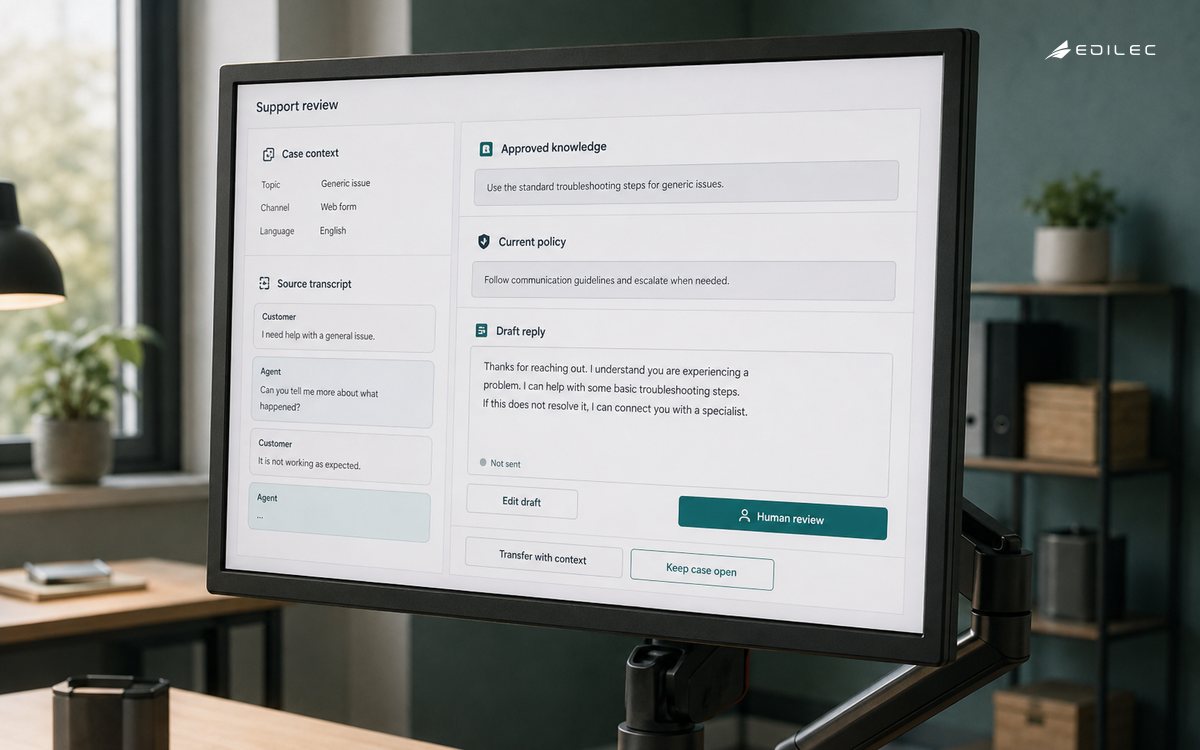
| Conversation summary | Faster handoff | Critical nuance omitted | Agent edit and source transcript |
| Draft reply | Consistent first response | Unsupported promise or poor tone | Rubric, source evidence and approval |
| Case update | Less manual entry | Wrong account or state changed | Scoped identity and deterministic validation |
| Autonomous resolution | Lower routine volume | Customer trapped or harmed | Narrow eligibility, audit and easy escalation |
Treat knowledge and customer data as products
Assign owners to policies, troubleshooting content, entitlements, prices, product status and escalation rules. Store effective dates, audience, region and approval. Retrieval should prefer authoritative current content and expose the supporting source to agents. Retire contradictory documents and measure failed searches. The model cannot reliably repair an unowned knowledge base; fluent output can make inconsistency harder to detect.
Map transcripts, attachments, account data, sentiment or inferred attributes, prompts, outputs, feedback and logs. Apply purpose limitation, minimization, retention and access. The NIST Privacy Framework helps teams reason about adverse effects from processing. Redact payment, identity and health data where unnecessary. Never let a customer-provided attachment or message grant tool authority; treat its instructions as untrusted content.
Design a controlled support workflow
Keep customer authentication, entitlement, policy thresholds, arithmetic and final action validation deterministic. The model may propose a route or reply but should not invent account state. Constrain output with schemas, allowed intents and mandatory evidence. Give tools narrow identities and row-level scope, require idempotency and limit refunds, credits, messages and retries. Separate retrieval from action and log both without storing excessive customer text.
Threat-model prompt injection, data disclosure, improper output handling and excessive agency with the OWASP LLM Top 10. Include denial paths and safe fallback. If the model or retrieval service is unavailable, preserve cases in a visible queue and route urgent work manually. Do not let automation failure make support disappear.
Evaluate on real support variation
Build a versioned case set across common, rare, difficult and consequential contacts. Include multiple turns, misspellings, mixed intents, angry language, ambiguous identity, outdated policy references, malicious instructions and sparse context. Define expert labels and allow genuine ambiguity. Score routing precision and recall, factual grounding, policy compliance, escalation, action correctness and customer-facing quality by segment.
The NIST Generative AI Profile can help teams select risks and actions material to generative systems. Test offline, then shadow agents, then assist a limited group. Compare against baseline and code correction reasons. Evaluate agent reliance: correct suggestions may be accepted, but reviewers must also catch plausible wrong answers.
Model cost per safely resolved contact
Include platform and model usage, retrieval, storage, integration, observability, security, quality review, agent training, exception handling, vendor management and ongoing content work. Estimate peak and multilingual demand. Price per interaction can be misleading when a long case has many model calls. Use cost per accepted assist or safely resolved case, and include reopen, escalation and customer recovery costs.
Separate capacity released from theoretical minutes saved. Time fragmented across agents may not reduce staffing or backlog. Value can instead appear as faster response, better consistency or capacity for complex cases. Use a holdout or staged rollout where practical. State assumptions for adoption, eligible volume, quality, deflection, growth and vendor price; test downside scenarios.
| Commercial item | Clarify in proposal | Hidden-cost question | Acceptance evidence |
|---|---|---|---|
| Discovery | Case analysis and baseline | Who labels examples and resolves policy ambiguity? | Approved workflow and evaluation plan |
| Integration | CRM, identity, knowledge and channels | Are connectors read-only, custom or metered? | End-to-end test and ownership |
| Usage | Model calls, tokens or resolutions | How do retries and long conversations bill? | Scenario-based cost model |
| Quality | Evaluation and sampling | Is human review an extra service? | Rubric and scored representative set |
| Operations | Support, updates and incidents | Who handles model regression? | Runbook and response exercise |
| Exit | Exports and transition | Can evaluation and configuration move? | Tested export and manual fallback |
Roll out with agent and customer authority
Involve agents and quality reviewers in design. Train them on evidence, limitations, correction and escalation, and protect time for feedback. Do not reward uncritical acceptance. Release by task, language and case cohort using feature controls. Monitor queue health, quality, overrides, transfer, reopen, complaint, tool denial, latency and spend. Publish known limitations internally and make customer automation transparent where appropriate.
Define stop conditions for privacy incident, harmful output, material policy breach, elevated reopen, inaccessible escalation, cost spike or unexplained drift. Preserve a last known good configuration and manual route. Review after model, prompt, policy, knowledge, tool or customer-population changes. The broader business process automation guide can help align support with enterprise workflow governance.
Design multilingual support as separate evidence, not as automatic coverage inherited from the base model. Validate language identification, retrieval language, terminology, politeness, policy meaning, escalation and agent availability for each supported cohort. Machine translation can preserve literal content while changing legal or emotional nuance. Give customers a route to request another language or person and avoid inferring sensitive characteristics from language alone. Track quality, transfer and complaint by language, with enough human review to interpret the measures.
Prepare for coordinated incidents across support, product and security. A burst of similar contacts may indicate an outage, abusive campaign, account compromise or confusing release rather than independent tickets. Define thresholds that cluster cases, alert the incident function, pause unsafe automated replies and publish approved status guidance. Preserve affected case identifiers and workflow versions for later analysis. Automation should help reveal systemic demand, not isolate every contact until the organization misses the shared cause. During an incident, clearly separate confirmed facts from generated summaries, and require an authorized owner to approve mass customer communication. After restoration, compare automated classification with the final cause, correct affected knowledge, reconcile promises or credits and add the scenario to regression evaluation. Include the service desk, communications owner and provider in exercises so escalation timing and authority are tested before a real surge.
Key takeaways
- Scope individual support tasks and case cohorts rather than claiming full-service automation.
- Protect sensitive and consequential cases with clear human escalation.
- Treat current knowledge, customer data and evaluation cases as owned products.
- Keep identity, policy, calculations and final actions deterministic and bounded.
- Price complete safe resolutions, including quality and exception work.
- Scale from shadow and agent-assist evidence with accessible stop and fallback paths.
AI business process automation for support teams FAQ
Should automation target ticket deflection? Deflection is useful only when the customer resolves the issue safely and does not return. Measure successful self-service, repeat contact and customer effort together.
Can sentiment determine priority? It may be one signal, but language and culture make it unreliable. Use explicit safety, vulnerability and service rules, and test segment effects.
Will agents still be needed? Yes. Automation changes the mix toward exceptions, judgment and relationship work. Plan skills, workload and quality capacity rather than assuming linear headcount reduction.
What should remain with the buyer? Customer policy, risk acceptance, knowledge ownership, quality thresholds, escalation authority, data purpose and service accountability should remain client-owned.
Conclusion
AI business process automation for support teams should make help easier to reach and safer to deliver. Scope bounded tasks, repair knowledge, constrain tools, evaluate representative cases and model full economics. A staged service with meaningful agent and customer authority can improve speed and consistency without converting unresolved customer need into an automated dead end.