Automation services and digital transformation should improve an end-to-end outcome, not make a poor process run faster. The delivery plan must define the workflow, users, decisions, data, exceptions, integrations and accountable owner before selecting robotic process automation, workflow, low-code, integration or AI components. The best first release is narrow enough to observe and reverse, yet complete enough to change a real customer or employee result.
The automation implementation checklist turns this plan into controls and tests, while the automation FAQ addresses operating questions. Treat transformation as a change in people, process and technology. The IEEE digital transformation standard explicitly includes those elements, which helps counter a tool-only program.
Choose a measurable workflow outcome
Select a service journey such as supplier onboarding, claims intake, order exception handling or employee provisioning. Baseline elapsed time, active work, wait states, rework, error severity, abandonment, backlog, cost and affected groups. Define the target and guardrails. “Deploy ten bots” is not an outcome; “reduce verified onboarding time while preserving sanctions review and accessible support” gives the team something testable.
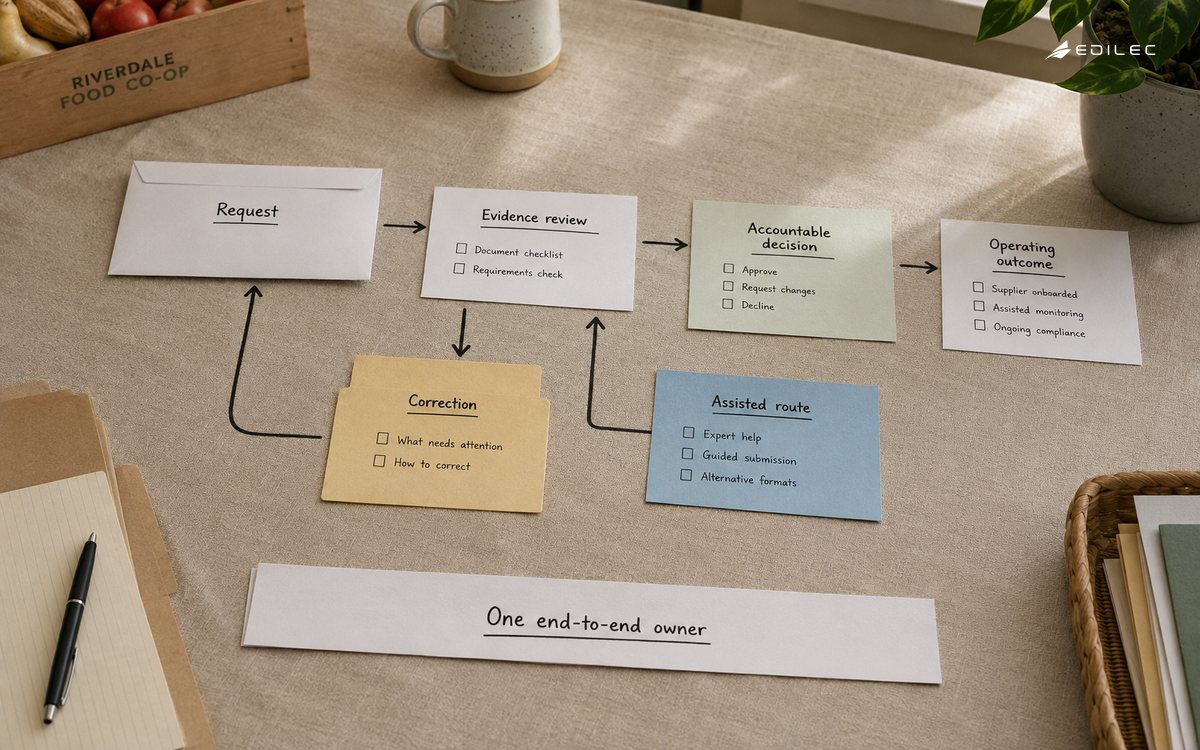
Follow representative cases through the actual workflow. Observe spreadsheets, inboxes, copy-and-paste work, informal judgment and downstream repair. Separate policy requirements from historical habit. Some manual steps are controls or compassionate exceptions; others exist because systems do not share data. Involve frontline operators and customers early, then give a product owner authority across departmental boundaries. Local automation without end-to-end ownership often moves the queue rather than removing it.
| Candidate signal | Favorable condition | Reason to pause |
|---|---|---|
| Volume | Frequent cases with measurable demand | Rare process with little benefit |
| Rules | Stable decisions that can be stated and tested | Unwritten or disputed policy |
| Data | Authorized, structured and sufficiently accurate inputs | Unknown provenance or extensive correction |
| Exceptions | Bounded classes with clear escalation | Most cases require expert negotiation |
| Systems | Supported APIs or stable interfaces | Fragile UI and no change coordination |
Redesign the process before automating it
Model triggers, activities, decisions, handoffs, timers, errors and completion. BPMN offers a standard notation when teams need a shared process language, but a simple map can be enough if it is precise. Eliminate duplicate approvals, request data once, move validation earlier and clarify policy. Design the desired process and compare it with the current one; otherwise automation calcifies unnecessary work.
Define which decisions remain human and why. Use humans for authority, empathy, contested evidence and material exceptions, not as invisible cleanup for poor automation. Specify queues, information, time limits and escalation. Design an accessible manual route for people who cannot use the digital channel. Measure correction burden and decision quality so apparent straight-through processing does not conceal work shifted to customers or another team.
Select an architecture for change and failure
Prefer supported APIs and event contracts over screen automation where feasible. Use workflow orchestration for long-running state, integration services for transformation, rules for deterministic decisions and AI only where probabilistic inference is justified. Separate a model recommendation from permission to act. Define idempotency, correlation identifiers, retries, timeouts, duplicate handling, compensation and dead-letter queues. Every automated action should be attributable to a business case and software version.
Screen automation can bridge a legacy gap, but record the UI version, selectors, credential model, expected break signals and retirement trigger. Avoid shared desktop identities. Keep secrets in managed storage, narrow permissions and separate development from production. Instrument each boundary so operators know whether an item is waiting, failed, duplicated or completed. A dashboard that only reports bot uptime misses the business process.
Contract data, privacy and AI behavior
For each field, identify source, meaning, owner, permitted use, validation, freshness, sensitivity, retention and correction. Reject or route ambiguous input instead of silently coercing it. Apply the NIST Privacy Framework to consider risks from data processing itself. Log enough for accountability while minimizing unnecessary personal information. Mask production data in development unless an approved use requires otherwise.
If AI classifies documents, extracts fields or drafts decisions, use the NIST AI Risk Management Framework to govern, map, measure and manage risk. Create representative evaluation cases, including severe errors, underrepresented groups, adversarial content and abstention. Set confidence or policy thresholds from business consequences, not vendor defaults. A human reviewer must receive source evidence and meaningful authority to correct or stop the action.
Deliver automation through six evidence stages
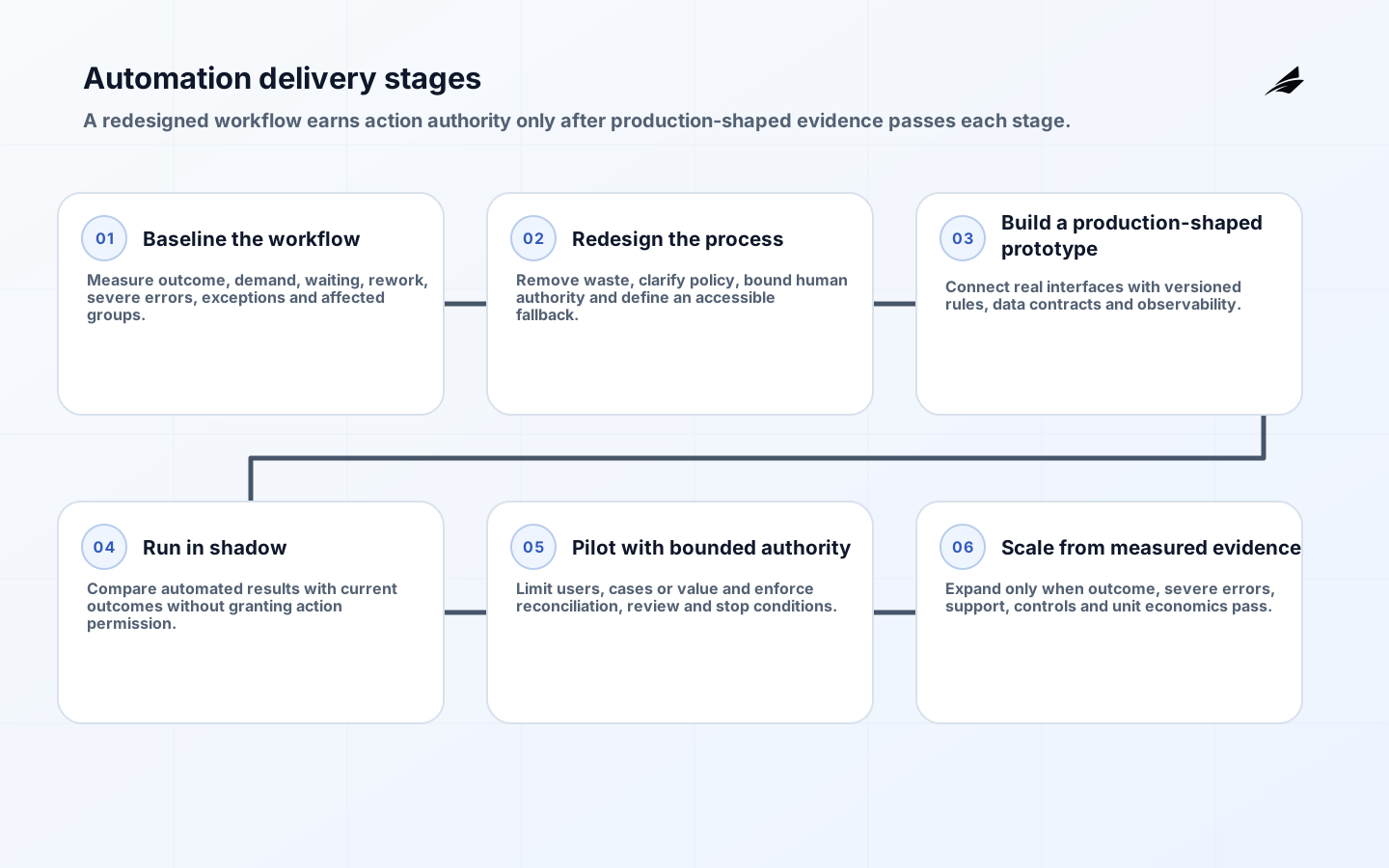
Move from baseline and scope to process redesign, production-shaped prototype, shadow run, controlled pilot and measured scale. A prototype proves connectivity and behavior; it does not prove operating value. In shadow mode, compare automated outputs with current outcomes without granting action authority. The pilot should limit users, transaction value or case class, preserve fallback and define stop conditions. Scale only after errors, support, controls and unit economics are understood.
Use version control, automated tests, environment promotion and rollback. DORA’s continuous delivery guidance supports keeping software releasable through small changes and feedback. Include workflow definitions, rules, prompts, model versions, connectors and infrastructure in change records. Test normal, boundary, duplicate, late, unauthorized and dependency-failure cases. Release timing should account for business peaks and the availability of trained operators.
Build controls into each automated action
Apply least privilege, separation of duties, approval thresholds, transaction limits, immutable-enough audit events and reconciliation. A bot should not both create and approve a sensitive payment. Confirm source authenticity, destination and amount at the point of action. Require explicit confirmation for high-consequence changes and block prohibited cases in code. Review privileged automation identities more often than ordinary accounts because their speed increases potential impact.
Design safe failure. After a timeout, determine whether the downstream action happened before retrying. Use idempotency keys or reconciliation rather than hope. Route uncertain items to an owned queue with enough context. Define kill switches, but test what they stop and how queued work resumes. Preserve manual continuity for critical workflows. Incident response should distinguish bad input, integration failure, compromised credential, defective rule and model drift.
| Risk | Design control | Production metric |
|---|---|---|
| Duplicate transaction | Idempotency and downstream reconciliation | Duplicates prevented and unresolved |
| Bad source data | Validation, provenance and correction route | Reject rate and recurring source defect |
| Excess authority | Scoped identity and approval threshold | Privilege exceptions and blocked actions |
| Model error | Evaluation, abstention and effective review | Severe error and reviewer correction by segment |
| Silent queue | Age alerts and accountable operations | Oldest item and time to resolution |
Estimate cost and value across the lifecycle
Cost includes discovery, redesign, licenses, runtime, API calls, model inference, integration, test environments, security, monitoring, support, process ownership, change management and legacy overlap. Add expected maintenance when source interfaces change. Estimate by transaction and scenario, then compare with avoided work, faster completion, lower error loss, improved capacity and customer outcome. Do not count displaced minutes as cash savings unless staffing or throughput actually changes.
Track unit cost, completion time, straight-through rate, severe errors, rework, queue age, fallback use and user outcome. Segment results to expose uneven impact. Revisit the case when volume, policy, model price or systems change. Some automations should be retired when the source platform gains a native capability or when maintenance exceeds value. Budget for removal and record ownership of generated data and audit history.
Prepare people and operations for adoption
Communicate how roles and decisions change, not just how to click the new tool. Train operators on exceptions, escalation, control purpose and incident recognition. Pair delivery staff with frontline teams and update procedures, performance measures, support queues and access. Avoid incentives that pressure reviewers to approve quickly. Give users a channel to challenge outcomes and report defects without bypassing the system privately.
Production acceptance requires the internal team to trace a case, change a rule, rotate a credential, diagnose an integration, reconcile transactions, operate fallback and explain cost. Store process models, code, tests, data contracts, runbooks and decisions in customer-controlled repositories. Close supplier and developer access after handover. Schedule outcome reviews after demand stabilizes and feed findings into the product backlog.
Automation and digital transformation takeaways
- Measure an end-to-end workflow before choosing an automation tool.
- Remove unnecessary work and clarify policy before encoding it.
- Prefer explicit data and integration contracts with observable failure states.
- Bound AI authority and evaluate severe errors with meaningful human review.
- Scale only after controlled production evidence supports value, safety and operations.
Frequently asked questions
Which process should be automated first? Choose a valuable, frequent and measurable workflow with stable rules, usable data and bounded exceptions. Is RPA obsolete? No; it can bridge legacy interfaces, but APIs are usually easier to govern and maintain. Does AI make automation intelligent? It adds probabilistic capabilities and new errors; use it only when evaluation shows an advantage.
How long should a pilot run? Long enough to cover representative volume, peaks and exceptions, with predeclared gates. What is straight-through processing? Cases completed without manual handling; interpret it beside errors and outcomes. Who owns an automation after launch? A business product owner owns the result, while engineering and operations own technical components under explicit responsibilities.
Conclusion
Digital automation creates value when process, data, authority and technology are redesigned together. Start with a measurable journey, build observable and reversible integration, test controls in production-shaped conditions and scale from evidence. The durable result is not a fleet of automations; it is a service that completes work more reliably while people retain accountability for consequential decisions.