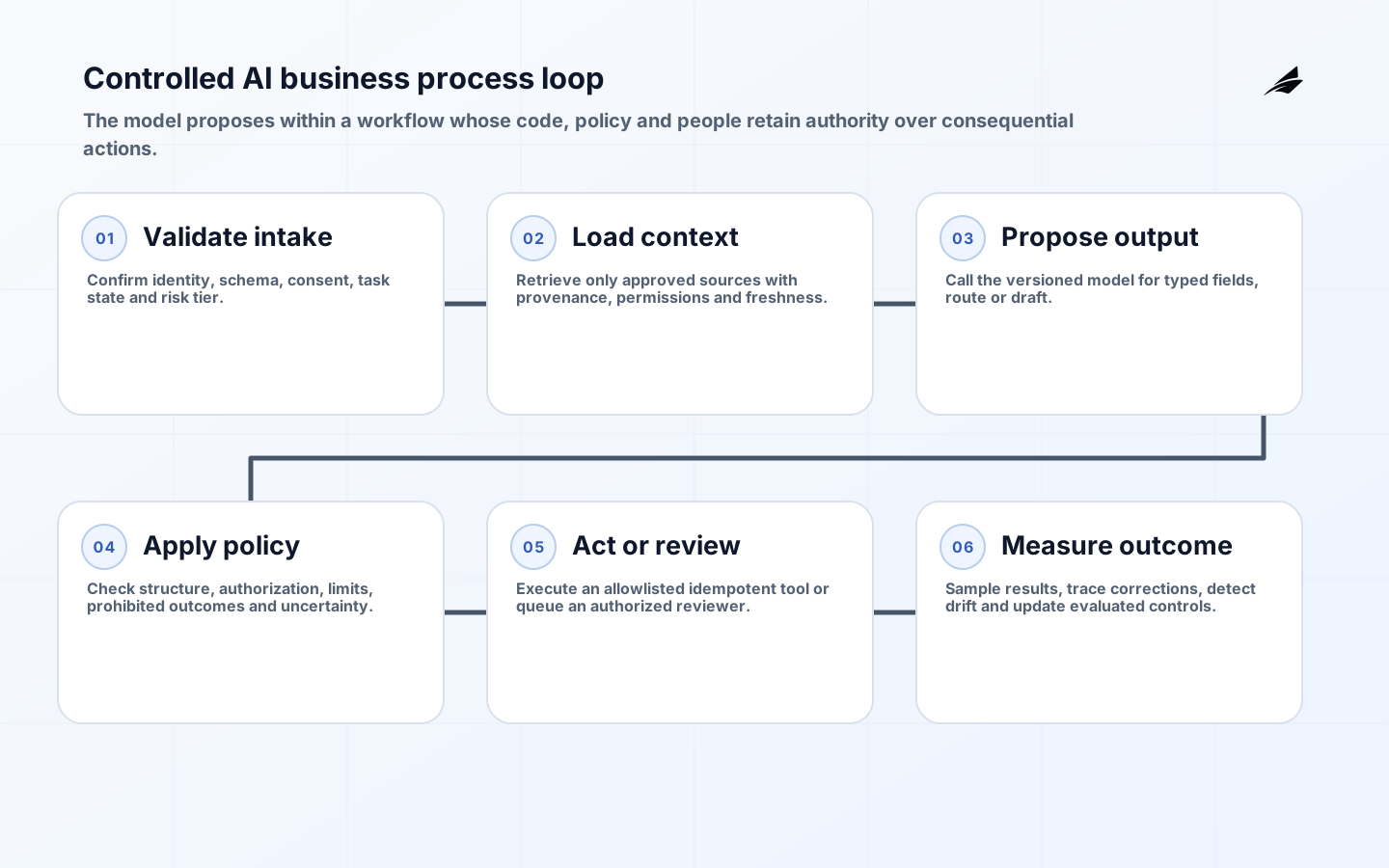
An AI business process automation implementation should improve a bounded workflow while keeping authority, evidence and recovery under deterministic control. The model may classify a request, extract fields, draft a response or recommend a route; workflow software should still validate inputs, enforce permissions, record state and decide whether an action can run. This distinction prevents a persuasive model output from silently becoming an authorized business decision.
The plan below is for operations, product and technology leaders moving beyond demonstrations. It extends the governed AI business process automation plan with implementation economics, evaluation and rollout detail. The companion readiness checklist and implementation FAQ help teams review prerequisites and supplier claims.
Scope the workflow before selecting a model
Choose a workflow with repeated inputs, a clear outcome, accessible examples and a named process owner. Map intake, validation, judgment, action, exception and review. Record current volume, handling time, wait time, rework, error severity and escalation rate. A strong first scope is valuable enough to measure but bounded enough to stop safely. Avoid starting with an instruction such as “automate customer service”; one request type and one controlled action produce much better evidence.
Classify every step as deterministic, model-assisted or human-authorized. Validation, identity, monetary thresholds, retention and access checks usually belong in code or policy. Models are useful where language or variable documents make rigid rules brittle. Humans should retain decisions where impact, ambiguity or legal duty demands judgment. NIST AI RMF organizes risk work through Govern, Map, Measure and Manage; use those functions continuously rather than as a one-time launch checklist.
| Workflow step | Best control | Example evidence | Automation boundary |
|---|---|---|---|
| Intake | Schema and source validation | Accepted payload and consent state | Reject malformed input |
| Interpretation | Model with grounded context | Output, sources, confidence signals | No direct side effect |
| Decision | Rules plus authorized reviewer | Policy result and approval record | Escalate high impact |
| Action | Allowlisted idempotent tool | Request, response and actor | Limit amount and scope |
| Review | Sampling and incident process | Outcome label and correction | Pause on guardrail breach |
Design a controlled automation architecture
Keep the workflow engine authoritative for task state. It loads only permitted context, calls a versioned prompt and model configuration, requires typed output, checks policy and then executes an allowlisted action or creates a review item. Separate retrieval from generation so source access can be tested. Attach provenance and freshness to retrieved material. Use short-lived service credentials and enforce authorization at the tool, not only in model instructions.
Every consequential request needs an idempotency key, timeout, bounded retry and visible failure state. Store model and prompt versions, input references, structured output, validation results, tool calls, reviewer actions and final outcome while minimizing sensitive content. Provide operators with replay or correction procedures that cannot duplicate side effects. If a model provider fails, define whether the workflow waits, falls back to a simpler rule, routes to a person or stops.
Build evaluation around business failure modes
Create an evaluation set from representative, difficult and prohibited cases before tuning prompts. Label the expected route, required fields, acceptable answer characteristics and unsafe outcomes. Include poor scans, contradictory documents, missing context, prompt injection, unsupported requests and changes in policy. Split development and holdout examples so repeated prompt changes do not merely memorize the test. For nondeterministic outputs, use several runs and inspect distribution rather than trusting one pass.
Measure task-specific precision, recall or field accuracy where a reference answer exists. Add groundedness, policy compliance, escalation quality, latency and cost. Automated graders can scale review but require calibration against expert judgment and periodic drift checks. A production gate should combine quality thresholds with zero-tolerance critical failures. Record the model, prompt, retrieval snapshot and code version so a result can be reproduced closely enough to investigate.
| Metric | Release question | Guardrail example | Production signal |
|---|---|---|---|
| Routing precision | Are auto-routed cases truly eligible? | No protected case auto-routed | Reviewer reversal rate |
| Extraction quality | Are required fields correct? | Critical identifiers exact | Field correction rate |
| Groundedness | Can claims be supported by approved sources? | No invented policy citation | Unsupported-claim sample |
| Action safety | Are limits and permissions enforced? | Unauthorized tools always blocked | Blocked action count |
| Economics | Does value exceed run and review cost? | Cost per completed case below ceiling | Unit cost and queue age |
Address AI, software and data risks together
Threat-model the whole system, not just the model endpoint. Risks include poisoned or stale sources, prompt injection, data leakage, excessive tool permissions, insecure output handling, dependency compromise and operator overreliance. Treat retrieved documents and model output as untrusted. Escape rendered output, validate generated queries or code, restrict egress, separate tenants and avoid placing secrets in prompts. NIST SSDF and OWASP ASVS remain relevant because most exploitable boundaries are conventional software boundaries.
Maintain a use-case owner, risk tier, approved data sources, processor inventory, retention rules and incident path. Review privacy, employment, consumer, sector and automated-decision obligations with qualified specialists for the jurisdictions involved. Do not claim that a framework alone establishes compliance. The CISA and UK NCSC secure-AI guidance reinforces lifecycle security: design, development, deployment and operation all need controls and supply-chain awareness.
Estimate cost as a range with explicit drivers
Implementation cost includes discovery, data preparation, integration, workflow software, model evaluation, security, user experience, observability, rollout and change management. Recurring cost includes model input and output, retrieval, storage, orchestration, monitoring, human review, support and re-evaluation. The model API is often only one line. Legacy access, weak examples and exception-heavy processes can dominate the budget.
Estimate per completed business case, not per model call. Use expected monthly volume, average calls, context and output size, retry rate, review rate and exception handling time. Run low, expected and high scenarios. Keep provider prices in a dated cost model because they change. Compare the future process with the full current baseline, including waiting and rework, while retaining a quality guardrail so cheaper automation cannot win by shifting errors to customers.
Use a staged delivery and rollout plan
- Baseline one workflow and approve the outcome, risk tier and stop conditions.
- Prepare representative examples, source access, retention rules and evaluation labels.
- Prototype the hardest interpretation step without production side effects.
- Build the controlled workflow, typed interfaces, tool permissions, logs and review queue.
- Pass offline quality, security, performance and cost gates on a held-out set.
- Run in shadow mode and compare recommendations with actual human decisions.
- Enable bounded assistance, then limited automation for low-risk eligible cases.
- Review drift, overrides, incidents and unit economics before expanding scope.
Define ownership after launch
Name the process owner, service owner, model or prompt owner, data owner, security contact and incident authority. Establish who approves source, model and policy changes. Review quality samples by risk, not only at random; rare high-impact cases deserve disproportionate attention. Monitor input drift, retrieval failures, latency, refusal, escalation, reviewer overrides, downstream corrections and cost per completed case.
Treat corrections as operational evidence. Link a bad outcome to the originating trace, preserve reviewer rationale and decide whether the remedy belongs in policy, source content, workflow design, prompt, model or training. Re-run the regression set before release. Publish user-facing limitations and an escalation route. Automation should make accountability clearer, not create a technical layer that nobody is authorized to question.
Example: automate invoice exception triage
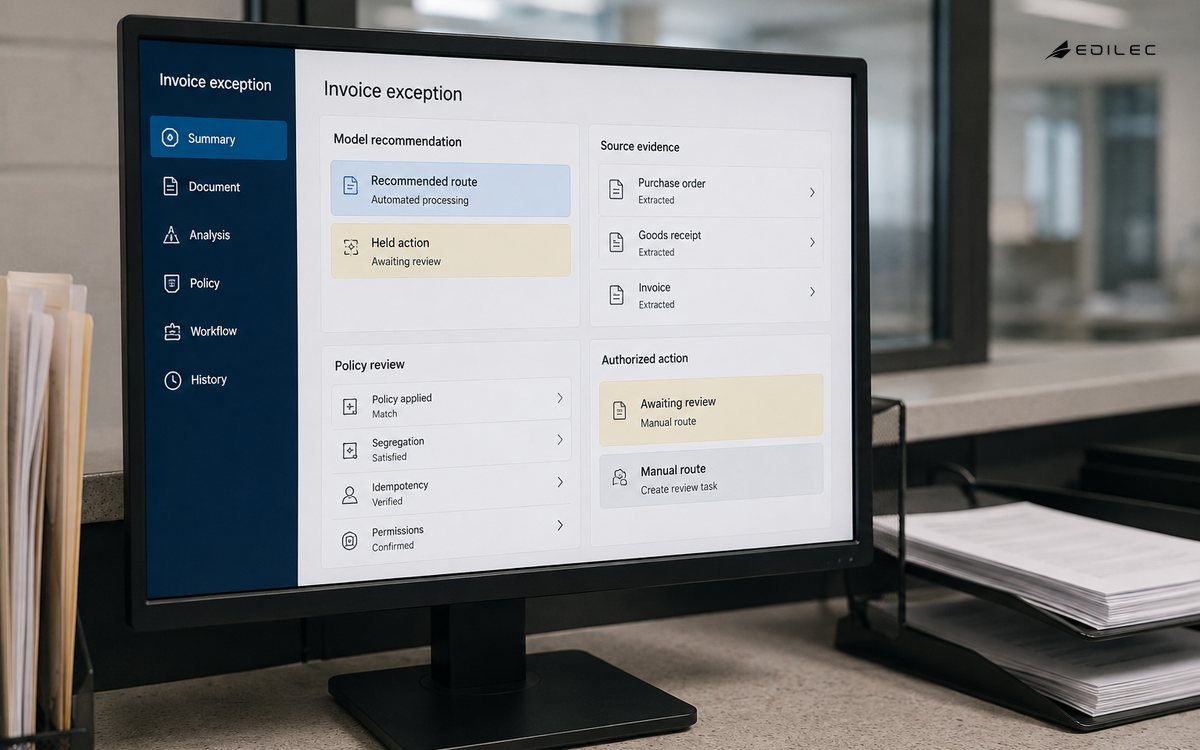
Suppose finance staff receive invoices in varied formats and route exceptions by email. The first release can validate file type and supplier identity, extract bounded fields, compare them with purchase records and propose one of several reason codes. Deterministic code checks totals, duplicate invoice IDs and authorization. Only complete, low-risk matches enter the posting queue; disagreements and missing evidence go to a reviewer with source highlights.
Offline evaluation should oversample duplicate invoices, changed bank details, low-quality scans and contradictory totals. Shadow mode measures whether proposed routes match experienced reviewers. Production measures include critical-field accuracy, unsafe auto-route count, reviewer reversal, queue age, cost per completed invoice and downstream correction. Expansion to posting should require explicit evidence that tool permissions, idempotency, reconciliation and stop procedures work.
Key takeaways
- Automate a bounded workflow, not an abstract department.
- Keep permissions, state and side effects outside the model.
- Evaluate representative failures before tuning for average quality.
- Estimate total cost per completed case, including human review.
- Expand autonomy only after shadow and bounded production evidence.
Frequently asked questions
Should a team use rules, machine learning or a language model?
Use deterministic rules for stable, explainable conditions; predictive models for learned classification or scoring; and language models for variable language and document tasks. Many reliable systems combine them. Choose the simplest method that meets measured quality and operating requirements.
When is human review required?
Require review when impact, uncertainty, novelty, policy or legal duty exceeds the approved automation boundary. Define those conditions in code and workflow state. A confidence score alone is not a sufficient policy because it may be poorly calibrated or unrelated to consequence.
How long should an AI automation pilot run?
Long enough to cover representative volume, exceptions and operating conditions. Completion should depend on predefined evidence rather than a calendar: held-out evaluation, shadow comparison, review burden, security findings, cost range and an executable support path.
A final go-live review should compare the deployed configuration with the evaluated one. Confirm prompt, model, source set, tool permissions, thresholds and workflow version; then execute a known safe case, an escalation case and a prohibited action. Configuration drift between evaluation and production can invalidate otherwise strong evidence.
Conclusion
Successful AI process automation is controlled workflow engineering with a probabilistic component. Scope one outcome, preserve deterministic authority, evaluate real failure modes and release autonomy in stages. That approach produces evidence about value while keeping people, data and business actions within an accountable operating system.