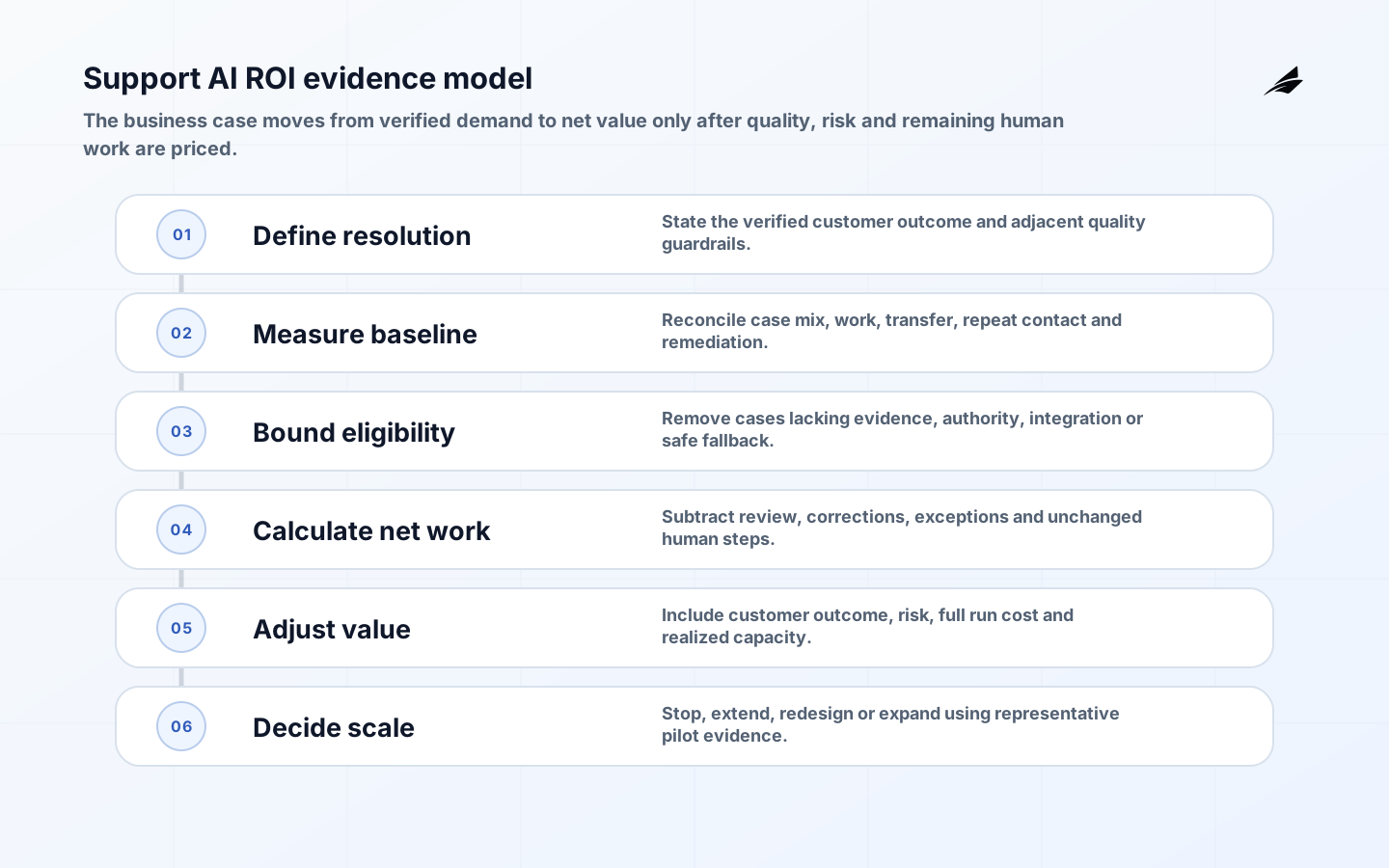
AI automation ROI planning for support teams should value a correctly resolved customer problem, not a generated message. A model can shorten drafting while increasing review, repeat contact or unauthorized commitments. A credible case therefore traces demand, work, quality and cost from intake through verified outcome.
The plan also prices the control system: governed knowledge, identity, integrations, evaluation, human escalation and incident response. It treats model performance as one input to an operating change. This approach helps leaders compare a narrow automation investment with process repair, better product design or ordinary workflow software.
Define the economic unit as verified resolution
Choose a case class and define completion. A billing explanation may be resolved when the customer receives a correct account-specific answer and does not return for the same issue. An access case may require identity verification and a successful state change. Do not count auto-closure, deflection or bot containment without evidence that the need ended safely.
Name adjacent outcomes: customer effort, satisfaction, error, complaint, employee load and downstream cost. Set prohibited outcomes such as cross-customer disclosure or unapproved refund. The economic unit should remain stable between baseline and pilot so the comparison does not improve by redefining success.
| Use case | Verified unit | Quality guardrail | Economic benefit |
|---|---|---|---|
| Triage | Case reaches correct queue | No missed urgent or sensitive case | Fewer transfers and wait |
| Knowledge assist | Agent uses correct evidence | Grounded and current source | Lower research time |
| Response drafting | Approved reply resolves issue | Material correction within limit | Lower handling time |
| Self-service | Customer completes safe task | Easy human handoff | Avoided assisted demand |
| Action assist | Authorized change reconciles | No duplicate or excess value | Lower processing effort |
Measure current case demand and cost
Sample enough weeks to capture releases, billing cycles, incidents and seasonality. Reconcile case taxonomy because miscoded contacts distort opportunity. Measure arrivals, handling, waiting, transfers, reopen, escalation, quality correction and downstream remediation by case class and channel. Include supervisor, knowledge and engineering support.
Calculate fully loaded labor and platform cost without pretending every minute saved becomes cash. Separate fixed staffing from variable vendor or overtime expense. Identify capacity that can be redeployed to growth, complex cases or quality. Verify repeat-contact linkage and avoid treating missing survey responses as success.
Estimate addressable work conservatively
Classify cases by evidence readiness, language complexity, action consequence and exception rate. Automation is addressable only where required sources exist and the intended task performs acceptably. Subtract cases needing identity, specialist judgment or unavailable integrations. Apply an adoption factor for employees and customers.
Use ranges rather than one headline percentage. Model a base case, downside and upside for eligible volume, time saved, correction, repeat contact and review. The NIST AI RMF asks organizations to examine benefits and costs in context, including non-monetary costs connected to error and trustworthiness.
Price the complete future service
One-time costs include discovery, knowledge remediation, data handling, integration, user experience, evaluation, security, procurement and training. Recurring costs include inference, retrieval, storage, observability, support, source ownership, model evaluation, human review, incident response and vendor changes. Include the manual fallback.

Model consumption per case using realistic context and tool loops, not a one-prompt demo. Add peak capacity and failed calls. Review cost may fall as evidence improves, but it should not be assumed away. Price a model or provider migration if concentration risk makes it necessary.
| Line | Calculation | Evidence owner | Sensitivity |
|---|---|---|---|
| Eligible cases | Total cases × validated eligibility | Support operations | Taxonomy and exclusions |
| Gross capacity | Eligible cases × net minutes changed | Workforce planning | Adoption and review |
| Quality effect | Errors avoided minus added remediation | Quality lead | False resolution |
| Run cost | Model + platform + review + operations | Engineering and finance | Context and volume |
| Net value | Capacity value + outcome value − total cost | Finance | Realized redeployment |
Value customer and operational risk
Estimate expected cost for plausible failures: unsupported advice, wrong account action, disclosure, missed safety case, duplicate credit and delayed escalation. Include low-frequency severe scenarios in approval even when they do not fit simple averages. Controls may reduce risk while adding review cost; show both.
OWASP excessive-agency guidance supports minimizing model tools, permissions and autonomy. Keep account actions in narrow services with policy and approval. Apply privacy and security review to prompts, logs, evaluation data and providers. Decide who can disable the capability and how affected records will be reconciled.
Design a pilot that can prove causality
Freeze baseline, case eligibility and success thresholds before pilot results. Start offline and shadow, then use a representative agent cohort. Compare matched case classes and control for incidents, product changes and staffing. Measure handling components, not only total time, so added review and reduced research are visible.
Review a statistically and operationally meaningful quality sample, including every high-risk error. Preserve model, source and policy versions. Track whether agents ignore, correct or over-trust outputs. If the pilot changes case classification, reconcile old and new measures rather than declaring improvement from cleaner labels.
Set finance and risk gates for scale
Define stop, extend, redesign and scale decisions. Scale requires stable quality, manageable exceptions, customer outcome, operating ownership and net value under the base scenario. Extension is appropriate when volume is too small or an integration arrives late. Stop when the safe review burden exceeds benefit.
For each new intent or language, reassess evidence, risk and economics. Do not apply the first cohort's performance to a different queue. Fund source maintenance and evaluation as product operations. Record the approved scope, residual risk, owner and next review trigger.
Compare automation with better alternatives
High support demand may indicate product defects, confusing billing, weak onboarding or missing self-service. Compare AI with fixing the cause, improving search, simplifying policy or adding deterministic workflow. A product change that removes a contact can deliver cleaner value than automating its explanation forever.
Sequence shared foundations such as identity, knowledge ownership and case telemetry across use cases. Avoid buying separate assistants that duplicate access and evaluation. Portfolio review should reward eliminated demand, customer success and resilient support, not the number of AI features launched.
Example: subscription plan questions
A SaaS company receives repeated questions about invoice changes after plan updates. Baseline analysis separates correct invoices needing explanation from genuine billing errors. The pilot retrieves plan and invoice evidence, drafts a cited explanation and requires agent approval. Billing action remains outside scope.
The business case counts reduced research and drafting time only for correctly resolved explanations. It subtracts review, source maintenance, model cost and additional repeat contacts. Cases exposing billing defects route to product engineering, and the value of removing that future demand is tracked separately from AI capacity.
Review realized value after launch
Compare approved assumptions with actual eligible volume, adoption, review time, corrections, repeat contact, platform spend and staffing decisions. Finance should distinguish avoided cost, redeployed capacity and soft benefit. Support operations should explain case-mix changes. Do not carry pilot savings into future years without source maintenance, model and salary changes.
Investigate distribution, not only averages. One language, product or customer tier may carry most errors. A rise in escalations can be healthy if risky cases previously received incorrect automated answers. Pair each metric with the customer or operating interpretation and examine representative case evidence.
Set triggers for reapproval: new tools, broader customer action, provider change, major policy revision, sensitive data expansion or degraded quality. An operating owner can approve routine tuning within bounds; material autonomy or risk belongs back with the original decision forum. Retire the capability if safer alternatives improve.
Report value with a narrative that finance and support can challenge. State which cases changed, what work disappeared or moved, how quality shifted and what uncertainty remains. Keep examples of both successful and harmful outcomes. A transparent account supports better funding decisions than a single percentage detached from customer experience.
Maintain a benefit ledger by case class and release. Record the approved baseline, actual volume, net minutes, quality adjustment, platform cost and accountable owner. This prevents gains from one queue being generalized to unrelated support work and lets finance retire assumptions when the product, policy or workforce model changes.
Related reading
Use AI Automation ROI Planning for portfolio principles, AI Workflow Automation for Support Teams for delivery architecture, and AI Automation ROI Mistakes for common estimation failures.
Frequently asked questions
Should ROI use ticket deflection? Only when the customer's need is verified as resolved. A visitor leaving a bot or not creating a case is not sufficient evidence.
How should time savings be valued? Use net changed work after review and corrections, then value only capacity that can be redeployed or avoided.
How long should a pilot run? Long enough to cover representative demand, releases and high-risk cases. The required duration depends on volume and variability, not a standard calendar.
When should a support AI project stop? Stop or narrow it when evidence quality is inadequate, customer harm exceeds tolerance, safe review costs erase value or a simpler fix removes the demand.
Key takeaways
- Use verified resolution as the economic unit.
- Measure case demand and remaining human work before forecasting benefit.
- Include knowledge, evaluation, review and incidents in full cost.
- Value risk and quality changes alongside labor capacity.
- Compare automation with fixing the source of customer demand.
Conclusion
Support AI ROI is credible when finance can trace it from eligible case to verified resolution and operating cost. Conservative baselines, representative pilots and explicit risk prevent drafting speed from masquerading as value. The strongest portfolio uses AI where it improves evidence and capacity while continuing to remove avoidable customer problems at their source.