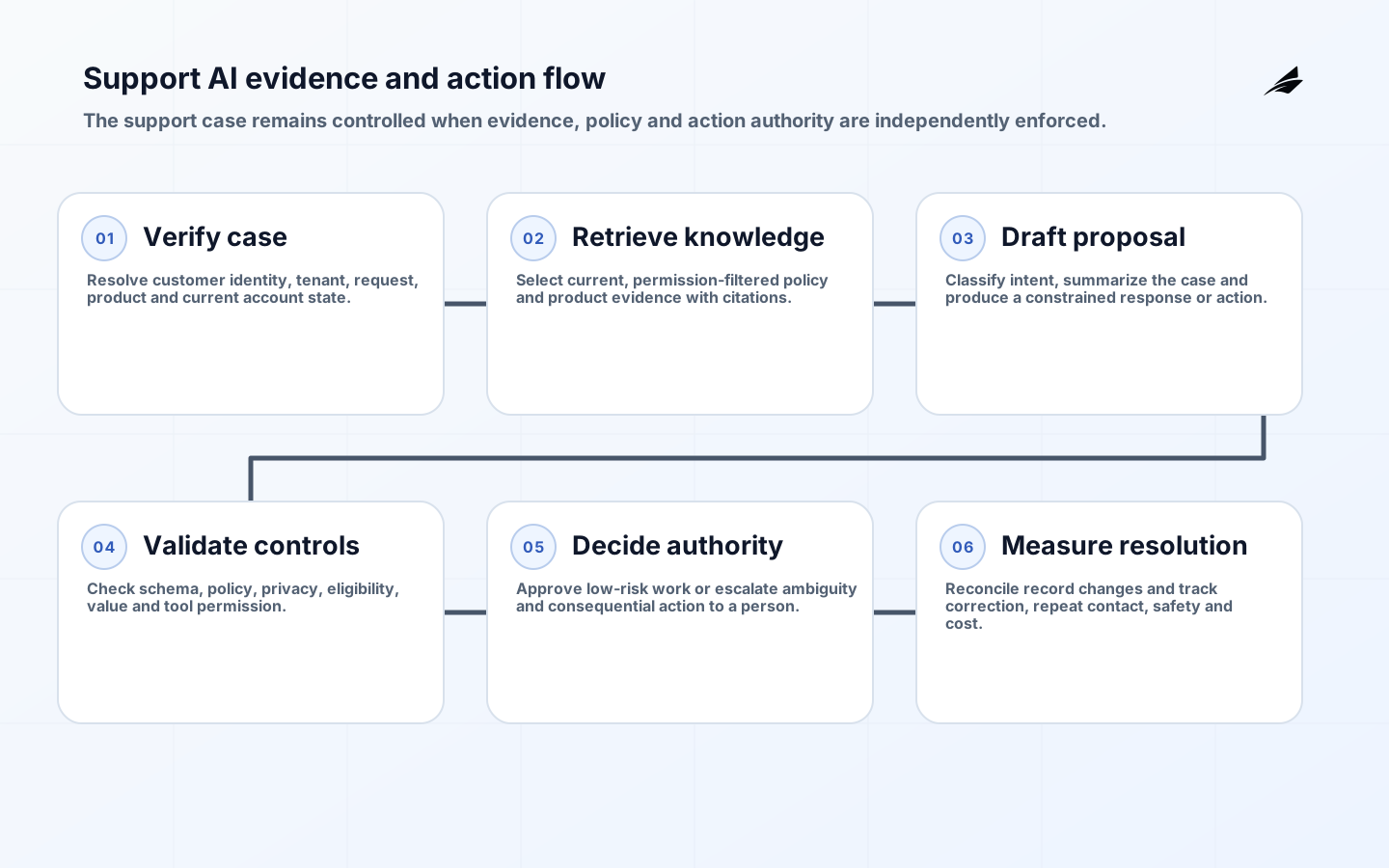
AI can help support teams classify requests, retrieve evidence, draft replies, summarize cases and recommend next actions. It should not be treated as a free-standing chatbot with broad administrative access. Customer support combines identity, policy, account state, product behavior and judgment; an error can expose data, misstate a commitment or make an unauthorized change.
The dependable pattern is a controlled case workflow. Conventional software owns state, access, policy, tools, audit and escalation. The model interprets language and proposes bounded outputs using approved evidence. Humans retain authority where ambiguity, value, safety, privacy or customer commitment demands it.
Start with one support decision
Map the current case from intake to verified resolution. Record categories, queues, identity checks, systems consulted, actions, approvals, exceptions and follow-up. Select a high-volume decision with observable quality, such as routing, knowledge retrieval or response drafting. Avoid beginning with rare escalations or unrestricted account action.
Define what automation means at each stage. Classification may be automatic with confidence-based fallback. A draft can require agent review. A password reset, refund or entitlement change needs deterministic eligibility and stronger identity. State the prohibited actions and customer situations that always escalate.
| Capability | AI role | Control | Outcome measure |
|---|---|---|---|
| Triage | Classify intent and urgency | Allowed taxonomy and fallback | Correct routing |
| Knowledge | Retrieve and summarize | Approved sources and citations | Grounded answer rate |
| Drafting | Compose response | Agent approval and policy check | Correction and resolution |
| Case action | Propose narrow tool call | Identity, eligibility and value limit | Authorized completion |
| Escalation | Summarize context | Human owns decision | Handoff quality |
Build an owned knowledge system
Inventory policies, product documentation, incident notices and solved cases. Assign owners, effective dates, audience and access classification. Remove obsolete or conflicting material. Retrieval should preserve document identity, section and version so an agent can inspect the evidence. Search quality depends more on source governance than embedding volume.
Segment content by product, plan, region and permission. Do not retrieve private cases into another customer's response. Define freshness requirements for volatile topics such as incidents and pricing. When evidence is missing or contradictory, the workflow should say so and escalate rather than allowing the model to fill the gap.
Keep models behind bounded workflow services
The case service authenticates the user, stores state and invokes retrieval or model functions with the minimum context. Outputs conform to schemas for category, summary, citation or proposed action. A policy service validates decisions. Tool adapters expose narrow functions and return typed results. The model never receives raw administrator credentials or arbitrary network access.
Treat retrieved text and customer messages as untrusted. They can contain instructions intended to override system behavior. Separate data from instructions, constrain tools and validate every argument. OWASP's excessive-agency guidance recommends minimizing functionality, permissions and autonomy; these controls limit the damage of both mistakes and prompt injection.
Protect identity, privacy and tenant boundaries
Collect only the data necessary for the case and chosen automation. Redact secrets, payment data and irrelevant personal information before model processing and telemetry. Confirm provider retention and training settings. Keep tenant and authorization filters outside natural-language prompts and enforce them in retrieval and tools.
Use the NIST Privacy Framework to map processing, affected people and response. Define retention for prompts, outputs, evaluation sets and traces. Give agents a visible indication of sources and proposed actions. Customers should not be misled about whether an answer is automated when that fact is material to trust or recourse.
Evaluate complete cases, not fluent text
Create a representative evaluation set across intents, products, languages, customer tiers and edge cases. Preserve expected evidence, correct resolution and escalation reason. Score routing, groundedness, unsupported claims, policy compliance, privacy, tool choice and final outcome. Review false confidence separately from ordinary error.
Use expert review for nuanced cases and automated checks for stable properties such as citation presence, schema validity and prohibited data. Re-run the suite after model, prompt, retrieval, policy or tool changes. Production feedback should be sampled and adjudicated before becoming training or evaluation truth.
| Gate | Required evidence | Stop condition |
|---|---|---|
| Offline | Representative case evaluation | Unsupported or unsafe result above threshold |
| Shadow | Comparison without customer action | Poor routing or latency |
| Agent assist | Correction and escalation data | Review burden exceeds benefit |
| Bounded action | Policy and identity tests | Unauthorized or unreconciled action |
| Scale | Stable customer and cost outcomes | Quality differs by cohort |
Design human approval and escalation
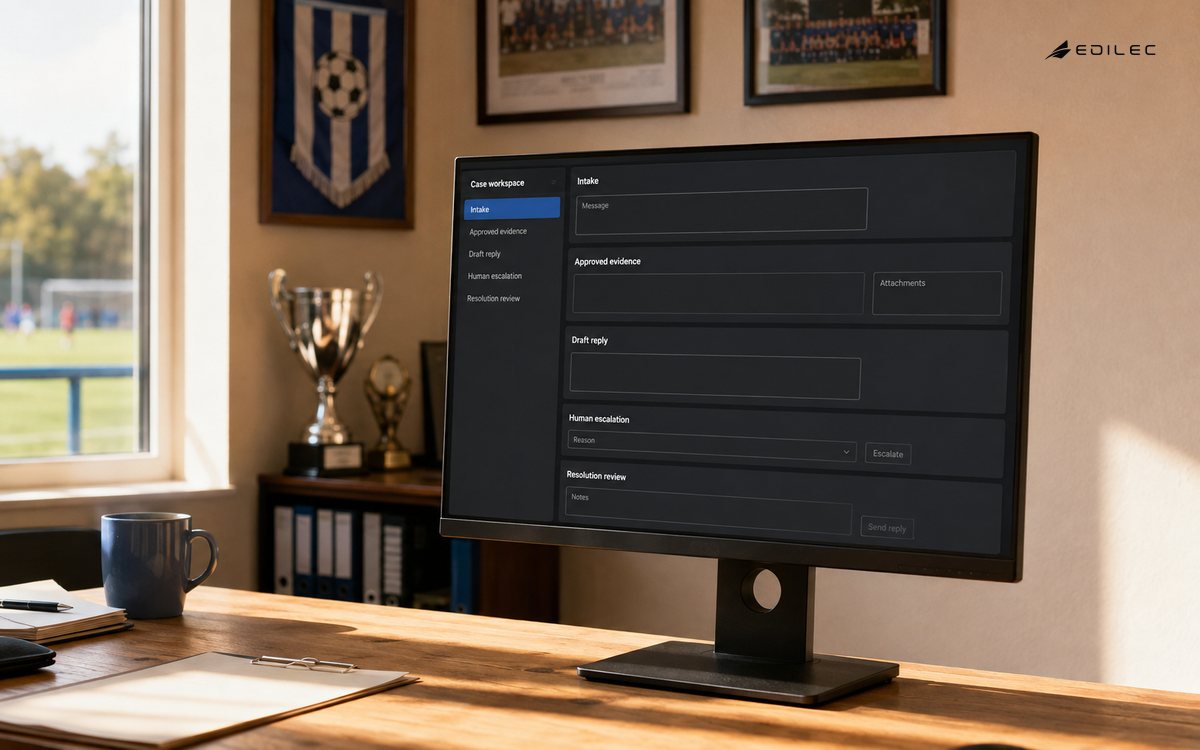
An approval interface should show the customer request, verified identity state, retrieved evidence, policy result, proposed response and action impact. Avoid asking agents to approve opaque output under time pressure. Capture corrections with reasons and let agents reject the automation entirely. High-risk decisions should route to trained specialists.
Escalation needs an owner and service level. Pass a concise chronology, attempted steps, evidence and unresolved question so the customer does not repeat the story. Preserve the human decision and resulting action. Measure whether automation improves the handoff, not only whether fewer cases reach people.
Release progressively and monitor outcomes
Launch offline, then shadow, agent-assist and narrowly automated stages. Start with a representative team and product. Keep a disable switch and the existing manual path. Version every model, prompt, source corpus, policy and tool. A provider model change is a release that deserves evaluation.
Monitor resolution, repeat contact, correction, escalation, unsupported claims, tool rejection, unauthorized attempts, latency and cost per resolved case. Segment by intent and cohort. Review customer complaints and security events. NIST AI RMF functions provide a useful structure for ownership, context, measurement and ongoing risk response.
Example: subscription billing support
A customer asks why an invoice increased. The workflow verifies account access, retrieves invoice lines, plan history and current billing policy, then drafts an explanation with citations. It may propose a credit only if a deterministic service finds a documented error and value falls below an approval threshold. Otherwise an agent decides.
Tests cover wrong-account retrieval, stale policy, ambiguous tax, prompt injection in customer text, unsupported promises and duplicate credit attempts. Monitoring follows explanation correction, repeat contact, approved credit accuracy and customer outcome. The model helps interpret evidence; the billing service remains authoritative.
Govern quality after the first release
Create an operating record for each automated capability: intended use, excluded cases, source collections, model and prompt, tool permissions, evaluation version, approval rules, owner and last review. Link production changes to this record. Support leaders need to know whether a quality shift came from a new product policy, a model release, changed retrieval or case mix.
Sample production cases by risk, not only at random. Include low-confidence results, corrected drafts, escalations, sensitive intents, new products and complaints. Have qualified reviewers adjudicate the evidence and final resolution. Do not automatically train on agent edits: a rushed workaround can be wrong, and customer text can contain malicious or private content.
Establish response plans for systematic misinformation, cross-tenant retrieval, unauthorized action and model-provider outage. Disable the narrow capability, preserve evidence and reconcile changed customer records. Communicate impact based on facts. Add confirmed failures to the evaluation suite and repair the underlying policy, source, adapter or permission rather than relying only on a prompt change.
Review economics with quality. Count platform and model usage, retrieval, evaluation, review, exception and remediation cost per resolved case. Compare repeat contact and customer effort. Automation that lowers handling time but increases incorrect commitments is not efficient. Retire or narrow capabilities whose safe review burden exceeds their benefit.
Support operations also need a clear content-change path. When an agent finds obsolete guidance, they should flag the exact passage and affected cases. A knowledge owner verifies the correction, sets an effective date and identifies related material. The retrieval index updates through a controlled job, and a regression set checks the changed intent before release. This is safer than letting agents edit a shared prompt or upload documents ad hoc.
Plan for multilingual service deliberately. Translation quality, product terminology, policy applicability and escalation capacity may differ by language. Evaluate native cases with qualified reviewers rather than translating an English benchmark and assuming equivalence. If the evidence or specialist support is unavailable, the workflow should route accordingly. Segment outcome measures so high-volume languages do not hide a harmful experience for smaller cohorts.
Give agents a concise explanation of what the automation can and cannot do. Training should use realistic cases, including refusal and escalation, rather than a feature demonstration. Supervisors need access to correction patterns and the authority to pause a capability. Psychological safety matters: people should report harmful output without being judged against an adoption target. Honest feedback is part of the control system and a prerequisite for useful improvement.
Related reading
See RAG Knowledge Bases for Support Teams, Semantic Search Architecture for Support Teams, and AI Workflow Automation for Support Teams for implementation depth.
Frequently asked questions
Should support AI answer customers without review? Only for bounded, well-evaluated intents with reliable evidence and a safe fallback. Sensitive, ambiguous or consequential requests should require review or specialist escalation.
Can an AI support agent issue refunds? It may propose one, but a conventional service should enforce identity, eligibility, value limits, approval and idempotency. The model should not hold unrestricted transaction authority.
How can teams reduce unsupported answers? Govern the source corpus, retrieve with permission filters, require inspectable evidence, constrain output, evaluate unsupported claims and route missing or conflicting evidence to a person.
Which support metrics matter after launch? Track resolution, repeat contact and customer effort alongside correction, escalation, unsupported claims, unauthorized attempts, latency and complete cost per resolved case.
Key takeaways
- Automate one support decision with a verified outcome.
- Govern knowledge sources, versions and permissions.
- Keep policy, identity and tool authority outside the model.
- Evaluate grounded resolution and escalation, not fluency alone.
- Release through shadow and agent-assist stages with a manual fallback.
Conclusion
AI support automation should make evidence easier to find and routine decisions safer to execute. The durable design combines owned knowledge, constrained models, deterministic policy, clear human authority and outcome monitoring. That architecture improves speed without turning customer trust, privacy or account state into probabilities the organization cannot explain.