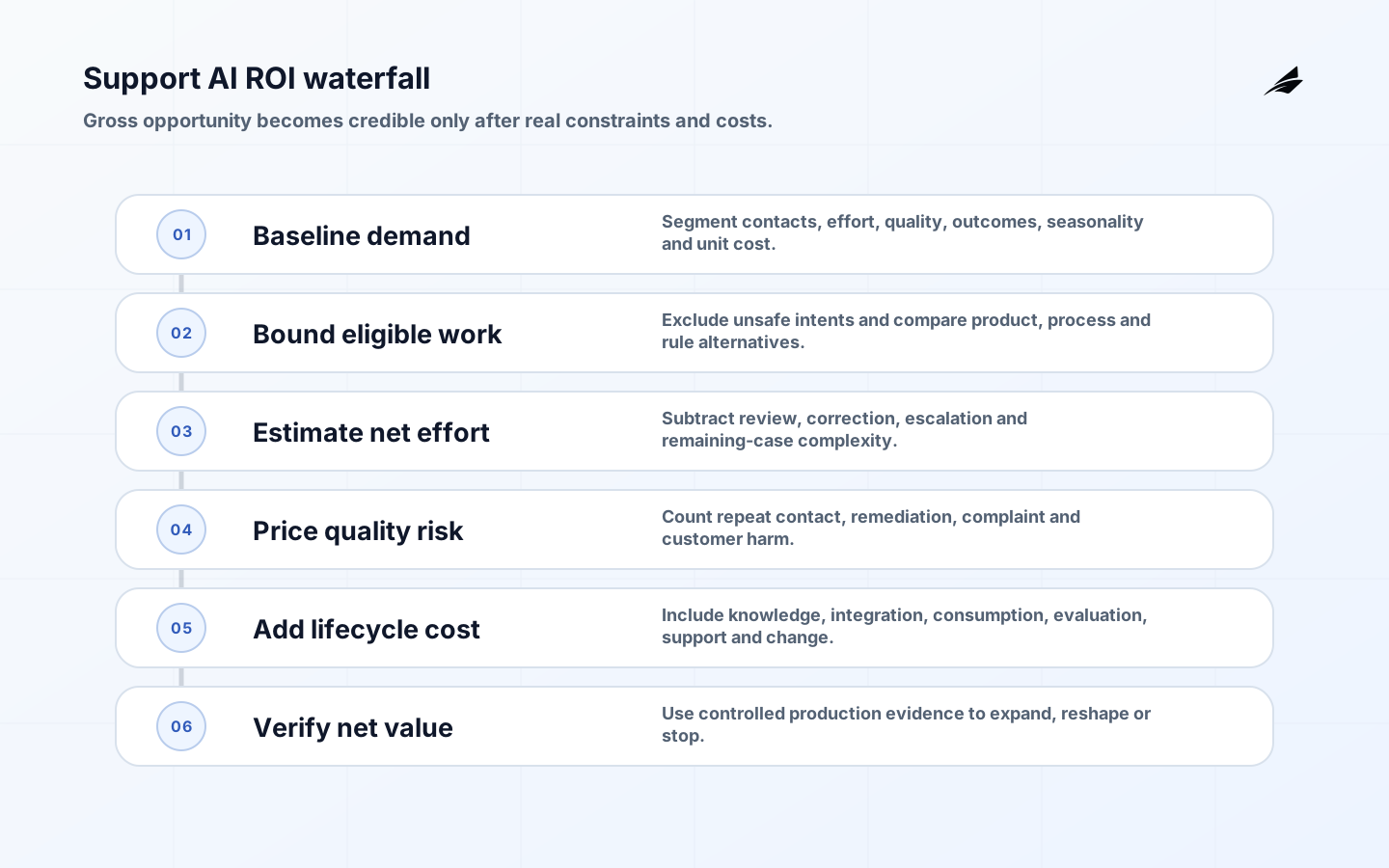
AI automation ROI planning for support teams should measure whether service outcomes improve after every new cost and risk is counted. Faster drafts or more deflected contacts do not automatically create value. Teams need a baseline for demand, resolution, quality and staffing; a clear distinction between assistance and autonomous action; and a pilot that observes customer outcomes. This FAQ provides a practical model for building and challenging that business case.
Use it with Edilec's support AI scope and cost plan, support automation implementation checklist and AI automation ROI FAQ. The calculations should remain auditable as ticket mix, models, prices and policies change.
What baseline does a support AI business case need?
Segment at least three to six months of demand by channel, intent, language, customer tier, severity and complexity. Measure incoming volume, backlog, first response, time to resolution, transfers, reopenings, escalations, quality review, satisfaction and cost. Separate handling time from calendar duration and paid effort from scheduled capacity. Capture seasonality, releases and incidents. A blended average will overstate opportunity if simple high-volume contacts already use efficient self-service.
Observe a sample of work to identify searching, reading, drafting, data entry, approval and waiting. Map systems and knowledge sources used, including access restrictions and update cadence. Record error and rework costs. The federal RPA Playbook is useful for disciplined use-case and program management even when the method includes AI. Assign a support outcome owner and a financial partner to approve assumptions.
| Baseline measure | Why it matters | Segmentation |
|---|---|---|
| Contact demand | Sets addressable volume | Intent, channel and season |
| Resolution effort | Estimates capacity effect | Complexity and role |
| Quality and rework | Prevents false savings | Error type and consequence |
| Customer outcome | Detects harmful deflection | Tier, language and journey |
| Unit cost | Supports comparison | Fully loaded cost per resolved case |
Which support AI use cases create credible value?
Start with bounded tasks: retrieve approved knowledge, summarize case history, suggest classification, draft a response, extract fields or recommend next action. Assistance may improve agent throughput with lower authority risk; self-service may increase availability but needs clear escalation; autonomous account or financial actions demand stronger verification. Rank each use case by addressable volume, time saved, quality opportunity, integration feasibility, knowledge readiness and potential harm.
Compare the AI proposal with search improvement, form redesign, product fixes, routing rules and training. Repeated contacts may reveal a product defect whose removal creates more value than handling them faster. Define eligibility and exclusions. Sensitive complaints, vulnerable customers, regulated advice or irreversible changes may remain human-led. A small high-quality scope can produce a more defensible return than broad automation with expensive review and remediation.
How should support AI ROI be calculated?
Use incremental annual benefit minus incremental annual cost, divided by incremental annual cost, and show payback separately. Benefits may include capacity avoided, lower outsourced volume, reduced rework, improved retention or additional service capacity. Count only effects supported by a causal assumption and avoid valuing the same saved minute twice. Capacity released is not cash saved unless schedules, hiring or vendor commitments change; state its intended redeployment.
Costs include discovery, knowledge cleanup, integration, model use, retrieval, storage, evaluation, security, agent training, change management, monitoring, human review, support and periodic revalidation. Add error handling, customer recovery and downtime. Model expected, conservative and stress cases for adoption, eligible volume, acceptance, token use and price. Present a waterfall so leaders can see which assumptions drive the result and what evidence will replace them during the pilot.
| ROI input | Example calculation | Required guardrail |
|---|---|---|
| Eligible cases | Demand multiplied by safe eligibility rate | No prohibited intents included |
| Net effort saved | Assisted time saved minus review and correction | Quality does not fall |
| Capacity value | Net hours multiplied by realizable cost or redeployment value | Workforce assumption documented |
| Run cost | Inference, search, tools, support and monitoring | Stress scenario within budget |
| Failure cost | Error rate multiplied by remediation impact | Incident and escalation threshold |
How do quality and risk change the return?
Quality is an economic variable and a service obligation. Evaluate factual correctness, policy compliance, tone, resolution, privacy, appropriate escalation and customer effort. The NIST Generative AI Profile identifies risks including confabulation, information integrity, privacy and cybersecurity. A response that is fluent but invents policy can create repeat contact, remediation, complaint and trust costs far beyond the handling time saved.
The NIST AI RMF supports mapping context, measuring trustworthiness and managing risk continuously. Build evaluation sets from representative support cases and important segments. Test prompt attacks, data leakage, unsafe instructions, unsupported languages and stale knowledge. Calibrate confidence and route uncertainty. Sample live output using independent review, then investigate clusters rather than averaging severe failures into a comfortable overall score.
What should an ROI pilot prove?
Use a controlled comparison against the baseline for enough volume and variety to estimate effect. Start with internal assistance or a narrow self-service intent. Predefine success, stop and expansion thresholds for resolution, quality, customer experience, handling effort, escalation, latency and cost. Instrument whether suggestions are shown, accepted, edited and associated with eventual outcomes. Do not infer customer benefit from model scores or agent clicks alone.
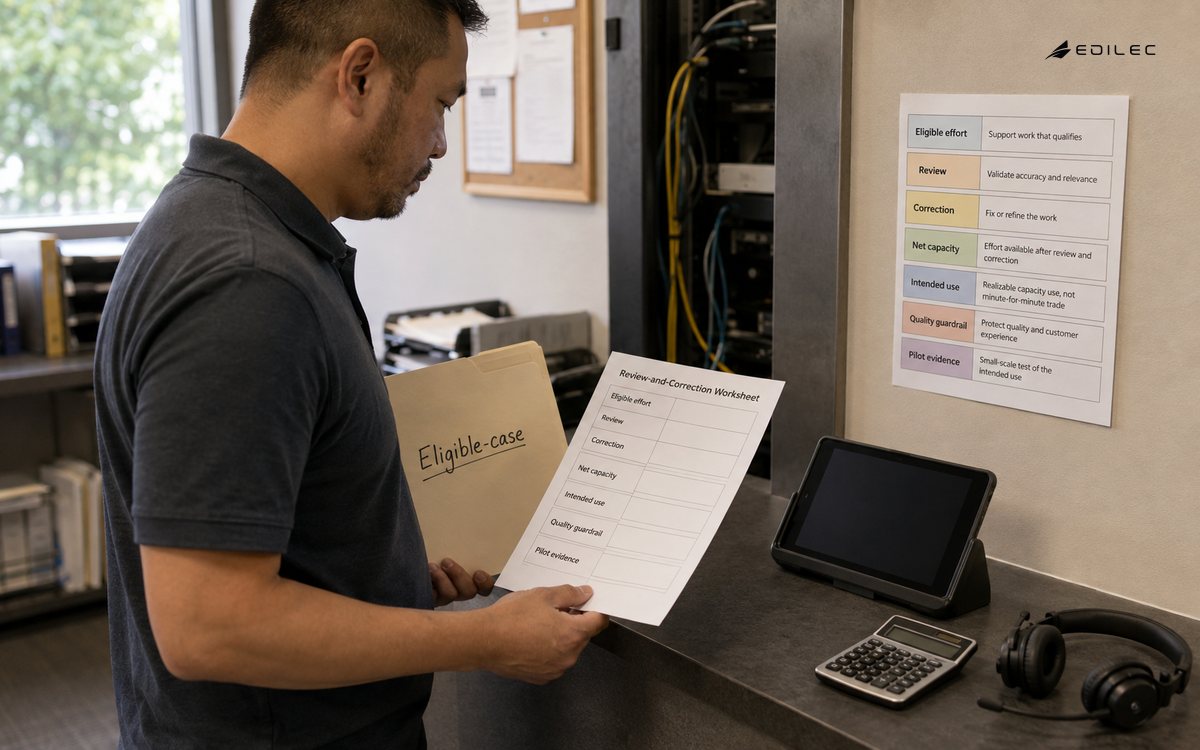
Account for learning and novelty. Agents may initially work slower; early enthusiastic users may not represent the full team; contact mix may shift. Run long enough to observe repeat contacts and delayed complaints. Track workload moved to knowledge managers, quality reviewers and engineering. Recalculate the business case with observed eligibility, net effort, consumption and failure costs. Fund the next stage only if uncertainty has narrowed enough for the decision.
Example: calculate ROI for an agent reply assistant
Suppose a support team handles 40,000 monthly contacts, but only 12,000 belong to stable intents with approved knowledge. Sampling shows agents spend four minutes searching and drafting on those cases. A reply assistant is expected to save two minutes when accepted, but reviewers need twenty seconds and ten percent of drafts need a two-minute correction. The model should calculate net eligible effort from these components rather than applying headline savings to all contacts.
The pilot randomly enables assistance for trained agents on eligible intents and retains a comparable baseline group. It measures accepted and edited drafts, total handling effort, resolution, repeat contact, escalations, quality findings and customer outcome. Provider consumption, retrieval, evaluation and support are logged per successful case. Results are segmented by intent and language. Any policy or privacy failure triggers review even if the financial threshold remains positive.
Finance values only capacity that changes overtime, vendor volume, planned hiring or documented redeployment. The team runs conservative scenarios for lower adoption and higher correction. If the observed return clears the threshold, expansion proceeds one intent at a time; if knowledge gaps dominate, funding moves to content governance. This worked example prevents a common error: converting gross model-assisted minutes directly into cash while ignoring eligibility, review, errors and operating cost.
How should support AI be governed in operation?
Maintain an approved-purpose record, owner, data sources, model, prompts, evaluation, access, authority and review date. ISO/IEC 42001 frames AI governance as a continuing management system. Reapprove material changes to model, retrieval content, policy, automation scope or customer population. Separate content ownership from model operation and make emergency suspension possible without disabling the entire support channel.
Tell customers when they are interacting with AI where context warrants, and provide a usable route to a person. The OECD transparency principle emphasizes awareness, meaningful information and ability to challenge outcomes. Human escalation should preserve conversation context and avoid forcing repetition. Monitor escalation success, complaints and vulnerable-customer handling as guardrails, not merely cost centers to minimize.
When should support AI scale or stop?
Scale by intent, channel, language or action authority after the current cohort meets thresholds. Recheck knowledge quality and reviewer capacity at each step. Volume expansion can change latency, cost and error exposure. Track unit economics by use case; a portfolio average can hide one valuable assistant and one costly autonomous flow. Preserve a holdout or periodic comparison when feasible so improvements are not confused with seasonality or product changes.
Stop or constrain when quality falls, required evidence becomes unavailable, complaint patterns rise, costs exceed thresholds or a simpler product fix removes demand. Retirement includes removing integrations and access, archiving required evidence, updating customer journeys and reassigning monitoring. Past development spend is sunk; it should not justify ongoing operation. A disciplined stop decision protects support quality and frees capacity for stronger use cases.
Support AI ROI takeaways
- Segment demand and quality before estimating addressable volume.
- Compare AI with product, process, search and rule improvements.
- Value only capacity that can be realized or deliberately redeployed.
- Include review, knowledge, monitoring, failure and customer-recovery costs.
- Use controlled production evidence to replace business-case assumptions.
- Scale and retire by use-case economics and service guardrails.
Frequently asked questions
Is contact deflection a sufficient ROI metric?
No. Deflection may represent successful self-service, abandonment or a customer who returns later. Pair it with confirmed resolution, repeat contact, escalation, complaint and satisfaction measures. Calculate cost per successfully resolved eligible case rather than cost per conversation started.
Should average handling time always decrease?
No. If AI handles simple work, remaining human cases may be more complex and average handling time may rise. Measure total effort by comparable intent and outcome, including review and rework. Longer handling can be worthwhile when first-contact resolution or risk control improves.
Conclusion
A defensible support AI business case follows value from real demand to verified resolution. Establish the baseline, bound eligible work, count total cost, price quality failures and update assumptions through a controlled pilot. The objective is not the highest automation rate; it is better support outcomes at a sustainable net cost with customers and staff able to escalate when the system is wrong.