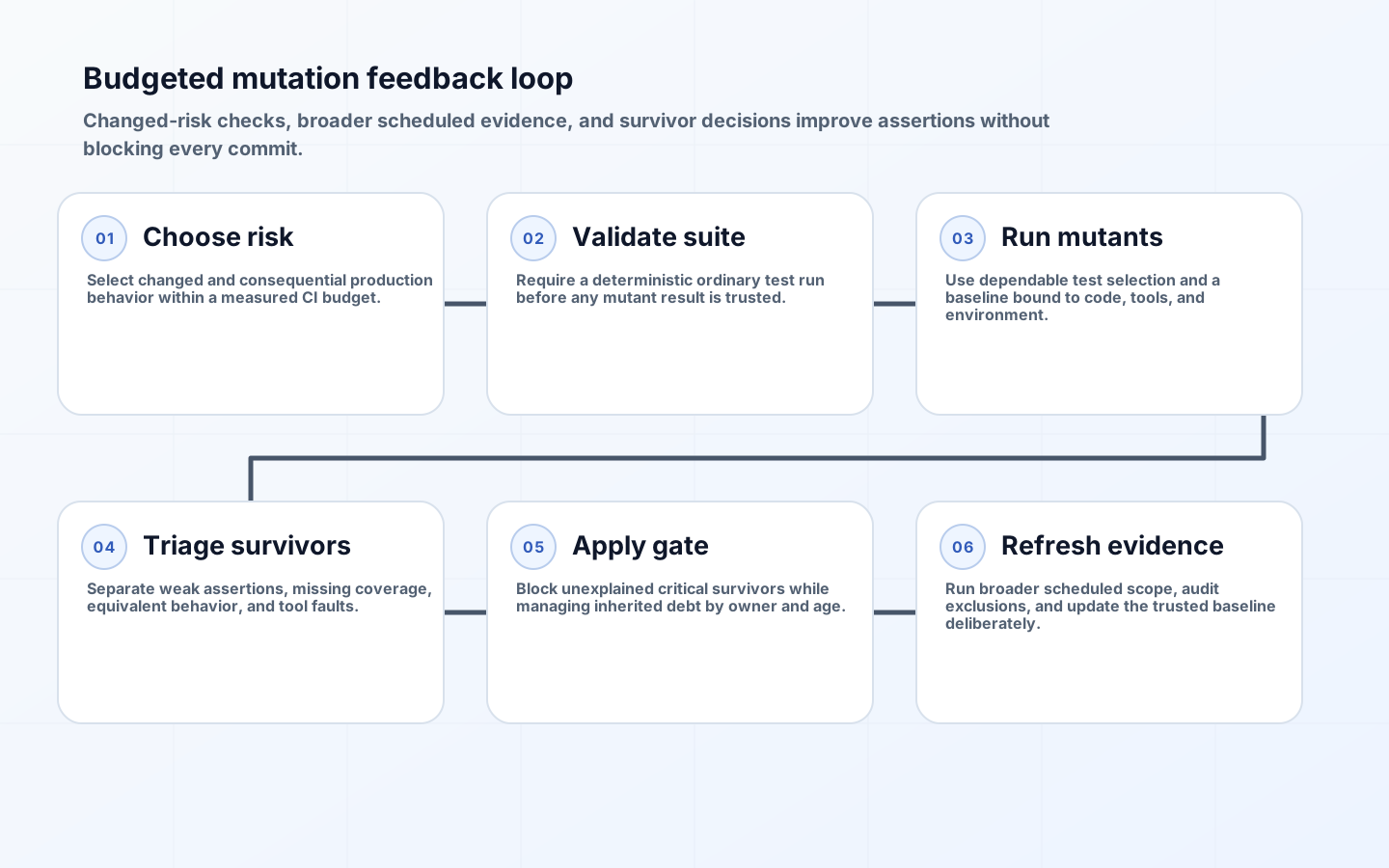
Mutation testing CI runs answer a harder question than line coverage: would the automated tests notice a small, meaningful change in production code? A mutation tool replaces an operator, removes a condition, changes a return value, or makes another controlled edit. A test failure kills the mutant; a passing suite leaves it surviving. Survivors often reveal an assertion that observes execution without checking the behavior that matters.
The obstacle is cost. Running an entire suite against every possible mutant can consume far more compute and wall time than an ordinary test job. The practical goal is therefore not to mutate everything on every commit. It is to build a layered feedback system: fast analysis on changed risk, broader scheduled evidence, and focused human review of survivors. Done well, mutation testing strengthens assertions without turning pull-request CI into a queue.
Define the decision mutation testing will support
Choose the decision before the tool. A pull-request check should answer whether changed behavior is defended by effective tests. A nightly run should reveal weak areas across a service. A release assessment may concentrate on high-impact calculations, permissions, state transitions, or failure handling. These purposes need different scopes and gates. One global score cannot express all three without rewarding large stable modules or punishing generated and defensive code indiscriminately.
Treat mutation results as evidence about the relationship between code and tests, not as a developer ranking. A low score can combine uncovered code, surviving covered mutants, timeouts, compile errors, and deliberately excluded areas. Stryker distinguishes detected mutants, such as killed and timed-out cases, from undetected survivors and no-coverage cases; invalid mutants are not part of its valid-mutant score. Preserve those states instead of flattening them into one percentage.
| Signal | What it means | Likely response | Do not infer |
|---|---|---|---|
| Killed | At least one test detected the change | Keep the relevant assertion and inspect redundant tests separately | Every behavior is tested |
| Survived | Tests ran but did not fail | Review observable behavior, boundary cases, and assertion strength | The mutant is always a real defect |
| No coverage | No selected test exercised the mutant | Add coverage if the path matters or remove dead code | An existing assertion is weak |
| Timeout | The mutant caused the run to exceed its limit | Check timeout policy and whether the change represents an infinite path | The suite made a precise assertion |
| Compile or runtime error | The generated variant could not be evaluated normally | Track tool or language compatibility | The test suite detected the behavior |
Pilot on consequential, deterministic code
Start with a module whose logic is important, tests are already fast, and outcomes are deterministic. Price calculations, authorization decisions, parsers, validators, and domain state transitions are strong candidates because a changed operator has a clear behavioral consequence. Avoid beginning with UI orchestration, generated clients, simple property accessors, or integration tests dominated by network setup. A noisy first run teaches the organization that mutation testing is expensive rather than useful.
Record the ordinary test duration, mutation duration, mutant count, tests selected per mutant, survivor categories, and reviewer time. The pilot succeeds when reviewers can turn survivors into better tests or justified exclusions at a tolerable cost. It does not succeed merely because the tool emitted a score. Include one intentionally weak assertion in the pilot so the team can verify that the workflow exposes a known gap and guides a repair.
Constrain pull-request scope without hiding regressions
For pull requests, mutate changed production lines plus a small risk-based neighborhood: affected functions, directly dependent domain code, or files selected by reliable test-impact analysis. Keep a scheduled full-module or full-repository run to catch weak assertions outside the diff. This two-speed model recognizes that a test change can alter protection for unchanged code and that dependency, environment, snapshot, or configuration changes may invalidate cached results.

Incremental mutation testing can reuse prior results, but the baseline is an input with provenance. StrykerJS documents that reuse depends on mutant and test changes it can detect and notes limitations for environment, dependency, snapshot, and other file changes. Store the report with the exact commit, tool version, configuration hash, runtime image, and test inventory. Force a broader run when any untracked influence changes or when the baseline cannot be trusted.
- Run the ordinary suite first; a failing or nondeterministic dry run invalidates mutation evidence.
- Mutate production sources only, excluding generated, vendored, migration, and declarative files by reviewed policy.
- Use per-mutant coverage or test selection when the runner reports it accurately.
- Cap worker concurrency so mutation jobs do not starve ordinary CI or shared services.
- Cancel superseded pull-request runs while retaining scheduled portfolio evidence.
Separate changed-code gates from portfolio baselines
A mature legacy service may begin with many survivors. Failing every change against an aspirational absolute score creates pressure to ignore mutants. Instead, establish a reviewed portfolio baseline and prevent deterioration on newly changed, valid mutants. The pull-request gate can require no unexplained new survivors in critical code while the scheduled program tracks survivor debt by owner and age. Tighten thresholds only after the review process proves stable.
Use both counts and rates. A score can rise when the denominator changes, when exclusions expand, or when an easy module dominates the total. Report killed, survived, no-coverage, invalid, ignored, and timed-out counts alongside the score, scope, and elapsed minutes. For changed code, display the exact surviving mutations and the tests that covered them. The reviewer needs behavior, not a colored badge detached from its population.
| Execution tier | Typical scope | Gate | Budget response |
|---|---|---|---|
| Developer focus | One function or file | Informational survivor list | Run locally or on demand |
| Pull request | Changed risk and dependable affected tests | No unreviewed critical survivor; no regression from trusted baseline | Hard wall-time cap and controlled workers |
| Nightly | Changed modules or rotating repository slices | Owner-visible debt and trend | Parallelize off the merge path |
| Release | Financial, security, or state-critical paths | All material survivors dispositioned | Reserve capacity and preserve evidence |
| Periodic full run | Entire eligible portfolio | Recalibrate baseline and exclusions | Schedule by module and compare tool versions |
Triage surviving mutants by behavior
Review each survivor in the context of the original code, replacement, covering tests, and domain consequence. First ask whether the change is observably different under the contract. If yes, identify the missing example or assertion. Boundary changes often need a test at equality; removed conditions need a case that depends on the excluded branch; changed returns need an assertion on the returned or persisted outcome rather than only a mock interaction.
Some mutants are equivalent for the reachable domain: the modified program has the same observable result under valid inputs. Stryker notes there is no definitive general mechanism for identifying all equivalent mutants. Require a concise justification tied to an invariant, and prefer refactoring opaque code when equivalence is difficult to explain. Suppress the smallest location and operator possible, with owner and review date, rather than disabling a broad mutator globally.
Control CI minutes with measurement and scheduling
Track mutation cost per eligible line, per executed mutant, and per actionable survivor. Measure queue delay as well as compute time because aggressive parallelism can slow unrelated builds. Use historical duration to shard work evenly, not merely by file count. Keep compilation and dependency caches separate from mutation-result reuse: one accelerates setup, while the other makes a claim that a specific mutant outcome remains valid.
Apply a stop policy when the ordinary suite is unstable, the mutant count exceeds the reviewed bound, or infrastructure saturation would breach the pull-request service objective. A stopped run should be visible and rescheduled, not reported as a pass. Teams can rotate broad modules nightly and prioritize recent changes, criticality, survivor age, and incident history so the fixed budget buys the most decision-relevant evidence.
Make quality gates accountable and reversible
Assign the changed-code author to explain new survivors and the owning team to manage baseline debt. A quality engineering or platform group owns tool configuration, version upgrades, run reliability, and exclusion audits. Exceptions need a reason code, exact scope, approver, expiry, and link to an issue. Expired suppressions should fail the policy check even if the underlying mutation job is not running, preventing forgotten exclusions from becoming permanent.
When upgrading the mutation engine or changing operators, run old and new configurations against the same commit. New mutants are not necessarily regressions, and removed mutants are not improvements. Rebaseline only after classifying the population change. Preserve reports long enough to explain a release decision, but avoid publishing source-bearing reports to an access level broader than the repository because replacements and file paths can expose implementation details.
Example: strengthen a discount boundary
Suppose a discount function applies a preferred rate when orderTotal >= 1000. Existing tests assert that a 1200 order receives the discount and that a 500 order does not. A mutant changes >= to >, and both tests pass. The useful repair is a contract-level example at exactly 1000, not an assertion that the source contains a particular operator. The new test documents the commercial boundary and kills the mutation for the right reason.
If another mutant replaces the preferred rate with the same value supplied by configuration in the test environment, changing the assertion may not help. The team should decide whether configuration variance is part of the contract, create fixtures with distinct values, or classify the mutant as equivalent under a fixed invariant. This illustrates why a survivor queue requires domain knowledge: the tool identifies sensitivity gaps, while people decide whether those gaps matter.
Key takeaways
- Use mutation testing to evaluate assertion effectiveness, not to replace coverage or ordinary tests.
- Keep pull-request runs narrow and pair them with broader scheduled runs.
- Bind incremental results to code, tests, environment, tool version, and configuration.
- Gate new critical survivors and manage legacy survivor debt separately.
- Review equivalent mutants narrowly and expire every suppression.
- Measure actionable findings per CI minute, including queue impact and reviewer effort.
Frequently asked questions
What mutation score should a team require?
There is no universal defensible percentage. Begin with a measured baseline, require no unexplained deterioration in changed critical code, and tighten by module as survivor triage becomes reliable. Always publish state counts and scope with the score.
Does a timed-out mutant prove the test is effective?
It shows the run detected a nonterminating or very slow variant under the configured limit, and some tools count it as detected. It does not prove a precise behavioral assertion, so investigate concentrated timeouts and validate that the limit is appropriate.
Should end-to-end tests be used for mutation testing?
Usually only selectively. Slow, stateful end-to-end suites multiply cost and can obscure which behavior killed a mutant. Prefer fast unit or component tests for broad mutation work, then target integration boundaries where the contract cannot be proven below them.
Conclusion
Mutation testing becomes sustainable when CI treats it as a budgeted feedback system rather than an all-code ritual. Changed-risk scope, trusted incremental baselines, scheduled portfolio runs, behavior-centered triage, and expiring exceptions turn surviving mutants into specific engineering decisions. The result is stronger tests where defects matter, with enough cost evidence to keep the practice on the delivery path.