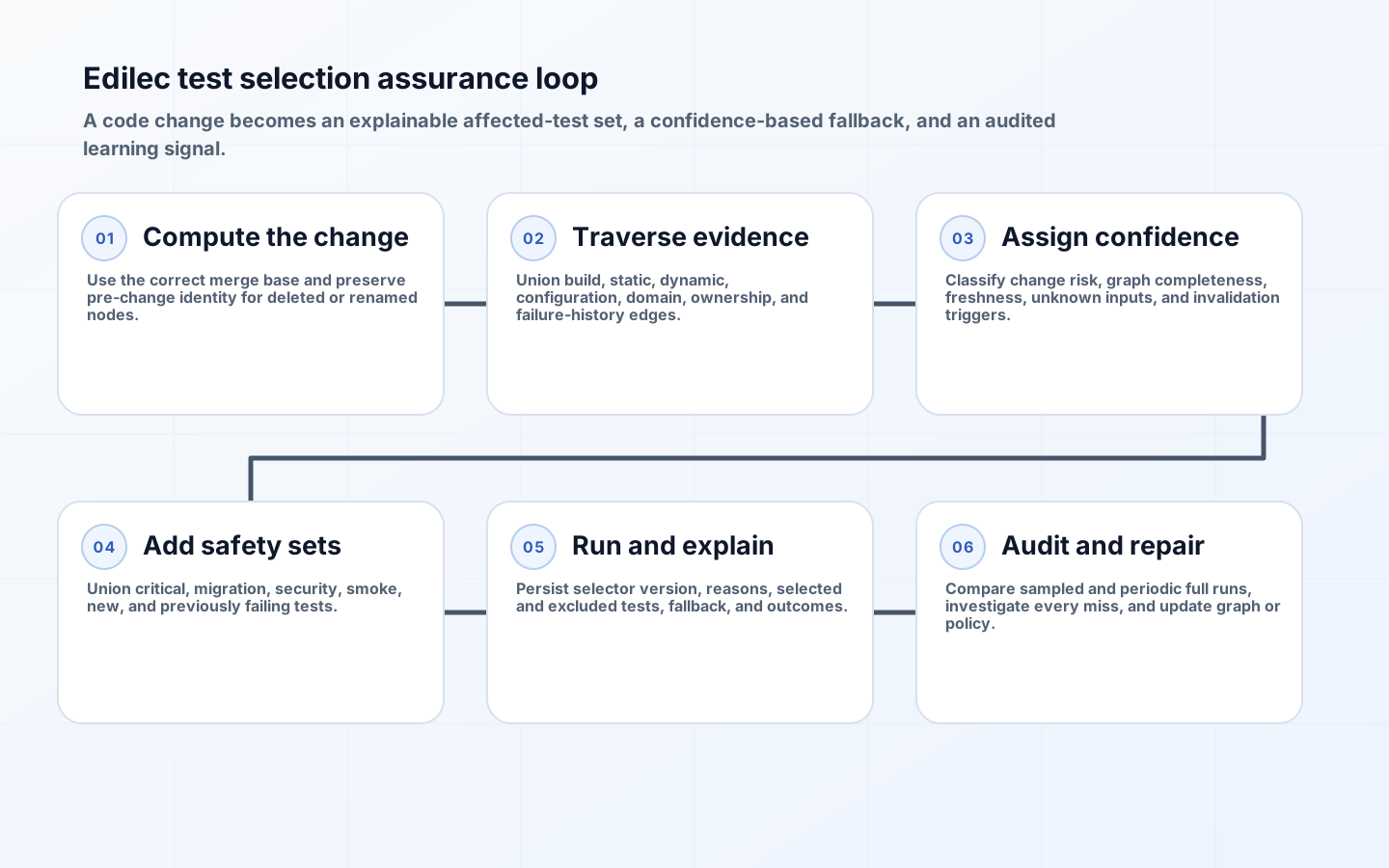
Test impact analysis selects tests likely to exercise a change so developers receive useful feedback sooner than a full suite can provide. Its core output is not a guarantee that unselected tests will pass. It is a risk-ranked selection based on a dependency model, historical execution, change classification, and safety policy. Blind spots appear when teams mistake an incomplete graph for certainty.
A safe program layers fast affected tests with mandatory checks, conservative full-suite fallbacks, periodic complete runs, and randomized audits. It then measures misses by comparing selected and full outcomes. The optimization earns trust only while the model is fresh, selection is explainable, and a change outside modeled knowledge expands coverage rather than silently shrinking it.
Define the feedback objective and tolerated risk
Choose where selection applies: local development, pull requests, merge queues, main branch, release candidates, or all of them. State a feedback-time target and which suites remain mandatory. Security controls, migration tests, smoke tests, previously failing tests, and tests covering critical revenue or safety paths may run regardless of impact score. A release can require broader evidence than a pull request.
Define a miss as a test excluded by selection that fails when the complete eligible suite runs against the same change and environment. Track selection precision and recall carefully: running fewer tests is not success if misses rise. Treat flaky failures separately but do not discard them; nondeterminism can corrupt the learned mapping and obscure genuine misses.
Build a multi-source dependency graph
| Source | Captures | Misses | Use |
|---|---|---|---|
| Build graph | Declared project, target, and generated-code edges | Runtime discovery and external state | Conservative transitive affected set |
| Static code graph | Imports, calls, inheritance, annotations | Reflection, configuration, dynamic loading | File or symbol impact |
| Dynamic coverage | Code exercised by each test | Untaken branches and environment-specific paths | Observed test-to-code edge |
| Configuration graph | Flags, templates, schemas, migrations, policy | Unregistered consumers | Change classification and fan-out |
| Ownership and domain map | Critical workflows and business boundaries | Fine implementation edges | Mandatory suite and risk weighting |
| Failure history | Tests correlated with changed areas | Novel failures and sparse data | Ranking, never sole exclusion |
Start with the build system because declared dependencies are inspectable and conservative. Bazel’s query guide documents target dependency queries such as dependencies and reverse dependencies; Nx’s affected command guidance uses the project graph plus a comparison base and head to determine affected projects and tasks. Correct base selection is essential: a shallow checkout or wrong merge base omits changes.
Add dynamic edges from test coverage or instrumentation, but union them with static and policy edges. A test that never executed an error branch still depends on that branch. Register non-code fan-out: changing a database migration, API schema, compiler option, container base, shared test fixture, feature flag, localization file, or CI image can affect tests without a direct source import. Unknown file types should trigger broader selection.
Design confidence tiers and fallback triggers
Assign selection confidence by graph completeness and change type. High confidence can run directly mapped tests plus transitive owners. Medium confidence adds neighboring project and integration suites. Low or unknown confidence runs the full eligible suite. Changes to the selector, build graph, lockfiles, dependency resolution, global configuration, test framework, code generator, shared runtime, or dependency mapping should usually invalidate the optimization.

| Change class | Selected set | Additional safety set | Fallback |
|---|---|---|---|
| Leaf implementation | Mapped tests and transitive dependents | Critical smoke and recent failures | Full suite if graph or coverage stale |
| Public API or schema | Provider and all known consumer tests | Compatibility and integration suites | Full affected domain on unknown consumer |
| Database migration | Repository, migration, rollback, and service tests | Critical data journeys | Full suite for shared schema |
| Build or dependency change | Reverse-dependency tasks | Packaging and startup tests | Full suite on resolution uncertainty |
| Global config or selector code | All tests in scope | Selector self-tests | Optimization disabled |
| Documentation-only | Lint and link checks | None if classification is proven | Full suite for embedded code or generated docs |
Microsoft’s current Azure Pipelines TIA guidance, updated in October 2025, says its selector includes impacted, previously failing, and newly added tests, falls back to all tests for scenarios it cannot understand, and supports periodic complete runs. It also documents a managed-code, single-machine scope for its built-in mechanism. Treat product-specific support boundaries as policy inputs, not universal capabilities.
Implement an explainable selection pipeline
Compute the trustworthy change set from the merge base, classify every changed path, update graph inputs, produce selected tests with reasons, union mandatory suites, and apply a budget only after risk policy. Persist the graph version, source commit, selector version, selected and excluded sets, fallback reason, and execution results. Developers should be able to ask why a test ran and why another did not.
undefinedDo not cap the selected set by dropping tests arbitrarily when a change has broad impact. Instead, shard or parallelize, move slow setup out of tests, cache build outputs with content verification, or run a fast gate followed by required complete evidence. Time budgets should influence pipeline topology, not falsify the impact claim.
Audit selection against complete outcomes
Run the full suite periodically and on a random sample of ordinary changes, after graph-affecting changes, before high-risk releases, and whenever the selector reports unknown input. Compare what the selected run found with failures in the complete run. Microsoft’s VSTest task reference exposes a periodic full-run setting and recommends regenerating mappings regularly; its documented default is a full run after 50 builds, but each team should set cadence from risk and change rate.
Calculate miss rate by change class, repository area, selector version, and graph age. Investigate each miss: missing edge, stale dynamic data, wrong merge base, nondeterminism, unmodeled external state, or incorrect test ownership. Add the repaired edge or fallback rule and replay historical cases. Keep a small regression corpus for the selector itself, including renames, generated code, deleted tests, dependency upgrades, and cross-language changes.
Roll out gradually and operate the model
Begin in shadow mode: run the full suite, predict selection, and measure what would have been omitted. Then use selection for early feedback while the full suite remains required later. Promote high-confidence areas after enough representative evidence; keep unknown or critical areas conservative. Provide a one-command or pipeline-variable override to force all tests, and use it automatically after incidents or selector-data failure.
Monitor selected fraction, time saved, queue time, fallback frequency and reason, graph freshness, unknown changes, missed failures, flaky-test influence, mandatory-suite cost, and escaped defects. Review exclusions with quality and service owners. A team should be able to remove optimization quickly if confidence degrades. Availability of the selector must not become availability of the delivery system unless an explicit fail-open policy is justified.
Deleted and renamed code require special handling. Preserve the pre-change graph long enough to find tests that depended on removed symbols or targets, then union that result with the new graph. If analysis uses only the post-change tree, the deleted node has no outgoing or reverse edges and its tests can disappear from selection. Treat large moves and generated-file relocation conservatively until identity mapping is proven.
Distributed and data-dependent tests also create invisible edges. A test may call a deployed service, read a fixture bucket, consume a schema registry subject, or depend on a feature-flag default outside the repository. Register these resources as graph nodes where possible and version their manifests. When a shared external dependency changes without a traceable version, invalidate affected mappings and run the broader suite.
Key takeaways
- Treat test selection as a risk-ranked prediction, never proof that excluded tests pass.
- Union build, static, dynamic, configuration, domain, and history evidence instead of trusting one graph.
- Use confidence tiers, mandatory suites, and broad fallback for unknown or graph-changing inputs.
- Persist an explanation for every selection and never drop tests merely to fit a time budget.
- Audit with periodic and randomized full runs, investigate every miss, and version the selector like production software.
Frequently asked questions
Is code coverage enough for test impact analysis?
No. Coverage records paths executed in prior runs, not every path a test semantically depends on. Combine it with build and static dependencies, configuration fan-out, mandatory suites, and conservative fallback.
How often should the full suite run?
Set cadence from change rate, graph freshness, criticality, and observed misses. Run it periodically, on sampled changes, after selector or dependency changes, before high-risk releases, and whenever input is unknown. A fixed build count is a starting control, not a universal answer.
Does test impact analysis require a monorepo?
No, but cross-repository version and deployment edges must be available. A monorepo build graph can make source dependencies easier to traverse. Multi-repository systems can combine service catalogs, contracts, artifact manifests, and deployment records, with broader fallback where evidence is incomplete.
Conclusion
Test impact analysis is trustworthy when it is designed to admit uncertainty. Build a graph from several evidence sources, classify changes, preserve mandatory coverage, and expand to full execution whenever the model lacks confidence. Continuous audits then turn misses into better mappings. The result is faster feedback with a measured safety case, not speed purchased by making regression risk invisible.