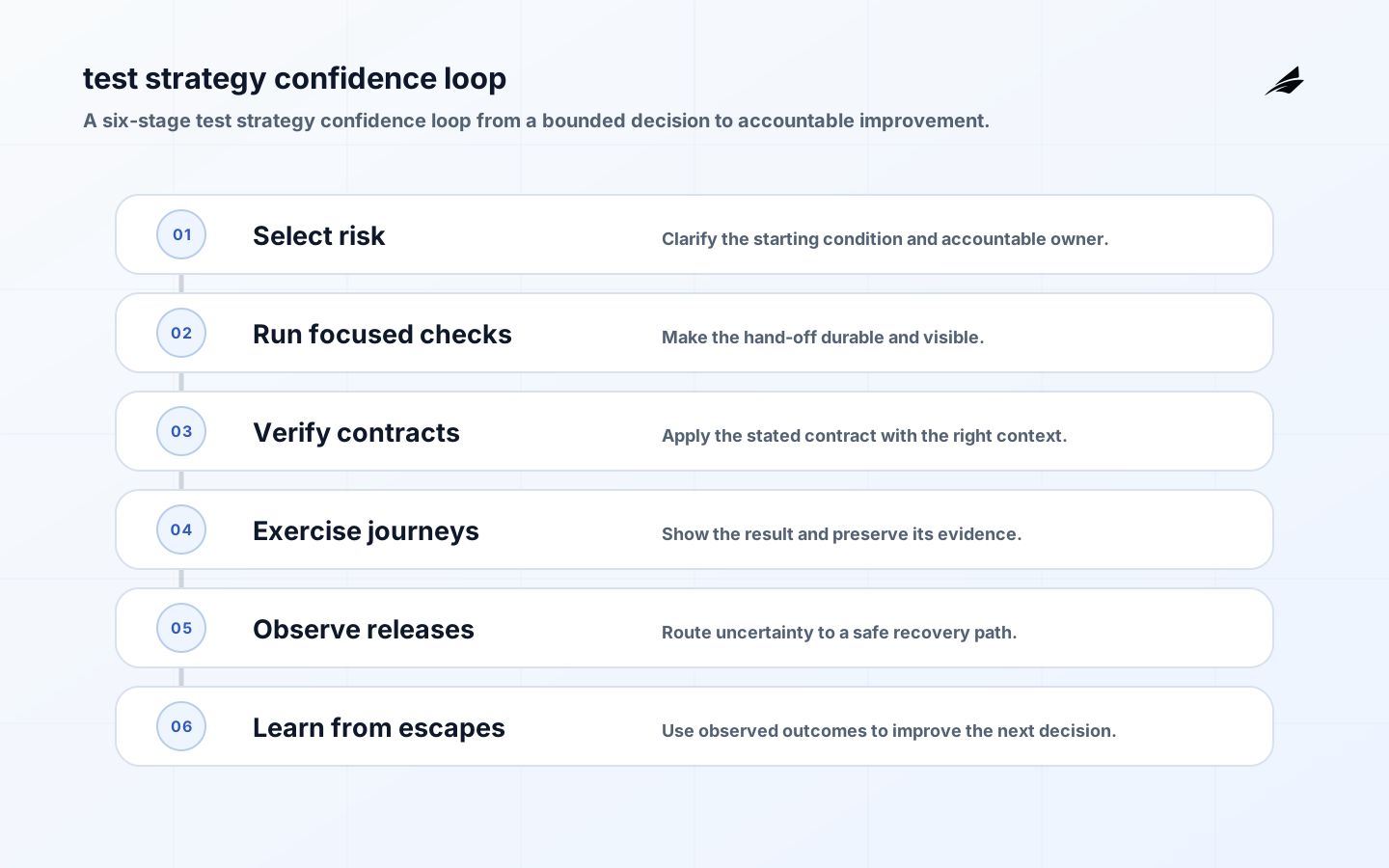
Test Strategy in Production: Confidence Without Slow Delivery
A production test strategy is not a target percentage or a catalogue of frameworks. It is the evidence a team needs before changing software that customers, operators, and other services depend on. The question is practical: which failures would be expensive, unsafe, or hard to discover later, and what is the fastest trustworthy way to detect them? Good strategy keeps a small set of decisive checks close to the change, then adds broader evidence where interfaces, data, and real deployment conditions make local tests insufficient. It also accepts that tests are software: they need ownership, readable failures, reliable environments, and deletion when they no longer express a useful risk. For this evaluation, name the accountable owner, supporting evidence, exception route, and next measurable check.
Start with risk boundaries, not test categories
Map the customer and operational promises first. Payment authorisation, tenant isolation, data retention, role changes, irreversible state transitions, and public API compatibility usually merit direct automated evidence. Cosmetic presentation and exploratory product questions may need a different mix of review, telemetry, and research. State the failure mode beside each promise: wrong result, missing result, disclosure, unacceptable delay, or inability to recover. This makes selection concrete. A unit test is useful when a rule can be proved without infrastructure; a contract check is useful when two independently changing systems must agree; an end-to-end flow is useful when wiring and browser behavior are the risk. The NIST SSDF is a helpful reminder that verification belongs throughout secure development, rather than at one late gate. Within this control, name the accountable owner, supporting evidence, exception route, and next measurable check.

| Risk boundary | Best first evidence | What it should prove |
|---|---|---|
| Business rule | Focused unit or property test | Inputs at the edge produce the allowed state. |
| Service hand-off | Consumer-driven or schema contract | Both sides agree on fields, errors, and compatibility. |
| Critical user journey | Small browser or API flow | The released path can complete with realistic identity and data. |
| Security control | Negative authorization and abuse cases | An untrusted actor cannot reach or infer protected behavior. |
Build a fast, layered evidence stack
Place fast deterministic checks nearest to the code that changes, and reserve slower environment-dependent checks for a few high-value flows. That is not a rigid pyramid diagram; the right mix follows the architecture. A rule engine may deserve extensive property tests. A system with several services may depend more on contracts. A browser-heavy workflow needs a thin set of accessibility and interaction checks. Avoid duplicating the same assertion at every layer merely to inflate confidence. Instead, identify the uncertainty that remains after a lower-level check. Use realistic fixtures with explicit builders, keep time and randomness controllable, and make state reset part of the test contract. Flaky tests train people to ignore alarms, so their repair budget is part of delivery capacity. When implementing this evaluation, name the accountable owner, supporting evidence, exception route, and next measurable check.
- Run format, type, lint, and focused behavioral checks before expensive environment work.
- Make fixtures state the business condition they represent rather than hiding it in opaque JSON.
- Use contracts for fields and error semantics that cross team or deployment boundaries.
- Keep end-to-end scenarios few, named after customer outcomes, and independent of execution order.
- Quarantine a flaky test only with an owner, expiry date, and visible impact on release confidence.
- Capture a failure artifact that lets the author reproduce the actual condition, not just the final assertion.
Test the release path as well as application behavior
A green suite cannot prove that the artifact, configuration, migration, and permissions used in production are compatible. Add checks around the delivery path: build provenance, dependency policy, database migration reversibility, feature flag defaults, and an executable smoke check after deployment. For a meaningful customer journey, test both the happy transition and the recovery boundary, such as a declined payment, a delayed provider response, or an expired invitation. Security verification also needs negative evidence. The OWASP ASVS offers a broad control catalogue; select the requirements that correspond to the application’s threat model instead of turning it into a generic checklist. Before releasing this evaluation, name the accountable owner, supporting evidence, exception route, and next measurable check.
| Release moment | Check | Failure should answer |
|---|---|---|
| Before merge | Change-focused suite and contract diff | Did this edit break a stated rule or consumer? |
| Build | Dependency and artifact verification | Is the deployable unit the one we reviewed and approved? |
| Deploy | Migration and configuration validation | Can old and new components coexist safely during rollout? |
| After release | Synthetic or controlled smoke flow | Does the live route work with live policy and routing? |
Use production signals to calibrate the suite
Tests are predictions; telemetry reveals whether the prediction matched operation. Correlate release markers with error rates, latency, conversion or completion steps, and support contacts. OpenTelemetry signals distinguishes traces, metrics, and logs because each answers a different investigation question; use that distinction when deciding what a test failure cannot tell you. A defect that escaped should lead to a short learning review: was the risk unknown, was the check absent, did the fixture hide the condition, or did the signal fail to reach a human? Add the smallest durable control and remove redundant checks when they no longer pay for their upkeep. While operating this operating step, name the accountable owner, supporting evidence, exception route, and next measurable check.
Govern test data and ownership
Production-like data can make tests convincing and unsafe at the same time. Prefer generated or deliberately masked data, use least privilege in shared environments, and document retention for screenshots, traces, and recordings. Name owners for suites that gate releases, for contracts shared across repositories, and for browser infrastructure. Review duration, failure rate, and coverage of critical promises rather than a single coverage percentage. This is particularly important as a codebase grows: the technical debt guide applies to brittle tests and slow pipelines as much as application code. When changing this data handoff, name the accountable owner, supporting evidence, exception route, and next measurable check.
Test strategy takeaways
- Choose checks from costly failure modes, not from a dashboard target.
- Use each layer to resolve a different uncertainty and keep feedback fast.
- Verify the deployable artifact, configuration, and migration path as well as code.
- Treat flaky checks as a reliability problem with accountable repair.
- Let escapes and production signals refine the strategy instead of silently adding more tests.
Test strategy FAQ
Do end-to-end tests replace contracts? No. They are slower and less precise when an interface changes; contracts identify the boundary earlier. Is 100 percent coverage the goal? Coverage can reveal untested areas but cannot establish meaningful behavior, failure handling, or operational readiness. When should a test be manual? Use a guided human check for visual judgment, exploratory behavior, or infrequent risky change, but record the decision and automate stable repeated evidence when it becomes worthwhile. During support for this evaluation, name the accountable owner, supporting evidence, exception route, and next measurable check.
Conclusion
A trustworthy test strategy makes important changes legible: what promise might break, where the evidence lives, and how a failed release is contained. Keep the critical path narrow, make failures useful, and allow production learning to correct the model. That is confidence that supports delivery rather than delaying it. To validate this part of the system, name the accountable owner, supporting evidence, exception route, and next measurable check.
A serious test strategy review starts with a real case. Bring the triggering request, visible outcome, information available to the decision maker, and a case where the normal path failed. Compare identity, timing, permissions, dependency state, version, and policy. Decide which facts must become part of the contract and which remain implementation detail. This prevents an all-too-common production failure: a plausible rule is built, yet no one can later explain why it produced a particular outcome. Durable evidence lets support resolve a case, engineering reproduce it, and product decide whether the behavior still serves the intended user.
Change management must be part of test strategy. Before rollout, identify systems and people relying on the current behavior, choose a compatibility window where needed, and prepare a correction path. During rollout, watch signals that reveal a broken assumption instead of waiting for a broad report. After rollout, compare intended results with observed cases and preserve decisions that should guide the next release. This is practical delivery discipline: it keeps a small change from becoming an untraceable operational surprise after several dependencies and owners have accumulated.
Access and data handling are part of test strategy, even where the feature appears technical. Use the least information necessary to complete the workflow, make privileged actions attributable, and distinguish diagnostics from material a broad audience can see. Review who can alter the contract, who can see exception detail, and how long records remain available. The strongest result is not a longer policy document. It is an operating path where the permitted action, its reason, and its result can be understood by the people accountable for delivery.
Feedback is an input to test strategy design. A support pattern, near miss, failed correction, or confusing hand-off can reveal a missing state or ambiguous term. Capture the case without blame, identify the smallest durable improvement, and verify that the next person sees the new rule at the moment it matters. Some improvements belong in validation, others in documentation, tests, observability, or interface language. The choice should follow the failure mechanism. Over time, this loop keeps system rules legible as original authors, integrations, and delivery cadence change.