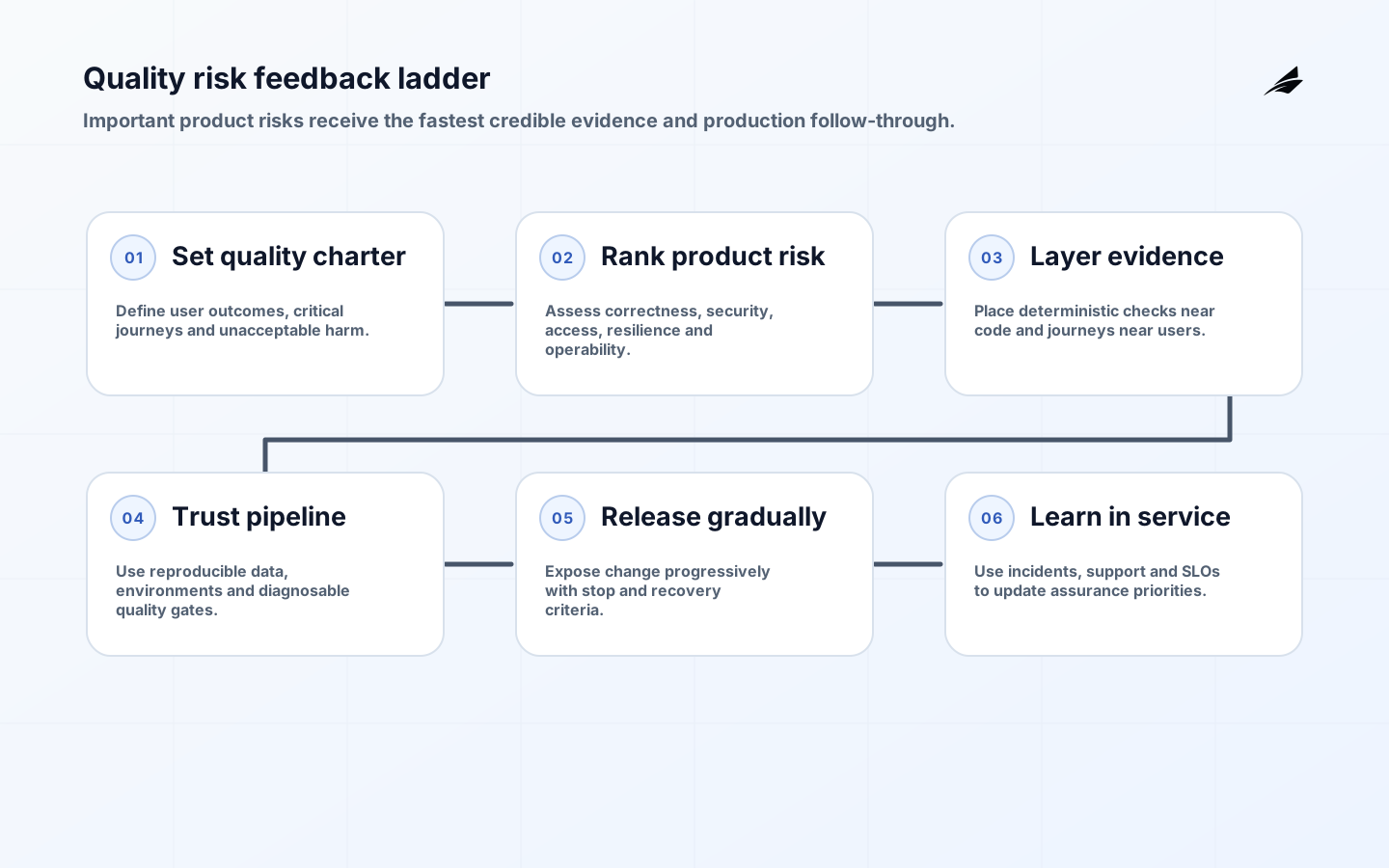
A quality and test engineering implementation checklist should help a team make better release decisions, not merely accumulate test cases. Quality is the degree to which a product delivers intended outcomes under real conditions while protecting users and the business. Test engineering supplies fast, credible evidence about that claim. It combines examples, exploratory work, automation, security, accessibility, performance, resilience and production measurement across the delivery lifecycle.
Use this checklist when establishing a new product practice or repairing a slow, flaky test process. The quality and test engineering guide explains the operating model, and the quality engineering FAQ addresses common decisions. Multi-team programs can add the custom-system quality checklist and test strategy operations playbook.
1. Establish a quality charter
Name the accountable product owner, engineering owner and quality lead. Describe the critical user journeys, harmed parties, regulatory obligations, service objectives and unacceptable outcomes. Define quality attributes in observable language: a keyboard user completes checkout; a duplicated payment request creates one charge; a customer can recover after a network interruption; an operator can explain who changed a record. Avoid generic goals such as high quality or full coverage because they cannot guide tradeoffs.
- Record the product outcome and the users whose experience defines success.
- Map critical journeys, business rules, data transitions, dependencies and privileged actions.
- Agree security, privacy, accessibility, reliability and performance acceptance criteria.
- Set release authority, evidence owners, exception approval and rollback responsibility.
- Choose a small set of production indicators that reveal correctness and customer harm.
2. Build a product risk model
Hold a cross-functional risk workshop before writing a large test plan. For each journey, ask how it can fail, who notices, how severe the effect is, how often the condition may occur and how easily the failure can be detected or reversed. Include misuse, inaccessible interaction, stale data, dependency outage, concurrency, regional settings, operational error and malicious input. Rank risk with a simple documented scale; mathematical precision is less important than shared reasoning.
| Risk class | Example | Primary evidence |
|---|---|---|
| Business correctness | A refund uses the wrong policy date | Decision tables, examples and record reconciliation |
| Security | A user accesses another tenant's record | Threat model, authorization tests and audit review |
| Accessibility | A modal traps keyboard focus | Automated checks plus keyboard and assistive-technology review |
| Reliability | A retry creates duplicate fulfillment | Idempotency, fault injection and recovery tests |
| Performance | Search degrades at a seasonal peak | Representative load, percentile latency and saturation signals |
| Operability | Support cannot diagnose a failed workflow | Telemetry, runbook and incident exercise |
3. Allocate evidence to the right test layer
Put most deterministic business behavior near the code or domain boundary, where feedback is fast and failures are easy to diagnose. Use contract tests at service boundaries, integration tests for real adapters and a small number of end-to-end tests for critical journeys. End-to-end automation is valuable but expensive and sensitive to unrelated changes. Duplicating every rule through the browser increases maintenance without proportionally increasing confidence.
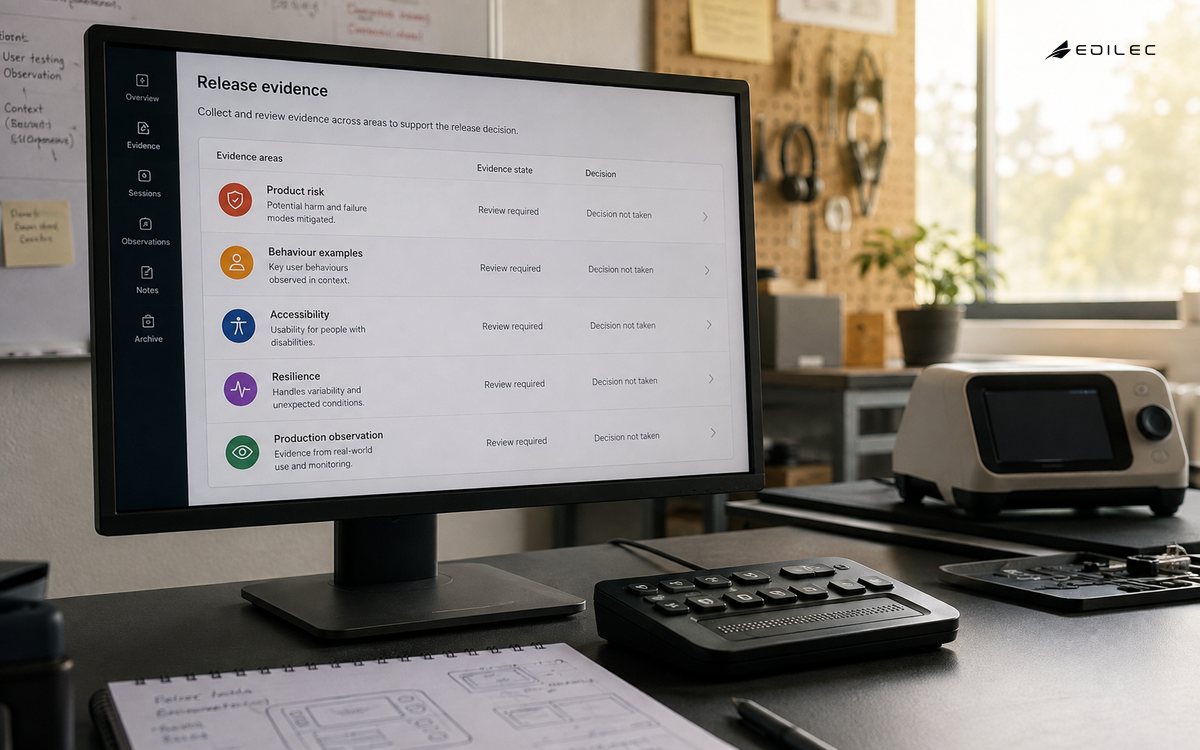
Define what is intentionally tested manually. Exploratory sessions are valuable for learning unfamiliar behavior, testing interaction quality and following surprising evidence. Usability, accessibility and complex operational recovery need skilled observation in addition to automation. Record charters, risks explored and findings rather than treating manual testing as an unstructured final phase. Rotate developers, designers, operators and domain experts through sessions so quality knowledge does not sit with one role.
4. Make environments and test data dependable
Create production-like interfaces and configurations from versioned automation. Test dependencies should behave like the real contract, including errors, timeouts and rate limits. Service virtualization can make rare conditions repeatable, but retain a path that verifies real integrations before release. Document environment ownership, supported differences from production, reset procedures and capacity. Shared environments without isolation often turn failures into scheduling disputes instead of product evidence.
Use synthetic or appropriately de-identified data by default. Build datasets around scenarios and relationships rather than copying an uncontrolled production database. Include boundary values, empty states, long text, multiple scripts, daylight-saving transitions, duplicate messages, historical policy versions and users with different permissions. Make data creation repeatable and destroy temporary data on schedule. Access to sensitive fixtures should be logged and limited to the people and systems that require it.
5. Engineer a trusted delivery pipeline
| Pipeline stage | Checks | Failure response |
|---|---|---|
| Commit | Formatting, static analysis, focused unit and security checks | Block merge with a local reproducible failure |
| Build | Pinned dependencies, artifact provenance and component scan | Quarantine artifact and assign ownership |
| Integration | Contracts, migrations, adapters and selected journey tests | Preserve diagnostics and stop promotion |
| Pre-release | Accessibility, performance, resilience and exploratory charters | Assess risk; fix or document an approved exception |
| Deployment | Configuration validation, smoke tests and progressive exposure | Pause or roll back automatically where safe |
| Production | User outcomes, SLOs, security events and data reconciliation | Trigger incident or learning review by threshold |
A pipeline is credible when a failed check is actionable and a passing check means something. Remove or repair flaky tests promptly; repeated reruns teach teams to disregard evidence. Assign an owner and expiry to quarantined checks. Capture screenshots, traces, logs, test data identifiers and environment versions on failure. Keep pipeline secrets out of logs and restrict deployment identities. NIST's SSDF also emphasizes protecting development environments and preserving software provenance, both relevant to test infrastructure.
6. Define release and exception decisions
Write a release policy that states mandatory evidence by risk tier, who can accept residual risk and how long an exception lasts. A low-risk copy change and a payment authorization change should not require identical assurance. Exceptions need a reason, affected users, compensating control, owner, review date and remediation item. A deadline is not evidence, though leaders may consciously accept risk when the consequence and recovery path are visible.
Use progressive delivery for changes whose risk can be bounded by tenant, user group or traffic percentage. Monitor business correctness and customer behavior alongside technical health. Predefine stop conditions and verify rollback, forward fix and data repair procedures. Some changes, especially destructive migrations, cannot be undone by reverting code; test expand-and-contract database changes and reconciliation before exposing the new behavior.
7. Close the loop with production evidence
Track escaped defects by customer effect and missing control, not as a score used to blame a team. Review incidents, support contacts, failed journeys, accessibility feedback, security findings and manual repairs. Ask which assumption escaped, where earlier evidence could have been cheaper and whether the system made the failure easy to detect and recover. Add focused regression evidence only when it protects a meaningful risk; indiscriminately adding a test for every defect bloats suites.
Useful measures include change failure rate, lead time to trustworthy feedback, flaky-test rate, critical-journey success, escaped harm, time to restore, accessibility defects by severity and percentage of high-risk requirements with traceable evidence. Code coverage can reveal unexecuted code but cannot prove correct behavior or useful assertions. Pair any coverage threshold with mutation testing, review or risk-based evidence rather than treating the number as the quality objective.
8. Set a cross-functional quality cadence
Make quality decisions part of normal product work. During refinement, identify examples, risks and required evidence. During development, pair on testability and observe pipeline feedback. Before progressive release, review residual risk and recovery. After release, inspect customer and service signals. A monthly quality review should find systemic constraints such as unstable environments, inaccessible components or slow security feedback, then fund improvements with an owner and date. Avoid a governance meeting that reviews defect counts without changing engineering conditions.
Clarify specialist roles. Quality engineers coach risk analysis, test architecture and exploratory practice; developers own code-level evidence and testability; designers own interaction intent and accessible behavior; product leaders define outcomes and accept residual business risk; security and operations provide challenge and production controls. Shared ownership does not mean every person performs every task. It means evidence and consequence remain visible to the team making the release decision.
Key takeaways
- Define quality through user outcomes, risks and observable product behavior.
- Place evidence at the cheapest layer that can detect the failure credibly.
- Treat exploratory testing, accessibility and resilience as planned engineering work.
- Version environments and create scenario-based data without uncontrolled personal information.
- Keep pipeline checks fast, diagnosable and trusted by fixing flakiness promptly.
- Use production outcomes to revise the risk model and assurance approach after every release.
Frequently asked questions
What percentage of tests should be automated?
There is no universal target. Automate stable, repeatable checks that provide valuable feedback and keep human work for exploration, judgment and interaction quality. Measure feedback speed, defect detection and maintenance cost. A smaller trusted suite plus purposeful exploration is often more useful than a high automation percentage dominated by brittle end-to-end scripts.
Should testing belong to an independent team?
Product teams should own everyday quality and automated evidence. Independent specialists remain useful for high-risk assurance, penetration testing, accessibility assessment, regulated validation and challenging shared assumptions. Independence should add a different perspective, not postpone all testing until after development or allow engineers to outsource responsibility for behavior they build.
Where should a weak test practice start?
Select one critical journey, map its risks, stabilize a small regression path, remove the noisiest flaky checks and add production measurement. Improve the pipeline around that journey before setting organization-wide mandates. Demonstrated faster and safer releases create a pattern teams can adopt with evidence instead of compliance theater.
Conclusion
Quality and test engineering works when evidence arrives early enough to change a decision and remains credible through production. Start with user harm and business risk, allocate checks across layers, maintain realistic environments, secure the delivery chain and make release exceptions explicit. Then learn from real outcomes. The goal is neither maximum testing nor zero defects; it is a release system that detects important uncertainty quickly and improves after every change.