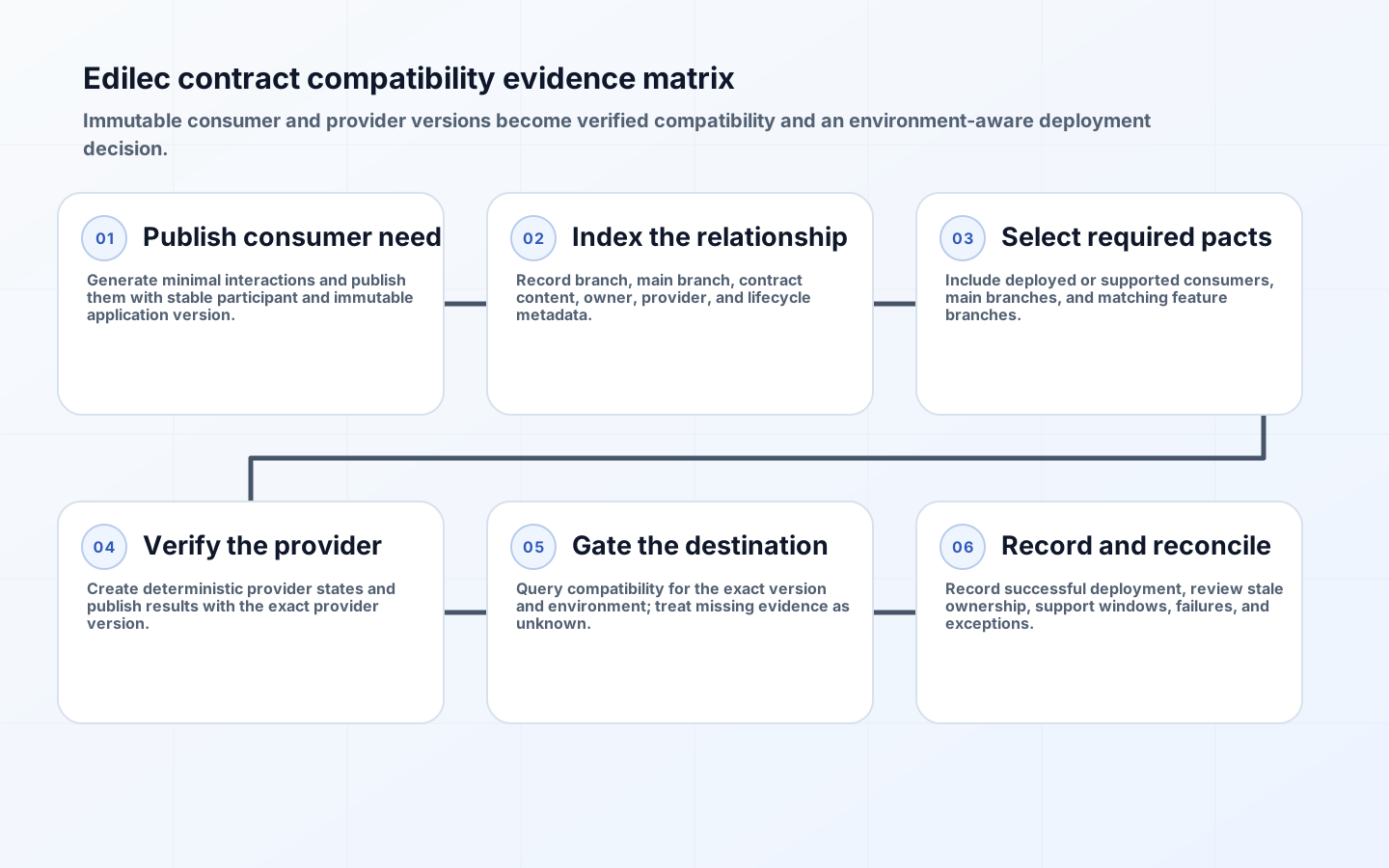
Consumer-driven contract testing at scale is an evidence-distribution problem, not merely a test-writing technique. Consumers publish executable examples of the interactions they rely on; providers verify those contracts against a real provider implementation; a broker records application versions, contract content, verification results, branches, deployments, releases, and environments. Delivery gates then ask whether the exact version moving forward is compatible with versions it will meet.
The system fails when identities drift, contracts are overwritten, providers verify only the latest convenient consumer, deployment records are missing, or stale consumers hold every change indefinitely. Scaling requires explicit ownership and lifecycle rules so the compatibility matrix represents reality rather than a collection of green builds.
Define the scope and limits of consumer contracts
Use consumer contracts at independently deployable boundaries where a consumer can state observable requests and responses or messages it needs. Keep provider implementation details out. Contract tests complement, rather than replace, provider unit tests, schema linting, integration tests for infrastructure, end-to-end journeys, performance tests, security tests, and production monitoring. A pact can prove an example is accepted; it does not prove every business rule or nonfunctional property.
The Pact Broker overview describes the core flow: consumer CI publishes pacts, provider CI retrieves and verifies them, results return to the broker, and deployment builds consult compatibility before release. Standardize this flow as a platform capability while leaving interaction ownership with the consumer and provider teams.
Standardize participant identity and immutable versions
| Identity | Required value | Producer | Control |
|---|---|---|---|
| Participant name | Stable service or application identity | Service catalog owner | No environment or team suffix |
| Application version | Immutable build or commit identifier | CI pipeline | Never reuse for different bits |
| Branch | Source branch name | CI pipeline | Publish on every relevant build |
| Main branch | Configured canonical branch | Application owner | Avoid assumptions such as master |
| Environment | Controlled deployment destination | Platform governance | Record only successful deployment |
| Provider version | Exact verified implementation build | Provider CI | Publish result with provider version |
Do not encode production, team names, or transient repository locations into participant identity. Rename through a governed migration because a new name creates a new relationship in the matrix. Publish a contract with the immutable consumer application version that generated it; do not use latest as the version or overwrite a version after rebuilding different code. Pact’s broker versioning guidance explains that contract content versioning is managed behind the scenes while application version identity remains central.
Select the right contracts for provider verification
A provider build should verify contracts from consumers currently deployed or supported, the latest main-branch contracts, and matching feature branches where coordinated work occurs. Pact’s current consumer version selector documentation recommends selectors such as mainBranch, deployedOrReleased, and matchingBranch; it warns that a broad latest selector can suffer race conditions when multiple branches publish.
Provider verification must control test state. Define provider states as business preconditions, create minimal deterministic data through a supported setup hook, verify the interaction, and clean up or isolate execution. Do not let consumers script provider databases or prescribe implementation. Parallelize by contract content where safe; the broker can deduplicate selected pacts with identical content, but provider-state isolation remains the team’s responsibility.
Operate the compatibility matrix as release evidence
Before deploying, query compatibility for the exact participant version and destination environment. After successful deployment, record that version in the environment. Pact’s can-i-deploy documentation explains that the matrix joins consumer versions, provider versions, contracts, and verification results, and recommends checking before deployment followed by recording the deployment. It also notes that environment and deployment support supersedes legacy environment tags for this purpose.

undefinedGate both consumer and provider deployments. A consumer can be incompatible with the provider currently in production; a provider can break one of several deployed consumer versions. Mobile, desktop, or partner clients may remain supported long after deployment, so record releases and end-of-support where deployment tracking alone is insufficient. Never interpret a missing verification as success.
Govern contract lifecycle and stale relationships
| Condition | Default action | Owner | Exception evidence |
|---|---|---|---|
| New consumer-provider relation | Require provider verification setup before enforcement | Both teams | Time-bounded onboarding plan |
| Consumer version deployed | Include in provider selection and deployment matrix | Consumer team | Accurate environment record |
| Consumer version supported but not deployed | Record release and include until end of support | Consumer/product owner | Support policy |
| No deployment or release activity | Notify owner and assess stale relationship | Consumer team | Confirmed active use or retirement |
| Provider failure | Block affected version’s deployment | Provider team | Approved incident path with compatibility mitigation |
| Consumer retired | Mark undeployed or unsupported, then remove after retention | Consumer owner | Retirement evidence and no traffic |
A contract is stale only after operational evidence and owner confirmation, not because its last publication is old. A stable client may legitimately publish no changes for months. Reconcile broker relationships with service catalog ownership, deployment records, gateway or message telemetry, and support policy. Notify owners before retirement and retain enough history for incident analysis.
Manage breaking change through expand-and-contract. Providers add compatible behavior, consumers migrate and deploy, old consumer versions leave supported environments, then providers remove old behavior after the matrix proves no required version depends on it. For messages, include event schema and semantic expectations; a schema-compatible event can still break a consumer if meaning or ordering changes.
Design incident exceptions and platform operations
A release exception should name the failed or missing interaction, affected versions and environments, customer risk, compensating control, approver, expiry, and follow-up verification. Prefer deploying a backward-compatible provider patch or holding the consumer over bypassing the matrix. During a critical incident, an emergency path may be justified, but record it and rerun verification when the system stabilizes.
Operate the broker as delivery infrastructure: secure publication and read scopes, back it up, monitor latency and availability, define retention, avoid secrets and personal data in examples, and test client-library upgrades. Track verification duration, pending and failed relationships, missing deployment records, stale owners, gate overrides, webhook failures, and time from contract publication to provider verification. Platform availability policy should state whether a broker outage blocks production or invokes an audited degraded mode.
Adopt pending contracts for new relationships where the Pact implementation supports them: a new consumer expectation can be visible to the provider without immediately breaking established provider delivery, while provider teams receive a clear obligation to implement it. Pending is an onboarding state, not permanent forgiveness. Set ownership, notifications, and a deadline, and require the consumer to handle existing provider behavior until verification passes.
Avoid overfitting examples. Consumers should express the minimum fields and interactions they actually use, generate varied domain values, and avoid asserting irrelevant headers or response ordering. Overly strict contracts make harmless provider changes look breaking; overly broad matchers accept behavior the consumer cannot process. Review failures jointly to decide whether the provider broke a dependency or the consumer specified an accidental detail.
Message contracts need provider verification at the producer boundary and consumer tests against the generated message. Validate metadata, schema, required semantics, and representative variants. Also test duplicate, delayed, and reordered delivery in integration tests because a content contract does not prove broker behavior. Record which producer version generated the message contract so the deployment matrix remains meaningful.
For large organizations, federate ownership while centralizing conventions. A platform team can provide broker hosting, templates, CI actions, identity validation, and dashboards. Domain teams still own contract meaning, provider states, compatibility fixes, and retirement. Publish a scorecard for missing main branches, mutable versions, unrecorded deployments, and unowned participants, and fix metadata before adding more gates.
Key takeaways
- Use stable participant names and immutable application versions across consumer, provider, and deployment pipelines.
- Verify currently deployed or supported contracts plus relevant main and matching branches, not an ambiguous latest contract.
- Query the exact version and destination before deployment, then record successful deployment immediately.
- Treat missing verification as unknown, not compatible, and govern exceptions with expiry.
- Retire relationships using deployment, support, traffic, and owner evidence rather than age alone.
Frequently asked questions
Do consumer-driven contracts replace OpenAPI or AsyncAPI schemas?
No. Schemas describe a broad interface and support design, documentation, and tooling. Consumer contracts capture concrete behavior a particular consumer relies on. Teams often use both, with separate checks for schema compatibility and executable provider behavior.
Who owns provider states?
The provider owns how a named business precondition is established. The consumer may request a state such as customer exists, but it should not manipulate provider storage or dictate implementation. Provider-state setup must be deterministic and isolated.
How should a stale contract be removed?
Confirm the consumer version is neither deployed nor supported, verify traffic or message evidence, contact the owning team, update deployment or release records, and observe the provider selection. Remove only after retention and rollback requirements are satisfied.
Conclusion
Contract testing scales when the broker’s matrix mirrors the versions that can actually meet. Stable identity, complete provider selection, deterministic verification, accurate environment records, and governed retirement turn isolated tests into release evidence. The outcome is independent delivery with a visible compatibility argument, not a central test environment by another name.