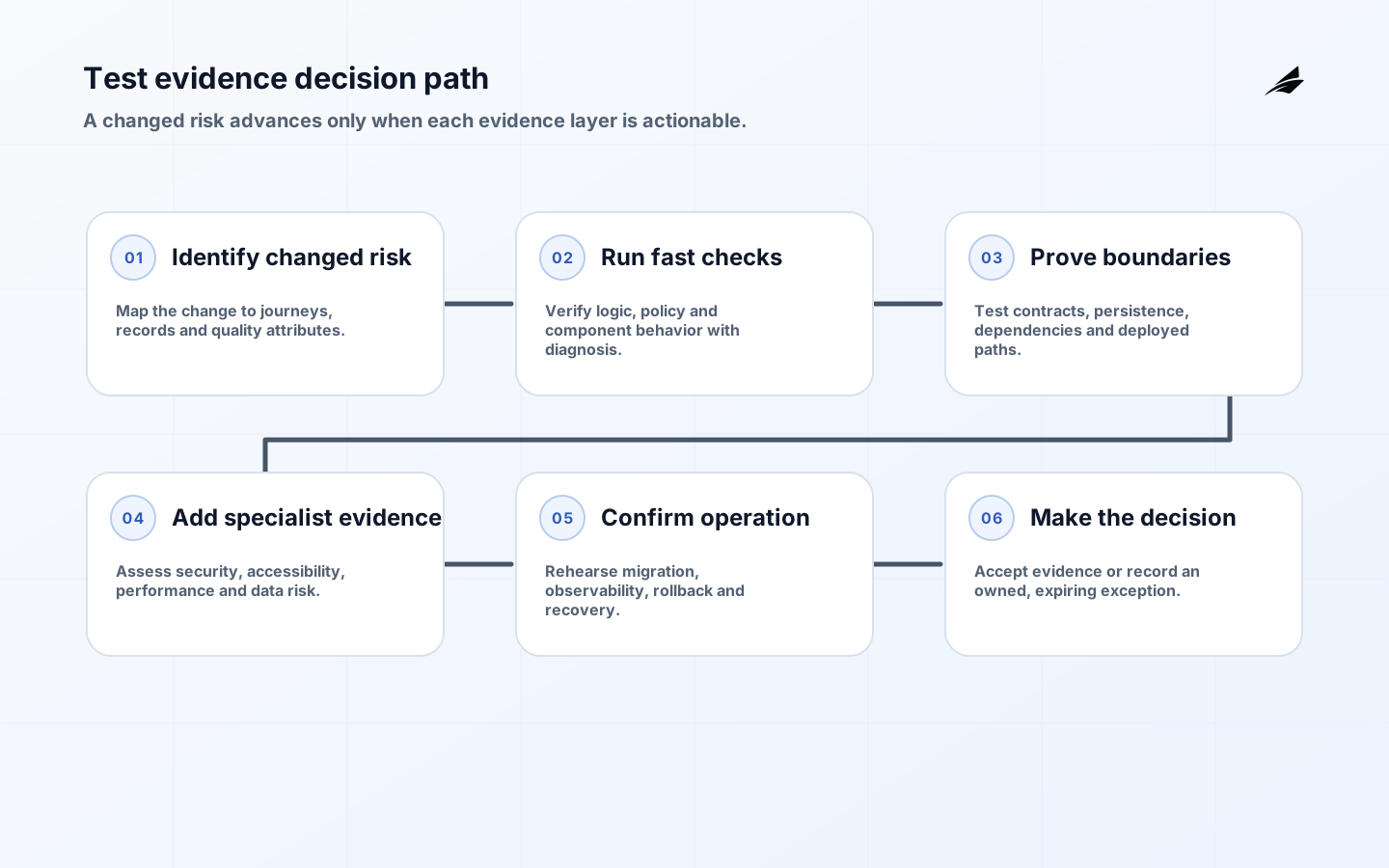
Quality and test engineering helps a team decide whether software is fit to change, release and operate. Buyers often ask for automation percentages or a test-team headcount, but those inputs do not reveal whether critical risks are covered. This FAQ focuses on the decisions that make a quality engineering service useful: scope, evidence, ownership, environments, gates, metrics and handover.
For a complete operating model, read the quality and test engineering guide. Use the implementation checklist during delivery and the test strategy operations playbook when assigning recurring reviews.
What belongs in quality and test engineering scope?
Scope should follow the product risk boundary. It can include requirements review, testability, test architecture, functional and contract automation, exploratory testing, security, accessibility, performance, resilience, data validation, environment engineering, release evidence and production quality signals. The statement of work should identify systems, interfaces, user journeys, quality attributes, environments and exclusions. “Test the application” is too vague to price or accept.
Ask for deliverables that remain useful: a risk-based strategy, traceable scenarios, versioned automated checks, fixtures, environment definitions, defect evidence, release reports, dashboards and runbooks. If an external provider builds automation, the customer should receive source, dependency manifests, execution instructions, credentials integration and maintenance ownership. Screenshots without reproducible tests are not a durable asset.
| Scope question | Credible answer contains | Warning sign |
|---|---|---|
| What is being protected? | Named journeys, records, quality attributes and consequences | A generic list of test types |
| Where will tests run? | Environment topology, data source, access and dependency behavior | “A staging server” with no parity analysis |
| What blocks release? | Risk-linked gates, exception authority and evidence | All failures block, or none do |
| What is handed over? | Code, fixtures, pipeline, runbooks, history and training | Vendor-only dashboard access |
How much test automation is enough?
There is no universal percentage. Automate stable, repeatable checks that protect valuable behavior or accelerate diagnosis. Prioritize domain rules, permissions, data contracts, critical state transitions and deployment smoke checks. Keep exploratory testing for uncertainty, usability and emerging risk. Measure critical-risk coverage, feedback time, failure quality and maintenance cost instead of dividing automated cases by an arbitrary inventory.
Automation should be distributed across layers. A small end-to-end suite cannot diagnose every failure, while thousands of unit tests cannot prove a configured production journey. Google SRE's chapter on testing for reliability explains how tests increase confidence that changes preserve behavior and why system-level validation matters. Choose each layer for the uncertainty it can reduce.
What evidence should a release decision use?

A concise release record should identify the build and configuration, changed components, affected risks, tests executed, environment, results, unresolved defects, security and accessibility findings, migration or recovery evidence and approver. Link to machine-readable results rather than pasting an unsearchable report. Preserve enough evidence to reproduce the decision later, including tool and rule versions.
Gates should be proportional. A failed authorization test is normally mandatory; a low-severity visual defect may be accepted by the product owner. Define exception authority before release pressure arrives. Every exception needs impact, compensating control, owner and expiry. NIST's Secure Software Development Framework is useful for mapping security practices into organizational, protection, production and vulnerability-response evidence.
How should flaky tests be managed?
Treat inconsistent outcomes as defects in the feedback system. First capture failure signature, environment and frequency. Diagnose shared state, uncontrolled time, network dependence, race conditions, weak locators and capacity contention. Playwright's isolation guidance uses separate browser contexts so tests do not inherit cookies or storage from one another; equivalent isolation principles apply at API and database layers.
Automatic retries can collect diagnostic evidence but must not convert red to green without visibility. Report initial failure and final result separately. Quarantine only with an owner and repair date, and keep risk-critical coverage through another check. Track the proportion of runs requiring retry and the age of quarantined tests. A fast pipeline that developers distrust provides slow feedback in practice.
Does the test environment need to mirror production?
It needs fidelity for the behavior under test. Match identity, database engine features, queue semantics, network policy, configuration and deployment mechanism where they affect risk. Scale can be reduced for functional checks but must be representative for performance and recovery work. Record intentional differences. Test configuration itself, because a correct binary with the wrong feature flag or permission can still fail customers.
Use controlled synthetic or masked data and seed it through supported interfaces where possible. Include dates, locales, large records, permission combinations, historical schemas and deletion states. Keep secrets out of repositories and test artifacts. Define who can access failure traces and screenshots; quality evidence frequently contains personal or commercial data.
When are specialist tests required?
| Specialism | Trigger | Minimum output |
|---|---|---|
| Security | Sensitive data, exposed interfaces, privileged actions or material threat | Threat-linked tests, findings, evidence and remediation verification |
| Accessibility | User-facing digital service or workforce tool | WCAG mapping, automated results, manual checks and user-impact findings |
| Performance | Volume, latency, concurrency or resource constraint matters | Workload model, thresholds, bottleneck evidence and capacity assumption |
| Resilience | Service depends on networks, queues, providers or recovery | Failure scenarios, observed degradation, recovery result and runbook changes |
| Data quality | Reports or automation depend on transformed records | Reconciliation, rule results, lineage and correction path |
Security testing should combine design review, automated checks and manual investigation. The OWASP Web Security Testing Guide publishes lifecycle guidance and versioned web scenarios. Accessibility needs more than an automated scan: WCAG 2.2 defines testable success criteria, while keyboard, screen-reader, zoom and cognitive usability checks reveal practical barriers.
Which quality metrics are worth reviewing?
Use a small balanced set: escaped customer-impacting defects, change failure rate, recovery time, feedback time, flaky-test rate, unresolved risk exceptions and completion of critical journeys. Segment by product area and severity. DORA's metrics guide warns against turning delivery measures into goals or comparing unlike applications; use trends to investigate the system, not rank individuals.
Defect counts alone reward teams for reporting less and ignore impact. Code coverage alone says which code executed, not whether assertions were meaningful. Pass rate can improve when weak tests are added. Pair every metric with a question and a decision. For example, increasing feedback time may justify parallelization or moving checks down a layer; it should not prompt deletion of critical evidence.
How should buyers evaluate a quality engineering provider?
Give candidates a real workflow, architecture sketch and recent failure. Ask them to outline risks, test layers, data needs, environment assumptions, reporting and first-month deliverables. Strong providers ask about authority, observability and recovery before naming tools. Review sample code for readability, isolation, secret handling and diagnostics. Confirm who maintains failed tests after application changes.
Commercial models should expose assumptions: applications, platforms, environments, execution frequency, browsers or devices, specialist reviews and support hours. Separate initial discovery and framework work from recurring operation. Avoid paying by case count; it encourages fragmented scripts. Define acceptance through usable evidence and handover, then require an exit plan that leaves tests runnable by the customer.
What roles and cadence work?
Product owners define value and accept business risk. Engineers design testable software and maintain checks. Quality engineers shape strategy, automation and investigation. Security, accessibility and reliability specialists contribute where material. A release authority decides exceptions; an operational owner closes production feedback. In a small team one person may hold several roles, but decisions should still be named.
Review risk and test design during refinement, run fast checks on each change, execute broader suites on relevant builds, and inspect production quality after release. Hold a monthly review for trends, flaky tests, escaped defects and aging exceptions. Conduct a deeper strategy review when architecture, suppliers, customer population or obligations change.
Example: a first 90-day quality engineering engagement
In the first month, map critical journeys, recent incidents, architecture and existing checks. Baseline feedback time, flaky outcomes and escaped defects. Repair the test environment and automate one thin critical path across domain, contract and deployed layers. In the second month, add security, accessibility and performance evidence for the highest risks; introduce release records and exception rules. In the third, rehearse recovery, connect production signals and hand operation to product teams with a maintained backlog.
Acceptance should not be “200 cases automated.” It should show that named risks have current, reproducible evidence; failed checks identify an owner and likely cause; the receiving team can execute and repair the suite; and release decisions preserve build, environment and exception context. Compare the baseline after several releases. Faster feedback with unchanged or improved stability is evidence of value; faster execution paired with more rework means the service must redesign its coverage or gates.
Keep the engagement backlog visible to both business and engineering owners. New automation should name the risk it reduces, while retired checks should record the replacement evidence. This prevents a large suite from becoming an inherited obligation whose purpose no one can explain.
Key takeaways
- Scope quality and test engineering around product risk, interfaces and operating conditions.
- Judge automation by useful risk coverage and feedback, not a target percentage.
- Make release evidence reproducible and exceptions explicit.
- Maintain test environments, data and automation as production engineering assets.
- Use balanced metrics to improve the delivery system, never to rank individual testers.
More common questions
Does shift-left remove the need for production testing?
No. Earlier feedback prevents many defects, but only the deployed environment reveals actual configuration, traffic, provider behavior and user patterns. Combine pre-release evidence with safe smoke checks, progressive delivery, monitoring and reconciliation.
Is user acceptance testing the final quality gate?
User acceptance confirms that representative users can complete agreed business work. It does not replace code, integration, security, accessibility, performance or recovery tests. Define UAT scenarios and decision authority, and fix issues at their proper engineering layer.
Conclusion
A useful quality and test engineering engagement leaves a team with more than passing scripts. It creates a shared risk model, trustworthy feedback, defensible release decisions and a way to learn from production. Buy and operate the capability around those outcomes; tools and case counts should follow.