A testing strategy for workflow-heavy software must prove more than screens and endpoints. Workflow systems coordinate long-lived records, permissions, timers, approvals, integrations and human exceptions. Their worst defects are often plausible states that should never exist: a paid order marked cancelled, an approval performed twice, a case with no owner or a retry that creates a second charge.
This guide focuses on executable state and boundary evidence. The quality and test engineering guide supplies the wider operating model, while the API versioning guide helps manage changing contracts. Use the test strategy operations playbook for recurring ownership.
Model the workflow before writing tests
Name each state, allowed transition, initiating actor, guard, side effect and recorded evidence. Separate business state from UI labels and background job status. Define terminal, cancellable, reversible and exceptional states. For every transition, state what must be atomic and what may complete asynchronously. A diagram is useful, but store rules in a form engineers and domain owners can review.
The W3C SCXML Recommendation standardizes a state-machine notation with states, transitions, events and executable content. A project does not need to adopt SCXML to benefit from its vocabulary. Hierarchical and parallel states help expose hidden complexity such as an order that is both in fulfillment and under fraud review.
| Model element | Question | Test evidence |
|---|---|---|
| State | What invariant must always hold here? | Record, permissions and derived values satisfy invariant |
| Transition | Who or what may trigger it? | Positive and negative actor tests |
| Guard | Which data and timing conditions permit it? | Boundary and decision-table cases |
| Side effect | What external or internal action follows? | Outbox, call, audit and reconciliation evidence |
| Timeout | What happens when work is late? | Controlled clock and scheduled action |
| Compensation | How is a partial outcome corrected? | Failure injection and restored business state |
Test invariants and transition coverage
Examples are necessary but not sufficient. Write invariants such as: money posted equals the sum of accepted ledger entries; a completed case has one outcome and completion timestamp; only active approvers can approve; and every externally visible state has an audit event. Check invariants after every transition, including failure and replay. Property-based tests can generate sequences and reveal paths humans did not enumerate.
Track transition and state-pair coverage rather than line coverage alone. Include forbidden transitions and repeated commands. Generate paths within practical bounds, then preserve any failing sequence as a regression fixture. Avoid testing implementation methods when the durable requirement is state behavior. Domain tests should read like business rules and remain stable through refactoring.
Use a six-stage workflow test cycle
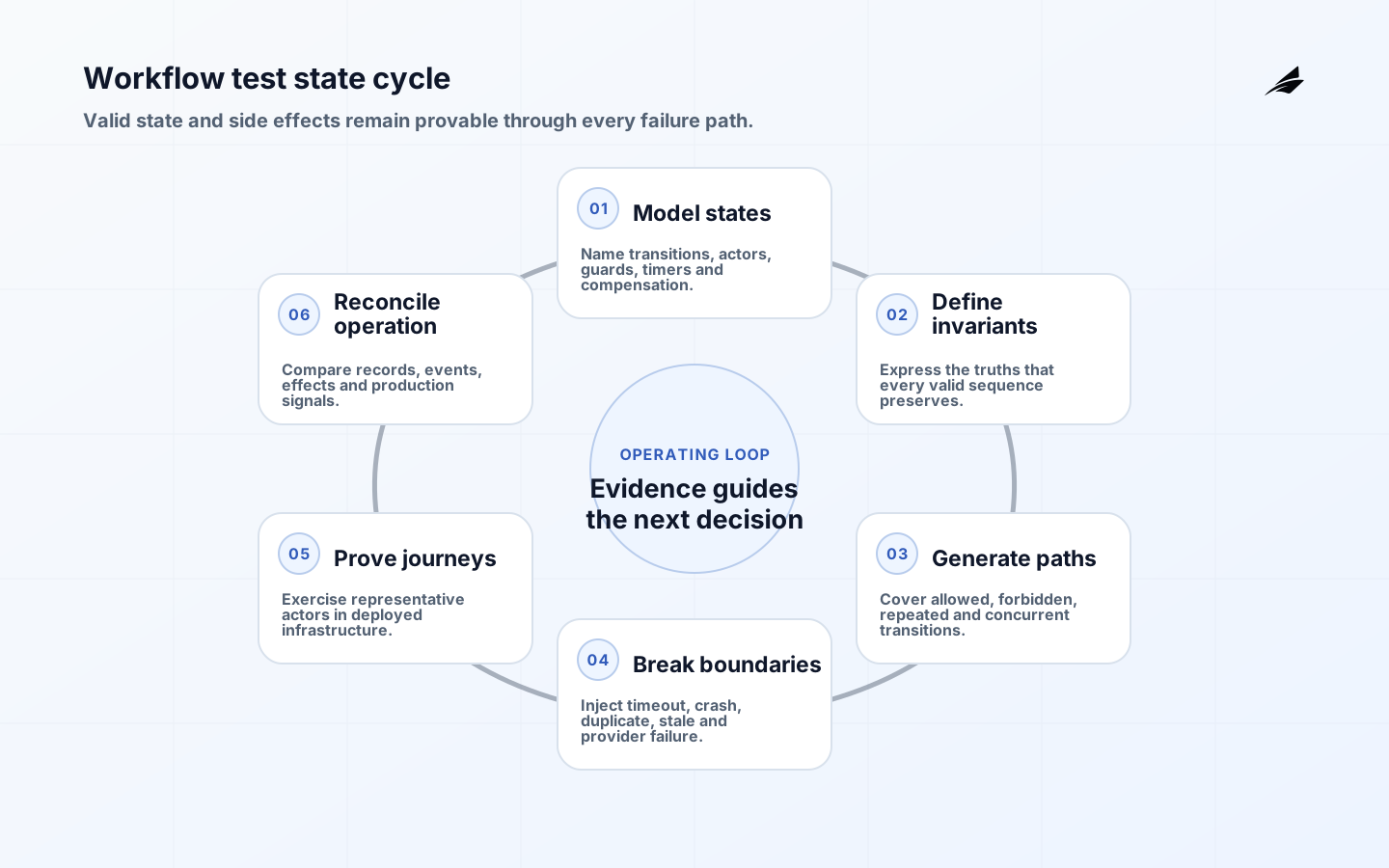
Begin with the model and invariants. Verify domain logic without networks. Add persistence tests for locking, transactions and history. Test contracts at every boundary. Exercise deployed critical journeys with real infrastructure. Finally compare production records, events and external outcomes. The cycle repeats when incidents, process changes or integration versions reveal a missing state.
Keep most sequence combinations below the browser. Browser automation should prove that representative actors can see and perform allowed transitions. Playwright isolation creates clean browser contexts, useful when testing multiple roles without leaking cookies or storage. Use distinct contexts for requester and approver, and verify backend authorization independently of hidden buttons.
Test concurrency, retries and idempotency
Run two approvals, cancellation during fulfillment, duplicate webhook delivery, worker restart after side effect, and stale-client update. Define the conflict policy: optimistic version rejection, serialized command, first writer, merge or human review. Assert both result and audit history. Concurrency tests need controlled synchronization so the race is created deliberately rather than hoped for.
Retries are part of the protocol. Assign commands and external effects stable idempotency keys, store outcomes for a defined window and reject key reuse with incompatible parameters. Stripe's idempotent request documentation describes returning the saved result for repeated keys and comparing parameters. The exact design differs by system, but tests should crash at every point between intent, side effect and progress recording.
| Failure injection | Expected behavior | Assertion |
|---|---|---|
| Timeout before provider receives request | Safe retry | One eventual effect and recorded attempts |
| Timeout after provider commits | Lookup or idempotent retry | No duplicate charge or message |
| Worker crash after local commit | Durable pending work resumes | Outbox and final state reconcile |
| Duplicate event | Consumer handles repeated delivery | State and side effects remain correct |
| Out-of-order event | Version rule rejects or delays stale input | No regression to earlier state |
| Partial batch | Accepted units and failures are explicit | Control totals and owned exception |
Verify integration contracts and compatibility
For each API, event or file, define schema, semantics, identity, ordering, error behavior and compatibility. Consumer-driven contract testing can catch incompatible provider changes without a full shared environment; the Pact documentation describes contract tests generated from consumer expectations and verified by providers. Contracts do not replace integration tests for authentication, networks and provider behavior.
Build provider simulators from observed and documented behavior, including rate limits, malformed responses, delays and duplicate callbacks. Run periodic tests against official sandboxes. Version fixtures and preserve examples of historical payloads. When the provider adds a field or enum, confirm consumers tolerate or intentionally reject it. Test credential expiry and webhook-signing key rotation.
Control time and scheduled work
Workflow rules often depend on business days, time zones, daylight-saving changes, cutoffs, expiries and escalations. Inject a clock into domain logic and schedule tests; do not wait in real time. Define whether timestamps represent event occurrence, receipt, decision or display. Store unambiguous instants and preserve the business zone where policy requires it.
Test a job that runs twice, starts late, overlaps its next schedule, sees no work and fails halfway. Verify leader election or leasing, checkpointing and catch-up rules. A timeout transition should remain idempotent when a scheduler redelivers it. Include a way for operators to see and safely replay missed scheduled actions.
Create representative workflow data
Build scenario factories from domain language: standard request, high-value request, missing document, suspended account and conflicting approval. Avoid giant shared fixtures whose irrelevant details obscure intent. Generate identifiers and isolate each test. Preserve referential relationships and realistic history because workflows frequently calculate eligibility from prior events.
Test migration and old records. A newly required field may be absent in records created years ago. Replay historical event versions and verify upcasters or compatibility adapters. Use masked or synthetic data; workflow histories can contain sensitive notes and attachments. Retain failure artifacts only as long as their diagnostic purpose requires.
Make workflow execution observable
Emit a correlation identifier, workflow identifier, command or event type, prior and resulting state, actor class, outcome and reason while respecting data minimization. OpenTelemetry defines a trace as the path of a request through an application; its trace guidance explains spans and context propagation. Long-lived workflows may require links between traces rather than one enormous trace.
Monitor state age, transition failure, queue delay, retries, dead letters, manual overrides and reconciliation variance. Alert when work is stuck or a critical invariant fails, not every expected business rejection. Build an operator view that shows why a record cannot progress and which safe actions are available. Test the view with actual injected failures.
Release workflow changes safely
Changing a state machine while records are in flight requires compatibility. Decide how old instances behave, whether new transitions apply retroactively and how workers of different versions coexist. Test mixed-version deployment, database migration, event compatibility and rollback. A rollback may be unsafe after new states or side effects exist; design a forward-fix or feature-disable path.
Use shadow decisions or a bounded cohort for high-risk rule changes. Compare old and new outcomes before granting authority. Google SRE's testing for reliability links testing to confidence across changes; complete that evidence with production monitoring and reconciliation. Review incidents as missing models or controls, not only isolated code errors.
Example: testing a refund workflow
Model Requested, UnderReview, Approved, Rejected, Sending, Completed and ReconciliationRequired. Invariants state that approved value cannot exceed captured value, one request has at most one final provider refund, and only an authorized reviewer can approve above the automatic threshold. Domain tests cover amount boundaries and state sequences. API tests prove ownership and stale-version rejection. Contract tests model provider success, decline, timeout and duplicate callback.
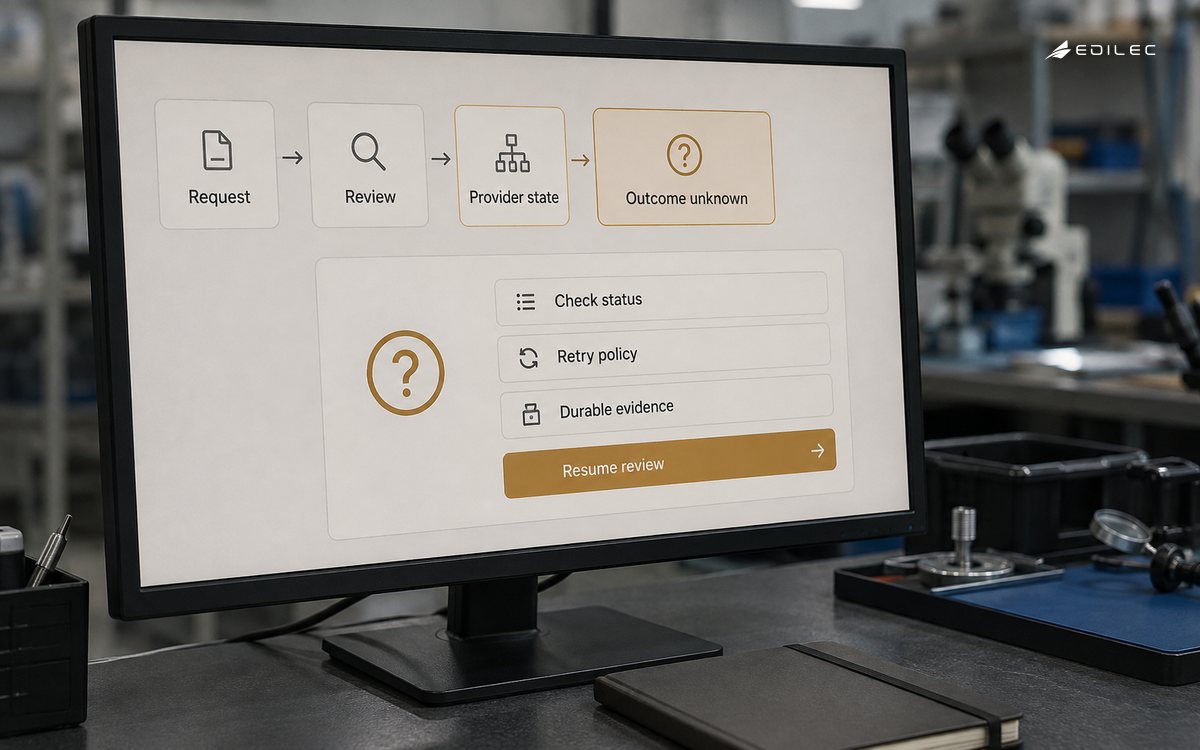
Crash the worker after the provider accepts but before local completion. On restart, the same idempotency key should retrieve or preserve the provider result, not create another refund. Deliver the callback twice and after cancellation. Advance the controlled clock past review and provider timeouts. In a deployed journey, verify customer status, operator exception view, audit history and ledger. Reconcile provider refunds against internal records after the run. This single scenario exercises the properties that make workflow testing materially different from page automation.
Preserve the generated transition sequence and injected failure as a regression fixture. Name the invariant that failed and the production signal that would reveal recurrence. That makes a difficult concurrency defect reproducible and connects pre-release evidence to operational detection.
Key takeaways
- Model explicit states, transitions, guards, actors, effects and invariants.
- Keep combinatorial path tests near the domain and use a focused deployed journey suite.
- Inject concurrency, crashes, duplicates, late events and provider failure deliberately.
- Control clocks and test old records, mixed versions and scheduled work.
- Reconcile production state and side effects to complete the testing strategy.
Frequently asked questions
Can a process diagram become the test model?
It is a valuable start, but add data invariants, authorization, error semantics, timing and side effects. Many process diagrams show the happy sequence but omit technical states and compensation. Keep the model synchronized with implemented behavior.
Conclusion
Workflow-heavy software is reliable when every important record has a valid state, every transition has authority and evidence, and every partial failure has a route to reconciliation. Build tests from that model, then challenge it with time, concurrency, dependency failure and version change. The resulting strategy protects the business process, not merely the code paths.