AsyncAPI 3 event contracts become valuable when they govern what producers and consumers actually exchange, not when they end as attractive documentation. Version 3 separates channels, operations, and messages more explicitly than version 2, making reuse and multi-protocol description clearer. That flexibility also requires deliberate ownership: a valid document can still describe the wrong topic, omit a binding that changes delivery behavior, use an incompatible payload schema, or drift from runtime infrastructure.
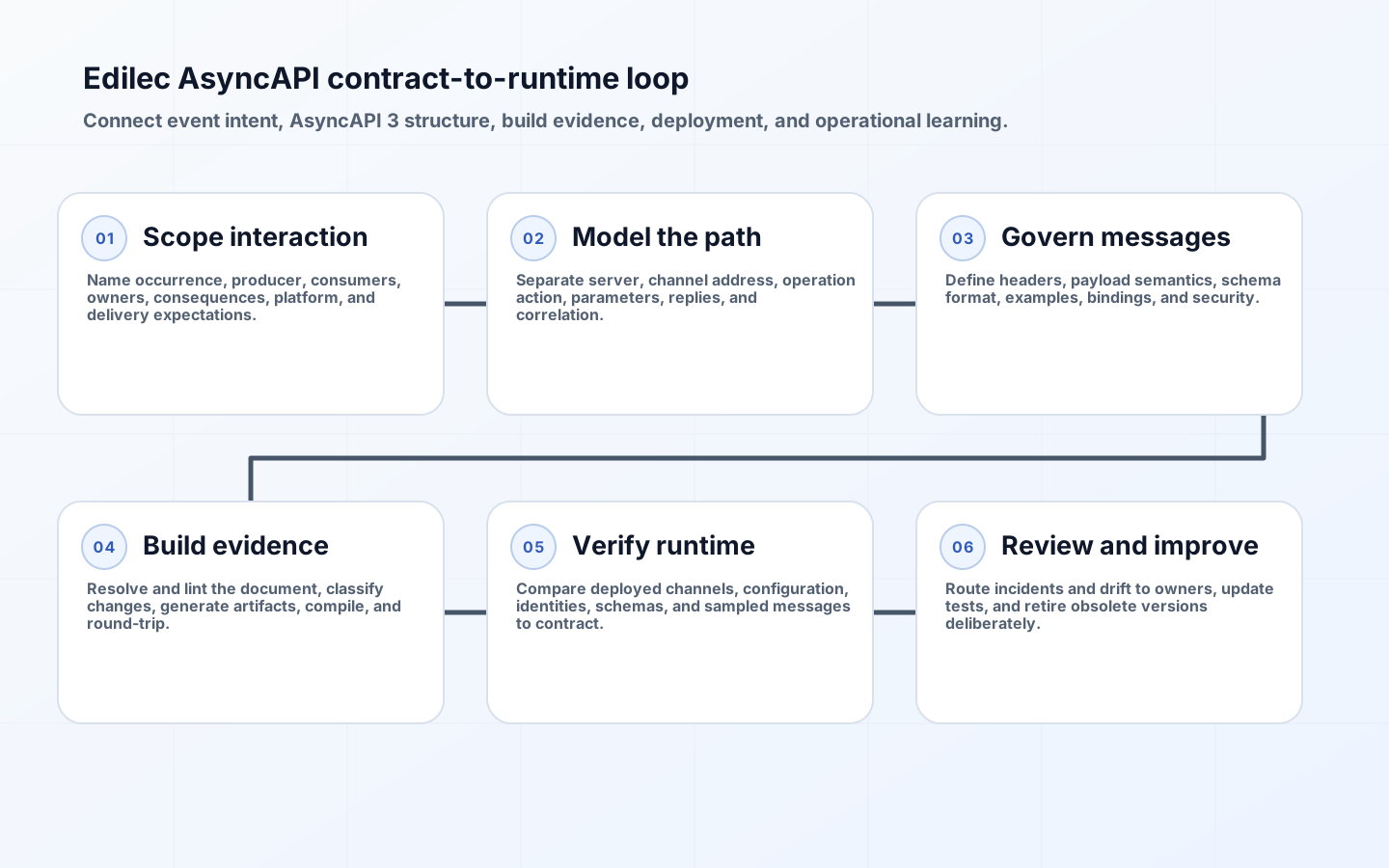
The AsyncAPI 3.0.0 specification defines the document model; it does not decide a company's event taxonomy, compatibility policy, or release gate. Build those operating rules around the contract. The useful lifecycle starts with an interaction and its owners, models channel and operation semantics, governs messages and protocol bindings, tests artifacts in CI, verifies runtime evidence, and feeds incidents back into the contract.
Build the six-stage contract-to-runtime loop
Scope one event interaction before authoring YAML. Name the business occurrence or command, producer, intended consumers, data owner, channel owner, delivery platform, and consequences of duplicate, late, missing, or reordered messages. Decide whether the interaction is notification, state transfer, command, request-reply, or stream of facts. This determines what the message promises and which behavior belongs in bindings, operations, or external service-level policy.
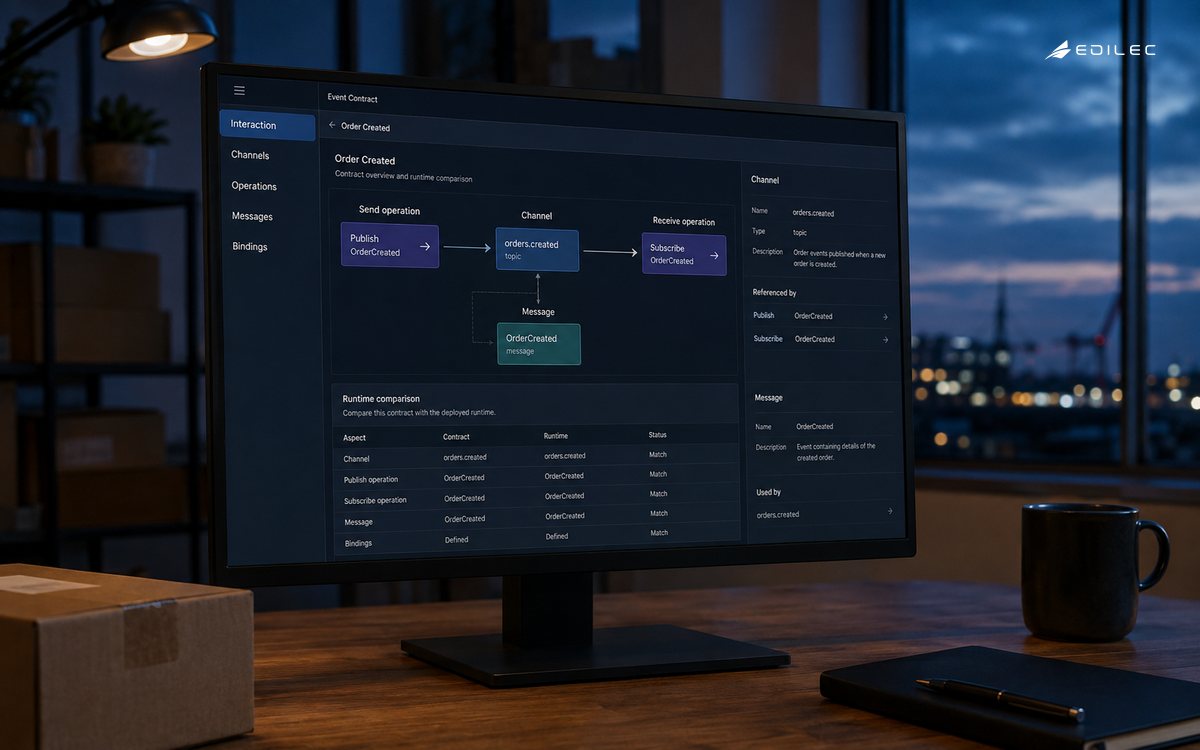
Assign separate ownership for payload meaning and transport operation. A domain team may own OrderConfirmed, while a platform team owns Kafka or AMQP conventions and the deployed channel. Consumers must have an escalation path and a way to declare compatibility constraints. Put stable owner identifiers, support links, and lifecycle metadata in controlled extensions or the surrounding catalog, but avoid copying rapidly changing on-call names into every contract.
| Layer | Question answered | Owner | Evidence |
|---|---|---|---|
| Information and servers | What system and environments are described? | API product and platform | Service identity, environment and security scheme |
| Channels | Where can messages be addressed? | Event platform with domain input | Address, parameters and protocol binding |
| Operations | What action occurs on a channel? | Producer or consumer service owner | Send/receive semantics, replies and traits |
| Messages | What event is exchanged? | Domain data owner | Headers, payload schema, content type and examples |
| Bindings | Which protocol details affect behavior? | Platform engineering | Topic, exchange, queue, key and protocol settings |
| Governance extensions | How is ownership and lifecycle carried? | Architecture governance | Approved namespace and extension schema |
Model channels, operations, and messages independently
In AsyncAPI 3, channels define addressable communication points, operations reference channel actions, and messages can be listed and reused. Give component keys stable repository identities while treating the channel address as the deployable location. Do not infer operation direction from a version 2 publish or subscribe mental model; read version 3 operations from the application's perspective and name them clearly. Use references to avoid copying a message into multiple operations where it should remain one contract.
Parameters belong to actual channel address placeholders, not arbitrary operational inputs. Replies and correlation require explicit design: state which identifier links request and response, where it appears, its uniqueness scope, and how long it remains meaningful. Traits can reduce repetition, but new version 3 trait behavior means migration needs resolved-document comparison. Overusing traits also hides critical semantics from reviewers, so reserve them for truly uniform policies.
Make message schemas express domain promises
A message contract needs identity, event type, creation time, schema or content type, headers, payload, and examples appropriate to the interaction. State whether the payload is a complete state snapshot, delta, or notification that requires a follow-up read. Define identifier scope, timestamp meaning, units, enumerations, absent versus null behavior, and personally identifiable data. A syntactically valid JSON Schema cannot compensate for ambiguous domain semantics.
Select schemaFormat deliberately when using a nondefault schema language or dialect. Pin external schema references and make the build reproducible. Validate examples against the schema and add negative fixtures for prohibited states. Treat headers as a contract too; correlation, trace context, partition key, tenant routing, and content metadata often drive infrastructure before a consumer reads the payload.
| Change | Typical risk | Evidence required | Safer rollout |
|---|---|---|---|
| Add optional payload field | Old consumers may reject unknown fields | Consumer tolerance tests and schema policy | Add, observe, then begin producing values |
| Rename or remove field | Existing consumers lose meaning | Inventory and explicit major transition | Dual field or new message version |
| Change enum set | Closed-enum generators may fail | Generated-client and runtime tests | Unknown-value policy before expansion |
| Change channel address | Deployment and ACL break | Infrastructure plan and consumer migration | Parallel channel with bounded bridge |
| Change partition key binding | Ordering and distribution change | Load, order and replay tests | New channel or coordinated drain |
| Change correlation location | Request-reply matching fails | End-to-end protocol tests | Support both locations during transition |
Use bindings for consequential protocol detail
Bindings should capture protocol-specific facts that materially affect interoperability: Kafka topic and key conventions, AMQP exchanges and routing, MQTT topic behavior, HTTP method, or message-level attributes defined by the binding. Keep vendor deployment trivia outside the contract unless a consumer needs it. Pin binding versions where the specification supports them and validate that generators understand those versions rather than silently dropping unknown fields.
Security schemes describe mechanisms, but deployment policy still decides identities, ACLs, rotation, and environment separation. Avoid publishing real server credentials or sensitive internal addresses. Parameterize or separate environment server definitions so a test contract cannot accidentally target production. Contract review should include platform engineering whenever binding changes can alter retention, ordering, routing, delivery guarantees, or access.
Turn the contract into CI evidence and artifacts
CI should parse and validate the AsyncAPI document, resolve references in a controlled environment, lint organization rules, validate examples, classify changes, and generate selected artifacts. Useful outputs include documentation, typed message models, producer helpers, consumer stubs, tests, or infrastructure checks. Generated code is a starting artifact, not proof of correct behavior; compile it and test serialization against golden messages in every supported language.
Apply compatibility rules to the schema language actually used and supplement them with semantic rules. A field can remain schema-compatible while changing units or meaning. Require owner approval for semantic change, security review for sensitive data or trust-boundary change, and platform approval for bindings. Store a resolved contract and artifact hashes with the release so an incident can reproduce what was approved.
Compare deployed reality with the declared contract
Runtime governance needs evidence from brokers, registries, gateways, and applications. Verify that channels exist with expected configuration, producers emit conforming message identities and schema versions, and consumers are authorized to the intended scope. Sample validation can detect drift, but protect sensitive payloads and control cost. Metadata-only checks can validate type, schema reference, key, size, and headers even when payload inspection is restricted.
Measure contract violations by producer and version, unknown message types, schema resolution failures, consumer lag, dead letters, and binding drift. Link alerts to the contract owner and deployed release. Do not automatically block every unknown-field event in production; enforcement depends on compatibility policy and failure impact. Use nonblocking evidence first, then enforce well-understood invariants at the earliest safe boundary.
Migrate from AsyncAPI 2 with semantic review
Use the official converter to establish a draft, then inspect every breaking structural change described by the migration guide: server URL splitting, operation and channel decoupling, channel address versus key, operation keywords, message collections, references, traits, schema format, and parameter restrictions. Compare the resolved v2 and v3 meaning, not line-level YAML. Regenerate artifacts and check that application direction and channel addresses remain correct.
Roll out repository tooling before runtime dependencies. Keep a bounded compatibility publication if downstream tools still require version 2, generated deterministically from the authoritative source where possible. Track tool owners and retirement dates. Do not begin using v3-only structure in a way that a lossy converter hides from legacy consumers without an explicit transition plan.
Key takeaways
- Scope the interaction, consequences, producer, consumers, and owners before writing the document.
- Use AsyncAPI 3 channels, operations, and messages as distinct reusable contract elements.
- Govern headers, payload semantics, schema dialect, examples, and protocol bindings together.
- Generate artifacts in CI, then compile and test them against golden messages.
- Compare broker and application evidence with the declared contract after deployment.
- Convert version 2 mechanically only as a starting point; approve the migrated semantics explicitly.
AsyncAPI 3 event contracts FAQ
Does AsyncAPI replace a schema registry?
No. AsyncAPI describes the wider interaction, including channels, operations, servers, messages, and bindings. A registry can store payload schemas and enforce compatibility. Link them with stable references and release evidence rather than forcing either tool to impersonate the other.
Should every message be fully validated at runtime?
Not necessarily. Choose validation depth from risk, volume, latency, privacy, and cost. Enforce cheap identity and schema-version checks broadly, sample deeper validation where suitable, and validate comprehensively before release.
Is successful code generation proof of compatibility?
No. A generator may ignore bindings or schema features. Compile generated artifacts, round-trip golden messages, test unknown values, and verify the deployed channel and security behavior.
Conclusion
AsyncAPI 3 can connect event design, code, infrastructure, and operations when teams treat the document as governed evidence. Clear interaction boundaries, explicit version 3 structure, domain-grade schemas, consequential bindings, CI compatibility checks, and runtime drift detection turn event documentation into a living contract. The document then helps prevent incidents and explain them, instead of becoming another stale portal page.