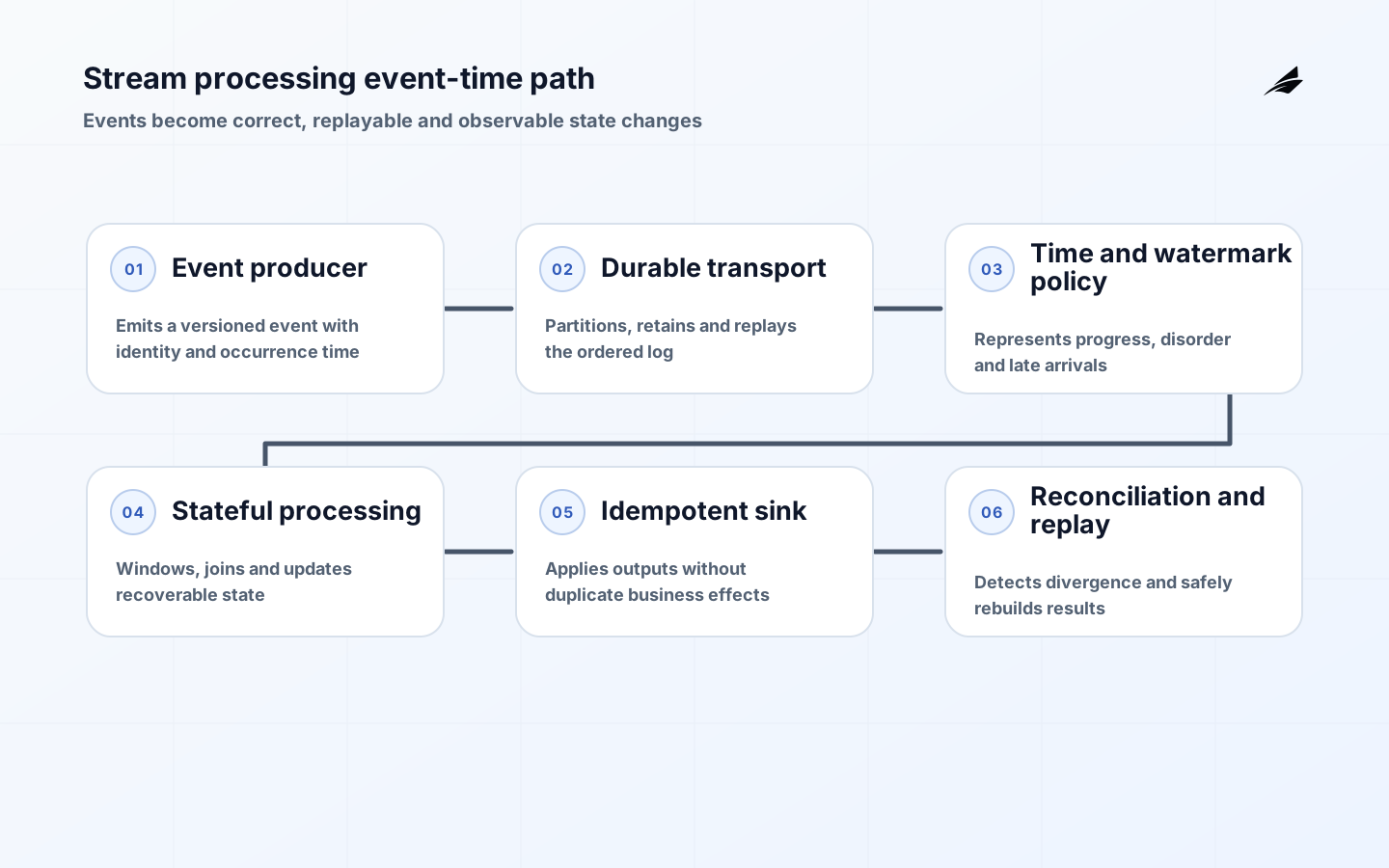
Stream processing is valuable when the cost of waiting for batch results is higher than the cost of designing a system that handles event order, lateness, replay and state correctly. It is not automatically better than batch. Many teams reach for streaming because dashboards feel stale or because event infrastructure is available, then discover that the hard part is not moving records quickly. It is deciding what time means, how state is rebuilt, how duplicate side effects are avoided and how operators will explain a result when late data arrives or a replay occurs.
A good stream-processing design therefore starts from the business action and the correctness obligation. What decision becomes meaningfully better with lower latency? Which output can tolerate approximation and which cannot? How late can data arrive before it is operationally useless? Which side effects must occur exactly once from a business perspective even if infrastructure retries happen many times? The official Apache materials are useful because they treat streaming as a model for time, state and recovery, not merely as a fast transport.
Choose stream processing for latency-sensitive decisions, not for fashion
The first question is whether lower-latency state actually changes outcomes. Fraud scoring, operational alerting, personalized recommendations, inventory allocation and industrial telemetry often justify streaming because waiting for the next batch window reduces value or increases risk. Many financial summaries, monthly reconciliations and slowly changing dimensions do not. If the workflow still depends on manual daily review, streaming may only shift cost earlier without improving the decision. Strong stream-processing programs begin by proving the business case for faster state.
This decision also shapes architecture. If users need sub-second updates, buffering and human review options differ from a system that publishes five-minute operational aggregates. If the consequence of a wrong update is material, the team may need idempotent sinks, audit trails and replay design that are unnecessary for softer analytics. The correct processing model follows from latency and correctness together, not from throughput slogans alone.
Define time semantics before choosing operators
Time is the first design problem in streaming. Event time represents when something happened in the business world. Processing time represents when the system observed or handled the event. In distributed systems, those values diverge because networks, buffers, clock skew and retries exist. If the team does not decide which notion of time matters for each output, it will accidentally mix them and produce confusing or unstable results. Event-time processing is usually the right model for business correctness because it keeps late but valid events in the same logical frame as the events that arrived earlier.
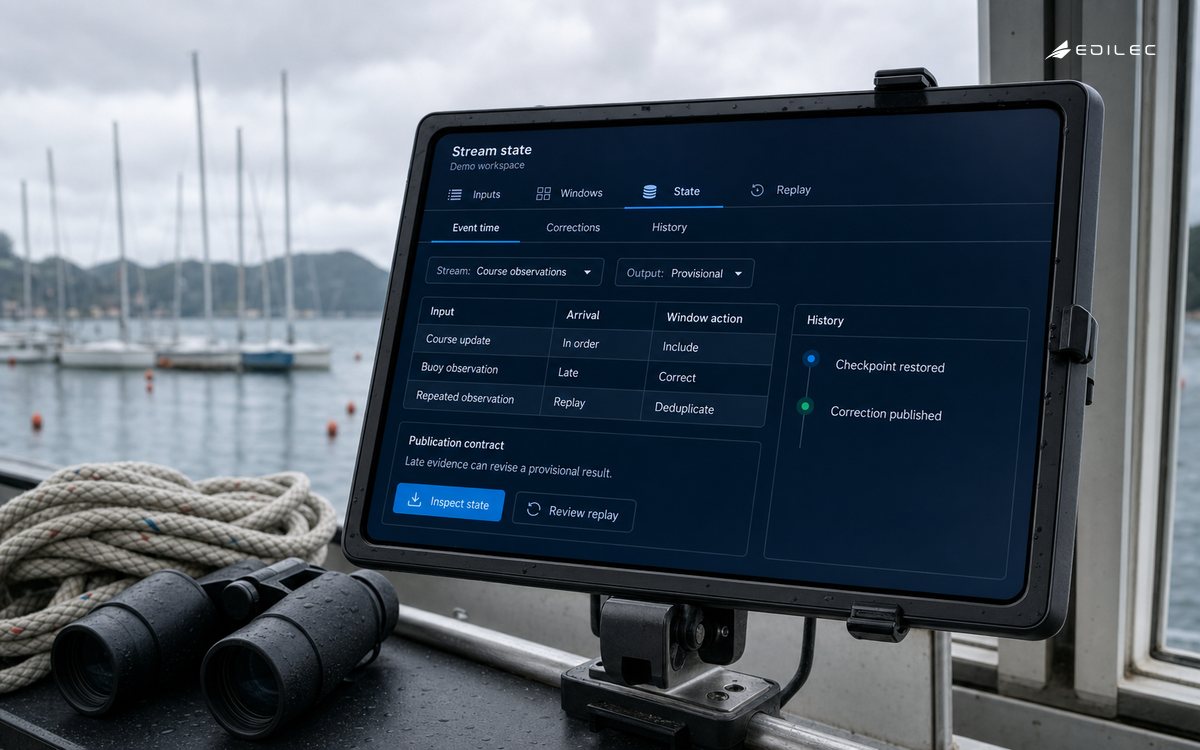
Watermarks are then the mechanism for expressing confidence about event-time progress. They do not guarantee that no earlier event will ever arrive; they communicate when the system believes most earlier events have already been seen. That belief shapes windows, joins, lateness policy and output timing. A practical design must therefore document the allowed lateness, what happens to late events, whether results are corrected after initial publication, and who can explain those corrections to downstream consumers. Without that policy, every late record becomes an ad hoc exception.
| Time concept | What it means | Design implication |
|---|---|---|
| Event time | When the business event actually occurred | Supports semantically correct windows and joins |
| Processing time | When the system handled the event | Useful for infrastructure monitoring but risky for business truth |
| Watermark | Estimated progress of event-time completeness | Controls when windows or joins can emit results |
| Allowed lateness | How long the system accepts late events for correction | Defines the trade-off between freshness and completeness |
| Replay time | When historical events are reprocessed after failure or change | Requires outputs and state to tolerate re-execution |
| Publication time | When a consumer sees the result | May differ from both event time and processing time |
Design durable transport and recoverable state together
Stream processing depends on a durable transport that preserves enough order and retention to support recovery and replay. Partition keys, retention duration and consumer progress handling are therefore architecture decisions, not operational afterthoughts. The transport should reflect how the business state is keyed and reconstructed. An event log keyed poorly may scale in infrastructure terms while still making joins, deduplication or customer-level replay needlessly complex. The transport and the state model should be reviewed together because one constrains the other.
Stateful processing is where a stream becomes a system of record for derived behavior. Windows, counters, joins, sessionization and anomaly detection all rely on maintained state that must survive failure and be rebuilt predictably. Official Flink guidance is useful here because it treats state and fault tolerance as first-class concepts. In practice, teams need to choose what state is authoritative, how checkpoints or snapshots are restored, how schema evolution is handled and how long derived state remains valid. If that contract is vague, replay after a bug fix becomes a risky exercise instead of a designed capability.
Treat windows, joins and retractions as business policy
Window size, session rules and join strategy are often taught as operator choices, but they are really business policy decisions. A five-minute aggregation, a one-hour session gap or a temporal join against slowly changing reference data all embody assumptions about how the business interprets time. Teams should document those assumptions with examples. Consumers need to know whether results are final, provisional or retractable. A correction stream or updated aggregate may be acceptable for observability, while a downstream billing workflow may require explicit settlement and reconciliation logic.
Retractions and updates should therefore be intentional. If late data changes a previously emitted result, the sink and consumer contract must say whether the system overwrites the result, emits a compensating event or records a new version. Hidden retractions break trust because downstream teams believe the first answer was final. Explicit retractions are more demanding to implement, but they preserve honesty about how event-time systems behave under real disorder.
Protect sinks from duplicate or out-of-order side effects
Exactly-once claims should be interpreted carefully. Infrastructure-level guarantees do not automatically prevent duplicate business effects at the sink. A payment instruction, email notification or inventory adjustment may still happen twice if the sink contract is not idempotent or if retries cross system boundaries awkwardly. Design sink interactions with stable identifiers, deduplication rules, transactional boundaries where possible and reconciliation workflows where perfect atomicity is impossible. The business outcome matters more than the processing engine label.
This is why many robust streaming systems separate derived analytical state from external side effects. The streaming engine computes a recommended action or a changed state, and a controlled downstream service decides how to apply it idempotently. That boundary can feel slower, but it makes failure easier to reason about. When a system couples complex stateful processing directly to irreversible side effects without idempotent design, operations teams inherit a fragile correctness story.
| Failure mode | Early signal | Practical treatment |
|---|---|---|
| Out-of-order events distort results | Aggregates swing unexpectedly after late arrivals | Use event time, watermarks and documented lateness policy |
| Replay changes business side effects | Reprocessing duplicates notifications or transactions | Use stable identifiers and idempotent sink contracts |
| State cannot be rebuilt confidently | Recovery creates different answers from the same history | Version schemas, test restore and document state authority |
| Window semantics surprise consumers | Teams assume provisional results are final | Publish correction rules and consumer expectations clearly |
| Reference data joins drift | The same event produces different results over time | Version reference data or use temporal joins deliberately |
| Operational visibility is weak | Lag grows or checkpoints fail without context | Monitor transport, state health and result freshness together |
Operate for replay, reconciliation and explanation
Operational maturity in streaming is the ability to explain and, when necessary, rebuild results. That requires transport lag monitoring, watermark visibility, checkpoint health, sink behavior, freshness indicators and a repeatable replay procedure. Operators should know what data range can be replayed, how downstream consumers are protected during replay and how reconciled results are validated. If replay is treated as a heroic manual intervention, the system is not yet operationally ready for material use.
Monitoring should connect system signals to business consequence. Lag matters because it delays a decision. Late-data percentage matters because it affects confidence in provisional outputs. Checkpoint failures matter because they threaten recoverable state. Freshness indicators matter because consumers need to know whether an apparently current dashboard is actually waiting on upstream events. Good stream-processing teams make those relationships visible so on-call responders understand why a symptom matters.
Adopt streaming in bounded stages
- Frame: name the decision that benefits from lower-latency state and define acceptable error.
- Model time: choose event-time rules, lateness policy and consumer expectations for correction.
- Design transport and state: pick keys, retention, checkpoints and replay boundaries together.
- Prove sinks: test idempotency, duplicate handling and business reconciliation under retry.
- Pilot: run one representative flow with production-like lateness and failure behavior.
- Scale: add streams or consumer groups only when replay and explanation are routine operations.
This staged approach matters because streaming errors are often subtle. A pipeline can look healthy while silently publishing unstable or duplicate business outcomes. Bounded rollout lets the team surface those issues where they can still reason about them clearly and correct the model before the estate grows.
Key takeaways
- Use stream processing when lower-latency state changes a real decision or action.
- Define event-time semantics and lateness policy before choosing operators.
- Design durable transport and recoverable state as one system.
- Treat windows, joins and retractions as business policy choices.
- Protect sinks with idempotent contracts and explicit reconciliation.
- Operate streams with replay, freshness and explanation as normal capabilities.
Frequently asked questions
When is batch processing still the better choice?
Batch is often better when the decision does not benefit materially from lower latency, when the data arrives in large predictable drops, or when the cost and complexity of event-time correctness outweigh the value of fresher state. Choosing batch is not a failure; it is often the disciplined choice.
Does exactly-once processing guarantee no duplicate business effects?
Not by itself. Engine-level guarantees help, but duplicate business effects can still occur at external sinks or during replay unless the sink contract is idempotent and the overall workflow is designed for it. Always evaluate correctness at the business outcome boundary.
How much late data should a system accept?
Enough to preserve useful correctness for the decision the stream supports, but not so much that freshness becomes meaningless or state retention becomes wasteful. The answer is domain-specific and should be written as policy, not left as an implicit engine default.
What should operators watch first?
Start with event freshness, lag, checkpoint or state health, watermark progression, sink error behavior and replay readiness. Those signals explain whether the stream can continue producing trustworthy outputs or whether intervention is needed before downstream consumers are misled.
Conclusion
Stream processing earns its place when it provides lower-latency state without sacrificing explainability and business correctness. That requires explicit time semantics, durable transport, recoverable state, careful sink design and operations that treat replay as normal. Teams that master those disciplines do not just process events faster. They make time, correction and trust explicit parts of the system contract.