An OpenAPI 3.1 migration is not complete when a repository changes openapi: 3.0.3 to openapi: 3.1.1. The difficult part is changing the schema language and contract toolchain without silently changing generated models, request validation, documentation, mocks, or client behavior. OpenAPI 3.1 aligns its Schema Object with JSON Schema Draft 2020-12 much more closely than 3.0 did. That alignment unlocks useful keywords and clearer null modeling, but it also exposes assumptions embedded in generators and validators that previously interpreted an OpenAPI-specific schema dialect.
Treat the migration as a compatibility program with an inventory, test corpus, acceptance criteria, and rollback path. The OpenAPI 3.1.1 specification says tooling supporting the 3.1 feature set should accept every 3.1 patch release, yet actual tools may support only parts of the Schema Object or produce different code from equivalent schemas. The safest sequence proves the contract at four boundaries: source document, schema semantics, generated artifacts, and real consumer traffic.
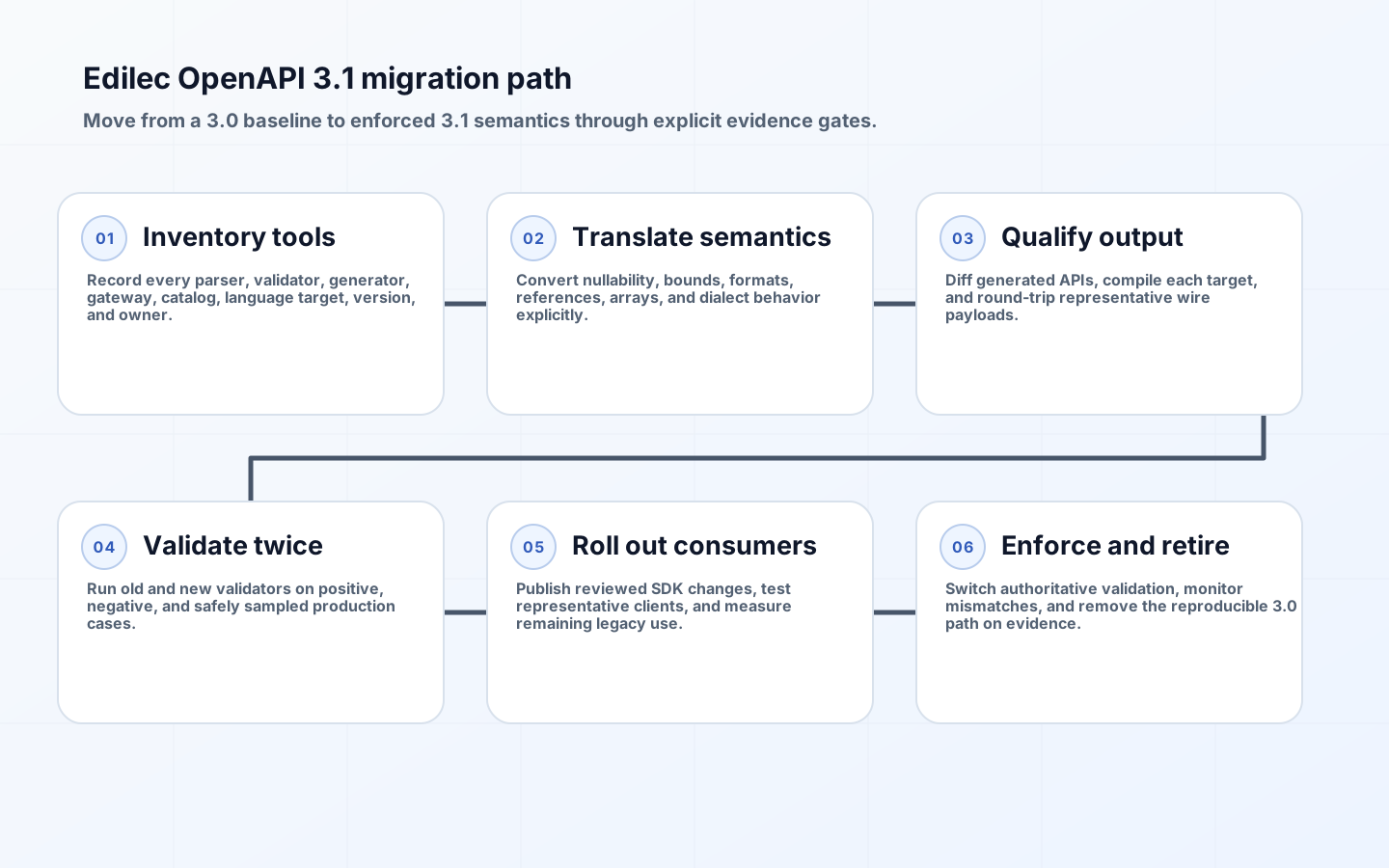
Map the six-stage migration path
Start by naming every consumer of the OpenAPI document. Include linting, documentation, gateway import, request and response validation, mock servers, SDK generation, server stubs, test-data generation, security scanning, catalog ingestion, and downstream teams that vendor generated code. Record tool version, owner, invocation flags, templates, language targets, and whether the output is committed. This inventory is more valuable than a generic compatibility claim because the same generator can support 3.1 for one language while mishandling a keyword in another.
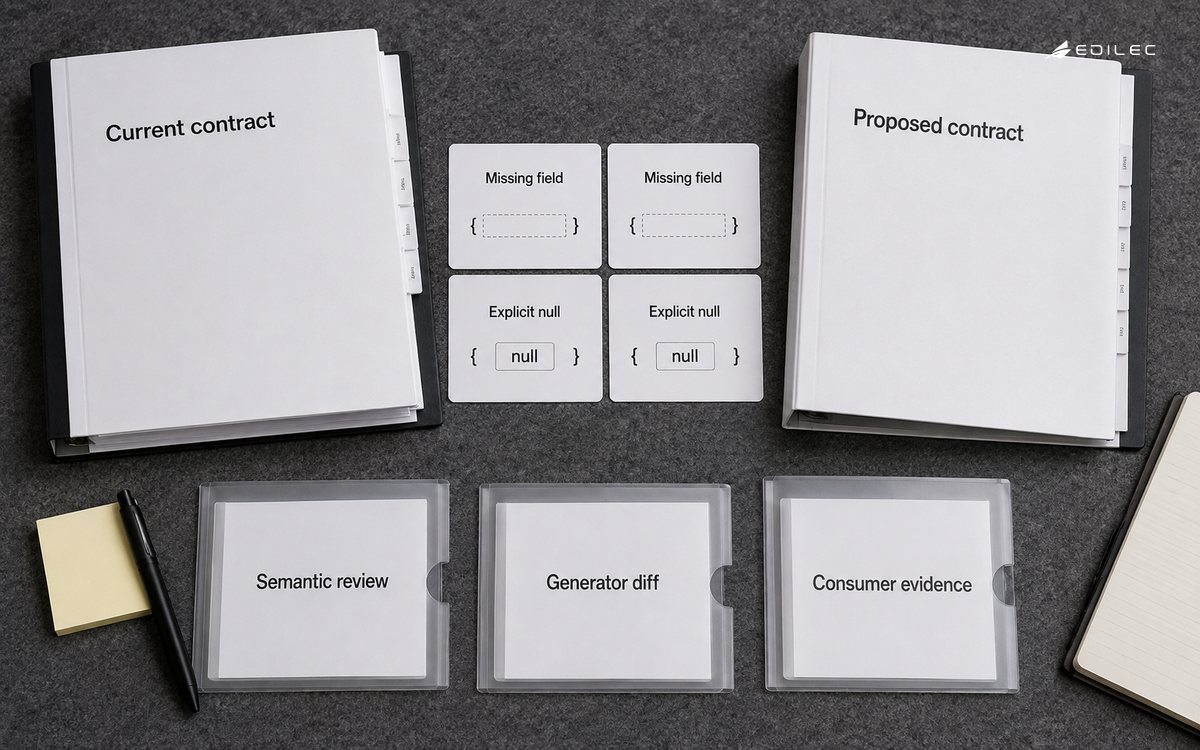
Capture a baseline before conversion: the resolved 3.0 document, representative valid and invalid payloads, generated source trees, public method signatures, serialized wire examples, and current validator decisions. Hashing generated output helps reveal broad changes, but semantic review matters more than line count. A new nullable wrapper, different enum representation, changed date type, or newly optional property can be a breaking change even when the HTTP payload examples still look familiar.
| Boundary | Evidence to capture | Failure to detect | Acceptance signal |
|---|---|---|---|
| Contract source | Resolved document, overlays, external references and lint rules | Conversion drops or rewrites a reference | Both dialect validators accept the intended contract |
| Schema semantics | Positive and negative payload corpus | 3.0 and 3.1 validators disagree | Expected pass and fail matrix is unchanged or approved |
| Code generation | Tool versions, templates, flags and generated API surface | Types or serialization change silently | Reviewed artifact diff and compile tests pass |
| Runtime enforcement | Gateway and service validators | Production rejects traffic accepted in test | Shadow validation shows explained differences |
| Consumers | SDK versions, owners and upgrade constraints | A downstream build or runtime breaks | Representative consumers pass contract tests |
Understand the schema dialect before converting
OpenAPI 3.1 bases data types on JSON Schema Draft 2020-12 and permits standard JSON Schema vocabulary with OpenAPI additions. Type applicability matters: a keyword such as pattern constrains strings but does not itself require a value to be a string. Keep explicit type declarations where the contract intends a type. Decide whether the document will use the default OpenAPI base dialect or declare another jsonSchemaDialect; changing dialect is an architecture decision because validators need the vocabulary and reference behavior of that dialect.
Review $ref behavior, $id, anchors, and base URI resolution. A schema assembled from external files can resolve differently when identifiers or file locations change. Draft 2020-12 also refines array modeling through prefixItems and items, and changes how dynamic references support extensible schemas. Do not introduce every new keyword during the version migration. First express the existing contract faithfully; adopt advanced vocabulary in later, independently testable changes.
Translate nullability and optionality explicitly
OpenAPI 3.0 commonly represented a nullable string with type: string plus nullable: true. In 3.1, model null as part of the JSON Schema type, such as type: [string, null], or with an equivalent composition. This is separate from whether the property is required. A required nullable property must appear but may contain null; an optional non-nullable property may be absent but may not contain null. Generators often collapse those states, so create tests for missing, null, empty, zero, and ordinary values.
Audit defaults and examples at the same time. JSON Schema default is an annotation, not a command that a server or generator must execute. A default does not make a property optional, and an example does not widen the permitted type. If a 3.0 generator injected defaults or inferred optionality, document that product behavior separately from the contract. Otherwise a new validator can be standards-correct while the generated client becomes behaviorally incompatible.
| Concern | 3.0-era expression | 3.1 decision | Test case |
|---|---|---|---|
| Nullable value | nullable: true | Include null in the allowed schema | Missing versus explicit null |
| Exclusive bounds | Boolean exclusive flag plus bound | Use numeric exclusiveMinimum or exclusiveMaximum | Boundary and adjacent values |
| Arbitrary objects | Tool-specific assumptions around object schemas | State property and additional-property rules | Known, unknown and nested fields |
| Tuples | Array items expressed with older constructs | Use Draft 2020-12 array vocabulary deliberately | Short, exact and extra elements |
| Binary content | String format conventions | Review contentEncoding and contentMediaType support | Actual multipart and binary round trip |
| Formats | Often treated as validation | Recognize that format assertion support varies | Invalid email, URI and date-time samples |
Qualify generators as products, not checkboxes
Build a generator qualification matrix for every supported target. Pin the generator image or package, templates, runtime library, and command. Generate from both the baseline 3.0 contract and converted 3.1 contract, then compare public types, null handling, enum fallbacks, one-of discrimination, inheritance, validation annotations, imports, naming, and serialization. Compile the output and run wire-level tests against a real service or contract fixture. A generator that parses 3.1 but ignores a keyword is not fully compatible for that contract.
Separate source-breaking changes from wire-breaking changes. A generated method changing from a primitive to an optional wrapper may require consumer code edits without changing JSON. Conversely, unchanged generated signatures can hide a wire change if a validator now rejects an additional property. Publish both dimensions in the migration note. For widely distributed SDKs, consider generating a new major SDK version while the HTTP API remains stable, then give consumers a measured adoption window.
Run dual validation against representative traffic
Convert the contract mechanically, then send the same corpus through the old and new validators. Classify each disagreement as an intended contract correction, a dialect difference, a tool defect, or ambiguous legacy behavior. Add the decision to a versioned exception file rather than weakening the schema until both tools agree. For sensitive APIs, shadow-validate sampled production requests and responses with redaction so real polymorphism, unknown fields, and rare null cases appear before enforcement changes.
Do not let shadow validation leak payloads or credentials. Record operation, schema path, keyword, validator version, release, and a safe correlation identifier. Set thresholds by failure class rather than one aggregate percentage. A single mismatch on payment amount constraints can be more serious than thousands of unknown optional fields. Close each mismatch with an owner and an explicit disposition before switching the authoritative validator.
Stage the document, tooling, and consumer rollout
A practical rollout begins with read-only tooling such as linting and documentation, continues through generation in nonblocking CI, then introduces shadow runtime validation before enforcement. Keep the 3.0 artifact available only if it can be generated deterministically from one canonical source or maintained with automated equivalence checks. Hand-editing two contracts invites drift. State which document is authoritative, how long the compatibility artifact will exist, and which features cannot be backported.
Gate each stage on evidence: zero unexplained schema-corpus differences, approved generator diffs, successful representative consumer builds, acceptable shadow results, and an exercised rollback. Rollback may mean restoring the previous gateway validator or SDK package, not reverting the canonical schema after producers have adopted 3.1-only features. Freeze unrelated contract changes during the final cutover so diagnosis remains tractable.
Key takeaways
- Inventory every parser, validator, generator, gateway, catalog, and consumer before conversion.
- Model null, absence, defaults, formats, and references according to 3.1 semantics rather than search-and-replace rules.
- Qualify each generated language target with API-surface and wire tests.
- Use dual validation to explain dialect and tool differences before enforcement.
- Keep one canonical contract and make any 3.0 compatibility artifact reproducible.
- Roll out documentation, CI generation, shadow validation, and enforcement as separate gates.
OpenAPI 3.1 migration FAQ
Can we migrate by changing only the version string?
No. A trivial document may parse, but schema semantics and tooling support still need qualification. At minimum, test nullability, references, formats, compositions, examples, generated types, and runtime validation. A version-only edit provides no evidence that consumers observe the same contract.
Should we maintain separate 3.0 and 3.1 source files?
Prefer one canonical source plus a deterministic compatibility export where a legacy tool requires 3.0. If conversion cannot preserve required semantics, isolate the affected operations or delay cutover. Two manually edited sources multiply review effort and make contract drift difficult to detect.
What if our generator parses 3.1 but ignores a keyword?
Treat that keyword as unsupported for that target. Add a contract test, choose an equivalent supported expression if one exists, patch or replace the tool, or keep generation on the compatibility artifact. Parsing success alone is not a sufficient acceptance criterion.
Conclusion
OpenAPI 3.1 is most valuable when teams use its clearer JSON Schema foundation without transferring risk to generated clients and validators. A disciplined OpenAPI 3.1 migration preserves the old contract in tests, translates semantics explicitly, qualifies tools per target, observes real traffic, and retires compatibility paths on evidence. That turns a specification upgrade into an intentional platform improvement rather than an uncontrolled change in every consumer at once.