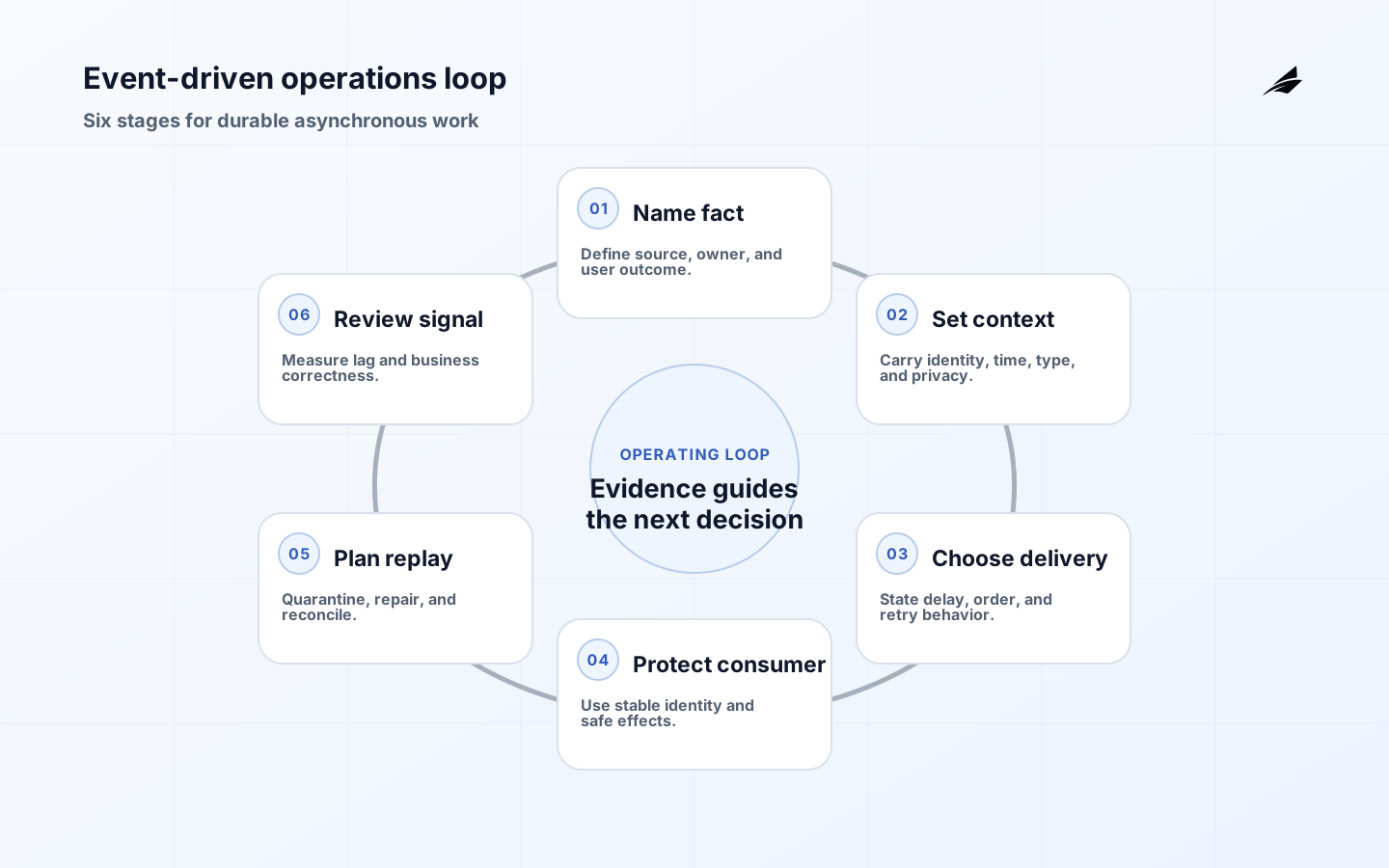
An event-driven systems checklist is a reliability tool for work that no longer has one request and one immediate response. A producer publishes a fact or command, one or more consumers react, and the customer may see the result later. That separation can reduce coordination, but it also creates new questions: which system owns the fact, how does a consumer know what the event means, what happens when delivery repeats or pauses, and how can operators reconcile the final state? The CloudEvents specification gives useful context conventions, while AsyncAPI helps describe message channels. The checklist below turns those standards into operating decisions.
Name the event boundary
Begin with a business fact that has an authoritative owner: an order was accepted, a document was classified, a payment was settled, or a user was invited. Decide whether the message announces a fact that already happened or requests an action. Name the producer, consumers, source record, expected freshness, data classification, and user-visible outcome. Do not publish an event merely because an internal function ran; consumers need a stable meaning that survives refactoring. If the same message is both fact and command, the vocabulary becomes difficult to test and replay. Keep the first channel narrow enough that one team can explain every consumer.
| Event decision | Example | Evidence to retain |
|---|---|---|
| Meaning | InvoiceIssued means the invoice record is authoritative | Producer rule and source identifier |
| Identity | Stable event ID plus subject or aggregate ID | Deduplication key and trace link |
| Time | Occurred time separate from published time | Clock and ordering assumptions |
| Ownership | Billing owns invoice meaning; fulfilment owns shipment | Consumer and producer responsibility |
| Privacy | Only fields needed by approved consumers | Classification and redaction review |
Make event context carry the meaning
Use a consistent envelope for event identity, type, source, subject, occurrence time, and content type. CloudEvents is a primary reference for those context attributes and for interoperability across event systems. Add a correlation or causation identifier when a later event exists because of an earlier workflow. Keep business payload fields versioned and documented separately from transport metadata. Avoid putting credentials, unrestricted customer data, or mutable display text in an event that may be retained and replayed. An event should let a consumer determine whether it can process the message, not force it to query an undocumented producer implementation.
Choose delivery behavior and consumer responsibility
State the delivery expectation rather than assuming the broker or framework makes the promise. Can a message be delivered more than once? Can it arrive out of order? How long may it be delayed? What happens when a consumer is unavailable? The producer should publish an authoritative fact once it is durable; the consumer should acknowledge only after its safe processing boundary. A business side effect may require a local transaction, an outbox or equivalent handoff, and a reconciliation job. Do not describe a system as exactly once unless the full path—including the side effect and recovery—is defined and proven.
Make consumers idempotent by design
Store or derive a stable event identity and decide what happens when the same identity is seen again. A consumer that sends an email, grants access, or charges an account should be able to recognize a completed event or reconcile the outcome before repeating the side effect. Keep the deduplication window and storage ownership explicit. For ordered workflows, use an aggregate or sequence rule and define what a gap means. A consumer that ignores unknown fields can evolve safely; a consumer that silently treats a new event type as an old one can create a much worse failure.
Treat payload schemas as contracts
Describe channels, operations, payloads, headers, examples, and security requirements in a machine-readable form where possible. AsyncAPI provides a vocabulary for event-driven interfaces, but compatibility remains a local decision. Decide whether consumers tolerate unknown fields, whether fields may become absent, how enums evolve, and what a new event type means. Publish a sample with a real business transition and a sample for a rejected or incomplete state. Keep a compatibility check in the producer's delivery pipeline so an event change cannot surprise an offline consumer after deployment.
| Failure condition | Safe consumer behavior | Repair evidence |
|---|---|---|
| Duplicate event | Detect identity and avoid duplicate side effect | Processed-event record and final state |
| Out-of-order event | Hold, reconcile, or apply sequence rule | Gap reason and replay decision |
| Unknown schema field | Ignore only where contract permits | Compatibility test and consumer metric |
| Poison message | Quarantine with reason and owner | Dead-letter record and retry limit |
| Consumer outage | Pause or queue without silent loss | Lag, oldest age, and recovery result |
Design retries, quarantine, and replay
A retry policy should name transient versus permanent failure, maximum attempts, backoff, and the point at which a message is quarantined. A dead-letter queue is not a repair plan by itself. Record why the event failed, who owns the next decision, and how a corrected consumer can resume. Replay by a bounded event identity or time range, then reconcile the consumer's state with the authoritative source. Test replay with a harmless event class before an incident. Be cautious with time-dependent rules, current permissions, external calls, and notifications; replaying historical data can produce a new effect unless those conditions are controlled.
Secure the message path
Authenticate producers and consumers, authorize who may publish or subscribe, and separate tenants or classifications where required. Treat a topic, queue, webhook, or schema registry as an API surface. The OWASP API Security Project is a useful cross-check for object authorization, inventory, resource consumption, and exposure. Do not rely on an internal network location as permission to read every event. Minimize payload data, protect retained messages and replay tools, rotate credentials, and log administrative reads or replays. A compatibility bridge should not grant a consumer access to fields that the new policy removed. Coordinate retention and replay with the background jobs checklist, validate durable state with the database schema checklist, and use the error handling checklist for poison-message escalation.
Observe lag, correctness, and reconciliation
Measure publish success, consumer lag, oldest message age, retry and quarantine counts, processing latency, duplicate rate, schema failures, and final business reconciliation. Correlate the event ID with the source record, consumer result, and user-visible action. A queue can be empty while a consumer has applied the wrong business rule, so compare derived state with authoritative state for high-consequence workflows. Segment by event type and consumer; an average lag number should not hide an invoice or access-provisioning path that is stuck. Keep a runbook with the safe pause, replay, and customer communication decisions.
Release through a controlled slice
Publish one event type to one consumer first when the architecture permits it. Verify schema compatibility, permissions, duplicate handling, retries, reconciliation, and support visibility. Add release annotations for producer and consumer deployments because an event contract can fail when only one side changes. The NIST Secure Software Development Framework helps place these checks inside secure delivery rather than treating them as a broker configuration task. Keep the old path until the new consumer proves its result and define how to stop publication without losing the source record.
Reconcile an event-driven workflow
Take a workflow in which an order is accepted, an inventory consumer reserves stock, and a notification consumer tells the customer what happened. Trace the source record and event ID through publication, each consumer's acknowledgement, retries, and the final customer-visible state. Then remove the notification response, duplicate the reservation event, and delay the inventory consumer. The system should still identify whether stock was reserved, avoid sending a misleading confirmation, and expose a repair path. This exercise tests business correctness, not only whether messages moved through the broker.
| Workflow point | Question | Evidence |
|---|---|---|
| Publication | Is the fact durable before consumers rely on it? | Source record, event ID, and publish result |
| Reservation | Can a repeated event avoid a second hold? | Idempotency record and inventory state |
| Notification | Does the customer see pending versus complete? | User state and message correlation |
| Repair | Can an operator replay or reconcile safely? | Bounded selection, owner, and final comparison |
Make consumer handoffs explicit
A consumer handoff should state when it owns a message and when it must return it for retry or quarantine. Define what happens if the local transaction succeeds but acknowledgement fails, or if an external service responds after the consumer timeout. Keep the source event immutable and record the consumer's outcome separately. This separation lets an operator distinguish a delivery problem from a business-rule problem and makes replay less likely to create a second side effect.
Review the handoff whenever a new consumer, schema field, permission, or retention rule appears. A message that was safe for one consumer can become sensitive or expensive when a second consumer subscribes. The event owner should know which fields each approved consumer needs and which replay tools can access them.
Event-driven systems checklist takeaways
- Define whether a message is an authoritative fact or an action request and name its owner.
- Use stable identity, context, timing, privacy, and schema rules that consumers can test.
- Design for duplicate, delayed, out-of-order, quarantined, and replayed messages.
- Authorize and minimize message access as if each channel were a public API surface.
- Measure lag and business reconciliation together, then release new producers and consumers in a controlled slice.
Event-driven systems checklist FAQ
What is the difference between an event and a command?
An event states that something happened and is usually owned by the system that records that fact. A command asks a consumer or service to perform an action. Both can be useful, but mixing their meanings makes retries, ownership, and replay harder to reason about.
Is exactly-once processing realistic?
A platform may provide a narrow delivery guarantee, but the full business path can still repeat around acknowledgements, external calls, or recovery. Use stable identity, idempotent effects, and reconciliation rather than making exactly-once a substitute for proof.
How do we make replay safe?
Bound the selection, test the consumer on representative historical events, control current permissions and external side effects, record the replay operator and reason, and compare the resulting state with the authoritative source. Replay is a governed repair action, not a button to press blindly.
Conclusion: make asynchronous work accountable
Event-driven systems become dependable when the asynchronous gap is visible rather than magical. Name the fact, document the context, design consumers for repetition and delay, secure the channel, and keep reconciliation close to the business outcome. With those decisions in place, events can decouple teams without decoupling responsibility for what the customer ultimately sees.