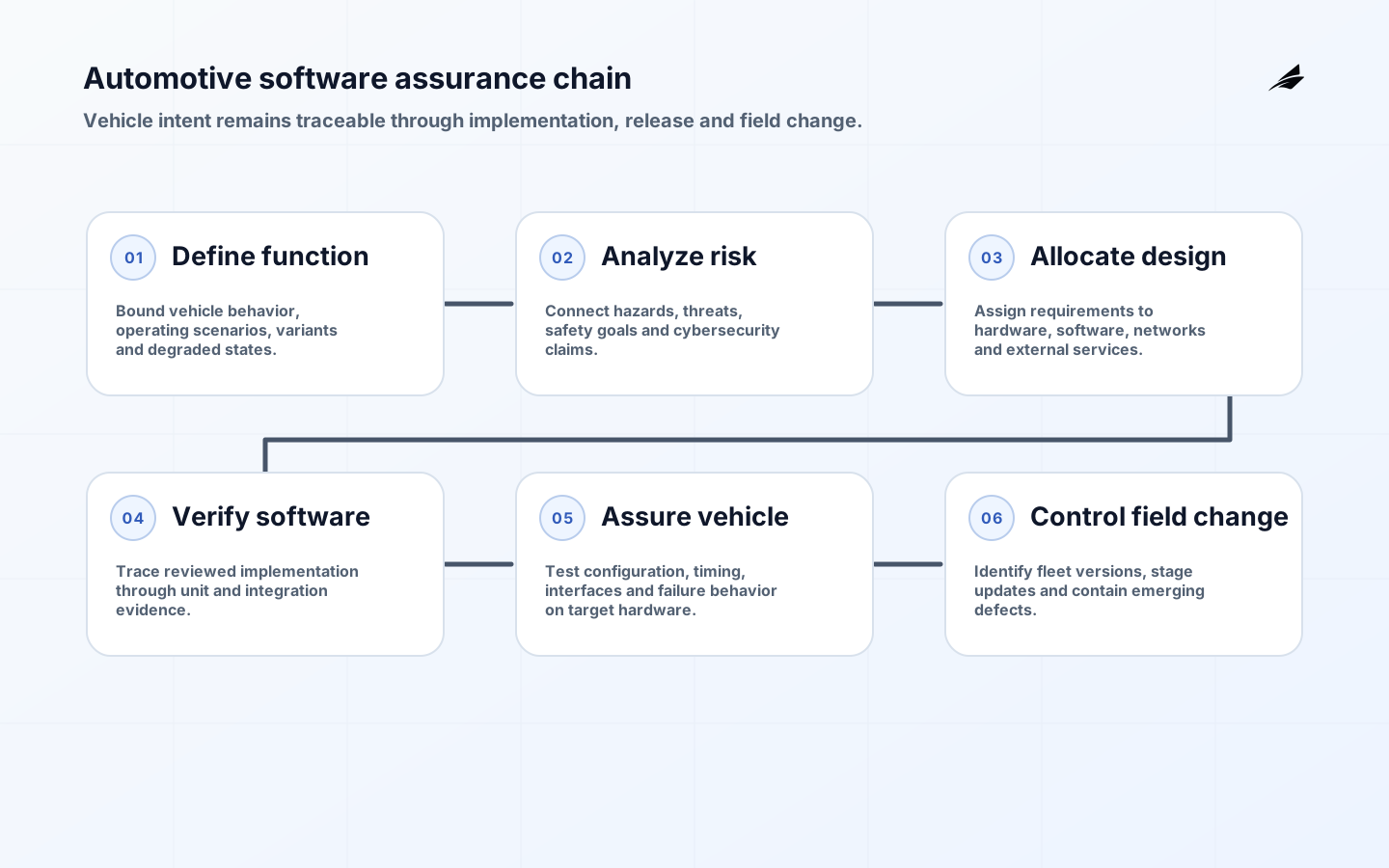
Automotive software engineering joins software delivery to a physical product whose safety, cybersecurity, manufacturing state and service life must remain understandable. A feature is not finished when code passes unit tests. It is finished when requirements trace to verified behavior on the intended hardware, configuration and vehicle variant; cybersecurity and safety assumptions are satisfied; release evidence is approved; and the organization can identify, update or contain affected vehicles in the field.
This FAQ answers the planning questions that matter before an OEM, supplier or engineering partner commits to delivery. The automotive engineering practical guide provides broader business context, while the automotive engineering implementation checklist turns the decisions into review evidence. Programs with defense-specific constraints should separately assess the defense automotive engineering guide.
What belongs in an automotive software scope?
Define the vehicle function, operating situations, users, markets, variants and lifecycle boundary. Then identify the electronic control units, sensors, actuators, networks, backend services, mobile applications and diagnostic tools that participate. A cockpit feature, battery function or driver-assistance capability may cross embedded code, high-performance compute, cloud APIs and dealership tooling. Treating only the visible application as the project hides the interfaces where timing, identity and version failures occur.
| Scope layer | Questions to settle | Core evidence |
|---|---|---|
| Vehicle function | What behavior and degraded states are acceptable? | Item definition and operating scenarios |
| System architecture | Which ECUs, networks and external services participate? | Interface and allocation model |
| Software | Which components, timing and resources implement requirements? | Software architecture and traceability |
| Production | How are binaries, calibration and keys bound to a vehicle? | Configuration and release records |
| Field operation | How are defects detected, updated and reported? | Monitoring, campaign and rollback plan |
The boundary should also state what is reused. Carrying forward a library, AUTOSAR component or supplier binary does not remove assurance work. Record its version, provenance, assumptions, known limitations and verification responsibility. For a product-line platform, distinguish shared platform evidence from vehicle-specific evidence so that reuse accelerates delivery without allowing an old assumption to pass silently into a new electrical architecture.
How do functional safety and cybersecurity fit together?
Functional safety addresses hazards caused by malfunctioning behavior of safety-related electrical and electronic systems. ISO 26262-6 covers software-level activities such as safety requirements, architectural design, unit implementation, verification and integration. Cybersecurity asks how a threat actor could violate assets or behavior. A compromised update path can create a safety-relevant malfunction, while a safety fallback can create a new attack surface. The analyses need distinct expertise but shared architecture assumptions and change control.
Create a joint interface between the hazard analysis and threat analysis. When a security control changes startup time, network availability or diagnostic access, revisit safety assumptions. When a safety mechanism adds privileged maintenance behavior, threat-model it. UNECE Regulation 155 frames a cybersecurity management system across development, production and post-production; Regulation 156 frames software update management. Applicable legal and type-approval obligations depend on vehicle category and market, so regulatory counsel and homologation owners must confirm the program baseline.
Which platform architecture should the program use?
Architecture follows timing, safety, compute, update and isolation needs. AUTOSAR describes a Classic Platform for embedded systems with hard real-time and safety constraints, an Adaptive Platform for high-performance computing ECUs, and Foundation specifications shared between them. A vehicle can use both, plus non-AUTOSAR components. The important decision is not a label; it is a documented allocation of functions, communication, failure containment and ownership.
| Architecture concern | Decision | Verification focus |
|---|---|---|
| Timing | Budgets for sensing, computation and actuation | Worst-case execution and end-to-end latency |
| Isolation | Process, memory, network and privilege boundaries | Fault injection and access-control tests |
| Communication | Signals, services, schemas and compatibility rules | Contract, load and degraded-network tests |
| Configuration | Variant, calibration and feature entitlement model | Combinatorial coverage and invalid-state rejection |
| Updateability | Independent units, dependencies and rollback limits | Compatibility, interrupted update and recovery tests |
Prefer stable contracts and explicit ownership over a distributed collection of shared state. Define units, ranges, freshness, timeout behavior and backward compatibility for every safety- or operations-relevant interface. Establish a canonical source for signal and service definitions, then generate or validate implementation artifacts against it. This reduces transcription errors and gives suppliers a concrete contract for integration.
What delivery process produces credible evidence?
Use an evidence-producing lifecycle rather than a document-producing waterfall. Requirements, hazards, threats, architecture decisions, code, tests, anomalies and approvals need durable relationships. Iterative development is compatible with assurance when each increment preserves traceability and runs the required checks. NIST's Secure Software Development Framework is not automotive regulation, but its practices for preparing the organization, protecting software, producing well-secured software and responding to vulnerabilities are useful for the general software supply chain.
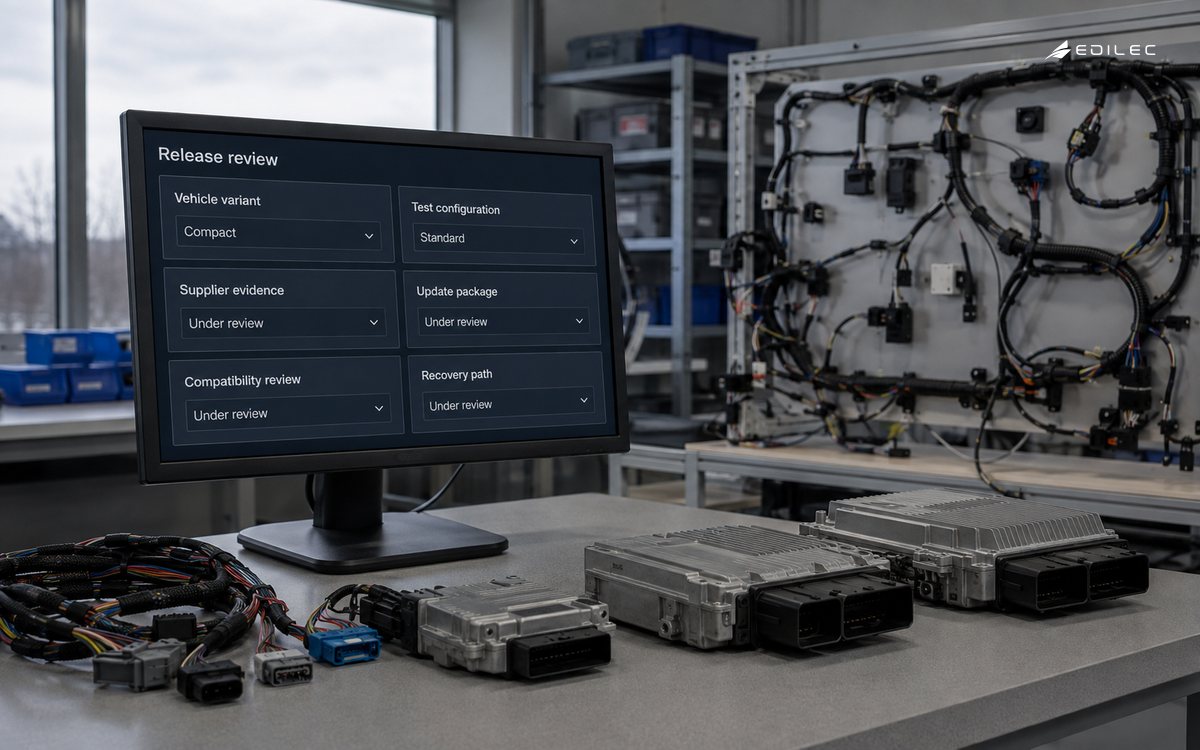
- Baseline the feature, safety, cybersecurity and regulatory requirements with owners and acceptance methods.
- Allocate requirements to hardware, software and operational controls; record assumptions at supplier interfaces.
- Build in small increments with code review, static analysis, unit tests and reproducible configuration.
- Integrate progressively through software-in-the-loop, hardware-in-the-loop, bench, vehicle and fleet-like environments.
- Close anomalies by impact and evidence; never convert an unexplained failure into an accepted limitation by schedule pressure.
- Release only an identified set of software, calibration, keys and dependencies with approved rollback or containment steps.
Independence should match risk and applicable standards. A reviewer needs enough separation and authority to challenge assumptions, but adding a late approval team does not repair weak evidence. Put assessors into planning early, agree artifact expectations, and automate trace and test reports where possible. Sampling can help find quality drift, but safety and cybersecurity arguments still require accountable engineering judgment.
Keep safety cases, cybersecurity arguments and release records connected to the exact vehicle configuration. That connection lets a future defect investigation identify which assumption, component and test supported the affected release instead of reconstructing the program from disconnected archives.
How should OEM and supplier responsibilities be divided?
Contract for engineering outcomes and evidence, not only binaries and dates. The interface agreement should identify requirements ownership, development assurance, cybersecurity monitoring, component provenance, defect notification, supported versions, tool qualification assumptions, data rights and end-of-support duties. Suppliers need enough system context to validate their assumptions; OEMs need enough component evidence to integrate responsibly without demanding unrelated intellectual property.
| Handoff | Minimum content | Acceptance test |
|---|---|---|
| Requirements | Behavior, timing, safety level, threat assumptions and variants | Bidirectional trace and ambiguity review |
| Software delivery | Binary, source entitlement, build identity and dependencies | Reproducibility or provenance verification |
| Verification | Environment, procedures, results, coverage and anomalies | Independent replay of critical tests |
| Vulnerability notice | Affected versions, exploit conditions and mitigation | Fleet impact query and response drill |
| Update package | Compatibility, signature, campaign and rollback metadata | Interrupted-update and wrong-target rejection |
How should over-the-air updates be governed?
An over-the-air update is an operational campaign, not a file transfer. Identify the target vehicle and current configuration; authenticate the source; verify package integrity and compatibility; establish preconditions such as battery state; install without violating safety; verify the new state; and recover when the process is interrupted. Regulation 156 places update management into an organizational system, which means evidence, roles and repeatability matter alongside cryptography.
Use staged cohorts with explicit stop conditions. Begin with internal and representative vehicles, observe installation and functional telemetry, then expand. Maintain a fleet inventory that can answer which vehicle received which software and calibration. Not every update can be rolled back because data or safety dependencies may be irreversible; where rollback is unsafe, design a forward-fix or restricted operating mode and prove it before the campaign.
Which measures reveal program health?
Measure flow and assurance together. Useful indicators include requirement volatility, unresolved interface decisions, build reproducibility, test pass rate by environment, escaped defects, anomaly age, trace completeness, integration lead time, update success by configuration, fleet rollback or containment rate and vulnerability remediation time. Raw code volume, story points and test counts do not show whether the vehicle behavior is safe or the release evidence is convincing.
Review measures by feature and variant, because aggregate green dashboards can conceal one dangerous configuration. Pair every metric with a decision: an aging safety anomaly blocks release; a rising integration failure rate triggers contract review; an update failure cluster pauses the cohort. Trend learning across releases so platform defects are fixed once instead of patched independently in every vehicle program.
Key takeaways
- Scope the complete vehicle function, including hardware, backend, diagnostics, production and field service.
- Connect safety and cybersecurity analyses through shared assumptions and architecture change control.
- Use platform standards to clarify contracts and reuse, not to replace system engineering.
- Require traceable evidence and explicit post-production duties from every contributing organization.
- Treat software updates as controlled fleet campaigns with targeting, verification and recovery.
Frequently asked questions
Can automotive software teams use agile delivery?
Yes. Short increments, continuous integration and frequent feedback can improve risk discovery. The team must still maintain configuration control, traceability, required independence and release evidence. A sprint completion is not a vehicle release approval.
Does AUTOSAR guarantee compliance?
No. AUTOSAR provides standardized platform architecture and interfaces. Compliance with functional safety, cybersecurity or type-approval requirements depends on the complete product, processes, configuration and evidence.
Is a software bill of materials enough for supply-chain risk?
It is useful inventory evidence, but it does not show exploitability, build integrity, update responsibility or safety impact by itself. Link component identity to provenance, vulnerability triage, affected vehicle configurations and remediation ownership.
What drives automotive software cost?
Cost grows with safety and cybersecurity assurance, hardware and variant diversity, supplier boundaries, test environments, integration complexity, homologation, field telemetry and support life. Reusable platforms and automated evidence help only when interfaces and assumptions are governed.
Conclusion
Automotive software delivery succeeds when every release connects intended vehicle behavior to controlled implementation and field evidence. Clear system boundaries, joined safety and security work, disciplined supplier contracts, progressive verification and governable updates turn software speed into durable product capability. The program should optimize for explainable confidence, not simply for the date a binary leaves the build system.