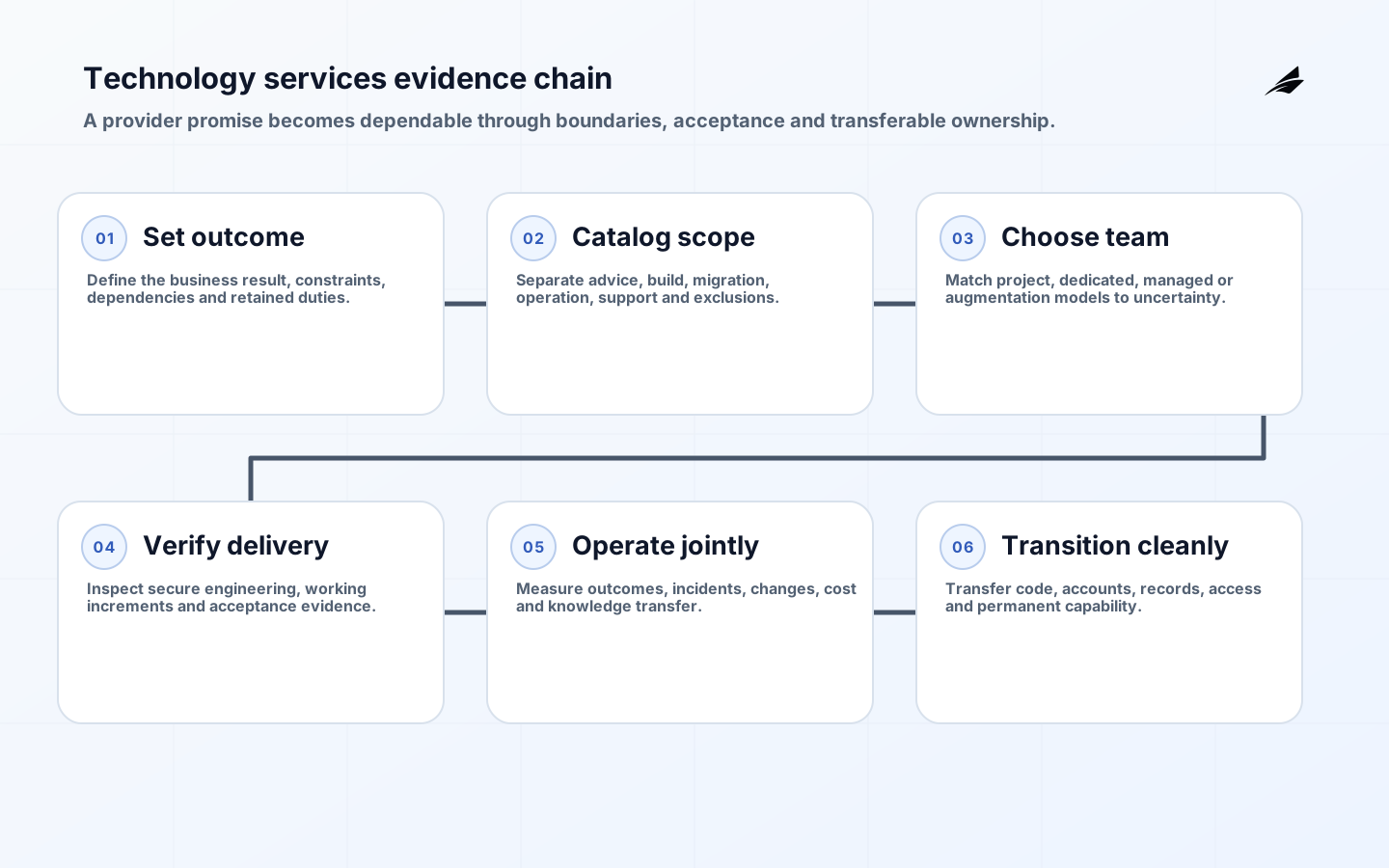
A technology services company supplies engineering, advisory or operational capability that a customer does not want to build alone. The label can cover custom software, cloud platforms, cybersecurity, data, automation, support and managed operations, so buyers should evaluate the exact service boundary rather than the breadth of a sales page. A good engagement leaves working systems, evidence and stronger permanent ownership—not unexplained dependency.
This FAQ helps business and technology leaders compare providers and convert proposals into an operable agreement. It covers scope, team model, security, pricing, intellectual property, measurement and exit. The central discipline is to connect every promise to deliverables, decision rights, acceptance evidence and retained customer responsibilities. Certifications and case studies can inform due diligence, but neither substitutes for proof on the proposed work.
What should a technology services company scope?
Start with the customer outcome, current constraint and systems in scope. Describe whether the provider will advise, design, build, migrate, operate or support. Separate project work from recurring service and identify exclusions, dependencies, customer inputs and third-party responsibilities. Acceptance evidence should identify the responsible owner, the source record, the expected result and the decision required when the result is missing.
Translate labels such as cloud management or digital transformation into a service catalog. Each item should state eligible assets, request path, hours, target, evidence and exception handling. Define who owns business rules, data, risk acceptance, architecture and production decisions. Test the normal path, boundary conditions and a realistic failure path; a successful demonstration alone does not prove the technology-services engagement is ready.
| Promise | Required definition | Acceptance evidence |
|---|---|---|
| Build software | User outcome, scope, quality and operating needs | Working release, tests, documentation and ownership |
| Migrate platform | Source, target, waves, reconciliation and rollback | Validated data, cutover rehearsal and legacy closure |
| Managed operations | Assets, hours, targets, authority and escalation | Service reports, incident evidence and runbooks |
| Security service | Control scope, telemetry, response and assurance | Verified control operation and exception ownership |
Which delivery and team model fits?
Use project delivery for bounded outcomes, dedicated teams for sustained product work and managed services for defined recurring operations. Staff augmentation supplies capacity but leaves more prioritization, architecture and management with the customer. Hybrid models are common; responsibility must remain explicit. Keep the definition and its effective date with the implementation so later teams can explain why historical and current behavior differ.
Evaluate named roles, seniority, availability, location, substitution rules and escalation. Interview people who will perform critical work. Ask how product, engineering, security and operations decisions are made, not just which tools are used. Preserve customer product and architecture leadership. Make exceptions visible in the same operating workflow instead of routing them to private spreadsheets or undocumented support messages.
How should technical capability be evaluated?
Ask for a representative approach to discovery, architecture, testing, deployment, observability, incident response and documentation. Request anonymized examples of acceptance evidence and lessons from failed assumptions. A credible provider explains tradeoffs and unknowns instead of presenting one stack as universally correct. Use progressive exposure and explicit stop conditions so the team can learn from production without placing the entire estate at risk.

Run a short paid discovery or representative slice when uncertainty is high. Measure the quality of questions, written reasoning, working increments and knowledge transfer. Avoid unpaid speculative builds that encourage performance theater and expose sensitive information without a sound engagement. Measure the business completion time and error consequence, not only component uptime or the number of tasks closed.
What security evidence should a buyer request?
Use CISA secure-by-demand questions and NIST SSDF language to examine development access, dependency management, vulnerability response, secure defaults, logging and support. Match evidence to the actual service; a corporate certificate does not prove a specific workload is configured safely. Preserve identifiers, timestamps and version information across handoffs so reconciliation can distinguish delay, duplication and correction.
Define data access, residency, subprocessors, secrets, administrative actions, incident notification and evidence preservation. Require named identities, least privilege and prompt access removal. Establish how vulnerabilities are triaged and who can contain a production event when customer approval is unavailable. Document the recovery sequence and exercise it with representative state before relying on it during a live incident.
How should pricing and change be structured?
Fixed price suits stable outcomes and assumptions; time-and-materials suits discovery and evolving product work; managed service fees suit cataloged operations. Each model can work when scope, transparency and decision cadence match uncertainty. Avoid a low headline rate that excludes testing, operations and transition. Apply least privilege to people and services, and record material administrative actions with enough context for later review.
Define rate cards, currencies, taxes, cloud and license pass-through, travel, after-hours work and approval thresholds. Use a change process that records cause, options, effect and decision. Do not punish evidence-driven scope reduction by measuring only consumed hours. Review this control when scope, integrations, users or obligations change; a launch-time decision should not become a permanent assumption.
| Model | Best fit | Control needed |
|---|---|---|
| Fixed price | Stable bounded deliverable | Assumptions, acceptance and change mechanism |
| Time and materials | Discovery or evolving product | Prioritized backlog, burn and outcome review |
| Dedicated team | Sustained product capability | Role mix, continuity and customer leadership |
| Managed service | Repeatable operations | Catalog, targets, authority and exit support |
| Outcome incentive | Measurable shared result | Baseline and protection from gaming |
Which measures reveal delivery health?
Measure lead time, deployment frequency, change failure and restoration where DORA metrics fit the delivery system, but interpret them together. Add business adoption, task completion, defect consequence, security findings, service objectives and cost. Do not compare unlike teams through one score. Separate a commercial promise from the operational mechanism and evidence that will make the promise dependable.
Review leading indicators such as aging decisions, blocked dependencies, unresolved risk and knowledge concentration. A provider can look busy while customer outcomes stall. Require concise evidence: completed increments, accepted decisions, tested recovery and transferred operational ability. Give users a clear degraded state and next action instead of allowing partial data or failed automation to appear complete.
Who should own code, data and operational access?
The agreement should define intellectual property, pre-existing components, open-source obligations, repositories, build pipelines, cloud accounts, domains, certificates, analytics and documentation. The customer should have timely access to assets needed to operate and change the service. Automate repeatable verification where it shortens feedback, while retaining accountable human judgment for consequential ambiguity.
Avoid shared administrator accounts and provider-owned production identities. Keep deployment and approval auditable. Define source escrow only where it solves a real continuity risk; routine repository access, reproducible builds and knowledge transfer are usually more useful. Version configuration with code and deployment records so a defect can be reproduced, contained and corrected without guesswork.
How should transition and exit be planned?
Plan exit during contracting. Specify notice, cooperation, export formats, documentation, access transfer, final reconciliation and deletion evidence. Price transition work or include a baseline allowance. A provider relationship is healthier when continuity does not depend on preventing departure. Define a small set of leading and lagging measures, then remove metrics that have no owner or operating response.
Run periodic transfer exercises: another engineer deploys, an internal operator follows the runbook, and credentials are rotated without provider shortcuts. Keep architectural decisions and operating records current. At exit, confirm downstream consumers, retention and subcontractor closure. Require each supplier dependency to have a documented owner, limit and continuity response rather than assuming the prime provider absorbs every risk.
Complete a proportionate provider due-diligence record
Due diligence should match the access and consequence of the engagement. A design workshop using public information does not need the same review as a provider administering production identities and sensitive records. Document financial and operational continuity, insurance where relevant, personnel screening, subcontractors, development controls, incident history, privacy terms, security evidence and customer references. Record the evidence date and owner because supplier conditions change.
- Map provider and subcontractor access to systems, data and production authority.
- Verify secure-development, vulnerability, logging and incident-notification practices.
- Review continuity, staffing concentration and replacement of critical personnel.
- Confirm intellectual-property, open-source, data-return and deletion obligations.
- Set reassessment triggers for scope, control, ownership or material incidents.
Convert findings into contract controls, technical restrictions or an explicit risk decision. Do not collect questionnaires that nobody evaluates. High-risk gaps may require reduced access, customer-held keys, additional review or a different supplier. Lower-risk gaps can have dated remediation. The useful output is a decision tied to evidence and operating safeguards, not a compliance score detached from the proposed service.
Key takeaways
- Define the outcome and service boundary before comparing providers.
- Choose a team and commercial model that matches uncertainty.
- Demand secure-development and operational evidence for the proposed work.
- Keep code, accounts, data and decision authority accessible to the customer.
- Plan transition from the start and measure permanent capability, not activity.
Frequently asked questions
Is a larger technology services company always safer?
No. Scale can offer capacity and process, while a focused provider may offer stronger attention or specialist depth. Evaluate the team, controls, financial and operational continuity, delivery evidence and fit for the actual scope. Brand size is one input, not acceptance evidence.
Should the cheapest hourly rate win?
Usually not by itself. Compare total cost of achieving and operating the outcome, including rework, management, security, support, cloud, transition and delay. A higher rate can be economical if the team reduces uncertainty and leaves maintainable systems; a low rate can be expensive when ownership remains weak.
Can one provider own everything?
A provider can perform broad work, but the customer retains business accountability, risk acceptance and supplier governance. Keep internal owners for product, architecture, data and service outcomes. Concentration risk, subcontractors and exit feasibility should be reviewed when scope expands.
Conclusion
A technology services company should extend customer capability through clear scope, sound engineering and operational evidence. The strongest relationship makes decisions visible, keeps customer ownership practical and improves the permanent team's ability to operate and change the system.
Begin by converting the proposal into a responsibility map, acceptance plan and exit checklist. Test the relationship on a representative slice, inspect the evidence and scale only when both delivery and ownership work as promised.